https://steveschmidt.substack.com/p/no-answers-no-speaker
~~ recommended by newestbeginning ~~
This article assumes the Democratic party is salvagable.. Given their one job - is to stop the Fascists, if they are collaborating with them, how is that possible. Thoughts? Am I wrong?
What should the Democratic Party stand for in the midterm elections of 2026?
Where should it plant the flag?
Where should it make its stand?
The answer is simple: Article I of the Constitution of the United States.
The Democratic Party must stand for the restoration of the Congress of the United States. It must bring Congress back into the realm of the living from the land of the neutered and the dead.
Article I begins with words that have been rendered nearly meaningless by a Congress that has surrendered power, responsibility, dignity and purpose:
All legislative Powers herein granted shall be vested in a Congress of the United States.
Congress.
Not the president. Not the White House chief of staff. Not presidential advisers. Not presidential relatives. Not billionaire courtiers wandering the earth conducting diplomacy without meaningful congressional accountability.
Congress. The first branch. The people’s branch. The branch empowered to write the laws, appropriate the money, regulate commerce, raise armies, maintain a navy, declare war, investigate the government and impeach presidents.
It has become a shell of what the Constitution intended.
The United States Congress has spent years surrendering its authority to the executive branch. Under Donald Trump, that surrender has accelerated into something more grotesque.
Congress has too often ceased behaving like a co-equal branch, and begun behaving like a politburo — ratifying the will of one man, surrendering its prerogatives, tolerating the humiliation of its members and abandoning the constitutional responsibilities that belong to them.
That must end.
This should be the promise of the Democratic Party in 2026: give us the House and we will restore Article I.
Everything else follows.
Oversight follows. Subpoenas follow. Hearings follow. The power of the purse follows. Accountability follows. The defense of alliances and scrutiny of foreign policy follow. The investigation of corruption follows. The restoration of checks and balances follows.
The word no follows.
Donald Trump is about to hear that word over and over again in a way it has rarely landed during his second presidency.
No.
No, you may not spend money Congress has not appropriated.
No, you may not ignore laws because they inconvenience you.
No, your advisers are not beyond congressional scrutiny.
No, your family is not beyond congressional scrutiny.
No, private citizens exercising public power are not beyond congressional scrutiny.
No, the Congress of the United States does not work for you.
No, the House of Representatives is not an annex of the White House.
No.
That is what millions of Democratic voters believe they are voting for in November.
They are not voting for better access to Donald Trump.
They are voting for resistance to Donald Trump.
They are not voting to send Democratic leaders into private rooms to find “common ground” with the president’s family.
They are voting to restore a constitutional boundary that has nearly disappeared.
They are voting to resurrect Congress.
Which brings us to Hakeem Jeffries.
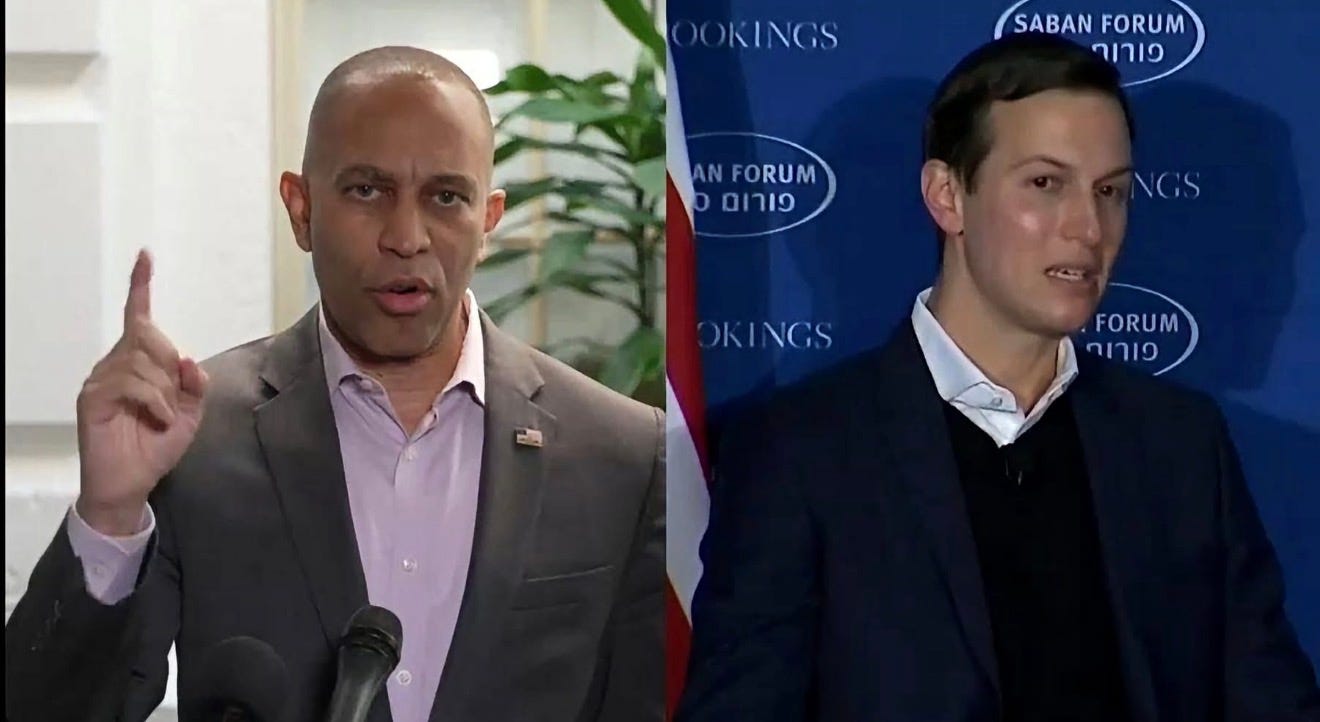
According to The New York Times, Hakeem Jeffries met secretly with Jared Kushner recently. By doing so, Jeffries exercised appalling judgment.
So did every person around him who knew about the meeting, facilitated it, arranged it, approved it, or failed to stop it.
There is no reason to mince words.
The meeting reeks of insider deal-making.
That does not mean a deal was made. There is presently no public evidence establishing that one was, but that is precisely why Hakeem Jeffries must answer immediately, completely and unequivocally what happened inside that room because Jared Kushner is not just anybody.
He is not the secretary of state. He is not the national security adviser. He is not the White House chief of staff. He is not an elected official.
Kushner holds no formal position in the White House, while remaining deeply involved in American foreign policy. He is the president’s son-in-law — a private citizen under congressional investigation. He is mired in ethical controversies stretching from one end of the earth to the other — and this is the man Hakeem Jeffries chose to meet privately in New York.
Reporting says Kushner and Jeffries discussed housing, immigration and affordability, while Democrats stand within reach of winning the House, and Jeffries stands within reach of becoming speaker.
That makes the questions unavoidable.
Did Jared Kushner ask Hakeem Jeffries — in any way, shape or form — for protection from congressional investigation, subpoenas, testimony or document demands should Democrats win control of the House?
Did Hakeem Jeffries offer, suggest, imply or agree to any such protection?
Did they discuss Affinity Partners?
Did they discuss Saudi Arabia?
Qatar?
The United Arab Emirates?
Albania?
Did they discuss Kushner’s foreign investors?
Did they discuss prospective subpoenas?
Did they discuss Jamie Raskin?
Did they discuss what a Democratic Judiciary Committee or Oversight Committee intends to investigate?
Did Jared Kushner seek any assurance — explicit or implicit — about investigations involving himself, Donald Trump, members of the Trump family or their businesses?
Did Hakeem Jeffries give him one?
There is another question that matters every bit as much.
Did Jared Kushner discuss with Hakeem Jeffries — in any way, shape or form — his diplomatic activities anywhere in the world?
Did they discuss Gaza?
Israel?
Hamas?
Saudi Arabia?
Qatar?
The Gulf?
Iran?
Russia?
Ukraine?
Did they discuss any negotiation Kushner has undertaken, any foreign leader he has met, any commitment he has sought, or any representation he has made while acting on behalf of the United States?
These are not fanciful questions.
Kushner has just been engaged in high-level Gaza diplomacy, including meetings with Hamas leader Khalil al-Hayya and Israeli Prime Minister Benjamin Netanyahu.
A private citizen is exercising enormous influence over matters of war and peace.
Where is the congressional testimony?
Where are the hearings?
Where is the accountability?
Where are the answers?
Jared Kushner has become something resembling a shadow secretary of state without submitting himself to the accountability that should accompany the exercise of such power.
The same fundamental accountability problem surrounds Steve Witkoff.
Congress cannot simply watch this happen — and the man who wants to become speaker of the House certainly cannot normalize it.
That is why the judgment involved in this meeting is so appalling.
Jeffries wasn’t meeting an administration official whose governmental responsibilities required a conversation. He wasn’t meeting the secretary of state. He wasn’t meeting the national security adviser. He wasn’t meeting the president of the United States.
He was meeting the president’s son-in-law — a private citizen under congressional investigation and mired in ethical controversies stretching from one end of the earth to the other.
There is no conceivable way Jeffries could have entered that meeting unaware of these facts.
The investigations weren’t secret. Kushner’s foreign financial entanglements weren’t secret. His extraordinary role in American diplomacy wasn’t secret.
What was secret was the meeting.
That is the point.
The prospective speaker of the United States House of Representatives does not need Jared Kushner to introduce him to Susie Wiles.
Susie Wiles is not the speaker’s peer.
She works for the president.
The speaker’s constitutional counterpart is the president of the United States. Congress is a co-equal branch of government.
The speaker doesn’t need a back channel into the Trump family.
He doesn’t need admission to the court.
He doesn’t need Jared Kushner.
He needs to understand Article I.
There are 71 days until the midterm elections.
Democratic candidates are fighting across the country for the seats necessary to take control of the House.
There are voters to persuade. Candidates to elect. Money to raise. A case to make. A country to convince that giving Democrats control of the House will finally restore accountability to a government desperately in need of it.
And during this precious final stretch, Hakeem Jeffries found time to meet privately with Jared Kushner in Manhattan.
It isn’t the central issue, but it tells us something about instincts.
It tells us something about priorities.
Most of all, it tells us something about judgment.
There is another model of leadership.
Look north.
When Mark Carney became prime minister of Canada, I wrote something about him three weeks into his premiership:
Make no mistake about who Mark Carney is. He is the leader of free North America.
I meant it.
I wrote it because Carney had already demonstrated something elemental about leadership.
He understood sovereignty, institutions, leverage and power. Most importantly, he understood that leadership in a dangerous moment requires something more than access to powerful people.
It requires the capacity to stand against them.
A month later, when Carney came to Washington and sat across from Donald Trump, I wrote something else:
The Canadian prime minister is no Chuck Schumer.
Then I described him in six words:
He is tough as nails, smart and prepared.
That is the standard.
Now look at Hakeem Jeffries.
The contrast could not be clearer.
Mark Carney understands exactly whom he represents when he walks into a room with Donald Trump: Canada. A sovereign democracy.
He doesn’t enter Trump’s presence seeking admission to the court. He doesn’t need a Trump relative to arrange an introduction to a Trump employee. He enters carrying the democratic authority of the Canadian people.
That is power.
The speaker of the United States House of Representatives should understand precisely the same thing.
The Democratic Party needs Mark Carneys in every important leadership position — not replicas of one Canadian politician.
Leaders with his seriousness, preparation, institutional confidence, and his toughness.
People who understand power without being seduced by proximity to it. People who know the difference between negotiation and supplication. People who remember whom they represent when the door closes behind them.
Sometimes leadership requires walking into the room. Sometimes leadership requires having the judgment to know you should never have entered it.
Hakeem Jeffries entered it. Now he must answer for what happened there.
If congressional investigations were not discussed, say so.
If subpoenas were not discussed, say so.
If testimony was not discussed, say so.
If no protection, delay, accommodation, restraint or assurance was sought by Jared Kushner or offered by Hakeem Jeffries, say so.
If Kushner’s diplomatic activities were not discussed, say so.
If they were discussed, tell the American people exactly what was said.
Who initiated the meeting?
Who arranged it?
Who knew about it?
Who attended?
Were notes taken?
What communications preceded it?
What communications followed it?
What did Jared Kushner want?
What, if anything, did Hakeem Jeffries give him?
No lawyerly language. No Washington word salad. No invocation of bipartisanship. No sentimental reminiscence about criminal justice reform. No lecture about keeping channels open.
Answer the questions.
If Hakeem Jeffries refuses to answer them fully, that refusal should disqualify him from consideration as speaker of the House.
The speakership is not a prize for climbing the congressional leadership ladder. It isn’t a promotion. It isn’t an entitlement.
It is one of the great constitutional offices of the American republic.
And this election must be about restoring that office — and the institution it leads — to the realm of the living.
That is the promise.
Article I.
A Congress that legislates, investigates, appropriates, demands testimony, and issues subpeonas.
A Congress that says no.
A Congress that remembers that it does not serve the president. It serves the people.
That is the standard by which Hakeem Jeffries should be judged.
More than eight decades ago, Winston Churchill reached backward into antiquity for words sufficient to describe leaders who had failed the test of their moment.
They remain sufficient:
Thou art weighed in the balance and found wanting.
Hakeem Jeffries has the opportunity to answer the questions before that judgment becomes his.
He should answer them now.
The stakes are too high.

No comments:
Post a Comment