If the workers of the world want to win, all they have to do is recognize their own solidarity. They have nothing to do but fold their arms and the world will stop. The workers are more powerful with their hands in their pockets than all the property of the capitalists. --Joe Ettor (IWW labor organizer)
https://www.youtube.com/watch?v=IASdERt3-m0
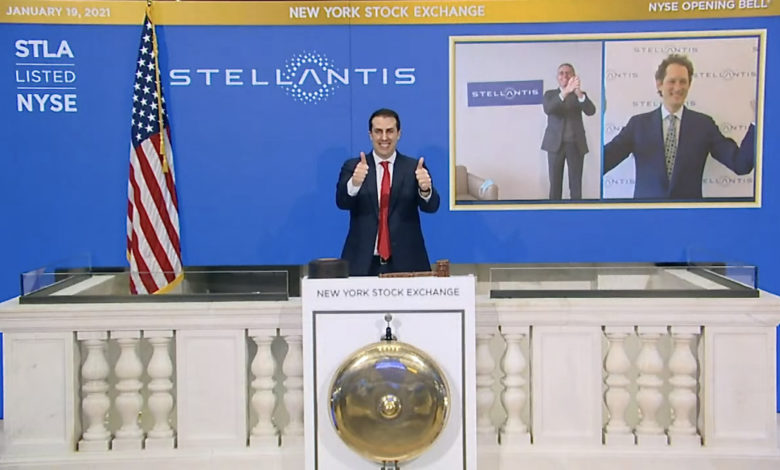
Jan. 19, a jubilant New York Stock Exchange celebrated Stellantis's listing. It honored the new multinational corporation's Chairman John Elkann and Chief Executive Officer Carlos Tavares by having them virtually ring the opening bell beginning trading that day. Liberation photo taken from YouTube video.
A remarkable event occurred on Jan. 4. Chrysler, for many years one of the “Big Three” U.S. automakers along with General Motors and Ford, ceased to exist as a corporation. Chrysler, which had already become Fiat-Chrysler after its partnership with Fiat of Italy several years ago, was taken over by PSA, the French maker of Peugeot, Citroen and Opel cars.
While the impact of this merger will not be felt immediately by the workers in the former Chrysler plants, who will continue producing their current vehicles for the new company, it will inevitably lead to job losses and restructuring.
The new corporation is called Stellantis. Only two members of the company’s board of directors are from the United States. The new corporation will be headquartered in the Netherlands.
Chrysler outsourced abroad, promoted ‘Buy American’ as a diversion
What makes this development especially noteworthy is that Chrysler was the corporation that ushered in the “Buy American” campaign in the 1980s. Chrysler, after entering bankruptcy in 1979, was the first of the Big Three U.S. auto companies to launch a massive restructuring based on automation, outsourcing of jobs and integrating worldwide production.
In 1979, there were approximately 100,000 hourly U.S. Chrysler workers, 165,000 Ford workers, and 511,000 General Motors workers. As of 2018, those numbers had declined to 47,000 Chrysler workers and 55,000 Ford workers. GM’s hourly U.S. workforce declined to 46,000 workers, though a significant portion of GM’s decline was due to the spinoff of its parts divisions.
Union leaders mirrored company’s racism, made concessions to restructuring
When the corporate restructuring began in 1979, the United Auto Workers leadership had no strategy to fight back against the attacks on workers’ jobs. Instead, they adopted a “Buy American” campaign, blaming “foreigners” — in particular Japanese workers — for taking “American” jobs.
The upshot of this strategy was that U.S. autoworkers were directed by the union leadership to cooperate with the bosses against “foreign competition.” This meant giving contract concessions, agreeing to two- and even three-tier wage scales, not challenging massive plant shutdowns when they occurred, and ultimately even giving up the “30 and out” pensions that had been a hallmark of the UAW.
It also meant a blatant appeal to racism. “Foreign-made” automobiles were banned in union parking lots. Union locals staged ceremonies where they would smash Japanese cars. And it resulted in racist attacks against Asian people, including the murder of a Chinese man, Vincent Chin, in Detroit.
Paving the way for Trump’s chauvinism
When we try to understand how a racist demagogue like Trump could appeal to white industrial workers, many of whom lost their jobs due to corporate restructuring, some blame should be placed on this backward approach adopted by the union leadership in lieu of presenting a program to challenge the bosses. Trump’s “Make America Great Again” is not a whole lot different than the union leadership’s “Buy American” campaigns.
The fact that Chrysler, the corporation that helped launched “Buy American” through its Trump-like pitchman Lee Iococca, has now been wholly taken over by a French corporation, shows what a nefarious ploy this “Buy American” strategy always was.
Bosses have no national loyalty, only concerned with profit
In the epoch of monopoly capitalism, the bosses owe no national allegiances. They are multinational corporations whose only concern is profit. They will shut plants and offices and move production anywhere in a minute in the pursuit of more billions to line their pockets. That was the case in 1979 just as it is today.
Promoting “Buy American” as a diversion from challenging capitalist restructuring is not just promoted by Trump or backward union leaders. It was a centerpiece of the Biden-Harris campaign, which published “The Biden Plan to Ensure the Future is ‘Made in All of America by All of American’s workers.’”
And on Jan. 25, while workers still waited for their promised stimulus, Biden proclaimed his “Buy American” initiative. Bernie Sanders similarly echoes the reactionary “Buy American” line, one of the reasons he won over many of the same workers who had previously voted for Trump in Michigan.
Chrysler’s takeover by Peugeot to form the new multinational auto giant Stellantis is motivated by the auto companies preparing a whole new round of job eliminations and restructuring. The entire auto industry is moving toward electric vehicle production. Electric vehicle production is labor intensive, requiring 30 percent fewer workers than producing internal combustion vehicles. If the restructuring is not challenged, it will lead to further demands for givebacks and concessions.
The move to electric vehicles is certainly in the interest of all humanity, but the bosses should not be allowed to use this conversion to maximize their profits at the expense of the workers. Rank-and-file auto workers must take the lead in demanding that the workers get the benefits of the new technology as well as the community.
International workers’ solidarity needed to effectively fight bosses
It is time to revive demands for 30 hours work for 40 hours pay and guaranteed lifetime jobs, and to fight to bring back pensions that are fully paid after 30 years of labor regardless of age.
And it is time to promote international workers’ solidarity in the fight against the bosses, not a strategy that pits workers against each other based on geography.
When Biden offers the bosses billions of dollars to subsidize electric vehicles, as he has pledged to do, these demands must be made conditions of any federal subsidies. Green New Deal activists should join the workers in supporting demands that workers, not bosses, profit from the technology.
Activists must let Biden know that they will not sit back and allow a bailout like he helped engineer at GM and Chrysler in 2008. This bailout “saved” the companies and their profits while cutting jobs and wages for the workers, and led to the proliferation of gas-guzzling SUVs and trucks to fatten the bosses’ bottom line.
In a television ad repeated incessantly, 60’s quarterback star Joe Namath reads his lines to promote the Medicare Coverage Helpline. “Are you getting all the benefits you deserve?” He ticks off the new benefits. You may be able to lower your out of pocket costs and get extra benefit now, he says.The ad announces that the Center for Medicare and Medicaid Services has officially authorized new benefits that Medicare Advantage Plans may include. “One simple call gives you free, professional assistance to help you get more benefits and save money,” says Namath. It sounds like a public service announcement from Medicare.
But it isn’t. It’s a pitch to sign up in the privatized, for-profit Medicare Advantage plans—and it’s a scam. It is true that a person may be able to lower monthly costs by enrolling in one of these plans. That’s a powerful incentive in a time when the majority of seniors live on tight budgets, many just an inch from disaster. The laws and regulations allow these insurance companies to lure seniors away from traditional Medicare, and Congresspersons of both parties should be held responsible.
Namath continues: “And like you I’m at home staying safe, but I wanted to get this message out. To make these uncertain times easier and safer while at home, Medicare Advantage plans have added new benefits including telephone appointments with your doctors, in home aides, home delivered meals, home delivered prescriptions, and so much more.”
He makes it seem to be a new opportunity provided by Medicare because of the corona virus that is keeping us homebound.
“But you don’t get all the benefits automatically, you need to enroll. The easiest way to enroll is to call the Medicare Coverage Helpline. It’s now more important than ever to make sure that your Medicare coverage is up to date,” says Namath.
It mimics a public service announcement—there are new benefits to help out in the pandemic but the benefits aren’t automatic, you have to enroll. That doesn’t sound like you are abandoning your traditional Medicare plan and allowing Medicare to give an annual sum to the for-profit insurance company that has now taken you into its scheme. But once you sign up, you’ve been had.
You may be okay for a time and save money monthly – as long as you don’t get sick. Once you need to use the plan, you will discover the problems that come from being in a for-profit plan that makes more when it denies you care. Your choice of physicians will be restricted to a list. The specialist you need may not be anywhere near where you live. The hospitals and rehabs centers will be limited. The post-hospitalization facility available to you is likely to be the one with the worst reputation. The drugs you need may now cost a fortune.
Tom Mills of San Diego was in one of these Medicare Advantage plans. Following a mitral valve repair and a mild stroke, his plan began to charge him hundreds of dollars in monthly copays for drugs and other services. He had to pay $295 a night for a hospital stay.
Then he learned the even worse news. If he tries to escape these exorbitant costs by returning to traditional Medicare and a prescription plan, he will need a supplemental Medigap plan to handle the 20% copays and deductibles. But he now has a pre-existing condition. A broker for health insurance told Mills that no supplemental plan would cover him and that applying would be a waste of time.
Namath didn’t mention that in the ad.
When seniors first sign up for a Medicare plan, they are protected by law against discrimination for pre-existing conditions in the purchase of a Medigap plan. But when a person tries to change back to traditional Medicare later, that protection is gone. Only four states have regulations to prohibit such practices.
Mr. Mills no longer saves that monthly sum on his Medicare Advantage plan; he pays extra.
Despite the problems of purchasing a Medigap plan, the negative experiences that Medicare Advantage patients encounter once they get sick induce many to return to traditional Medicare. It all works so well for the insurance companies! While the patient is healthy with few expenses, the company rakes in the money. Once the patient becomes ill and needs more care, many patients, facing massive expenses, will return to original Medicare. Now the extra expenses of a sicker patient will fall on the public once again.
That’s the way this for-profit system functions. The poor, the disabled, the sick and the elderly are covered under the public programs, Medicaid and Medicare, leaving the healthy, vibrant families to the private insurers who profit from the lower costs of care for the healthy.
Not only do these Medicare Advantage Insurance companies profit at the public trough, they use the seniors who are signed up in their plans to lobby Congress to continue with these rip-offs. America’s Health Insurance Plans (AHIP), the organization of health insurance companies, keeps the deceptions going by telling seniors to let their Congressperson know that their Medicare plan is in jeopardy. All legislative efforts to reduce the massive ill-gotten gains of these companies are defeated by AHIP’s shrewd use of the popular “protect Medicare” sentiment to ward off any reform of the Medicare Advantage plans.
The Senate letter includes 66 signatures and the House letter over 300, including many who ought to know better.
The insurance industry manipulates our democracy.
That’s just the beginning of the shameful marketing of Medicare Advantage plans. The Joe Namath ad for the Medicare Coverage Helpline includes some tiny print that no one could possibly read on the television. The fine print of the ad says “The Medicare Coverage Helpline is a private for-profit lead generation campaign and does not offer insurance and is not an insurance agency or broker. Your call is sold to a licensed insurance agent….”
Now the Medicare Payment Advisory Commission (MedPAC) announces that Medicare is spending more than planned during the pandemic and that funds will run short by 2024. There is a solution to all of this. A well-designed national single payer plan, an Improved Medicare for All, would boot the Medicare Advantage cheats, solve Medicare’s funding future, and cover everyone, not just the elderly, for all medically necessary care.
Such a plan has been set forth by Physicians for a National Health Program.
The plan removes the profits from the system, allowing our wealth to instead expand care to all, ending forever the for-profit scams and the denial of care because of inability to pay.
How this label is used to justify a social order in which workers are abused, discarded and left to die.
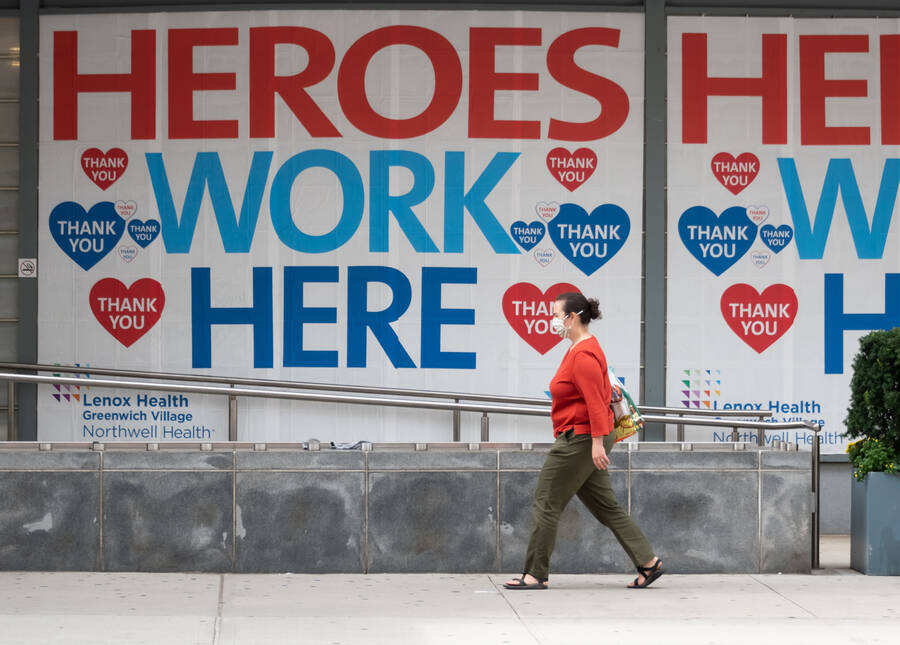
A person wears a face mask outside Lenox Health Greenwich Village hospital on September 27, 2020 in New York City.NOAM GALAI/GETTY IMAGES
Politicians, pundits, CEOs and think tank staffers have spent the past 10 months effusively praising the heroism and sacrifice of essential workers. “I’m not alone in being grateful for the work you are doing,” Amazon CEO Jeff Bezos declared in a March 2020open letter to the company’s workers who have labored throughout the pandemic, risking their lives to deliver hand sanitizer, face masks and baby formula (and increased Bezos’ personal fortune by 65%). Walmart has taken out television ads praising and thanking essential workers (even as it has imperiled and underpaid those under its employ). House Speaker Nancy Pelosi (D‑Calif.) tweeted in July 2020, “Frontline and essential workers across the country have performed heroically since the start of the COVID-19 pandemic.” Former President Trump, who oversaw 400,000 Covid deaths in the U.S. alone, ran a taped segment during the Republican National Convention in which he said to essential workers, “Thank you all very much. Great job.”
But beneath this praise is a troubling truth: Whatever mitigation of suffering and hardship has been achieved during the pandemic, it’s been built on the backs of an “essential” workforce that is hyper-exploited, underpaid, placed in extreme danger, and nowhere close to fairly compensated. The endless praise of these essential workers, from the very architects of their exploitation, only serves to justify and normalize a social order in which people who are disproportionately Black, Brown and low-wage are sacrificed. Instead of talking about how workers are being economically coerced into laboring under deadly conditions, we’re talking about heroism. Instead of criticizing policies and political decisions that send workers to their deaths, we are fawning at workers’ voluntary self-sacrifice. The “essential worker” discourse has the effect of enforcing discipline on a labor force that CEOs and politicians have decided is dispensable. This is not the language of gratitude — it’s the language of throwing people away.
A recent report on Chicago-area workers in the food industry shines new light on the conditions these “essential workers” face. In December, the workers’ rights organizations Warehouse Workers for Justice (WWJ) and Chicago Workers’ Collaborative (CWC) interviewed 90 Chicago-area workers in food production, distribution and logistics (10% of those interviewed are white, 42% are Black and 48% are Latino). Eighty-five percent of the workers interviewed said that when employees raised Covid-19 safety concerns, bosses either failed to respond to complaints, retaliated against people who spoke out, or took actions that were not helpful. Sixty-one percent said they had to go without pay when they were ill or forced to undergo quarantine. Eighty-three percent of the workers who were infected with Covid-19 report that “they did not receive paid sick leave from their employer or government assistance.” And a stunning 96% of workers interviewed said they were not receiving hazard pay.
These workers are being asked to risk their lives every time they clock in to the job, but in return they are receiving no social support or meaningful compensation. One anonymous worker told the researchers, “I had the virus in April and had to quarantine for a month. Without insurance or quarantine pay, I had no choice but to stay home and suffer through it.” Another anonymous worker told researchers of a coworker who “got sick with Covid and passed away.” The person who died had been working while ill and, according to the interviewee, “The company never addressed the death or told us a coworker had died.”
The “essential workers” who are dying or going without pay so they can quarantine were already severely underpaid when the pandemic began, particularly those in the food industry. In 2019, the median wage for food and agricultural workers, for example, was just $13.12, according to the Economic Policy Institute. Meanwhile, just 8% of workers in this sector were represented by unions. Once the pandemic broke out, the Centers for Disease Control and Prevention put out health and safety “guidance” for essential workers. However, according to a research brief from The Shift Project, which collects and analyzes survey data, “The Occupational Safety and Health Administration, the federal agency ordinarily tasked with enforcing regulations to protect workers, has largely left safety standards and protocols up to individual employers.” (On Thursday, President Biden instructed OSHA to issue new guidelines to protect workers from Covid-19.)
Essential workers themselves have been some of the loudest critics of the effusive praise with which their exploitation has been met. “We are tired of taking the risk,” said San Jose, California McDonald’s worker Maria Ruiz, while on strike in April 2020 for hazard pay of an additional $3 per hour. “I’m kind of afraid” to go on strike, she added in an interview with In These Times, “but I’m more afraid to lose my life.” A cashier at a New Seasons Market in Portland, Oregon toldIn These Times in March 2020, “I don’t really know if any amount of money would make working in this environment and being exposed to this level of risk feel worth it. Personally, I live with my grandmother and mother so it’s just really hard to know if continuing to come to work is the right choice.”
Meanwhile, Koch-funded think tank staffers, Wall Street bankers and even Reagan-era economist Art Laffer have emerged as some of the biggest cheerleaders of sending workers into deadly conditions. “We need to get production back — period,” Laffer proclaimed just weeks into the U.S. pandemic (Trump gave Laffer the presidential medal of freedom in 2019).
Of course, there is a conversation to be had about the need to keep people fed and cared for during the pandemic, a feat that almost certainly requires some degree of sacrifice and hard work in the service of the common good. Food must still get to people’s homes, health workers must still care for the sick and dying, farms must keep growing produce so that people can live. And indeed, many workers are acting heroically, as illustrated when they’ve stood up again and again to defend their lives, and the lives of their coworkers, under harrowing conditions.
But 10 months into this crisis, U.S. society has not had a meaningful collective conversation about what a just, shared sacrifice could look like. We have not talked about how to evenly distribute the burden of danger, how to make sure that each human life is valued as we tackle the mammoth challenges before us. With no real public debate, we are operating under the assumption that if sacrifices must be made, it is the most exploited sectors of the working class that should make them — an attitude that prevails during “normal” times, but now with brutal efficiency. As Hamilton Nolan pointed out in March, we’re not asking Art Laffer to wait tables. We’re not asking politicians to send their children to work the checkout lines in grocery stores. The idea that those options would even be on the table is laughable.
If we continue on the current trajectory, when this is all over, the pandemic is going to be the story of how, in the face of social crisis, an entire class of people was abused, discarded and left to die. All the while, we were told that the only way through the crisis was for the workers who have always been sacrificed for the profits of the few to make greater sacrifices than ever before. And as Black, Brown and poor people disproportionately perished from Covid-19, as Chicago-area food workers languished without sick pay, we were reassured not to be outraged. Because this is noble sacrifice, and essential workers are “heroes.”
In his report “The Trump coup and the rise of fascism: Where is America going?” David North traced out the historical processes that led to the events in Washington on January 6.
He explained that while extreme right-wing and fascistic movements had always been present within the American body politic, these malignant political and social forces had been able to be contained so long as the US was a rising economic power.
The present situation is fundamentally different. America is no longer a rising power. For the past 50 years it has been in an inexorable historic decline that has seen two existential financial crises in the space of 12 years—the 2008 meltdown of the banking system and the potentially even bigger disaster of mid-March 2020, when the initial impact of the COVID-19 pandemic resulted in a freeze-up of all financial markets in the US and globally.
Traders work on the floor of the New York Stock Exchange. (AP Photo/Richard Drew)
In his report, North insisted that the crisis and its significance could be grasped only when placed within its historical and international context. Accordingly, he located its economic origins in the decision of President Nixon on August 15, 1971 to remove the gold backing from the US dollar, effectively destroying at one stroke the Bretton Woods Agreement of 1944 that had formed the basis of post-war global capitalist economy.
The pillar of that agreement, which provided a key foundation for the restabilisation of world capitalism after the 30 years of carnage beginning with the outbreak of World War I in 1914, was the establishment of the dollar as the world’s reserve currency, redeemable for gold at the rate of $35 per ounce.
Barely a quarter of a century after that commitment had been given, it was scrapped because of the decline in the position of the United States within the world economy. The build-up of the US balance of trade and balance of payments deficits meant that to honour the pledge to redeem dollars with gold would bring national bankruptcy.
“In historical retrospect,” North wrote, “this action marked a turning point not only in the global economic position of the United States, but also in the fate of American democracy.”
This vital point in locating the economic origins of the present political crisis can be established through an examination of the trajectory of American capitalism over the past 50 years, and particularly the developments in the monetary and financial system.
That history could be summed up as the unending rise of finance capital, the most rapacious and predatory form of capital as a whole, and its domination over the entire economy.
This process, as we shall trace out, forms the underpinning and has now provided the economic impulse for changes in the political superstructure that have seen the emergence of the real and present danger of fascist forms of rule.
It has not been confined to the US. The developments within the United States are only the most violent expression, at least so far, of what has been a global process manifested in every country. But as the saying goes, the fish begins to rot from the head.
The shock of August 1971 was the initial expression of a major turn in the development of the global capitalist economy—the ending of the post-war economic boom.
In 1974–75, following a significant downturn in the rate of profit in the US and across the world from the end of the 1960s onward, world capitalism entered the deepest recession to that point since the 1930s.
It was quite unlike the recessions of the1950s and 1960s. After their passing, they had given way to a new upswing in the business cycle and greater economic growth than previously.
The recession of 1974–75 passed, but it was not replaced by anything resembling the upturns of the past. Rather, under conditions of reduced growth, it ushered in what became known as “stagflation”—the combination of rising prices and high unemployment. The so-called Keynesian measures, based on government stimulus, not only proved to be ineffective in bringing a revival, they only made the situation worse.
Key sections of the ruling class in the US and internationally understood, at least at some level, there was no way out of the morass with half-measures based on the industrial framework of the post-war boom. They had tried to increase the level of exploitation within the old order to boost profits, but this only provoked a series of militant struggles by powerful sections of the working class—the miners’ strike in Britain of 1973–74, which brought down the Heath Tory government, being one of the more graphic examples.
Based on this experience, they recognised that nothing less than the restructuring of the capitalist economy was necessary and a new regime of production had to be developed if the decline in the rate of profit was to be arrested.
This involved the closure of less profitable sections of industry, coupled with the elimination of the major concentration of workers they employed; the introduction of new job-cutting technologies in those that remained; and the outsourcing of production internationally to take advantage of much cheaper sources of labour.
This program was spearheaded internationally by the Thatcher and Reagan governments. The chief economic weapon used to impose the restructuring agenda was wielded by the US Federal Reserve under the chairmanship of Paul Volcker. Appointed by Jimmy Carter in 1979, he raised interest rates to historically unprecedented levels, hitting 20 percent at one point.
Conducted under the banner of the fight against inflation, the central target of these measures was the working class. A major turn in the class struggle came in 1981, when Reagan carried out the mass sacking of air traffic controllers and jailed the leaders of their union, PATCO.
Volcker was later to praise Reagan for his strikebreaking, declaring that the defeat of the PATCO workers was the most important factor in bringing inflation under control. The PATCO outcome, he said, was decisive in its “psychological effect on the strength of the union bargaining position on other issues—whatever the issues were.”
A member of the Fed’s interest rate-setting Federal Open Market Committee put the issue even more directly, saying at a meeting in February 1981 that “inflation would not be securely defeated… until all those workers and their unions agreed to accept less. If they were not impressed by words, perhaps the liquidation of several million more jobs would convince them.”
But these measures could go forward only with the direct collaboration of the trade union bureaucracy, which refused to lift a finger in defence of the PATCO workers, setting the pattern for the betrayal of a host of major industrial battles that were to follow in the rest of the decade.
The destruction of vast sections of US industry and the consequent war against the working class was a component of a vast reorganisation of the American economy—its transformation into the centre of parasitic profit accumulation via financial manipulation and speculation.
It began with the buying up of companies in hostile takeovers, financed by junk bonds, and then hollowing them out and selling off the component parts. The accumulation of profit was carried out not through production, but through parasitic activity financed by debt—the start of a process that has now reached stratospheric heights.
In his report, North referred to the growth of outright criminal activity in the political sphere, exemplified by Reagan’s laying of a wreath at a cemetery in the German town of Bitburg in 1985, where members of the Waffen SS were buried, followed by the Iran-Contra scandal a year later.
This involved the Reagan administration, in violation of a law passed by Congress, funding death squads in Nicaragua seeking the overthrow of the left-wing Sandinista government. Congressional hearings revealed that Colonel Oliver North, while directing the murderous operations in Nicaragua, was also involved in plans for the detention of 100,000 Americans in the event of a national emergency.
There were parallel developments in the underlying financial structure of American capitalism, as methods that had been regarded as illegal in the past became the norm. In 1982, Congress passed legislation allowing companies to buy back their own shares in order to boost their price—a practice that has now become a major component of Wall Street’s operations. Previously, this activity had been outlawed by the Securities and Exchange Commission as market manipulation.
A new breed of financial operators emerged to organise financial speculation, particularly through the issuing of less than investment grade, or junk, bonds for the financing of hostile takeovers.
One of the most significant of these, Michael Milken, was eventually jailed. But the methods he developed rapidly became standard operating procedure on Wall Street—a fact recognised by President Trump in February 2020, when he granted Milken a pardon to the applause of finance capital. In praise of the decision, the Wall Street Journal declared: “Mr. Milken was one of the great financial innovators of the 20th century. In the 1980s he invented the high-yield bond market that is now a financial staple.”
However, the orgy of speculation unleashed in the 1980s, made possible by successive waves of deregulation that widened the scope for the activities of finance capital, did not proceed smoothly. It erupted in a major crisis that exposed the growing rot and decay at the very centre of US capitalism.
In October 1987, Wall Street experienced its largest one-day fall in history—eclipsing the October 1929 crash—as the Dow plunged by more than 22 percent. It was brought back from this near-death experience, which lasted for some weeks, only by the intervention of the US Federal Reserve. Its actions were not one-off, but signified a qualitative transformation in its role in US financial system.
In the post-war period, the role of the Fed was summed up in 1955 by its chairman, William McChesney Martin: “In the field of monetary and credit policy, precautionary action to prevent inflationary excesses is bound to have some onerous effects… Those who have the task of making such policy don’t expect you to applaud. The Federal Reserve… is in the position of the chaperone who has ordered the punch bowl removed just when the party was really warming up.”
In the fall of 1987, the newly appointed chairman of the Fed, Alan Greenspan, issued a one-sentence statement on the share market crash. “The Federal Reserve,” he said, “consistent with its responsibilities as the nation’s central bank, affirmed today its readiness to serve as a source of liquidity to support the economic and financial system.”
This meant opening the money spigots of the Fed to the finance houses. The scale of its actions, though dwarfed by subsequent interventions, was extensive for the time. Altogether, the central bank supplied $17 billion to the banking system, an amount equal to more than 25 percent of bank reserves and equivalent to seven percent of the national money supply.
It was the start of a new program, as Greenspan was to make clear. The task of the Fed was not to act against inflationary asset bubbles and deflate them before they became dangerous, but to allow them to develop, and when they burst, to pump out money to clean up the mess and prevent the bankruptcy of the banks and finance houses that had engaged in the speculation that had produced the bubbles.
This was based on the understanding that such methods were now becoming central to the functioning of the American economy. Instead of taking away the punchbowl, Greenspan made clear that the role of the Fed was to add more alcohol to it.
The decade of the 1990s was marked by a series of crises: the Mexican peso crisis, the Asian crisis of 1997–98, the collapse of the Russian rouble. These developments led to the collapse of the hedge fund Long Term Capital Management, which was bailed out by the New York Federal Reserve to prevent the hedge fund’s demise from sparking a crisis throughout the financial system.
The development of the internet was accompanied by the growth and collapse of the dot.com bubble in 2000–2001. In 2001, the energy company Enron, whose reported profits were the result of “creative accounting” signed off by a major accounting firm, collapsed when its profits were revealed to be completely fictitious.
These crises were not a series of accidents, but the expression of a deepening malaise flowing from the relentless accumulation of profit through financial activities completely divorced from the underlying real economy and the production of real value.
At every point, the reaction of the Fed was the same. It lowered interest rates and created the conditions for the next bubble. Throughout the 1990s, under the Clinton administration, the last vestiges of the regulatory mechanisms that had previously been put in place were removed, culminating in the repeal of the Glass-Steagall Act of the 1930s, which separated the banking and investment activities of the major banks.
In 1999, when financial derivatives began to assume greater importance as a means of speculation, Clinton’s treasury secretary, Lawrence Summers, strenuously opposed making them subject to regulation.
The crisis of 2008 marked a qualitative turning point in the historic crisis of American and global capitalism, Here it was a question of not just the activities of an individual firm such as Enron or a hedge fund, as in the case of Long Term Capital Management, that had collapsed.
The crisis that began in the $50 billion sub-prime mortgage market, a relatively small part of the financial market, became all-embracing because the methods employed there were rife throughout the system as a whole. After the bankruptcy of the investment bank Lehman Brothers, the government and the Fed had to rescue the insurance giant AIG to prevent a collapse of the entire financial system.
The massive intervention by the Bush and the Obama administrations, involving corporate bailouts and the pouring of trillions of dollars into the financial system by the Fed. The US central bank’s balance sheet expanded from around $800 billion to more than $4 trillion as a result of the continuous purchase of financial assets under its quantitative easing program. This signified that the so-called “free market” could not survive for a single day without the support of the state.
These interventions, coupled with the further restructuring of the labour market under Obama, including the expansion of the two-tier wage system and the scrapping of regular labour contracts, accelerated a process that had begun decades before—the siphoning of the wealth of society up the income scale, creating the greatest levels of social inequality ever seen in history.
The intervention of the Fed through the purchase of government bonds and the reduction of interest rates to historic lows, essentially providing free money to the financial oligarchs, were declared to be temporary measures, to be withdrawn once conditions returned to normal.
That day never came. The new normal was that continuous Fed support was essential for the day-to-day operations of the financial markets. Any effort by the central bank to wind back its measures was met with a violent reaction on Wall Street, bringing an immediate back-down. Such was the case in 2018, when the Fed carried out four interest rate rises, each of 0.25 percentage points, and indicated it would wind down its holdings of financial assets at the rate of $50 billion a month. The markets tanked and Fed Chairman Jerome Powell announced that he was halting further rate hikes.
The 2008 crisis was the outcome of the rise and rise of financial parasitism over the previous three decades and more. This did not arise from a change in the mindset of the ruling classes that could somehow be reversed if only another policy were adopted. Rather, it arose from deep-seated objective contradictions within the capitalist profit system that had come to the surface with the ending of the post-war boom.
Through all the ups and downs of the business cycle following the end of the boom, profit rates in the spheres of industrial production never returned to the levels they had enjoyed in the 1950s and 1960s. This was the driving force behind the ever-increasing turn to financial methods of profit accumulation.
Therefore, the response to the 2008 crisis was to lift parasitic profit accumulation to ever greater heights through the provision of essentially free money to the financial oligarchy, while launching austerity programs against the working class on the basis that there was “no money.”
When the pandemic struck, it exposed the devastating social consequences of the institutionalisation of the accumulation of wealth at the heights of society at the expense of the mass of the population. No effective measures based on science, which would have involved the lockdown of non-essential workplaces and the payment of compensation to the workers affected, could be implemented to combat the pandemic because this would have set off a crisis on Wall Street.
The reason is to be found in the nature of the financial assets that have now assumed such gargantuan proportions. Finance capital is essentially fictitious. That is, it does not embody value in and of itself, but, in the final analysis, is a claim on the surplus value extracted from the working class in the process of capitalist production.
When an industrial concern makes a profit from its activity, real value has been created and surplus value has been generated from the exploitation of the working class in the process of production. However, when shares are traded on Wall Street at a profit, when profits are made on currency transactions, such the $2 billion raked in by George Soros by betting against the pound sterling in 1992, or a financial killing is made from derivative trades, to name just a few examples, not an atom of new value has been created.
These fundamental economic relationships are the basis and driving force of some of the most significant changes in the physiognomy of US capitalism over the past 40 years.
The continuous driving down of real wages, despite vast increases in the productivity of labour, coupled with the intensification of exploitation, has become an indispensable feature of the capitalist economy, as the vampire of fictitious capital demands the ever greater extraction of surplus value to sustain it.
Likewise, the destruction of social services—the attacks on education and the nightmare that is the US health care system—serves the same end, because, in the final analysis, all social spending represents a deduction from the mass of surplus value available to Wall Street.
The rise of fictitious capital and the consequent development of parasitism as the dominant mode of profit accumulation point to another significant development. The past 30 years have seen the launching of continuous wars by US imperialism—wars of plunder aimed at trying to enhance the flow of wealth to Wall Street and counter America’s economic decline by military means.
At the same time, under both Democratic and Republican administrations, the US has increasingly pursued economic warfare against its rivals—not only against China, but also increasingly against Europe—to achieve the same objective. It has now reached the point where the dollar, the world’s major reserve currency, has become “weaponised.” Corporations and states deemed to be acting at variance with US objectives—trading with Iran, for example—can be excluded from key financial markets.
The onset of the pandemic not only exposed the devastating social consequences of financial parasitism, it made clear how the conditions for a new financial crash, going even beyond the scale of 2008, had been created in the ensuing 12 years.
This is the significance of the mid-March 2020 crisis on Wall Street, extending into the entire global financial system, when markets froze across the board.
The extent and intensity of this financial heart attack was revealed in the fact that it was centred in the $20 trillion US Treasury bond market—the bedrock of the American and global financial system. In periods of significant market turbulence, the Treasury bond market acts as a kind of financial safe haven, with money flowing into the purchase of US government bonds. On this occasion, however, there was a bond market sell-off in what has been described as a “dash for cash” that threatened to bring down the entire financial system.
The circumstances of this crisis reveal the significance of the class struggle for the operation of the financial system and why all stops are pulled by the political establishment and its servants in the trade union bureaucracy to suppress it.
In March, as the effects of the pandemic and the enormous dangers it posed became apparent, there were walkouts and strikes by significant sections of workers, particularly in the auto industry, demanding that effective measures be taken to combat it. This sent a shiver of fear through the financial oligarchy, petrified at the prospect that this movement would grow and develop.
The initial movement was blocked, above all by the actions of the trade unions. But the fear has not gone, as exemplified by the worried response to the strike by Hunts Point Produce Market workers in New York City, driven by concern that the strike could be the catalyst for an explosion of pent-up social anger in wider sections of the working class.
The scale of the Fed’s intervention in mid-March revealed the extent and depth of the financial crisis. Virtually overnight, it stepped in to act as the guarantor of all areas of the financial system, committing to increase its bond purchases, guaranteeing the commercial paper market, the market for municipal bonds, student loan and credit card debt and, for the first time in history, purchasing corporate debt.
This intervention, which took place in combination with the provision of hundreds of billions of dollars to major corporations under the CARES Act, has seen the Fed’s balance sheet expand from around $4 trillion to more than $7 trillion. The Fed has pledged to keep interest rates at virtually zero for the indefinite future, and is buying Treasury bonds and mortgage-backed securities at the rate of $120 billion a month—that is, more than $1.4 trillion a year.
These measures, going far beyond what was undertaken after 2008, mean that the capitalist state has become the guarantor of the financial oligarchy.
Fed and government action has driven a 75 percent rise on Wall Street since its mid-March nadir, resulting in the transfer of hundreds of billions of dollars to the coffers of the financial oligarchy.
The financial house of cards is being lifted to ever greater heights even as its foundations become increasingly shaky, amid warnings from within Wall Street itself that the situation is inherently unstable and unsustainable.
It is from these processes that the objective economic impulses for vast changes in the political superstructure, including the emergence of fascism as a significant and highly dangerous force, emanate.
In their pronouncements on the events of January 6, the various pseudo-left tendencies in the US and around the world have sought to chloroform the working class as to their meaning. Their universal response, flying in the face of a growing mountain of evidence, is that the storming of the US Capitol was not a fascist coup attempt. Bourgeois democracy still enjoys support in key sections of the state and the invasion of the Capitol was nothing but a piece of theatre, motivated by a deranged president, but without backing in decisive sections of the bourgeoisie and its state apparatus, they declare.
Above all, they maintain that there are no fundamental economic processes that would necessitate the development of a fascist movement to enforce the dictates of the bourgeoisie. The ruling classes are continuing to make money hand over fist and there is no significant social opposition that the ruling classes need to counter with fascist forces.
These dangerous political fictions, which so clearly reveal the class basis of the pseudo-left tendencies as agencies of the bourgeoisie, are exposed through an examination of the origins of the fascist forces that gathered in Washington.
They grew and developed in a campaign against lockdowns to deal with the COVID-19 pandemic. The fascist plot to capture Michigan Governor Gretchen Whitmer, put her on trial for treason and execute her, was motivated by the limited lockdowns she had imposed in the state.
When these forces held demonstrations, involving the display of arms, to demand the opening of the economy, they were given significant coverage in the media. This was because their demands were in line with those of powerful sections of the ruling class. They were summed up in the pronouncement of New York Times columnist Thomas Friedman that the “cure cannot be worse than the disease,” which became the banner under which Trump, supported in large measure by the Democrats, pursued the homicidal policy of “herd immunity.”
Nothing could be allowed to stop the flow of surplus value. Wall Street quite literally began to feed on death.
This policy, spearheaded by fascist forces, was the direct and immediate expression of the most basic interests of the financial oligarchy. They may not have liked the fascists’ methods, but they agreed with their objectives.
Once their own position was secured by the actions of the Trump administration and the Fed, all of which were supported by the Democrats, the financial elites demanded a return to work, recognising that any effective measures to deal with the pandemic would bring a crisis on Wall Street, as the near-death experience in mid-March had revealed.
Any assertion that the ruling classes as a whole and the dominant financial oligarchy have no need for fascist bands, let alone a coup, because they are continuing to make money ignores both the lessons of history and the explosive contradictions within the very heart of American capitalism and its financial system.
The fundamental issue is that the accumulation of vast wealth at the top and the rise of social inequality to historically unprecedented levels portend the eruption of massive social and class struggles, which, by their very nature, will very rapidly assume a political form. One of their immediate effects will be to produce a crisis in the financial markets, whose rise has been made possible not least by the suppression of the class struggle by the trade union apparatuses over the past three decades.
In this context, the pronouncements of Trump against the dangers of Marxism and his continuous denunciations of socialism as he has sought to build his fascistic movement should not be dismissed as the deranged outpourings of an individual.
They are the recognition by a section of the financial elites, out of which Trump emerged, of the dangers they confront—that under conditions of worsening economic conditions for the mass of the population and vast problems confronting young people, there is an enormous build-up of social anger and a shift to the left.
It is not necessary to point to Trump, who has sought to steer this anger in a rightward direction, to identify this phenomenon. Every serious study of the current economic situation in the US and worldwide points to the acceleration of social inequality and the dangers it poses for the capitalist ruling class.
For example, the latest edition of the Global Risks Report of the World Economic Forum, the organiser of the annual Davos gathering of the international elites, warns that many young people “are now entering the workforce in an employment ice age.” Youth disillusionment will become a “critical threat to the world in the short term,” as the current generation “loses faith in today’s economic and political institutions.”
In examining the connection between the rise of financial parasitism to truly stratospheric heights and the emergence of fascist forces, it is necessary to distinguish between fascism and other forms of authoritarian of rule. The bourgeoisie much prefers to use the existing forms of capitalist rule to enforce its demands and dictates. But under certain conditions it has the need for other mechanisms.
As Leon Trotsky noted, the bourgeoisie is by no means enamoured of fascism. It regards the fascist method “much as a man with a swollen jaw dislikes having his teeth pulled.” But under certain conditions, of the kind now unfolding in the US and internationally, the big bourgeoisie has need of the fascist dentist.
A fascist movement, developing under conditions of economic and social breakdown, seeks to mobilise dispossessed sections of the petty bourgeoisie, small proprietors, individual traders and sections of workers, impoverished and disoriented because of the decades-long betrayals of the trade union bureaucracy, into a political force.
Because of its social base, its ideology generally has a superficial “left” colouration. It claims to be fighting the deep state, the corrupt corporate media, the political establishment, even at times the giant monopolies that oppress the little man and woman. It doing so, it trades on real social grievances.
But everywhere and always it seeks to turn them in a reactionary direction, serving the interests of the ruling class against the working class. This connection is exemplified by Trump, who, while railing against the establishment and the elites and claiming to be fighting for the “forgotten people,” continually hailed the rise of Wall Street and demanded it be boosted even further.
Fascism feeds on the social distress and despair produced by capitalism and the operations of its financial system, under conditions where there is no basis for any meaningful reform within the existing economic order. Therefore, the ground can be cut from under it only when the working class advances and fights for its own independent program for the re-organisation of the economy and society.
Fascism cannot be undermined by appeals to disoriented layers of the population to respect the existing order, for that very order is responsible for their plight and has sent them in search of desperate means to overcome it.
Let us draw a balance sheet of the present situation. The attempted fascist coup by Trump enjoyed deep support within considerable sections of the Republican Party, with whom Biden now calls for unity.
It was actively supported by sections of the state apparatus, some openly, but many more covertly, which continue to serve under the Biden administration.
The social and economic base of the Trump fascistic movement in dispossessed layers of the population, many of them in rural areas, is not going to disappear with the change in the presidency. It will continue to grow as the crisis of American capitalism deepens. There is no New Deal to be implemented and Biden serves the rapacious oligarchs of Wall Street just as Trump did.
The real and present danger of fascism, whether under the leadership of Trump or someone else, will remain until the working class advances and fights for its own independent program for the reconstruction of society. Such a program must begin by tackling head on the source of the financial parasitism that has played such a crucial role in creating the social breeding grounds for fascism.
This means that at the very centre of the program advanced by the working class must be the fight for the expropriation of the entire financial system—the Fed, the private banks, the investment houses—bringing them into public ownership under democratic control, in order to begin the construction of a socialist society, in which human need, not private profit, is the guiding force and principle.
The fight for this program has a burning immediacy. The events of January 6 have revealed that as a result of a gathering crisis rooted in the very heart of American capitalism, democracy, in its bourgeois form, is on its death bed. It can be revived and developed only on new, socialist foundations.