Thursday, May 6, 2021

Freedom Rider: Gun violence starts at the top ~~ by Margaret Kimberley

https://mronline.org/2021/04/30/freedom-rider-gun-violence-starts-at-the-top/

~~ posted for collectivist ~~


Freedom Rider: Gun Violence Starts at the Top


If the state reserves the right to commit mass murder no one should be surprised that the people follow suit.

Mass shootings happen with appalling regularity in the United States. It is bad enough that recent shootings took place in Atlanta, Boulder, and Indianapolis, but the horror is always followed by the same useless faux debates. Half the population wants to limit gun ownership, the other half doesn’t and continues a gun buying spree to prove their point. Politicians pretend to take action, victims are mourned, thoughts and prayers are uttered, and the cycle repeats itself with the next awful event.

What very few people dare to discuss is how these acts are connected with U.S. history and with the state in its current form. This country exists as a result of genocides and terrorism. The indigenous inhabitants were attacked with wars and disease and the survivors were driven from their ancestral lands. Africans were enslaved and treated like chattel, all Black people were deprived of their legal rights, and Jim Crow lasted for 100 years. Lynch law prevailed and the torture and killing of black people was a spectator sport across the land. The fits and starts of anything resembling justice have been far outweighed by institutional resistance which maintains the status quo.

The police continue to kill three people every day, more than 1,000 people every year. While George Floyd’s police murderer was on trial, young Daunte Wright was killed in a nearby community. Video footage revealed that 13-year old Adam Toledo was unarmed with his hands raised when he was shot and killed by Chicago police. Lest anyone forget, Chicago is the city which holds hundreds of people at Homan Square, a city jail that operates like a CIA black-ops site. Chicago should forever be known as the city where black men were tortured by police for years.

When this nation wasn’t practicing state sanctioned terror within its boundaries, it committed atrocities internationally. Wars, interventions and coups have been committed from Chile to Haiti to Guatemala to Iraq to Ukraine. There are U.S. troops in Iraq and Afghanistan and more than 800 bases under U.S. or other NATO nation control around the world.

Joe Biden has undone the Trump administration agreement to leave Afghanistan by May 1. He cynically uses the date of September 11 to forestall what should have happened years ago. The occupation of Afghanistan has gone on so long that people born after it began are now old enough to join the military themselves. But no one should be fooled. Biden is privatizing war with contractors and intelligence operatives and moving troops to create havoc elsewhere in the world.

If the state reserves the right to commit mass murder no one should be surprised that the people follow suit. They are taught that their violent country is exceptionally good, fair, benevolent and democratic. The U.S. leads the world in military spending and brings wars home by militarizing local police. Of course the bloodletting doesn’t end. It would be shocking if it did.

The phony concern must come to an end. Foolish and false platitudes such as, “This is not who we are,” should disappear from discourse and be replaced with honesty. Biden has proposed increasing defense spending to $753 billion and after the rhetorical dust settles, there will be a bipartisan congressional consensus to approve what he wants. Military spending takes up 60% of the discretionary budget and is the reason why people in this country cannot have nice things.

State violence is like background music that seeps into the collective consciousness. The same people who express shock when an individual goes on a killing spree in this country are silent when their government is responsible for killings around the world. They may support the mass incarceration state, which makes the U.S. the world’s number one jailer.

It is all connected. State sanctioned violence tells the people that individual violence is just fine. The hand wringing over the latest shooting doesn’t mean anything if the wars and law enforcement brutality continue. The hypocrisy is obvious and no one should be surprised when a well-armed population makes use of their personal arsenals.

The United States of America is and will remain violent without some revolutionary change. The carnage is both official and personal. If this country is honest the next mass shooting should be ignored by the media, politicians, and by the people too. Any consternation is temporary because it is dishonest. For now the most that can be expected is that Americans will finally end the pretense of concern and treat the inevitable results of their history and politics with nonchalance. It is the only honest thing they can do.

Wednesday, May 5, 2021

Between the Lines: Congressional Report Finds US Sanctions to Blame for Venezuela Crisis ~~ Roger D. Harris

 https://www.mintpressnews.com/congressional-report-finds-us-sanctions-blame-venezuela-crisis/276963/

~~ posted for dreamjoehill2 ~~

If the U.S. government’s propaganda is correct that the current crisis is due to Maduro’s mismanagement and corruption, then illegal and inhumane sanctions would not be needed to dislodge the “regime.”

CARACAS, VENEZUELA — Venezuela was once one of the most prosperous countries in Latin America. The popular classes enjoyed major advances from the Bolivarian Revolution initiated by Hugo Chávez. Today Venezuela is experiencing an unprecedented economic crisis with severe humanitarian consequences.

The U.S. government blames the crisis on the mismanagement and corruption of the Venezuelan government headed by Nicolás Maduro. The Venezuelan government faults the U.S. and its allies for imposing sanctions, unilateral coercive measures illegal under international law.

An official U.S. Congressional Research Service report entitled “Venezuela: Background and U.S. Relations,” issued April 28, suggests the Venezuelan government has valid arguments that it is being strangled by U.S. sanctions. According to the report:

It is difficult to attribute precisely the extent of Venezuela’s economic collapse that is due to U.S. sanctions versus broad economic mismanagement. A February 2021 Government Accountability Office report asserted that ‘sanctions, particularly on the state oil company in 2019, likely contributed to the steeper decline of the Venezuelan economy.”’The Maduro government has defaulted on all its bonds, and U.S. sanctions prohibit debt restructuring with creditors.


Reverse-engineering history

The Congressional Research Service report provides a brief revision of history to fit an imperialist narrative produced to justify the hybrid war to achieve regime change in Venezuela. Hence the U.S.-backed coup in 2002, when the U.S. government welcomed a “return to democracy,” is euphemistically referred to as President Chávez’s “brief ouster from power.”

The subsequent employers’ lockout in 2002-2003, designed to economically cripple the government and cause its fall, is called an “oil workers’ strike.” The lethally violent guarimbas, calculated to overthrow the elected Maduro government, are called “student-led” protests.

While in all the above instances, the U.S. role in events is rendered invisible, the report describes how “Congress has provided funding to support democratic civil society in Venezuela,” which is Washington’s duplicitous shorthand for regime-change programs


One might think that a supposedly innocent American citizen on trial for terrorism inside a hostile enemy country, facing decades behind bars in Venezuela’s notorious prisons, would spark a nationwide media furor.

The report continues: “For more almost [sic] two decades, the U.S. has provided democracy-related assistance to Venezuelan civil society through the U.S. Agency for International Development and the National Endowment for Democracy (the former through its appropriately named Office of Transition Initiatives)…. For FY2021, the Administration requested…$200 million to support transition in Venezuela.”

In January 2019 the U.S. and its allies ceased to recognize Maduro as Venezuela’s legitimate president after then-National Assembly Leader Juan Guaidó, who had never run for national office, “announced he was willing to serve as interim president.” Guaidó’s coup attempts are euphemistically described as “high-profile but ultimately unsuccessful efforts to encourage security forces to abandon Maduro.”

Even the U.S. allies that have recognized Guaidó, “oppose military intervention in Venezuela and have expressed concerns about the humanitarian effects of broad sanctions,” according to the report, which laments: “The Venezuelan government has made it difficult for Venezuelans to obtain a valid passport and therefore legal status outside the country.” The difficulty, conveniently omitted from the report, is that when a foreign state expels the legitimate Maduro representatives and installs Guaidó’s, Caracas is left with no means of conducting normal embassy activities.

Economic crisis

Key in the hybrid war to achieve regime change in Venezuela are economic sanctions. The report forthrightly describes:

[the] multiyear economic crisis, one of the worst economic crises in the world since World War II: [Venezuela’s] economy has contracted by more than 75% since 2014, estimated as the single largest economic collapse outside of war in at least 45 years and more than twice the magnitude of the Great Depression in the U.S.

Imports — which Venezuela relies on for most consumer goods — have fallen by almost 95% since 2013. The country faces shortages of critical food and medicine.

Contrary to the official narrative that Venezuela’s Bolivarian Revolution is the root cause of the country’s economic woes, the report admits: “The trigger for Venezuela’s economic crisis was the crash in world oil prices in 2014.” It goes on to explain how U.S. sanctions confounded the Venezuelan government’s efforts to address this crisis:

Piecemeal efforts to address the crisis, including price controls and the creation of a new digital currency, the petro, were ineffective [because they were blocked by the U.S. government]. Some initiatives, such as restructuring debt or bringing the government budget into balance, were pledged and then abandoned [again prevented by the U.S. government sanctions].

Subsequent rounds of U.S. sanctions targeting the government, central bank, and gold sectors, as well as limiting Venezuela’s access to the U.S. financial system, likely exacerbated economic pressures in Venezuela. With private creditors unwilling and unable (due to sanctions) to purchase new Venezuelan debt, the Maduro government routinely turned to its main international financial backers — China, Russia, and more recently, Iran — but China and Russia are increasingly reluctant to extend further assistance [due to secondary sanctions].

Venezuela Sanctions Feature photo

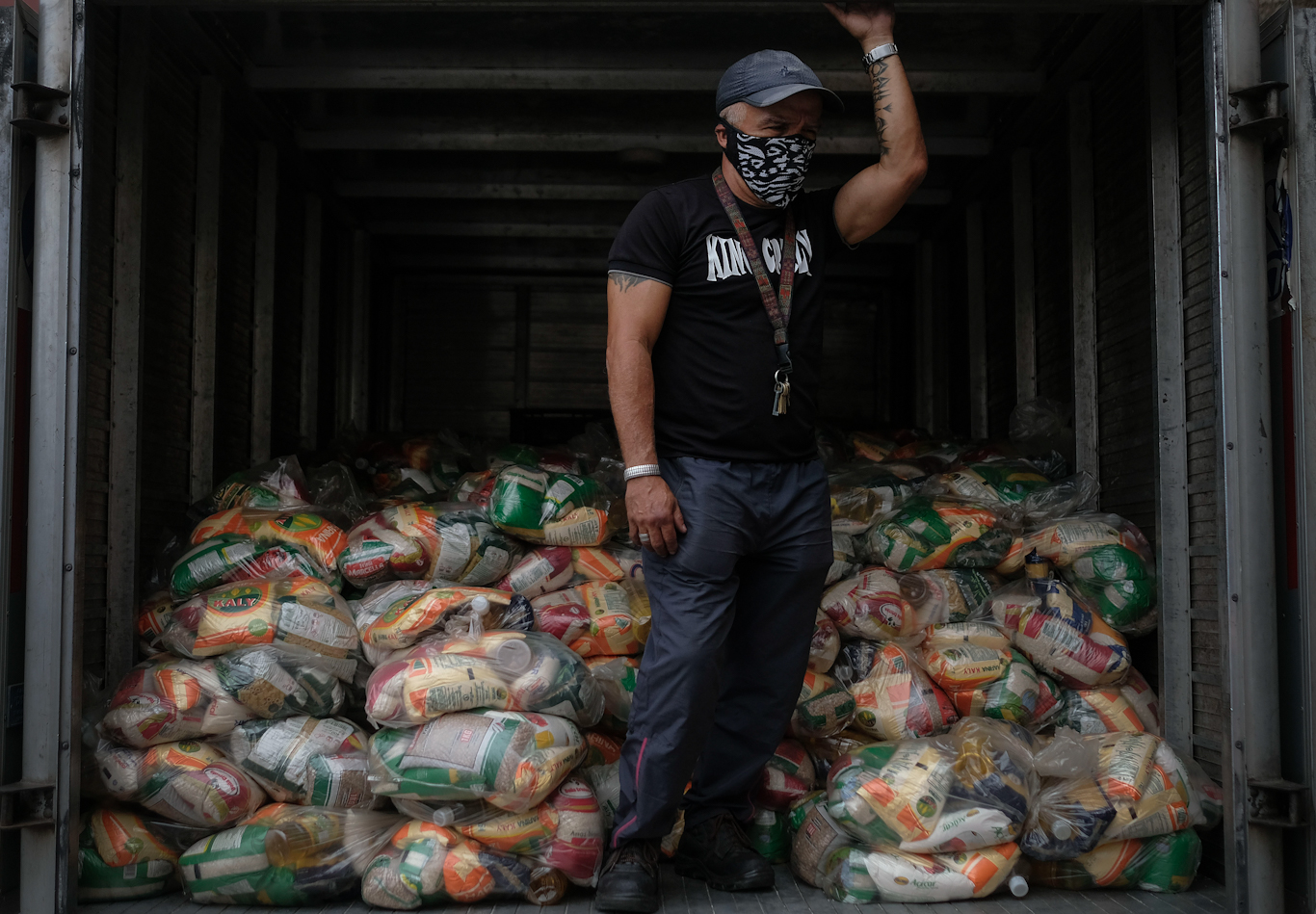
A man waits to unload bags of basic food staples provided by a government food assistance program in Caracas, April 10, 2021. Photo | AP

The sanctions are not just against Venezuela but affect other countries, amounting to a blockade:

The sanctions framework also prohibited non-U.S. entities from transacting with PdVSA [the Venezuelan state-owned oil company] in U.S. dollars and made non-U.S. entities subject to having their U.S. property blocked, should it be determined that they materially assisted PdVSA…

Under the sanctions framework, Treasury also has sanctioned numerous individuals, vessels, and companies involved in trading and shipping Venezuelan oil. This progressive application of sanctions — designed to prevent export and sale of oil produced in Venezuela — has made it more difficult, though not impossible, for PdVSA to complete petroleum sales and export transactions.


Venezuela’s dilemma: patria o muerte

The U.S. government imposes the choice on Venezuela – in the words of the Latin American revolutionary slogan – of patria o muerte (homeland or death). In the period 2017-2018 alone, some 40,000 deaths were attributed to the sanctions. And that was pre-COVID and before the most devastating sanctions fully took effect.

In a weaponization of the pandemic, the U.S. took advantage of the health vulnerability to make conditions even worse, according to the report:

The outbreak of the COVID-19 pandemic further exacerbated the economic challenges facing the Venezuelan government… Fuel shortages, exacerbated by the end of U.S.-licensed oil for diesel swaps in the fall of 2020, reportedly have made food distribution and humanitarian aid delivery more challenging. 

Noting that “it is unclear how Venezuela’s economy can rebuild in the absence of a significant reorientation of economic policies,” the report calls for the abandonment of the Bolivarian social project and adoption of an IMF structural adjustment program, which would remove price controls on vital necessities, privatize banks, and fully open the economy to the dictates of international finance.

“The economic crisis, now exacerbated by the pandemic,” the report coldly explains, “has been devastating for its citizens, with no clear or quick resolution on the horizon in the absence of a resolution to the concurrent political crisis.” The “political crisis” is the U.S. regime-change program designed to subjugate Venezuela.

“Although sanctions do not seem to be physical warfare weapons,” the Lancet (3/18/20 as quoted by FAIR) noted, “they are just as deadly, if not more so. Jeopardizing the health of populations for political ends is not only illegal but also barbaric.”


Rick Sterling traveled to Venezuela as part of a group of election observers and says that some in the US media have gotten the story seriously wrong.

The one sure conclusion is that the U.S. is punishing the Venezuelans for the good things (such as poverty reduction, documented in the report) and not the bad. Otherwise, demonstrable narco-states like Colombia and Honduras, which are guilty of manifest human rights violations, would be treated like Venezuela, and Venezuela would be the largest recipient of U.S. aid.

The Congressional Research Service report concludes:

The failure to dislodge Maduro from power demonstrated the limits of U.S. and other international efforts to prompt political change in Venezuela. Unilateral U.S. policies, such as oil sanctions, arguably worsened the humanitarian crisis in the country and caused divisions within the international coalition that once backed Guaidó.

In other words, despite inhumane sanctions by the U.S. and its allies, the Bolivarian Revolution has endured because of its popular support.

Feature photo | In this March 3, 2021 file photo, youths who cull through trash for items to resell ride on the back of a garbage truck entering the Pavia landfill on the outskirts of Barquisimeto, Venezuela. Ariana Cubillos | AP

Roger D. Harris is with the human rights organization Task Force on the Americas.

Saturday, May 1, 2021

In the Smithy of His Soul: A Steel Worker and Scholar ~~ PETER LINEBAUGH

 https://www.counterpunch.org/2021/04/30/in-the-smithy-of-his-soul-a-steel-worker-scholar/

~~ posted for collectivist ~~


Noel Ignatiev speaking at Occupy Boston.

On May Day 1986 Noel Ignatiev, the former steel worker, was aboard the good ship “New Boston,” on a harbor cruise from Rowe’s Wharf in Boston to Mary Mount in Quincy Bay. With fellow passengers from Haiti, Ethiopia, Peru, Somerville, Cambridge, Jamaica Plain, and Southie, he was celebrating with the kids dancing around the May Pole at the Harbor campus of the University of Massachusetts, and now he was sailing to the first May Pole dance in North America by anti-Puritanical “savages” in 1627 at Mary Mount over there in Quincy. Looking spiffy as ever and with an eloquence born in decades of Marxist revolutionary agitation, Noel spoke of the struggle of the working class from then to the present day in 1986, the centenary.

The signs of the times were clear. Four days earlier reactor number four at Chernobyl, Ukraine, broke into an uncontrolled nuclear chain reaction, initiating days of radioactive isotopes of caesium, strontium and iodine which were wind carried across Europe menacing water, fauna, and flora. Four days later on May Day itself in 1986 1.6 million workers in South Africa, under a new organization, Congress of South African Trade Unions, embarked on a general strike called a “stay away.” This massive show of force did not end apartheid at once, but it started it. The people’s toi toi dance had begun.

What did we make of those signs of the times, the mortalities inherent in constant capital (the machine), the possibility of liberation in variable capital (the people)? Thirty-five years later amidst plague, flood, fire, and extinctions conditions are dire.

Having worked at the International Harvester Tractor Works and U.S. Steel blast furnace division Noel spoke with authority. He came from Chicago to Boston, from the city of Carl Sandburg, Nelson Algren, Jane Addams, and “Jane” (code for underground abortion access) to work for a Harvard Ph.D. in the city of Cotton Mather, and gangs of tight-lipped bankers, blue-stockings, and snobs.

It was the hundredth anniversary of the Haymarket massacre. Noel told us the story of Haymarket from the iron molders strike for the eight hour day to the rainy meeting at Haymarket Square which the cops sought to disperse. Dynamite exploded, a cop was killed, and hell’s gates opened to the repression afterwards. Four were hanged. The story is now known all over the world; it is labor’s day, a day for the international working class. It began in America, in Chicago, among metal workers.

That’s what Noel Ignatief had to tell us: The story of the working class.

In a perverse way that is also the story of steel. Steel forms the plates making ships’ hulls. Steel forms the girders to bridges and skyscrapers. Steel makes the bodies and engines of cars. Steel makes the railways and the trains. Home appliances. Tools. Weapons of war. “Structure” and “infrastructure” alike consists of steel. That is the material of our world.

What have we become? The issue is clear: not only do men make steel, it makes them. Under what conditions? Who? Whom?

Noel edited four journals: Urgent Tasks, The Calumet Insurgent Worker, Race Traitor (“treason to whiteness is loyalty to humanity”), and the last one, Hard Crackers, takes its name from the meager fare dished out to Union soldiers during the Civil War. Hard Crackers brings our attention to another Civil War kind of sustenance, the food for thought found in Rebecca Harding Davis, Life in the Iron Mills, published in 1861. Taking place in Wheeling, West Virginia, it is about the steel production necessary for that first war dependent on railways, or the iron and steel workers who made possible the mobilization and transportation of soldiers and the victory over the slaveocracy.

In lines that might apply to Noel’s Gary, Indiana, works, she wrote, “Not many even of the inhabitants of a manufacturing town know the vast machinery of the system by which the bodies of workmen are governed, that goes on unceasingly from year to year. The hands of each mill are divided into watches that relieve each other as regularly as the sentinels of an army. By night and day the work goes on, the unsleeping engines groan and shriek, the fiery pools of metal boil and surge. Only for a day in the week, in half-courtesy to public censure, the fires are partially veiled; but as soon as the clock strikes midnight, the great furnaces break forth with renewed fury, the clamor begin with fresh, breathless vigor, the engines sob and shriek like gods in pain.” The only difference a century later was the absence of a Sunday break. In Noel’s time it was 24/7.

“Their lives were like those of their class: incessant labor, sleeping in kennel-like rooms, eating rank pork and molasses, drinking – God and the distillers only know what; with an occasional night in jail, to atone for some drunken excess. Is that all of their lives?” This was capitalism red in tooth and claw. The boss’s son pays a visit, and the steel worker responds, “Never! He had no words for such a thought [of equality], but he knew now, in all the sharpness of the bitter certainty, that between them there was a great gulf never to be passed. Never!” On the workers’ side of that gulf in 1861 were Welsh, Cornish, Irish, and mixed race people of color.

“Nothing remains to tell that the poor Welsh puddler once lived, but this figure of the mill-woman cut in korl.” Korl is the rock-like substance left over as slag from the the iron has been separated from the ore. The puddler is an artist! “I see a bare arm stretched out imploringly in the darkness, and an eager, wolfish face watching mine: a wan, woeful face, through which the spirit of the dead korl-cutter looks out, with its thwarted life, its mighty hunger, Its unfinished work.”

And, now, seventy years later, we might well ask, what is the unfinished work?

The struggle to form a union took another eighty years after the Homestead defeat (1892), to the Great Steel Strike of 1919, to the Memorial Day Massacre in south Chicago (1937). The National Labor Tribune, March 1878, quoted the effort to bring together the crafts to make the “industrial union.” (The iron puddler worked among heat and fumes and was generally finished off by his thirties.)

Heater, roller, rougher,

Catcher, puddler, helper,

All unite and join the fight

And might (for right) encounter;

In the name of truth and justice

Stem the tide of evil practice

Mammon’s sordid might and avarice

Our land from ruin save.

Katherine Stone, “The Origins of Job Structures in the Steel Industry,” Review of Radical Political Economy, 6 (1974) describes the introduction of the stop watch, clipboard, and white coat, that is “scientific management.”

Sometime after the three month steel strike of 1959 John F. Kennedy ran for president and Noel Ignatiev walked under the gates of U.S. Steel in Gary, Indiana.

Studs Terkel, another Chicago voice, wrote Working (1972),describes what it was like for steel workers around the time that Noel passed under those gates. Terkel interviewed Steve Dubi, hired on by U.S. Steel as a waterboy in 1929. He worked forty years. He was still paying off mortgage on his house and loan for his car. “You’re just a number out there. Just like a prisoner. A lot of people die. Who knows what they die of?” He continued, “I told my sons, ‘If you ever wind up in that steel mill like me, I’m gonna hit you right over your head. Don’t be foolish. Get yourself schooling. Stay out of the steel mill or you’ll wind up the same way I did and what have I got to show for it. Nothing.” Why would Noel enter a mill?

Another steel worker, Mike Lefevre says, “I’m a dying breed. A laborer. Strictly muscle work… pick it up, put it down, pick it up, put it down.” And then mocking the naïve communist wannabe who infiltrated the mill, “I cannot picture myself singing to a tractor, I just can’t. (Laughs.) Or singing to steel. (Singsongs.) Oh whoop-dee-doo. I’m at the bonderizer, oh how I love this heavy steel. No thanks. Never happen.” (The bonderizer coats the steel with an anticorrosive phosphate solution, usually in preparation for the application of paint, enamel, or lacquer.)

It’s a famous passage, the epitome of ‘the blue collar blues.’ Fifty years later looking at Mike Lefevre testimony and something else stands out. He wouldn’t fight back in the same way against the foreman who demanded, not work, but obedience. The foreman pointed his finger at Mike who grabbed his finger instead of his throat! He was no longer single but married. It’s not just for his wife, the mother of his children, but the children who he wants to stay out of the mill and wear a coat and tie. 5-10. The nuclear family is the rebel’s ball and chain.

Noel liked Marx: “The free development of each is the condition for the free development of all” (Communist Manifesto), or “Labor in the white skin cannot be free where in the black it is branded” (Capital). He admired the oratory and writing of Wendell Phillips. He liked C.L.R. James. He loved John Henry who died with a hammer in his hand, lord, lord. But it was to W.E.B. DuBois to whom Noel turned again and again – the wages of whiteness, the historian’s blind spot, Black Reconstruction in America: An Essay Toward a History of the Part Which Black Folk Played in the Attempt to Reconstruct Democracy in America, 1860-1880 (1935).

Those in the know, the militants who paid attention, the cognoscenti of the struggle, already knew Noel from the coinage, “white skin privilege,” a coinage at the center of the politics of the Sojourner Truth Organization (STO). Formed in the wake of the disintegration of the Students for a Democratic Society (SDS), it took its name from the former slave of Ulster County, New York, Sojourner Truth (1797-1883). She ran away to freedom, became an abolitionist, a charismatic preacher, militant during the Civil War, an organizer who refused to abide by the street car conductor ordering her off the vehicle, and became an advocate for land for the former slaves now free.

Ted Allen wrote, “We believe that three centuries of history show that the key to bourgeois domination in this country is white supremacy, as we have said before: The principal aspect of United States capitalist society is not merely bourgeois domination but bourgeois white supremacist domination. It follows from this that proletarian revolutionary strategy in the United States must direct the main blow at white supremacy.”

Noel wrote in the preface to Workplace Papers (STO), “Briefly stated, this perspective was as follows: in modern industrial societies, bourgeois rule depends on the development of a variety of ‘systems’ that channel the outbreaks of the exploited class and allow their absorption by capital; that the specifically American framework for this process is the white-skin privilege system — the conferring of a favored status on the white sector of the proletariat; and that the trade unions cannot be understood apart from this framework.”

Or, again, “The white race is a historically constructed social formation. It consists of all those who partake of the privileges of the white skin in this society. Its most wretched members share a status higher, in certain respects, than that of the most exalted persons excluded from it, in return for which they give support to a system that degrades them.”

Hard Crackers: Chronicles of Everyday Life provided a special issue for the spring 2021 as tribute to Noel Ignatiev, 1940-2019. It contains testimony, memories, critique, biography, correspondence, a poem, jokes, argument, good humor, and lots of love. John Garvey summed up: Noel had a profound influence on several generations of political activists – the student radicals of 1968, the anti-fascist Anti-Racist Action activists of the 1980s, the anti-globalization protesters of the turn of the century, the Occupiers during the last decade, and anti-police insurgents of today.”

At Harvard (the Harvard Corporation) Noel leaned back in his easy chair and gloated, “If the guys back in Gary, Indiana, knew how good I have it here, the entire steel industry would come to a halt.” Noel studied Ireland and Irish Americans. Joyce’s Portrait of the Artist as a Young Man (1916) concludes with words that apply to Noel and his revolutionary yearnings. “Welcome, O life! I go to encounter for the millionth time the reality of experience and to forge in the smithy of my soul the uncreated conscience of my race.” A former steel worker and an aspiring scholar, anti-capitalism was as clear as ever in his sights. In 1995 he submitted his dissertation and a year later it was published as How the Irish Became White.

Acceptable Men is the title of Noel’s memoire. It is actually about his years employed in the blast furnace division of the U.S. Steel, Gary, Indiana works. It was the largest steel mill in the U.S. in the largest steel corporation. The book has a clear description of he labor process and its architecture. It amasses well told stories, worker’s witticisms, deft characterization, humorous anecdotes, straight up political opinion, and persistent solidarity with all his fellow workers, cleaving to the black. Iron ore originating in the Mesabi of range of northern Minnesota was shipped from Duluth in freighters upon Lakes Superior and Michigan. Here I must make another digression. Well so it seems. Actually it gives us two clues as to our unfinished business.

Many of the miners in the Mesabi range were Finnish, specifically ‘forest Finns’ who migrated at the beginning of the last century. Oral poetry maintained the memory of the mythic origins of the world. My colleague, Mikael Lövgren, explained to me that in Finland these became the Kalevala, the national saga. And were brought to the Mesabi iron range of Minnesota by Finnish miners and metal workers. A blacksmith and shaman, the archetypal artificer, named Ilmarinen forges Sampo, a wealth-making machine, or talisman, often interpreted as the sun. Ilmarinen is akin to Daedalus. There are many stories of his search for a wife and his failure, until he forges a woman of gold! With bellows, forge, and ore he fashions cross bow, skiff, heifer, and plow. These creations do not please. He then creates Sampo, solar like source of energy and power.

The eternal magic artist,
Ancient blacksmith, Ilmarinen,
First of all the iron-workers,
Mixed together certain metals,
Put the mixture in the caldron,
Laid it deep within the furnace,
Called the hirelings to the forging.
Skilfully they work the bellows,
Tend the fire and add the fuel,
Three most lovely days of summer,
Three short nights of bright midsummer,
Till the rocks begin to blossom,
In the foot-prints of the workmen,
From the magic heat and furnace.

….

Leave my native fields and woodlands,
Never shall I, in my life-time,
Say farewell to maiden freedom,
Nor to summer cares and labors,
Lest the harvest be ungarnered,
Lest the berries be ungathered,
Lest the song-birds leave the forest,
Lest the mermaids leave the waters,
Lest I sing with them no longer.

The clues here are first, gender, and second, meaning myth. The steel worker for all his brawn, bravery, and bull cannot have whatever woman he chooses. Certainly not if she must leave the harvest and the birds. He may be allied with the fire, she is allied with earth and air. The problem of climate change will not be solved without smashing the patriarchy. She simply will not have it. Such is the meaning supplied by the tale of Ilmarinen. Superstition or class consciousness? It was part of the lore of the Finns. The other clue may also be found in West Africa.

The Yoruba deity, Ogun, was the orisha, or spirit of iron and metal working. Among the Mande of West Africa the forge was an altar and sanctuary as well as a place of craft. Iron smelting was active in Dahomey and Benin cultures from six centuries B.C.E. Children were apprenticed to learn the nyama, an axiom that knowledge is power if property articulated. The weapons and the agricultural implements upon which material subsistence depended were made by these iron workers. They are also strict gender regimes. Robert Farris Thompson writes, “Thus, across the Atlantic, iron instruments are all, in the end, the children of Ogun, carried on his broad and mighty shoulders…. Oguin marches only with the spiritually vital and the quick of hand.” It was Ogun who throughout African America, Bahia to Haiti, accompanied the liberation fighters against slavery.

The archaeologist and historian V. Gordon Childe explains that the metal worker was the first crafts person in human history preceding even the potter and the weaver. The craft involved discoveries of geology and chemistry and transformation under heat. Smelting and casting were not simple procedures. The abstruse knowledge or craft lore was bound with magic, and eventually the workers formed a “mystery” or guild.

Noel Ignatiev did not hear these historically profound myths, one from Scandinavia and the other from West Africa, though his fellow workers had ancestors from both regions. We cannot imagine for a moment that Ogun hovered over the men in the maintenance shed at the U.S. Steel’s Gary works, men playing cards, men napping on the bench, men sharing a cold sandwich, men hassled, annoyed or destroyed by a thousand tricks played by management. Nor do we find Ilmarinen among them glorifying his powers of creation. Alienation is the theme, refusal of work is the survival method, and with it a mite of joy, a tad of pilfering. To read how the maintenance crew, black and white, repaired a motor-boat engine and organized a fishing trip is the feint sign of another world of self-activity, commoning, and cooperation. It becomes one of those anecdotes of what Noel comes to call “ordinary people.” He has faith enough in us not to call it “prefigurative.” We could do that ourselves.

Noel writes with pleasure and wit, prodding and smiling as he goes. The memoire is introduced with a quotation from The Apocrypha, “For gold is tried in the fire, and acceptable men in the furnace of adversity.” Much of the adversity is unsaid. Of course it involves longing for the other half of the human race. Ogun, Ilmarinen, and Rebecca Harding Davis help discern it. More is involved than, as the I.W.W. used to say, pork chops.

Let us conclude with DuBois who can still help us with our ‘unfinished business’ and ‘uncreated conscience.’ He said that the “basic principles of Reconstruction in the United states during 1867-1876 – Land, Light and Leading for slaves black, brown, yellow and white, under a dictatorship of the proletariat.” He omits the basic person, the native American, who is essential to the world to come. A word about each, land, light, and leading. “Land” must mean the expropriation of the expropriators and the first nations. No longer real estate, no longer scenery, no longer resources to be extracted. Here was the anti-ecological, metabolic rift. “Light” is the learning, it is the knowledge, the art, the experiences of the class expressed. It is epitomized by the korl sculpture of the woman mill worker . “Leading” is when the corner stone is the stone the builders rejected. It is strategic. It turns the world upside down.

Lucy Parsons, Woman of Will

https://archive.iww.org/history/biography/LucyParsons/1/

~~ posted for collectivist ~~

Lucy Parsons: Woman of Will

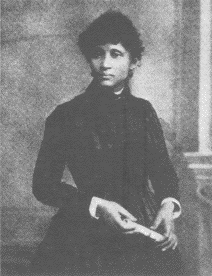
Lucy ParsonsBy the Women's History Information Project For almost 70 years, Lucy Parsons fought for the rights of the poor and disenfranchised in the face of an increasingly oppressive industrial economic system. Lucy's radical activism challenged the racist and sexist sentiment in a time when even radical Americans believed that a woman's place was in the home.

Early Life

Little is known about the early life of Lucy Parsons. She had an African American, Native American, and Mexican ancestry. She was born in Texas around 1853, during the Civil War Era, and it is likely that her parents were slaves. During her lifetime, in order to disguise her racial origins in a prejudiced society, Lucy went under many surnames. She often went by Lucy Gonzales, denying her African American roots, while claiming her Mexican heritage as the cause of her dark skin tone.

Around 1870, while living with a former slave named Oliver Gathings, Lucy met Albert Parsons, who would soon become her husband. Their marriage, however, was probably not legal, since miscegenation laws (laws forbidding marriage or cohabitation between white people and members of other races) prevented interracial marriages at the time.

In 1872, while the South was instituting repressive Jim Crow segregation laws, Lucy and Albert were forced to leave Texas due to their political involvement. Albert had worked diligently on registering Black voters and was shot in the leg and threatened with lynching. He and Lucy also felt threatened because of their interracial marriage.

Lucy and Albert arrived in Chicago in 1873, where Albert quickly found a job as a printer for the Chicago Times. This was a difficult time for working people all over the nation, especially in industrial cities like Chicago, because the country had fallen into a depression, leaving millions of people unemployed. The passing of the Contract Labor Law of 1864 allowed American businesses to contract and bring in immigrant laborers. A large, unskilled pool of workers grew in Chicago, which drove wages down. The laboring population, however, was being radicalized by the introduction of socialist and anarchist ideology to the United States.

Inspirations and Actions

In the summer of 1877, one of the greatest mass strikes in US history took place in response to the depression. Rail workers all over the country joined the picket line to protest wage cuts enacted by the Baltimore Ohio Railroad. In July, the strike moved to Chicago, where rail workers waged a militant battle. They derailed an engine and baggage cars and engaged in sporadic battles with police who attempted to disperse them and break the strike. Albert addressed crowds of up to twenty-five thousand people to promote peaceful ways of negotiating. This helped to bring him into the forefront of the anarchist movement in Chicago.

Because of his involvement in organizing workers, Albert was fired from his job at the Times and blacklisted in the Chicago printing trade. Lucy opened a dress shop to support their family, and, with her friend Lizzie Swank, hosted meetings for the International Ladies' Garment Workers Union (ILGWU). Lucy found herself juggling her career, as well as her political work, which was becoming more and more involved.

Lucy began to write for many radical publications, including The Socialist and The Alarm, an anarchist weekly published by the International Working People's Association (IWPA), which she and Albert had helped found in 1883. She had little sympathy for bosses who were paying their workers substandard wages. Her most famous article, "To Tramps," advocated "propaganda by the deed," a philosophy that held that only violent direct action or the threat of such action will ultimately win the demands of the workers. She was often considered more "dangerous" than her husband because she was so outspoken in her beliefs on the rights of the poor. Lucy was also threatening as a militant and radical woman who refused to assume the role of a homemaker.

May Uprisings

By 1886, it was becoming exceedingly difficult to keep the lid on the kettle. People across the country were boiling up in resistance to their working conditions and the squelching of their union activities by authorities. Across the US, people were calling for an eight hour work day, proclaiming, "whether you work by the piece or work by the day, decreasing the hours increases your pay." May 1st was chosen as the date to kick off the official movement for the eight hour day.

The strategy was this: workers would demand eight hours work with no cut in pay, and if this was received with opposition, they would strike. As a result, 350,000 workers across the nation walked off their jobs to participate in a mass general strike. Forty thousand workers struck in Chicago, creating a whirlwind of radical activity and convincing prominent radical leaders, such as Lucy Parsons, that the country was ready for a mass workers' revolution.

On May 3rd, a strike at McCormick Harvest Works in Chicago became violent as police fired into a crowd of unarmed strikers. Many strikers were wounded, and four were killed. Reacting to the events, radicals called a meeting in Haymarket Square to discuss the situation. The peaceful meeting was disrupted by police, and an unknown figure threw a bomb, killing one officer. One of the worst violations of US civil rights occured over the next few days, as police swept the town looking for any and all anarchists and radicals. Although he was not even at Haymarket Square that day, Albert was one of the eight men accused of the bombing. He went into hiding until the first trial date, at which point he walked into court to turn himself in and sit with his comrades.

During this period, Lucy was under constant surveillance by the police. She was arrested under the slightest suspicions that she knew the whereabouts of her husband. Although authorities looked upon Lucy as a threat to the status quo, she was never charged with conspiracy in the bombing. The rationale of the authorities was that the chances of a woman being convicted of murder and receiving the death penalty were too slim, and if a woman were to stand trial with the men it would decrease the chance of the men receiving such a harsh conviction. Women were not believed to be capable of such radical and militant action.

The Haymarket Affair

The movement for the eight hour workday was one of the most difficult struggles for laboring people in the United States. It is filled with stories of huge protests which were broken up by police and Pinkertons (private security). Many people were maimed and killed before demands to shorten the workday were finally met. One of the most famous events in the history of the eight hour struggle was the Haymarket Affair.

In response to a huge protest at a mill in Chicago in which a few workers were killed by the police, local radical activists organized a meeting at Haymarket Square in downtown Chicago. Over 2,000 people showed up to hear the speakers. Even the Mayor of Chicago appeared, and reported that the event was peaceful. However, after the Mayor left and the meeting's numbers dwindled, a huge army of police marched towards the crowd and gave them an order to disperse. During the confusion, an unknown person threw a bomb into the crowd of police, killing an officer. A riot broke out in which both workers and police were injured and killed.

The days that followed were bleak, as nearly every anarchist and socialist in town was arrested and detained. Many radical anarchist papers were illegally shut down, and homes, meeting halls, and offices where outspoken supporters of the eight hour movement lived and did political work were raided without warrant. Oscar Neebe, Adolph Fisher, August Spies, Louis Lingg, Michael Schwab, Samuel Fielden, Carl Engel, and Lucy Parsons' husband Albert Parsons were scapegoated for the riot and brought to trial, even though many of the men were not even at Haymarket Square at the time of the melee.

With a jury of twelve men who were actively opposed to radicalism, the defendants were found guilty. After the appeals, four of the men were sentenced to hanging, three were given lengthy prison sentences, and one committed suicide while in his cell.

The Haymarket Affair influenced many prominent anarchists, including Emma Goldman and Voltarine De Cleyere. It also serves as a reminder of the difficulties involved in the eight hour struggle as well as the need to remain vigilant and not allow these gains to wither away.

Don't Mourn... Organize!

After Albert turned himself in to the police, the trial proceeded. In October, 1887, after a lengthy trial wrought with injustices, the men were sentenced to death by hanging; however, eventually one man committed suicide while in prison, two were given life sentences, and one received fifteen years imprisonment in an appeal. Lucy, stricken with both anger and pride that her husband would die for his beliefs in anarchism, headed a campaign for clemency. She toured the country distributing information about the unjust trial and gathering funds. Everywhere she went, Lucy was greeted by armed police who barred her entrance into meeting halls.

In her hard attempts to save the lives of the convicted men, Lucy confronted another battle, this one within the labor movement's own ranks. The leadership of the Knights of Labor, the group to which she belonged for over ten years, took a strong stand against the Haymarket activists. Terence Powderly, the leader of the Knights, took a passive approach to the labor struggle of the time. He opposed strikes, often discouraging members of his group from using those means of obtaining their demands. In addition, he was strongly opposed to the growing trends towards radicalism. Powderly stood against the Haymarket defendants with the belief that the government should make an example of them. Although she found herself without support from the Knights, Lucy continued her speaking tour, gaining more and more people's interest in the Haymarket case and making a big name for herself.

Lucy's efforts, however, did not sway the courts of the Governor of Illinois who was under political pressure to execute the men although all evidence against them had been circumstantial. Four men were executed on November 11, 1887. Lucy brought her two children to see their father one last time, but she was arrested, along with her kids, taken to jail, forced to strip, and left naked with her children in a cold cell until the hanging of her husband was over. In tears upon her release, she vowed to continue to fight injustice even though her husband had been killed and she feared the same fate for herself.

After the execution, Lucy lived in poverty, receiving eight dollars a week from the Poineer Aid and Support Association, a group formed to support the families of the Haymarket martyrs and others deprived of support because of working for labor interests.

New Struggles

Soon Lucy's affiliations within the labor struggle changed again as different factions in the movement arose in response to the upcoming elections of 1890. Many opted to organize for reformative measures and to support the Democratic Party, swaying the vote of the workers in this direction. Lucy vehemently opposed the new emphasis, feeling that reform would weaken the movement and that collaboration with oppressive parties would mean doom for the independent labor parties after their success in the 1887 elections. She held an uncompromising syndicalist position that envisioned a voluntary association of workers supporting and enforcing common regulations. Her political perspective was firmly based in class consciousness - she identified a class heirarchy as the pivotal problem in the oppressive systems of her time. Because of this, she scoffed at reform measures within the existing government where the rich still lorded over the working class. The 1888-1889 Economic Forums called by the city of Chicago exemplified the new liberal reformist tendancies. Though they attempted to address labor issues by allowing representatives from labor and business to meet, Lucy continued to question and critique these measures as not enough because they still preserved this society's system of class segregation.

In October of 1888 Lucy went to London to address the Socialist League of England. On her return, the struggle for free speech consumed her as she compared the freedom she found in England with the repression at home in the US. Through force and arrest, the city continually thwarted her efforts to speak and fined her for selling copies of her pamphlet Anarchism on the street. She felt that the free speech struggle was of primary importance and harbored frustration toward others who did not fight with as much dedication. Even after Judge Tuley's 1889 ruling that anarchists also have the right to free speech, she continued to fight for this right throughout her life in constant conflict with the forces wanting to silence her.

By 1890 craft unionism, with which Lucy and Albert had been heavily involved, witnessed major defeats due to the increased technology and the industrial scale of the workplace. With these new parameters to the labor struggle, Lucy saw the importance of an international scope to the movement. In 1891 Lucy with Lizzy Holmes began editing Freedom: A Revolutionary Anarchist-Communist Monthly in which she proclaimed that the major labor struggles of 1892, such as the ones at the Carnegie steel mills in Pennsylvania and the silver mines of Coeur D'Alene, Idaho, meant that revolution was coming. Conditions for workers worsened as the Reading and Philadelphia Railroads closed and millions were left unemployed. In 1894 Pullman workers went on strike after their organizers had been fired. At first, the boycott was a success, under the leadership of Eugene Debs and the American Railway Union, yet it was crushed in the end by President Grover Clevland. For Lucy the success within this struggle was another example of the strength of the workers and the coming of the revolution. During this time, Lucy spoke to the disenfranchised, agitated amongst the downtrodden at the Spruce Valley Coal Co., spoke to Coxey's army as it prepared to march on Washington, and boycotted State Street stores during the Chicago Teamsters' strike.

Rifts Within the Movements

Lucy's relationship to the anarchist movement had always been vague. As part of the IWPA Lucy was identified as an anarchist, a label intended to be derogatory by the Socialist Labor Party (SLP) who held animosity toward the IWPA. Because Albert died for the anarchist movement, Lucy was devoted to defending the anarchist cause. Nevertheless, the 1890's witnessed the formation of a major rift between her and others in the movement, especially Emma Goldman, over the more abstract arguments that anarchist papers carried at the time. Most of these anarchist debates pivoted around the issue of free love. Lucy believed that marriage and the family existed naturally in the human condition and criticized anarchist papers for carrying articles attacking these institutions. Her speeches against these topics, which she felt were far below the importance of directly working against capitalist oppression, alienated her from other anarchist leaders.

The IWW

In response to the growing labor unrest throughout the country, the labor movement in Chicago mobilized, planning a Continental Congress of labor for June 1905. Before that, however, Big Bill Haywood called a convention drawing anarchists, syndicalists and trade unionists. This was the founding convention of the Industrial Workers of the World (IWW) which united these groups with the new revolutionary model it offered. For Lucy Parsons, the second woman to join this new organization, the class conscious perspective of the IWW mirrored her political leanings. She believed that a revolution could only come through a well-organized working class movement that seized the methods of production, and that the IWW's tactics of militant strikes and direct action would enable this movement. Lucy promoted the idea of a general strike and spoke strongly for this at the founding convention.

After a major shift towards industrial unionism, in 1905 Lucy began editing The Liberator, a paper published by the IWW and based in Chicago. Through this medium, she took her stand on other women's issues, supporting a woman's right to divorce, remarry, and have access to birth control. She also wrote a column about famous women and a history of the working class.

From 1907-1908, a period encompassing huge economic crashes, Lucy organized against hunger and unemployment. In San Francisco Lucy and the IWW took over the Unemployment Committee, pressuring the state to begin a public works project. The San Francisco government's refusal to acknowledge the committee gave rise to a march of ten thousand people. At the front were unemployed women. The success of Lucy's Chicago Hunger Demonstrations in January 1915 pushed the American Federation of Labor, the Socialist Party, and Jane Addam's Hull House to participate in a huge demonstration on February 12. Two weeks after this demonstration, the government began planning for a decentralization of hunger and unemployment policy.

Later Communist Work

In 1925 Lucy began working with the newly formed Communist Party. Though she didn't officially join until 1939, she held an affinity with the party, seeing them work toward revolution from a perspective of class consciousness. At this point, after major conflicts with the new directions of the anarchist movement and watching its momentum slow, Lucy felt that the anarchist movement had no future as it no longer actively moved the people toward revolution.

During this period, Lucy mainly worked with the coalition for International Labor Defense, a Communist Party group, aiding with the Scottsboro Eight and Angelo Hearndon cases. Both of these cases were situations where the establishment charged African-American organizers with crimes they did not commit. This was Lucy's first return to the South and her first work on issues involving race. Her work in these areas and on the Tom Mooney case illustrates her lifelong dedication, after the murder of her husband, to expose the fascism of the judicial system. Though controversy exists over the Communist Party's involvement in both of these cases, especially its indictment of the NAACP and its party propaganda during the Scottsboro Boys' Trial, they extended the Communist Party's influence in African-American communities, where Communist Party members helped organize unions.

The Scottsboro Trial

In the Spring of 1931, eight young African American men and boys were hoboing a train to Memphis trying to find work in the Depression-torn South. On this ride, they were accused of raping two white women who were on the train. The young men - from age 13 on up - were put into jail in Scottsboro, Alabama to await trial. They were ultimately found guilty of rape and were sentenced to death.

The trial and conviction of the Scottsboro Eight would have all but been forgotten if not for the clemency campaign initiated by the International Labor Defense (ILD) of the Communist Party, a group to which Lucy Parsons dedicated much of her energy. The ILD's clemency campaign for the Scottsboro Eight was the first time racism was openly challenged in the United States courts.

The ILD was able to launch an effective campaign in support of the young men. One of the women accusers even recanted her testimony, thus dismissing the bulk of the incriminating evidence. Eventually the death penalty was dropped for the defendants; however, it was only a partial victory as they still served lengthy prison sentences for a crime which they did not commit.

The main victory of the case can be seen on a larger level in terms of how it affected racism in this country. The membership of the Ku Klux Klan, at a high in the 1920's, dipped drastically in the 1930's. Also, to some extent, capital punishment against African Americans was used less frequently than it had been in the past.

Scottsboro and the ILD helped pave the road for the civil rights movement nearly three decades later and served as an inspiration for activists for generations to come.

Lucy's Death and a Continuing Struggle for Free Speech

Even with her eyesight failing, Lucy Parsons was active in the fight against oppression until her death. Continuing to inspire crowds, she spoke at the International Harvester in February 1941, one of her last major appearances. An accidental fire killed her on March 7, 1942 at the age of 89. Her lover George Markstall died the next day from wounds he received while trying to save her. To add to this tragedy, Lucy's library of 1,500 books on sex, socialism and anarchy were mysteriously stolen, along with all of her personal papers. Neither the FBI nor the Chicago police told Irving Abrams, who had come to rescue the library, that the FBI had already confiscated all of her books. The struggle for fundamental freedom of speech, in which Lucy had engaged throughout her life, continued through her death as authorities still tried to silence this radical woman by robbing her of the work fof her lifetime.

Though she affiliated herself with many different groups throughout her lifetime, Lucy Parsons' strong politics and beliefs remained distinctly individual and uncompromising. She never sought less than revolution to change the oppressive capitalist system surrounding her. Working with a clear focus from a perspective of class consciousness, Lucy fought with the workers first, seeing issues of sex and race as intertwined with the larger struggle. Because she was a woman of action and strong words, the establishment tried to repress her individual voice, often relegating her to merely the role of a bereaved widow. Yet the legacy of her seventy years of fighting stay with us to inspire our similar struggles today.