Friday, March 5, 2021

An Open Letter to Chris Hedges: Racism, Not 'Cancel Culture' is the Problem. ~~ Jon Jetter

https://www.blackagendareport.com/open-letter-chris-hedges-racism-not-cancel-culture-problem

~~ posted for collectivist ~~

An Open Letter to Chris Hedges: Racism, Not 'Cancel Culture' is the Problem

The author, a former corporate journalist like Hedges, reminds him that white workers betrayed Black workers and class solldarity, not the other way around.

“Is coddling racists your best advice for winning the class war?”

Dear Chris Hedges:

I read with great interest your February 15th essay entitled Cancel Culture: Where Liberalism Goes to Die , in which you make several compelling points, key among them your assertion that a souped-up capitalist culture is both the wellspring of our national discontent and the iceberg which will inevitably capsize the American experiment. Duly noted as well was your reproach of a venal, out-of-touch liberal elite that views the white working class as “deplorables,” and invites authoritarianism with its muzzling of Trump on social media platforms.

Less convincing was your averment that silencing “politically incorrect” speech runs counter to the aims of racial justice and your appeal for empathy for the mostly white mob that converged last month on the nation’s capital with bad intentions. After offering the example of Rev. Will Campbell – who ministered to both the Ku Klux Klan and black civil rights activists – you referenced a Washington Postanalysis  which found that nearly 60 percent of a sample of 125 defendants charged in the January 6th attack “showed signs of prior money troubles, including bankruptcies, notices of eviction or foreclosure, bad debts, or unpaid taxes over the past two decades,” you wrote:

“Campbell would have reminded us that the demonization of the Trump supporters who stormed the capital is a terrible mistake.  He would have reminded us that racial injustice will only be solved with economic justice. He would have called on us to reach out to those who do not think like us, do not speak like us, are ridiculed by polite society, but who suffer the same economic marginalization. He knew that the disparities of wealth, loss of status and hope for the future, coupled with prolonged social dislocation, generated the poisoned solidarity that give rise to groups such as the Klan or the Proud Boys.”

We cannot heal wounds we refuse to acknowledge.”

Indeed, forgetting is the worst violence, which is why your failure to identify the most gaping wound on the national body politic was so stunning. The principal reason that the American people can’t have nice things is that we live in a de facto apartheid state constructed by white workers’ Biblical betrayal of African Americans since the end of the Civil War. For the better part of 166 years, white laborers such as those who attacked the Capitol have conspired with white landowners, industrialists and financiers to slander, fleece, lynch, rape, exploit and murder blacks who they view as competitors rather than comrades, and ATMs rather than allies. Or, as the slain black radical George Jackson wrote:

“The major obstacle to a united left in this country is white racism.”

And so forgive me if I glibly decline the invitation to your white pity party on behalf of the vast majority of 42 million African Americans in language that recalls both Ella Fitzgerald and Justin Timberlake:

Cry Me a River.

“Your failure to identify the most gaping wound on the national body politic was stunning.”

The Capitol Hill mob was heavily indebted, you say? Do tell. Blacks are twice as likely as whites to be saddled with poor credit scores, according to a 2016 study ; in fact, whites earning $25,000 annually are likely to have better credit than blacks earning between $65,000 and $75,000. African Americans who earned their bachelor’s degree from a four-year public university in 2012 owed an average of $3,500 more in school loans than white graduates that year  and the default rates widen, rather than narrow, over time, as blacks who earn less than whites struggle to keep up with their payments. Moreover, regulators have fined lenders such as Toyota, Fifth Third Bank and Ally for overcharging black and Latinos for car loans and African Americans, on average, pay between $300 and $500  more for an auto loan than do white borrowers. One-in-three blacks between the ages of 18 and 64 have past due medical bills compared to one-in four whites  in the same cohort. African Americans are twice as likely to be in arrears on bills  including water or utility bills and more likely to have their service disconnected or even lose their home  as a result of a lien. And payday lenders absolutely feast on black women .

But nothing represents the racial Ponzi scheme that is the U.S. economy better than subprime mortgages  which are often referred to as “racialized lending” in other parts of the world. An analysis by the Economic Policy Institute  of data compiled at the zenith of the real estate boom found that 53 percent of all black borrowers were issued subprime loans, compared to a quarter of white borrowers. Another study  found that between 2004 and 2008, only 6.2 percent of white borrowers with a credit score of 660 or higher received a subprime loan while the rate for black borrowers with similar credit scores was 21.4 percent. In fact, the lending disparities actually widened when households with higher incomes were compared, meaning that an African-American family earning more than $200,000 annually was more likely to be given a subprime loan than a white family making less than $30,000, leaving New York University Sociology Professor Jacob Faber  to conclude that borrowers of color were targeted not because they were credit risks, but because they weren’t.

The difference is that in the nation’s most prosperous majority-black community , the Washington, D.C., suburb of Prince George’s County, Maryland, one in every 624 homes is in foreclosure , while across the Potomac River in Fairfax County, Virginia, where two of every three residents is white, the ratio is one in every 5,189  homes.

While it’s true that the U.S. has experienced debt bubbles since at least 1873, policymakers’ response to the Great Recession represents a seismic shift in the way that government regulators have typically handled such crises. Rather than force creditors to accept a reduction, or “haircut” on their loan  portfolios – thereby freeing up consumers’ cash and restoring the buying power that fuels a demand  economy – the Obama administration bailed out the grifters, purchasing toxic paper from unscrupulous lenders for 100 cents on the dollar , repaying the investors who purchased the liar’s loans and other fraudulent financial instruments, and showering the big banks and corporations with trillions in cheap money in a bid to effectively re-inflate the speculative bubble and send the stock market soaring again. Left holding the bag were the borrowers, disproportionately us “mud people” as blacks were often referred to by the mortgage brokers peddling “ghetto loans.” It wasn’t just Wall Street bankers who were in on the con, however, but white workers as well, who could leverage financial advantages gained over 400 years of settler colonialism to join the oligarchs in fleecing the low man on the capitalist totem pole, flipping homes, borrowing against them, and even acting as the middleman in the fraudulent transactions.

“It wasn’t just Wall Street bankers who were in on the con, however, but white workers as well, who could leverage financial advantages gained over 400 years of settler colonialism.”

The result is that African Americans lost half of their wealth during the Obama years –more than at at any time since the collapse of the Freedman’s bank in 1864 – and today own 1 percent of all assets in the country, according to Mehrsa Baradaran, a law professor at the University of California-Irvine. That figure is virtually unchanged from January 1st, 1863 when Abraham Lincoln signed the Emancipation Proclamation.

A study published last year by Citigroup  found that racial discrimination against African Americans since 2000 has cost the U.S. economy $16 trillion – equivalent to nearly one year of Gross Domestic Product – in lost economic activity. Such yawning disparities can only be contextualized as part of a racial kleptocracy in which all institutions –banking, real estate, the criminal justice system, schools, organized labor and the news and entertainment media – conspire to nickel-and-dime blacks and keep us from obtaining capital that is the cornerstone for self-sufficiency. But as either Hegel or Henry Ford could advise, when blacks lose buying power that deficit will eventually bleed into the broader economy as businesses lose customers and are forced to lay off workers. In a trend that began well before the onset of the pandemic, commercial activity in the U.S. plummeted to a historic low in 2020, and the Federal Reserve is keeping the zombie economy afloat by printing money; one fifth of all U.S. dollars in circulation was printed in 2020 .

The imminent cataclysm is rooted in whites’ historic rejection of appeals for class solidarity made both by black workers, and even Karl Marx himself who took a break from writing the first volume of Das Kapital to pen a letter in 1865 exhorting whites in the U.S. to embrace the freedpeople in their labor struggles. That same year, white laborers in Baltimore successfully lobbied their bosses to fire 100 black caulkers and longshoremen, who responded by raising $40,000 to buy their own shipyard and manage it as a workers’ cooperative.

“Even Karl Marx himself penned a letter in 1865 exhorting whites in the U.S. to embrace the freedpeople in their labor struggles.”

Within six months the Chesapeake Marine Railway and Dry Dock Company employed 300 blacks in Baltimore and other cities along the Atlantic seaboard at an average wage of $3 per day –roughly $250 in today’s dollars – and as the cooperative expanded began to hire white laborers in addition to blacks. According to the Marxist historian Phil Foner, a black caulker named Issac Myers pleaded with white delegates to integrate their unions at an 1869 meeting of the National Labor Union in Philadelphia.

“ I speak today for the colored men of the whole country,.... when I tell you that all they ask for themselves is a fair chance; that you shall be no worse off by giving them that chance; that you and they will dwell in peace and harmony together;... The white men of the country have nothing to fear from the colored laboring man. We desire to see labor elevated and made respectable; we desire to have the highest rate of wages that our labor is worth; ... And you, gentlemen, may rely on the support of the colored laborer of this country in bringing about this result.... American citizenship with the black man is a complete failure, if he is proscribed from the workshops of this country.”

Continuing, Myers invoked the Baltimore stevedores’ cooperative efforts:

“ We gave employment to a large number of the men of your race, without regard to their political creed, and to the very men who once sought to do us injury. So you see gentlemen, we have no prejudice.”

White labor leaders, of course, declined, providing industrialists with a ready supply of strikebreakers, culminating in the Red Summer of 1919 when an angry white precariat roamed the country attacking African Americans. These racial antagonisms continued largely unabated until the onset of the Great Depression (which, coincidentally, began in the black community three years earlier than in the greater U.S.), when, out of desperation, white leaders of the newly organized Congress of Industrial Organizations –perhaps most notably an Australian longshoreman named Harry Bridges –began to integrate organized labor.

Working together black and white employees created the most prosperous working class in the Industrial Age, yet even as the CIO lifted Americans’ living standards, thousands of whites walked off the job to protest the hiring of the best, and not the whitest. Read one flier exhorting white transit workers to strike in Philadelphia in 1944:

"Your buddies are in the Army fighting and dying to protect the life of you and your family and you are too yellow to protect their jobs until they return. Call a strike and refuse to teach the Negroes. "

The celebrated head of the United Auto Workers, Walter Reuther, exemplified this class sedition. Reared in West Virginia, Reuther was the only nonblack speaker invited to speak at the 1963 March on Washington, yet it was later revealed that his union was at that time “negotiating discriminatory union contracts that locked black workers in de facto segregated job classifications in violation of Title VII of the Civil Rights Act,” according to Foner. By 1960, according to data compiled by the U.S. Commission on Civil Rights, black workers accounted for seven-tenths of 1 percent of the skilled labor force in Detroit auto plants, yet 42.3 percent of the entire workforce. In the 1973 documentary, Finally Got the News , about the radical League of Revolutionary Black Workers, one sympathetic white autoworker recalled:

“I took three tests, now one of the math tests I took I didn't do too well on. The fella who was running the tests said ‘well I tell you what: you go home and study up on this a little bit and come back and see me in a week.’ I know Goddamn well he wasn’t going to tell that to any colored boy.”

“By 1960, black workers accounted for seven-tenths of 1 percent of the skilled labor force in Detroit auto plants, yet 42.3 percent of the entire workforce.”

Despite widespread defections by whites, an argument can be made that the workers were winning the class war as the nation approached its bicentennial. By 1973, a third of the workforce was unionized, and blacks, in turn, accounted for a third of all union members, fueling a record 424 work stoppages in 1974, according to the Bureau of Labor Statistics . Such militancy earned workers in 1973 their largest ever share of national income –about 51 percent of GDP– and the fewest Americans living in poverty, roughly 1-in-10. That same year, the nation’s wealthiest 1 percent took home only 4 percent of GDP, their smallest share ever. In an interview, Marlon Brando explained what inspired him to send Native American actress and activist Sacheen Littlefeather to refuse the Oscar he’d won for the Godfather in 1973 as a protest against ugly Hollywood stereotypes.

“The blacks have brought about changes because they were just damn angry about it and they thumped the tub and threatened and made some noise about it but if they had just been silent and thought ‘well gradually wisdom will come to those who are in the business of the movies and they will do right by us’ the day would never have come. We have a lot to be grateful for that the blacks were as insistent as they were . . . ”

Brando’s class consciousness stands in stark contrast to Reagan’s tribal appeals to white Democrats, the bloodthirsty mob that stormed D.C. in January, or the white patients interviewed by the psychiatrist Jonathan Metzl in his book, Dying of Whiteness: How the Politics of Racial Resentment is Killing America’s Heartland.  Metzl explained how whites’ racial animosities shape their support of the very things –guns, and cuts to health care, social services and education – that are literally killing them. Similarly, while many observers have noted that white youths are awash in a deluge of opioids, there has been little public discussion about the role that racism has played in fueling addiction among whites. Studies have shown that while white doctors underprescribe opioids and other painkillers for black patients  who they’ve criminalized as addicts, they tend to overprescribe for white patients who they see as human beings like themselves.

In your broadside, Mr. Hedges, you praise Rev. Campbell’s steadfast refusal to “cancel” racists. I did not know Campbell and so take you at your word that he was a good man but is coddling racists your best advice for winning the class war? I am reminded of the German theologian Dietrich Bonhoeffer, who, inspired by the teachings of Adam Clayton Powell Sr. at Harlem’s Abyssinian Church, didn’t return to his homeland to minister to Hitler but to kill him. Similarly, at a 1969 Students for a Democratic Society conference, a 27-year old graduate of the University of Chicago’s Law School, Bernardine Dohrn proposed:

"The best thing that we can be doing for ourselves, as well as for the Panthers and the revolutionary black liberation  struggle, is to build a fucking white revolutionary movement.”

You also mention the firing of a white, longtime New York Times journalist, Donald McNeil, after staffers complained about his use of the “N-word” while retelling a joke. I cannot imagine a black reporter at the Times uttering an anti-Semitic slur and keeping his job, but that aside, I met McNeil, and his ex-wife, Suzanne Daley, more than 20 years ago when I was assigned to head the Washington’s Post’s bureau in southern Africa. I would not describe McNeil as a racist, but he was, in no sense of the word, an ally. I remember a spokesman in the new black-majority government warning me to steer clear of the couple if I had any hope of developing official sources because they were widely regarded as sympathetic to the old white-minority apartheid regime. On another occasion, McNeil and I were discussing the revelation that a young, black Times reporter had fabricated several stories and interviews. When the subject turned to the now-late black managing editor, Gerald Boyd, who was eventually fired for the scandal, McNeil exploded, complaining that Boyd had never distinguished himself as a journalist in the first place, and shouldn’t have been in such a position of authority. Among black journalists, Boyd’s reputation was that of a black “yes” man, who shucked-and-jived for the benefit of white editors but I had never before heard anyone criticize his journalistic skills; he was, from everything I knew, as qualified as anyone in the Times newsroom, including his boss, Howell Raines, who won a Pulitzer for his reminisces of his black “Mammy” while growing up in Alabama. The last time I saw McNeil was at his going-away party in Johannesburg, where I was one of only two blacks in attendance – out of at least 30 people – who was not a member of their wait staff.

It has always struck me as ironic that white Americans’ self-obsession lessens their self-awareness. Your plea for understanding comes when blacks are treated almost daily to videos of white police officers pepper-spraying 9-year-old black girls, body slamming to the ground black teenage girls, strangling to death handcuffed black men begging for their life or hunting down a black jogger in the street as though he were some wild boar.

Perhaps, white workers would do well to heed the advice of one Fyodor Dostoevsky who wrote in The Brothers Karamazov:

"Above all, don't lie to yourself. The man who lies to himself and listens to his own lie comes to a point that he cannot distinguish the truth within him, or around him, and so loses all respect for himself and for others."

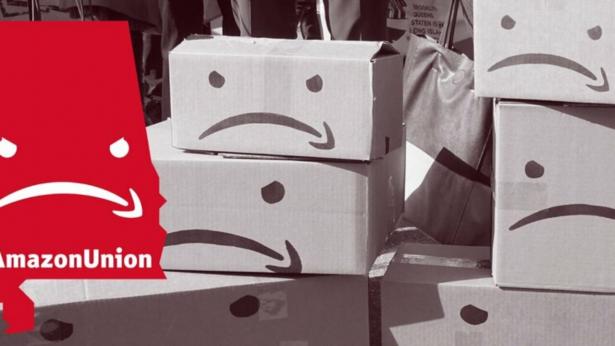
LABOR Amazon Launches Anti-Union Website to Derail Alabama Union Drive ~~ Lauren Kaori Gurley

 https://portside.org/2021-01-19/amazon-launches-anti-union-website-derail-alabama-union-drive


Workers are trying to organize a union at an Amazon warehouse in Bessemer, Alabama.,

Anew website full of anti-union propaganda is targeting workers at an Amazon warehouse in Bessemer, Alabama in an attempt to convince them to vote against forming a union. Amazon has avoided unions throughout its 25-year history, and the union election will be one of the first in the company's history. Workers are expected to vote on February 8.

The slick anti-union website, Doitwithoutdues.com, implores Amazon warehouse workers to "get the facts" about unions, "get your voice back," and even to call a federal labor agency to revoke cards workers sign to indicate support for a union. These talking points are juxtaposed with cheery pastel animated graphics depicting megaphones, a dancing dog, and an Amazon package surrounded by hearts. Photos of friendly, empowered-looking warehouse workers dressed in Amazon-emblazoned outfits appear next to anti-union rhetoric. 

Motherboard has also obtained screenshots of text messages sent to Bessemer warehouse workers and photos of signs displayed in the Bessemer warehouse with anti-union messaging, urging workers to "get the facts," about unions which also, in some cases, use the tagline "Do It Without Dues." 

Under the National Labor Relations Act of 1935, it is illegal for employers to intimidate, retaliate against, or ask workers whether they support a union drive. But union avoidance firms and law firms specialize in crafting rhetoric companies can use to convince workers to vote no in union drives without breaking the law. Amazon did not respond to a question about whether a union avoidance firm helped create the website, banners, or text messages sent to workers.

"There’s so much MORE you can do for your career and your family without paying dues," the homepage reads, referring to fees that unions collect from their membership. "We’ve got you covered with high wages, health care, vision, and dental benefits, as well as a safety committee and an appeals process."

Amazon’s argument about union dues is misleading. As a right-to-work state, Alabama does not require that workers pay union dues if they work in a unionized workplace; workers must authorize unions to deduct dues from their paycheck.

The union drive at the Amazon warehouse in Bessemer, Alabama carries significant weight both for the labor movement and the e-commerce giant, marking one of the few times in the company's history that workers will have the opportunity to vote in a union election, which is scheduled for February 8. If workers vote in a union, their union could set off a wave of union organizing at Amazon facilities around the country. 

For years, human rights and labor organizations have criticized Amazon for its warehouses' grueling working conditions that lead to serious injuries, sophisticated surveillance programs targeting workers, and its lack of transparency. During the coronavirus pandemic, Amazon cut off $2 an hour hazard pay and unlimited unpaid time off for its warehouses workers. 

Amazon has also made clear through anti-union videos, surveillance programs, and the firing of union organizers that it staunchly opposes the formation of unions in its facilities. To represent the company in the Alabama union drive, Amazon has hired Harry Johnson, a former Republican member of the National Labor Review Board, who helped craft and interpret federal anti-union labor law. Johnson works for Morgan Lewis, one of the most prominent pro-management laws firms in the country. 

"Amazon has unlimited resources to fight this union drive," said John Logan, a professor who studies union avoidance industry at San Francisco State University. "They will do anything for unions not to get a foothold. There’s no amount that Amazon wouldn’t be willing to pay Morgan Lewis to defeat this campaign."

On the new website, one link takes viewers to a list of ten anti-union talking points presented as "facts" about unions. "We want to make sure you and everyone in our BHM1 family knows all they can about unions to make the best decisions for themselves," the page reads. "You deserve to know all the information and have your questions answered before you pay almost $500 in due!" It goes on to tell viewers that unions will not provide job security, guarantee better wages or benefits and could force workers to approach union representatives instead of managers about their problems. "You could end up with more, the same… or less than you make today," it reads. 

Another link directs viewers to a form that allows workers to contact Amazon to revoke a union card they've signed. (Union cards signed by workers are used to show the National Labor Review Board that there's ample support at a worksite for a union drive.)

"IF you signed a card, feel misled or concerned someone submitted your name/info without your consent, you have the RIGHT to get your card and your voice back," the website reads. "Tell the union representative you'd like your card back, call the National Labor Relations Board, or click below."

Text messages sent to Bessemer warehouse workers by Amazon rely on similar rhetoric.  "Unions are a Business," a screenshot of a text message sent to a worker obtained by Motherboard reads. "A union is an organisation that charges employees money to speak for them to their employer. A union is a business that takes money from your paycheck to fund itself."

"If someone is telling you it doesn't cost you a dime to sign an authorization card they are misleading you," reads another text message sent to a work. "Signing a card is you saying you want to be represented by a union. You pay dues out out of your paycheck every month to be in the union. Signing a card is you saying you want to pay for union representation."

In December, the National Labor Review Board charged Amazon with illegally firing a warehouse worker who organized to improve working conditions during COVID-19. 

The National Labor Relations Board has not determined when and where the election will take place, but the NLRB says it is expected to set a date soon for early this year

Thursday, March 4, 2021

Ruling Class Joe and the Essence of American Politics ~~ PAUL STREET

https://www.counterpunch.org/2021/03/03/ruling-class-joe-and-the-essence-of-american-politics/

~~ posted for collectivist ~~

Photograph Source: Maryland GovPics – CC BY 2.0

It’s a damn good thing that the demented pandemo-fascist oligarch Donald Trump no longer sits in the White House and that his Republifascist Party no longer holds the majority in the U.S. Senate. But make no mistake: Americans continue to live under an unelected dictatorship of money and empire. Just because that class dictatorship isn’t quite ready for Door #1, open fascist rule, don’t look for Door #2, neo-New Deal reformist social democracy, anytime soon. No, we are still getting slammed in the face with Door #3, a neoliberal corporate-imperial authoritarianism that cancels #2 while setting us up for a harsher version of #1 in the not-so-distant future.

Status Quo Joe

Biden is showing us that he is what many of us who paid attention knew and warned he was: the Weimarian Third Way/Door. Biden has the full legal authority to cancel all federal student debt. He pledged to use that power if he became president. Now he is refusing to honor the promise. As leading student debt abolitionist Astra Taylor notes:

“At his recent town hall, Joe Biden made a series of convoluted and condescending comments about American student debt…Biden’s rambling justification of the status quo was peppered with straw men, invocations of false scarcity and non-solutions. He pitted working-class Americans against each other, implying that people who attend private schools aren’t worthy of relief, as though poor students don’t also attend such schools. He said that money would be better spent on early childhood education instead of debt cancellation, as if educators aren’t themselves drowning in student debt, and as if we can’t address both concerns at once. He suggested relying on parents or selling a home at a profit to settle your debt, a luxury those without intergenerational wealth or property cannot afford. And he touted various programs, including Public Service Loan Forgiveness (PSLF), that have totally failed borrowers: over 95% of PSLF applicants have been denied…As he rambled on, Biden gave the distinct impression that he preferred not to have the power to do so. That way he could blame Congress should his campaign promises go unkept.”

Then there’s the pathetically low federal minimum wage. Labor and civil rights activists have long called for the national wage floor to be raised to $15 an hour, which translates (assuming 40 hours a week for 50 weeks) to $30,000 a year, equivalent to less than a quarter of the Economic Policy Institute’s (EPI) no-frills Basic Family Budget for a family of two parents and two children in the New York City borough (and New York State county) of Queens.

Candidate Biden promised to honor this demand. He’s doing no such thing as president. Biden and his fellow multi-millionaire Democrats in his old dollar-drenched stomping ground, the now majority Democrat U.S. Senate, cannot bring themselves to include the $15 minimum wage (phased in by 2025) in their coming COVID-relief stimulus bill. “Oh,” they say, “we tried, but the rules won’t let us” – a reference to the Senate parliamentarian’s ruling last week that the proposed minimum wage hike is not immune from Republican filibuster because “it doesn’t meet the budgetary requirements of reconciliation.”

This is an excuse. If these corporate Democrats were serious, they’d fire the parliamentarian, as Rep. Ilhan Omar recommends. In 2001, when Senate Republicans didn’t get the reconciliation rulings they liked, they replaced him.

But nobody in Congress to the right of the Squad (who reside in the House, not the Senate) and the progressive Democratic Senator Bernie Sanders backs this obvious solution.

Biden could also direct the Senate Democrats to overrule the parliamentarian, as Reps Japyal (D-WA) and Khana (D-CA) advocate. This too has been rejected by the White House, which says that it “respects the parliamentarian’s decision and the Senate’s process.”

Translation: Biden will not use his power to force an overdue significant if woefully inadequate rise in the federal minimum wage in a savagely unequal, poverty-ridden -nation where millions of people, including full-time workers, rely on food pantries while the top tenth of the upper One percent possessed nearly as much wealth as the bottom 90 percent even before the upwardly distributive corona recession.

Meanwhile, in other news, mass deportations continue under Biden, contrary to his campaign promises.

Why Study History Reason 102

Progressives can whine all they want about these betrayals, but they have no business being surprised.

It’s important that Biden isn’t a maniacal fascist pig and that he is being considerably more competent and decent than Trump on COVID-19. It’s nice if elementarily civilized that Biden extended the CDC on evictions and foreclosures to March 31st. It’s good if elementarily decent that Biden will let migrant families separated under Trump re-unite in the U.S., Who is against that? (Well, who besides your friendly online 50- to 70-something white male Trumpenleft dunce-cap donner who thinks that being glad to see changes like this is a sign that one is a Dem-loving liberal practitioner of bourgeois identity politics who thinks that electing Democrats is the answer to all our problems).

Still, anyone who has expected much more in a seriously progressive way from corporate Joe hasn’t been paying much attention to his long wealth- and power-serving career. It pays to know a president’s pre-presidential history before getting all hopey-dopey about his supposed eagerness to do progressive things. You might learn that you must join others in organizing for something more militant and revolutionary than trying to “push” a deeply conservative ruling class functionary “to the left.” That was the essential lesson of my 2008 book Barack Obama and the Future of American Politics, which examined Obama’s biography and career to successfully predict the corporate and imperial trajectory of Obama’s arch-neoliberal presidency and that presidency’s Weimar role in hatching a neofascist successor.

“No Empathy” Joe: “No One’s Standing of Living Will Change”

Do progressives not recall the anti-Bernie Biden telling a Los Angeles Times interviewer in 2018 that he had “no empathy, give me a break” for the plight of Millennials in the savagely unequal and eco-cidal world he’d helped create over decades of Congressional service to corporate and financial America?

Are progressives unaware of his long corporatist and slavishly pro-Wall Street record in Congress? This record includes:

+ votes to rollback bankruptcy protections for college graduates (1978) and vocational school graduates (1984) with federal student loans.

+ Working  with Republicans to pass the Bankruptcy Abuse Prevention and Consumer Protection Act, which put “clean slate” Chapter-7 bankruptcy out of reach for millions of ordinary Americans (2005)

+ Voting against a bill that would have compelled credit card companies to warn customers of the costs of only making minimum payments.

+ Honoring campaign cash from Coca Cola by cosponsoring a bill that permitted soft-drink producers to skirt antitrust laws (1979).

+ Joining just one other Congressional Democrat to vote against a Judiciary Committee measure to increase consumers’ rights to sue corporations for price-fixing (1979).

+ Strongly backing the 1999 Gramm-Leach-Bliley Act, which permitted the re-merging of investment and commercial banking by repealing the Depression-era Glass-Steagall Act. (This helped create the 2007-8 financial crisis and subsequent recession, which led to a massive taxpayer bailout of the rich combined with little for the rest of the population – a policy that Biden backed as vice presidential candidate and as Vice President).

+ Supporting the globalist investor rights North American Free Trade Agreement (NAFTA), which cost millions of US manufacturing workers their jobs.

Adding neoliberal insult to neoliberal injury, the Obama-, Citigroup-, New York Times-, Washington Post-, MSNBC-, CNN- and James Clyburn-appointed presidential candidate Biden criticized those who advocated a universal basic income (a fundamental need, in the wake of the Covid-19 crash and the broader and ongoing specters of runaway automation) of “selling American workers short” and undermining the “dignity” of work.

(*Here it is worth bearing in mind that fast food and other low-wage employers would likely respond to a significant increase in the minimum wage with increased labor-displacing automaton. We are dealing with capitalism, the profit-addicted commodification of everything and everyone, a system that is actively ending life on Earth, for what that’s worth.)

He opposed calls for supposedly “too expensive” universal Single Payer health insurance, going so far as to suggest he would veto a Medicare for All bill as president.

The anti-Bernie Biden defended Big Business and the rich from popular criticism, mocking those who “want to single out big corporations for all the blame” and proclaiming “I don’t think five hundred billionaires are the reason we’re in trouble. The folks at the top aren’t bad guys.” He did not speak one critical word about Trump and Congress’s taxpayer-funded bailout for the American capitalist “elite” and its top corporations and financial institutions in the wake of Covid-19 – a massive and largely unaccountable giveaway that puts no caps on executive compensation and elite profits while offering little more than a pittance to the nation’s working-class majority.

“No one’s standard of living will change, nothing would fundamentally change” when he became president. That’s what Biden told elite donors in Manhattan in 2019. It was a revolting thing to be caught saying in a nation where the top thousandth had as much wealth as the bottom 90 percent even before the upwardly distributive Covid-19 recession.

The financial elite, conscious of his Wall Street-friendly record, believed him. His massive campaign finance take from the financial and securities and investment industries in the 2020 election cycle was $196,794,532, nearly four times what the Republifascist incumbent received from those industries.

And Empire Too

We should be no more surprised about Biden betraying progressive- and populist-sounding domestic policy promises and filling key posts with Wall Street operatives and allies than we should about his decision to spend millions of taxpayer dollars menacing Russia with B-1 bombers and launching a criminal, mass-murderous (at least 22 killed) air assault on Syria in “self-defense” and “retaliation” for alleged Iranian attacks on American military forces and a civilian contractor in Iraq (as if the U.S. has any right to maintain military forces in Iraq in the first place). Senator Biden didn’t just “go along” with George W. Bush’s invasion of Iraq in 2003; he helped lead the charge on the Democratic side.

Biden’s a cold-blooded Empire man. That’s why he’s making make nice with Saudi Arabia, refusing to impose any serious sanctions on that deeply reactionary absolutist state even after his Director of National Intelligence released a report finding officially what every already knew: Saudi Crown Prince Mohammad bin-Salman (MBS) ordered the 2018 murder-vivisection of a Washington Post journalist who was critical of the Riyadh regime. MBS himself will suffer no U.S. punishment of any kind. (“Biden Vowed to Hold MBC Accountable,” screams a CNN headline, “Now He’s Accused of Letting Him Get Away with Murder.” The network should have dropped “Accused of” but didn’t because Biden isn’t Trump.)

It’s called imperial realpolitik.

Comrades, Start Your Engines

Maybe Bernie and the Squad will call for millions of workers and students to take to the streets and public squares and undertake large-scale strikes and other direct mass actions to fight back against capitalist economic terrorism and related military imperialism in the U.S.

Probably not. Don’t hold your breath.

Maybe we should form a Left, the kind of popular movement that doesn’t wait for signals from members of the political class to undertake mass resistance to capitalism-imperialism.

In the meantime, the Biden Dems may well re-demobilize the Democrats’ majority progressive base (ala Rubin-Obama-Hillary 2009-2016) in ways likely to yield Republifascist wins in 2022 and 2024, opening the way for the white- nationalist revenge triple-impeachment of Biden in 2023 and a new and improved version of something closer to Door #1 in 2025. That’s something to look forward to in a nation where nearly two-thirds (63%) of young adults are unaware that Hitler’s Third Reich killed 6 million Jews, where nearly a quarter (23%) of young adults think the Nazi Holocaust is or may be a myth or exaggerated, here more than one in ten young adults think Jews caused the Nazi Holocaust, and where just 8 percent of high school seniors know that slavery was a central cause of the Civil War.

Rosa had it right: it’s socialism – Door #4 – or barbarism/fascism, though we must add the critical ecological and eco- communist postscript for the age of what the radical Green political scientist Craig Collins rightly calls “catabolic capitalism”: mere barbarism, fascism, and tribalism if we’re lucky.

The barbarism is winning, but Biden’s win may give up some breathing space to try to turn the tide the other way.

It’s no small task. There’s one helluva lot of organization and educational work required – we might start with a mass historical literacy campaign – if we’re going to be “lucky” enough to avert fascism and ecocide in coming years.

Gentlepersons of the Left, start your engines: we need to blow the doors off of fascism, reformism, and neoliberalism before it’s too late.

Wednesday, March 3, 2021

Is the United States Heading for a Rural Insurgency?

https://www.justsecurity.org/72681/is-the-united-states-heading-for-a-rural-insurgency/

~~ posted for dmorista ~~

The intrusions of white supremacist militias into cities to intimidate and attack protestors from the Black Lives Matter (BLM) movement highlights the possibility of rural insurgency. Rural insurgencies range from week-long armed rebellions against local governments, law enforcement, and the wealthy to decades-long ones against subnational and national-level security forces, which seek to impose new revolutionary regimes. Many African, Asian, and Latin American countries have faced such insurgencies, which have slowed economic growth, caused mass internal migration to more secure urban areas, as well as undermined democratic politics locally and nationally. While the U.S. is not currently at the point of a full-blown insurgency, such insurgencies exist across a spectrum rather than being characterized by the crossing of a line, and consequently, it behooves us to worry now rather than when we get to “there.”

Although culture, economic or political grievances underlie such rebellions, a successful rebellion must overcome collective action barriers because the rewards of victory cannot be restricted to rebels who risk their lives and liberty, thus, encouraging people to free-ride. Resources that lower the collective action barriers of rebellion include availability of weapons, rebel organizations that provide leadership and training, as well as funding from wealthy allies. Opportunities that reduce these barriers include inaccessible terrain, weak and complicit law enforcement, as well as uncertainty or weakness in the repressive capacity of state security forces. Currently, these factors are present in the United States.

Ideologies of Rebellion

In her book on white supremacist groups, Bring the War Home, Professor Kathleen Belew shows that the grievances of rural white militia groups center on threats to white racial supremacy that date back to the U.S. defeat in the Vietnam War. These have recently combined with fears of becoming a minority group due to changing demographics. The targets of such fears have shifted from primarily African Americans to include non-White immigrants. In conjunction with racial fears, other causes include anti-Semitism as well as perceived threats to Christianity from Muslims, who have replaced Catholics as antagonists. Some scholars have observed, however, that the militias do not constitute a cohesive movement, but have many groups with varied beliefs, broadly classifiable as anti-federal government control of lands, guns, speech, and other liberties.

With regards to political alignments, many such groups were formed after Barack Obama’s victory in the 2008 presidential election. Although racial animus played a factor, their official positions were similar to that of the conservative Tea Party movement’s demand for low taxes and reduction in government. These militias became associated with President Donald Trump partly due to his rhetoric during the 2016 campaign, which emphasized anti-immigrant nativism, proposed banning Muslims from coming to the United States, and supported fundamentalist Christian beliefs. After he assumed office, in addition to his equivocation about deadly white supremacist attacks against protestors, his administration’s policies also appeared to favor militia groups by reducing monitoring by federal law enforcement. Trump may accept pre- and post-electoral violence by such militias during the 2020 elections, as indicated by his statements about the white supremacist Proud Boys during the first presidential debate.

Rebel Resources: Available Weapons, Access to Funding, Existing Organizations, and Military Training 

Unlike insurgencies in countries evaluated in RAND’s seminal How Insurgencies End study, the wealth and freely available weapons in the United States may obviate the need for foreign assistance—in terms of funds, personnel, and material—as the critical determinant of the fate of such insurgencies.

In most countries, insurgent groups must smuggle quantities of small arms, offered by willing foreign sponsors or bought in black markets, across international borders. In the United States, however, per capita gun ownership is the highest in the world, while gun laws are some of the least restrictive. Thus, militias can legally acquire vast quantities of small arms. Although eight out of the top 10 states with the highest percentage of gun ownership relative to their population voted for Trump in 2016, the problem is not just a state-level one. Guns from states with lax gun-ownership laws can also be easily transported to states with stricter laws. For example, of the guns used for criminal activities in Chicago and its suburbs under the purview of the eighth strictest gun laws of Illinois, 21 percent are brought in from Indiana (with the 28th strictest gun laws), 5.1 percent from Mississippi (with the 50th strictest gun laws) and 4 percent from Wisconsin (with the 21st strictest gun laws).

Although foreign funding may not be accessible to American militias, they can acquire funds to buy weapons, ammunition, and logistics, from food and blankets to vehicles, via a network of associated organizations. Akin to the use of mosques by Islamic terror groups in the Middle East and Sub-Saharan Africa, militias can use sympathetic churches to seek donations. Also racist but peaceful allied organizations like the Council of Conservative Citizens can act as fronts to sell products and accept donations via websites like Amazon, DonorBox, and Stripe. For example, a Christian crowdfunding website called GiveSendGo has collected more than $ 500,000 for the defense fund of Kyle Rittenhouse who shot three protestors in August, 2020 during the BLM protests in Kenosha, Wisconsin.

By comparing insurgent groups in South and Southeast Asia, Professor Paul Staniland’s book The Networks of Rebellion reveals that militia organizations also need leaders who are both internally united and embedded within pre-conflict social networks in order to successfully challenge the national government in multi-year confrontations. Despite ideological similarities, militia groups in the United States lack cohesive regional and national-level organizations. Rather, disparate groups communicate and coordinate via social media sites like Facebook. Thus, while such fragmentation may prevent a civil war that seeks to topple the federal government, loosely tied groups of small organizations may be sufficiently powerful to prevent state and federal authorities from controlling rural areas. A phenomenon that has occurred in parts of India, Myanmar, and the Democratic Republic of Congo.

Although training is critical for insurgent success, levels of training among militia groups can vary contingent on the presence of veterans and active-duty members of the military and National Guard. Reports suggest that a number of veterans and currently serving members of the armed forces have joined these groups, although the former are more numerous. With the military’s increasing proficiency in counter-insurgency tactics, training, and experience, veterans and active-duty troops could introduce exactly the type of small-unit, small-arms focused training that militias would need to fight against the government.

Rebel Opportunities: Inaccessible Terrain, Weak and Complicit Law Enforcement and Security Forces

Militias will also benefit from geography, the nature of local law enforcement, and the makeup of the U.S. military. The large size and difficult terrain in parts of rural America, exemplified by states like Montana and Arizona, would both slow counter-insurgency efforts by security forces and deliver the advantage to insurgents because of their local knowledge and civilian sympathizers who can provide food and shelter.

The other major advantage for militias is the nature of local law enforcement agencies and national-level military and security forces. Local police forces in many states have a history of being either sympathetic to white supremacists and/or being infiltrated by these groups. More importantly, geographical recruitment patterns in the U.S. military show that the representation ratio is the highest in states like Georgia, Florida, North Carolina, and Texas that are conservative in cultural and political orientation, have significant presence of militias, and are reliable supporters of the Trump administration. Thus, deploying troops to quell rebellions would have to account for the unwillingness of some troops to fire upon ideological sympathizers or possibly their kith and kin.

Conclusion: The Threat and Promise of Inevitable Urbanization

Mao Zedong allegedly remarked that rebels should inhabit their environment as fish in the sea, which was the case in mid-20th Century China with its rural hinterland where the vast majority of the population resided. In the past 50 years, rural insurgencies from Vietnam and India, to Colombia and Guatemala, have followed this dictum of garnering local sympathy for both recruitment and logistical support with varied success.

Twenty-first Century United States, however, has a mostly urban population. In a social media interaction with me, Professor Doug Thompson of the University of South Carolina mentioned that less than 2 percent of the American population lives in 100 percent rural countries, while most states have “roughly the same spatial distribution of partisanship,” which neither overlaps with traditional regions like the North, South, Midwest, etc. nor with urban/rural divides. Rather, what he terms the “new sectional conflict,” in a reference to antebellum regional divisions, could be centered in the exurban and suburban areas. In which case, the nearness to urban centers may mitigate conflict by facilitating pacification efforts, which may even deter insurgencies from breaking out, or worsen insurgencies because of the accessibility to high-value urban targets and populations.

Despite how the political geography of the United States ultimately shapes the nature of such insurgencies, however, the above-mentioned grievances, resources, and opportunities indicate that the preconditions for insurgencies are already present. Consequently, militia groups deserve more scrutiny from security forces and a unified political consensus to deter and suppress them in order to maintain peace and stability.