~~ recommended by newestbeginning ~~
By E. A. Halevi
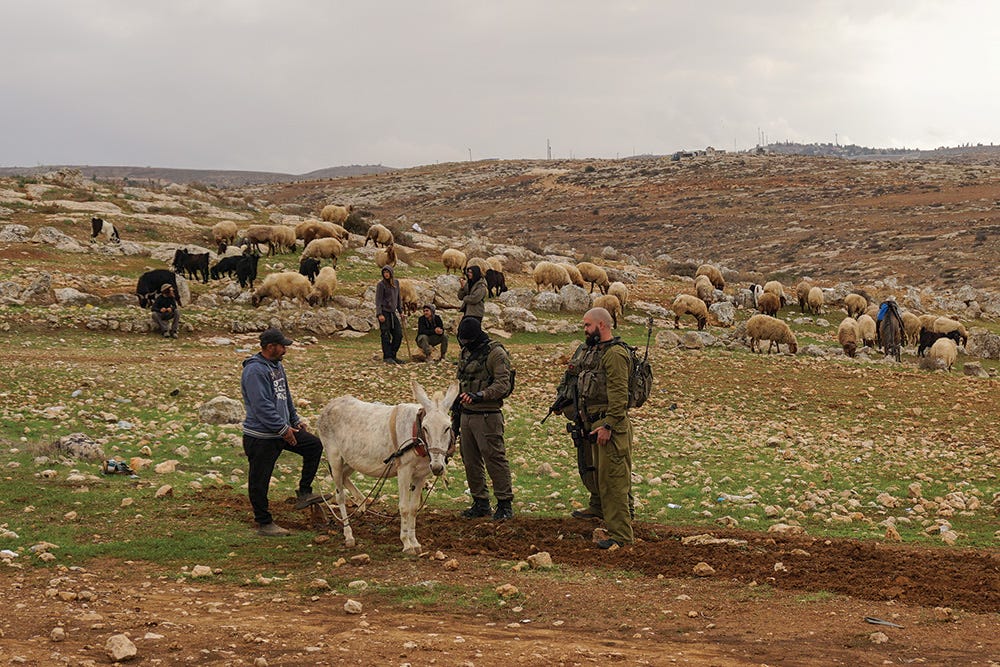
In November 2025, I joined international and Israeli activists in the Palestinian community of Masafer Yatta, a rural area in the South Hebron Hills. There and in other communities across the West Bank, Palestinians have responded to attacks from settlers and the Israel Defense Forces (IDF) by inviting volunteers to stay in their homes, help plow their fields, and accompany them in their daily lives.
As Israeli violence in the West Bank has escalated alongside the Gaza genocide, there has been an influx of volunteers like me joining in a practice commonly known as “protective presence,” or more recently, “solidarity presence.” My time in Masafer Yatta was spent with a loose collective of Jewish activists in Palestine whose work can be found online under the moniker Kivsa Shchora, Hebrew for “black sheep.” I paid close attention as they spoke with particular venom about the most violent settlers harassing the Palestinian communities there.
Jacobin’s Substack offers selected articles, original work, interviews, and live events. Subscribe to support our work here and beyond.
On our drive from the activist flat in At-Tuwani to the village of Az Zuweidin, where we had been called due to settler activity, an Israeli veteran of the solidarity movement told us about one notorious settler-terrorist we should be especially wary of: Shimon Atiya. In 2022, Atiya founded the illegal outpost Havat Shorashim between Az Zuweidin and the village of Umm al-Khair. In the past two years alone, he has shot a Palestinian resident in the leg, led an attack on Umm al-Khair that hospitalized six women and children, and run over a village dog with his vehicle. We stayed in Az Zuweidin for half the day watching and filming Atiya and his gang of youth shepherds construct a makeshift sheep pen from supplies stolen from a shed at the edge of the village. There was little we could do; when Magav (Israel Border Police) arrived, it was only to photograph our passports and manhandle us for filming.
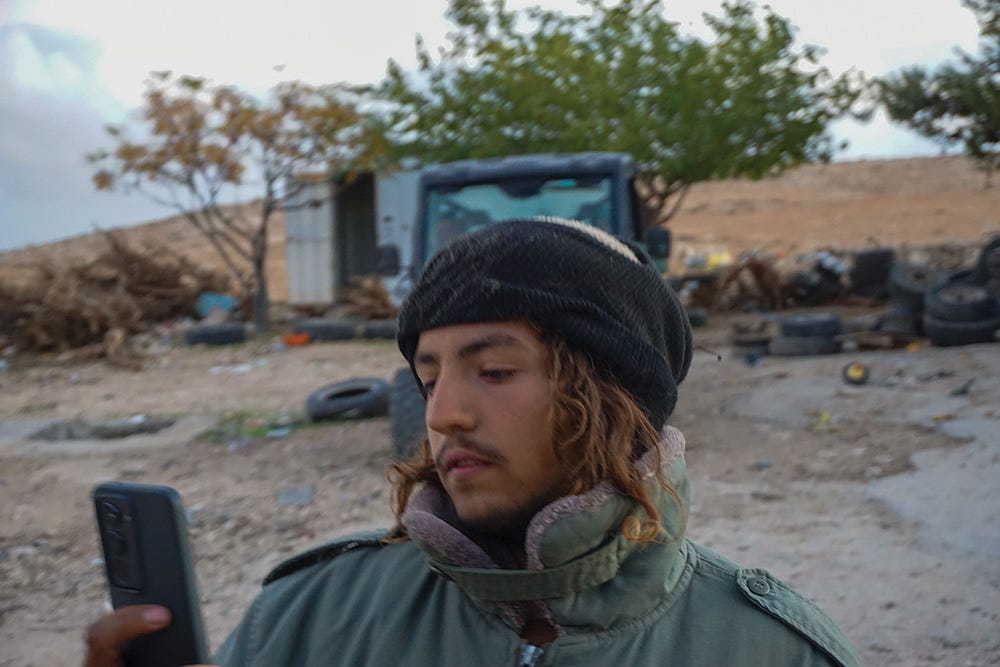
The following day, Atiya was nowhere to be found in Az Zuweidin. One of his shepherds now led the gang in his place: Dror, around fifteen years old, well built but not particularly tall. It wasn’t Dror’s physicality that elicited fear whenever activists spoke about him but his eagerness for violence and the palpable joy he took in terrorizing others. He had, I was told, brutally assaulted multiple people in the past, foreign volunteers and Palestinians alike. Joining him and his fellow shepherds was a group of older, cleaner-cut young men, presumably students of Reuta Beit Midrash, a religious school in the settlement of Carmel where Dror and his fellow shepherds also live.
Violent Settler Youth
Dror, who grew up in a settlement bloc south of Jerusalem, is part of a group known as “dropout youth.” In 2023, the Israeli Civil Administration, which governs Area C of the West Bank, stated that “approximately 220 youths live cut off from formal education and family in basic field conditions, sometimes without running water and electricity.” According to activists I spoke with, many of these teens experienced abuse or behavioral challenges early in life, factors that ultimately led them to fall out of the education system in their hometowns.
These “hilltop youth,” like Dror, find support and meaning working as a dedicated vanguard of settlement expansion displacing Palestinians. Many of them live in these settlements or nearby outposts. The settlements are illegal under international law, including the Fourth Geneva Convention, and the outposts are often additionally illegal under Israeli law. Such informal residences, which are often not the homes at which they are registered, make their identities and violent activities harder to track.
For years, both Shin Bet, the Israeli secret police, and the Israel Ministry of Defense have acknowledged that dropout youth have become a problem. But under a government that brazenly proclaims its genocidal aims for a Greater Israel, their efforts to address the issue are dubious, to say the least. On June 4, 2025, Defense Minister Israel Katz appointed Colonel (res.) Avichai Tanami as the first ever civilian “project manager” charged with addressing “nationalist violence” among hilltop youth.
A former IDF intelligence commander and current West Bank settler, Tanami’s approach to the issue was, in his own words, to prevent “draconian administrative arrest warrants [against settler youth]” with a promise to lead his “national mission” with “sacred reverence.”
The implication was clear: he would use his power to support violent settler youth rather than stop them.
Encouraging Hilltop Youth Outposts
Uri Blau’s September 2023 story for Shomrim, an Israeli investigative publication, revealed that the Israeli Civil Administration under Finance Minister Bezalel Smotrich awarded 800,000 NIS ($258,000) of state funds intended for Palestinians in Area C to an organization by the name of Shivat Tzion L’rigvy Adamatah (The Return of Zion to the Foundation of Her Land). Rather than aiding Palestinians, the funds were granted with the express purpose of rehabilitating hilltop youth.
Despite the organization having no public-facing website, Shivat Tzion’s CEO, Yonatan Achia, was able to grow its budget to more than seventeen million NIS ($5.5 million) in 2024, including over four million NIS in Israeli state funds for activities like “volunteering in agriculture” and “Jewish studies in an informal setting.” Although Shivat Tzion refused to clearly answer questions from Shomrim, an anonymous source familiar with the organization was willing to explain that it operates among youths who are already on farms in the West Bank, “instructing them in agriculture and attempting to direct them back to their studies and enlistment in the IDF.”
In addition to Israeli state funds, Shivat Tzion and another organization working with settler youth in the West Bank received a combined 2.5 million NIS from the Jewish National Fund (JNF) under its “Youth With a Chance” program, which provides financial support and programming for at-risk youth on a large number of farms across the West Bank.
Achia’s prolific activities, however, extend beyond Shivat Tzion. His email signature and Facebook page name him as the CEO of Artzenu, meaning “Our Land.” According to Artzenu’s website, the organization is “dedicated to bringing the pioneering spirit back to the forefront of Israeli society” and organizes over 1,280 “agricultural volunteers” and 400 “farm guards” per month across the West Bank, Galilee, and the Negev. Stranger yet, the group has achieved this success without a formal registry in Israel’s NGO system. Its domestic funding is instead channeled through Shivat Tzion.
Artzenu’s website claims dropout youth “have found a safe haven at these farms” and that the organization’s goal in working with them is to help “these teens to believe in themselves and their capabilities, and to re-integrate into Israeli society” through “guidance, trips and enrichment, preparation for the IDF, professional training, and teaching various life skills.” Its social media posts make it clear exactly what this means: encouraging youth to live and volunteer on farms in the West Bank, many of which are illegal outposts with a well-documented history of violence and harassment of neighboring Palestinians.
A recent post from January 5, 2026, praises the youth of Tirat Zvi, a religious Zionist kibbutz in the Galilee, for coming “to strengthen the nighttime guard shifts at Hagai Sharara’s farm.” Sharara’s farm is in the illegal outpost of Yad Hashomer-Tevetz in the northern Jordan Valley, and settlers associated with it have been responsible for the ethnic cleansing of ten families over the past two years from the neighboring village of Khirbet al-Malih, through assault, harassment, and sheep theft. Only twenty-four days after Artzenu’s post, Sharara himself led an operation to expel Palestinian shepherds from their grazing land.
When organizations like Artzenu and the JNF speak about “rehabilitation” and “reintegration,” they mean reintegration into the project of Zionist settlement and expulsion of Palestinians. Their “job training” refers to driving lessons, welding classes, and instruction in the skills for a shepherd to establish a new outpost. Those youths whom Artzenu convinces to serve in the Israeli military will likely return to their outposts as settler-soldiers, settlers operating with the authority of the IDF granted by a uniform and a rifle — a phenomenon I experienced firsthand when one notorious settler-soldier descended from his outpost above the village of Tuwani and, on a whim, detained me at gunpoint.
When organizations like Artzenu and the JNF speak about “rehabilitation” and “reintegration,” they mean reintegration into the project of Zionist settlement and expulsion of Palestinians.
As left-wing activist and chemist Yoram Sorek explained, “Hilltop youth are not a problem; they are a solution: a solution devised by the settler leaders to the problem of the presence of Palestinians in Area C.” As he puts it, “To that end, it is necessary to recruit those who can be trained for the task, especially those whom the system does not care if they are injured or killed in the process.”
Funding Illegal Settlements
While there are no public records of Artzenu’s revenue beyond its receipts from Shivat Tzion, its English-language website reveals that it also receives tax-deductible donations from the Boston-based 501(c)(3) the Ne’eman Foundation. In 2024, Canada revoked the tax-exempt status of the Ne’eman Foundation and the JNF for violating Canada’s Crimes Against Humanity and War Crimes Act through their funding of illegal settlement activities and the Israeli military itself.
Under Ne’eman’s CEO, Chaim Katz, who is now a resident of the notoriously violent settlement Shilo, the foundation brought in $6.2 million in 2024 to transfer to Israeli NGOs. Beyond Artzenu, those NGOs include a fund for Netzah Yehuda, a nationalist Haredi IDF unit, as well as the Beit Yatir Pre-Army Torah Academy in the settlement of Beit Yatir.
The Ne’eman Foundation is hardly the only such tax-exempt slush fund. The donation platform Jgive has US and Canadian tax-exempt status and is registered with the International Revenue Service at an address in West Jerusalem as “Friends of Asor Fund USA Inc.” Through Jgive, the Jordan Valley Regional Council, the regional government for Israeli settlers in the Jordan Valley, has raised millions of dollars to fund settlement activities, including $105,000 for security equipment for the settlement of Ovnat and $2.6 million to reconstruct a farm in the settlement of Mehola.
Colorado-based Christian Friends of Israeli Communities (CFOIC) transferred millions of US dollars to illegal Israeli settlements and outposts across the West Bank in 2022 and 2023, such as funds for security devices in Avigayil, whose residents took part in a recent pogrom against neighboring Palestinian villages in Masafer Yatta. PEF Israel Endowment Funds, Inc., which was placed under investigation by US House Republicans in 2025 for allegedly donating $18 million (some of which may have come from USAID) to a centrist anti–Benjamin Netanyahu NGO, gave out a whopping $263 million in grants, including to Reuta Beit Midrash for, once again, the purpose of supporting “at-risk youth.”
While the Leahy Law prohibits the US government from funding foreign security forces implicated in gross violations of human rights, there has been continuous reticence from both the Joe Biden and the Donald Trump administrations to apply pressure to the Israeli armed forces or settler infrastructure. Until that changes, organizations like Ne’eman and the JNF will continue to use American dollars to fund a system that conscripts sadistic and unstable teenagers like Dror into a vanguard of violence and dispossession against Palestinians.

No comments:
Post a Comment