1). “Here’s what America’s last WWII atomic veterans want you to know”, Aug 9, 2026, Victoria Kelly & Karin Tanabe, Bulletin of the Atomic Scientists, at < https://thebulletin.org/2026/
2). “Hiroshima and Nagasaki bombings: The two nuclear bombs dropped on Japan in 1945 killed and maimed hundreds of thousands of people, and their effects are still being felt today.”, n.d., Anon, The International Campaign to Abolish Nuclear Weapons (ICAN), at < https://www.icanw.org/
3). “The little-known history of secrecy and censorship in wake of atomic bombings”, Aug 7, 2015,Janet Farrell Brodie, The Conversation, at < https://theconversation.com/
4). “Beyond ‘Pax Americana’: How JFK’s lessons on unilateral nuclear restraint show that Trump should do more”, June 10, 2026, Matthew Bunn, Bulletin of the Atomic Scientists, at < https://thebulletin.org/2026/
~~ recommended by desmond ~~
Introduction by desmond: Today is, of course, the 81st anniversary of the dropping of the atomic bomb on Nagasaki, following the atomic bombing of Hiroshima three days earlier. There are numerous theories as to why the U.S. took this horrible action, much is made of the battle for Okinawa a few weeks earlier, in which the Japanese military resisted stoutly; and many civilians jumped off cliffs to their deaths after they knew being taken prisoner by the Americans was imminent. Led by Gar Alperowitz, left-leaning scholars have theorized that the bombings were aimed at the Soviet Union as a warning that the U.S. possessed these weapons and was ruthless enough to use them. He boldly proposed this in his Ph.D. dissertation, and expanded on it in books and articles produced after he was a professor.
In Item 1). “Here’s what America’s last ….”, the authors Victoria Kelly & Karin Tanabe (who produced the 2025 PBS documentary Atomic Echoes) talk with the few remaining U.S. veterans who were sent to Hiroshima and Nagasaki after the war. Item 2)., “Hiroshima and Nagasaki bombings: ….” discusses the effects of the bombings as part of their overall presentation of the ongoing horrors of the nuclear attacks on the two cities. Item 3)., “The little-known history ….”, discusses the attempts at secrecy about the horrific effects of radiation on the people of the two cities, and even on American soldiers sent there after the war.
Finally Item 4)., “Beyond ‘Pax Americana’: ….”, looks at the effects of President John F. Kennedy's famous “Peace Speech”, delivered to the graduating class at American University on June 10th of 1963. Among other proposals Kennedy offered to quit nuclear bomb testing while waiting for the Soviets and the U.S. to negotiate a test ban treaty, which was a successful endeavor. Kennedy, and his dear friend Ted Sorensen, wrote the speech in secrecy and never discussed the proposals with the military leadership or the State Department or anybody else. Of course, JFK was dead just 5 months later, the first of a series of critical political assassinations that exclusively killed leaders trying to unite people across class, political, and racial / ethnic divides, or journalists trying to expose the ugly truth.
It is ironic that Iran, that publicly stated again and again that the previous generation leaders there did not want nuclear weapons. But the decapitation attacks by Israel and the U.S. have removed those more resistant leaders with younger more aggressive people who think it would be wise for Iran to develop its own nuclear bombs. Pressed hard by the U.S. (the only country to actually use nuclear bombs on civilian populations in war) and Israel (a nuclear power that did not sign the Nuclear Non-Proliferation Treaty {NNPT} but that possesses at least 200 nuclear bombs): Iran (that is a signatory to the NNPT) is unfortunately moving towards developing their own bombs.
xxxxxxxxxxxxxxxxxxxxx
Here's what America's last WWII atomic veterans want you to know
As the world marks 81 years since the atomic bombings of Japan, only a handful of Americans remain who witnessed the aftermath.
They’re called “atomic veterans”—servicemen who arrived in Hiroshima and Nagasaki in the weeks after the bombs were dropped. Of the millions of Americans who served in World War II, only a small fraction—roughly 67,000—were assigned to those Japanese cities as part of the Allied occupation. Many were teenagers, sent into the two cities to keep order, in some cases helping to treat the tens of thousands of Japanese civilians who had survived the blasts but were dying of injuries no one yet fully understood.
When we set out to make the 2025 PBS documentary, Atomic Echoes: Untold Stories of World War II, we knew it was a race against time. Fewer than 10 of these American atomic veterans were still alive, and one of the three we included in the film—Michas Ohnstad of North Branch, Minnesota—passed away earlier this year. The film explores the trauma and legacy of nuclear war through interviews with both American veterans and Japanese survivors. Their stories tell the unbearable truth of nuclear holocaust that new generations should know.
Witnessing the unthinkable. Archie Moczygemba of Taylor, Texas, turned 102 on July 4. A Marine assigned to the occupation of Nagasaki, he arrived in September 1945. Larry Pressley of Columbia, South Carolina, will celebrate his 100th birthday this September. He was also assigned to Nagasaki, although the two never met.
We reinterviewed them in July to ask what messages they most want future generations to know.
Moczygemba, the Texan, recalled a detail he didn’t mention in the film: “We walked through a hospital shortly after we arrived. All the metal beds were just crumpled against one wall. The sheer power of the bomb—it was unthinkable.”
The veteran struggles with his short-term memory now, but the images of Nagasaki have stayed with him for 81 years. Moczygemba remembers vividly the patterns of women’s kimonos, burned directly onto their skin by the heat of the blast—a detail so specific and so haunting that eight decades later, he still lives with it. “The blisters on people’s skin,” he says, “It’s something a lot of people don’t talk about, what the exposure did to those who survived it.”
The nuclear weapons that exist today are in an entirely different class than those used against Hiroshima and Nagasaki. Some modern nuclear warheads deployed today are 50 to 100 times more powerful than the atomic bombs detonated in 1945.
Breaking the silence. For decades, much of what the atomic veterans saw was classified. Many were ordered never to discuss what they had witnessed—an oath some carried for nearly half a century before the government eased those restrictions in 1996. Even then, connecting a specific illness decades later to months spent in an irradiated city proved to be its own battle—and some atomic veterans fought against the Department of Veterans Affairs for years, with mixed results.
The two atomic veterans both count themselves lucky. Many of the men they served alongside did not live long enough to tell their stories.
Pressley of South Carolina remembers how the Marines brought only limited water to Nagasaki for drinking and cooking. They showered in contaminated water, and many of them also drank it—something he believes contributed to servicemembers’ radiation-related cancers later in life.
The former Marine is aware of how different the use of nuclear weapons would be today. “It’s almost meaningless to even discuss it,” he says. “You can’t drop another atomic bomb—ever. There would be immediate retaliation.”
As one of the last American witnesses of nuclear holocaust, his warning carries a weight and perspective few others can claim.
Preserving atomic memories. The testimonies of the last atomic survivors come as the global nuclear landscape becomes increasingly unstable, with nuclear powers engaged in an escalating arms race. The risk of nuclear weapons being used is higher today than at any point since the end of the Cold War.
Statistics can sometimes numb people to the stakes rather than clarify them. What projects like Atomic Echoes aim to do is focus on the specificity—like the chrysanthemum-shaped kimono burns Moczygemba remembers seeing in Nagasaki, or the Geiger counters that both soldiers wore to measure radiation that never stopped squealing.
It’s a difficult subject to put on a screen even 80 years later. Christopher Nolan, in his 2023 film Oppenheimer, chose not to show the horrors of the atomic bombings, and Hollywood’s Doomsday films have ranged in their effectiveness. But we continue to emphasize the stories of the humans behind—and below—these weapons.
And after all American and Japanese eyewitnesses are gone, the living bridge between today’s world and the only wartime use of nuclear weapons will disappear, forcing storytellers to find new ways to tell their stories.
There have been efforts to preserve the testimonies of hibakusha (Japanese survivors) as well as Manhattan Project scientists, including the use of technology like AI and virtual reality (VR) to show the memories of atomic warfare. And in Japan, one can now stand at several points in the city and, through a VR headset, see what it was like when the bomb dropped and the city burned to the ground.
We hope the voices of the last American atomic veterans—including the veterans of US atmospheric testing in the Marshall Islands—will similarly be preserved and amplified as their numbers get smaller.
Every American atomic veteran we spoke to for the film told us that they’d never been asked to publicly share their stories. Not once in 81 years. This is a collective failure. In truth, historians, journalists, and filmmakers alike should be asking these veterans about their lived experience. We can’t afford to let the human consequences of nuclear war become an abstraction.
“I was one of very few people to experience it,” Moczygemba says. “And I’ll never forget it.”
 Veteran Michas Ohnstad talks to Karin Tanabe (center) and Victoria Kelly for the 2025 PBS documentary Atomic Echoes. Fewer than 10 American atomic veterans who served in the cities of Hiroshima and Nagasaki in 1945 are still alive. (Photo by Beatrice Becette / Blue Chalk Media)
Hiroshima and Nagasaki bombings
The two nuclear bombs dropped on Japan in 1945 killed and maimed hundreds of thousands of people, and their effects are still being felt today.
By the end of 1945, the bombing had killed an estimated 140,000 people in Hiroshima, and a further 74,000 in Nagasaki. It is estimated that of those killed, 38,000 were children. In the years that followed, many of the survivors would face leukemia, cancer, or other terrible side effects from the radiation.
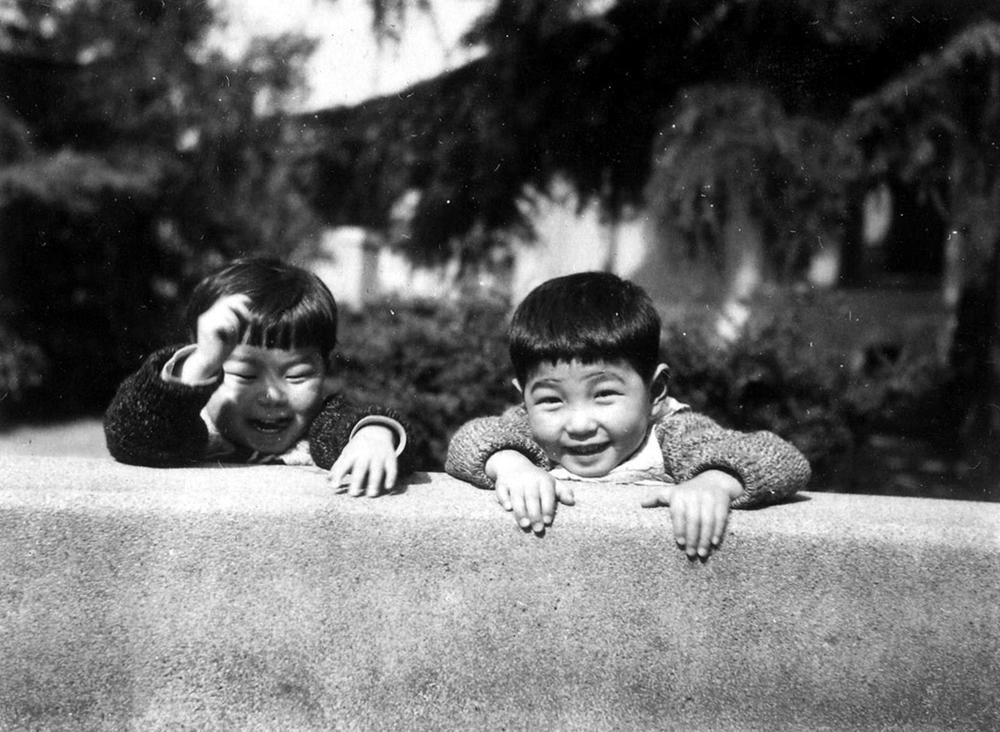
The Suzuki siblings: Nine-year-old Kimiko (left) and 11-year-old Hideaki (right) were killed in Hiroshima. Read their story, and others at the Children's Peace Memorial
“Each person had a name. Each person was loved by someone. Let us ensure that their deaths were not in vain.”
- Setsuko Thurlow, survivor of the August 1945 atomic bombing of Hiroshima Nobel Peace Prize acceptance speech, December 2017
The uranium bomb detonated over Hiroshima on 6 August 1945 had an explosive yield equal to 15,000 tonnes of TNT. It razed and burnt around 70 per cent of all buildings and caused an estimated 140,000 deaths by the end of 1945, along with increased rates of cancer and chronic disease among the survivors.
A slightly larger plutonium bomb exploded over Nagasaki three days later levelled 6.7 sq km. of the city and killed 74,000 people by the end of 1945. Ground temperatures reached 4,000°C and radioactive rain poured down.
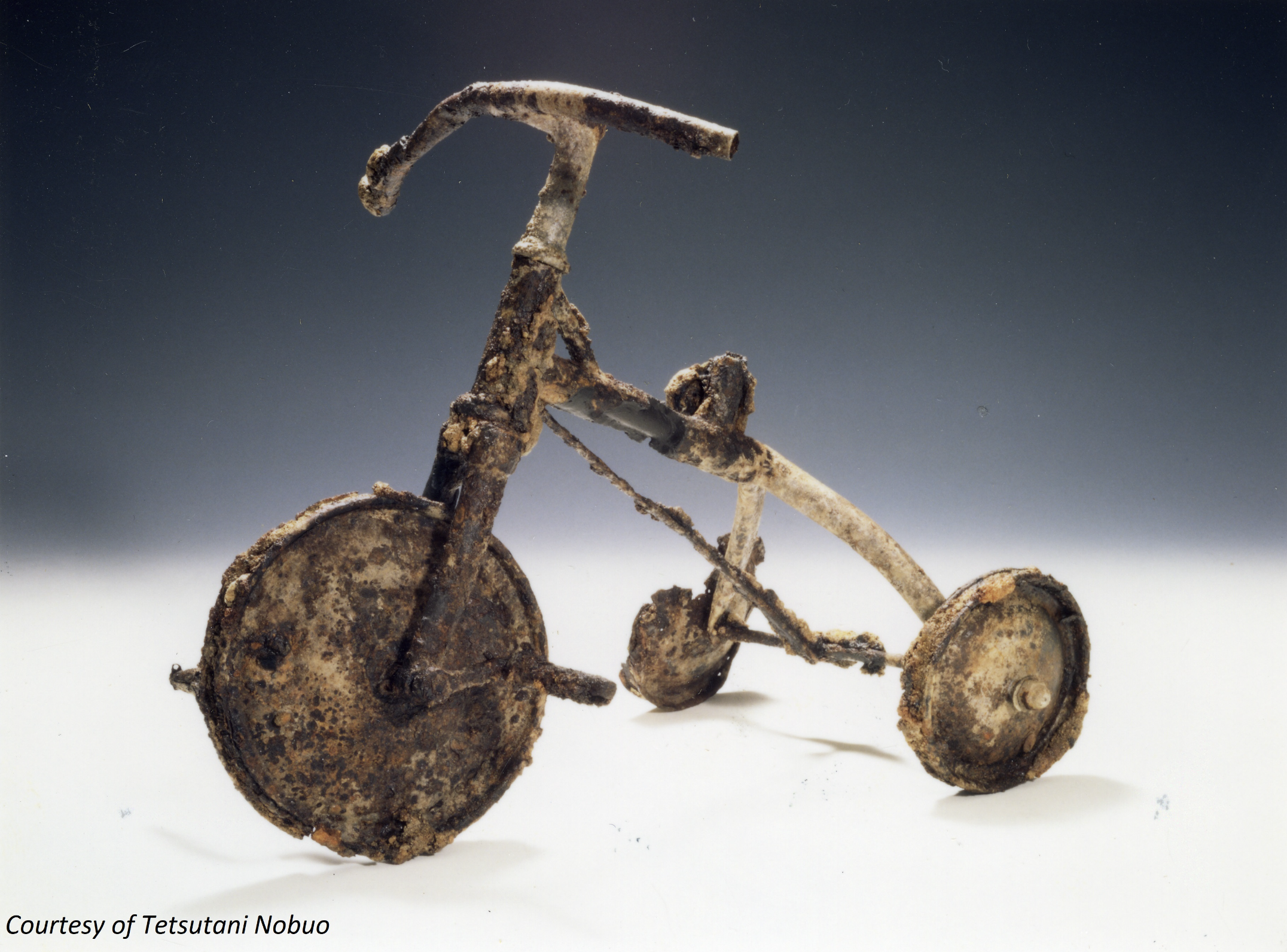
Photo: Tricycle belonging to 3-years-and-11-months-old Shinichi Tetsutani - who was riding outside of his house in Hiroshima when the atomic bomb was detonated over the city on August 6th, 1945. Courtesy of the Hiroshima Peace Memorial Museum, copying and use of this photo without permission is prohibited.
No response capacity
If a nuclear weapon were to be detonated over a city today, first responders - hospitals, firemen, aid organisations - would simply be unable to help. This powerful video by the Red Cross explains why:
The reason we know this is that the extent of the damage in Hiroshima and Nagasaki in 1945 made it nearly impossible to provide aid. In Hiroshima 90 per cent of physicians and nurses were killed or injured; 42 of 45 hospitals were rendered non-functional; and 70 per cent of victims had combined injuries including, in most cases, severe burns.
All the dedicated burn beds around the world would be insufficient to care for the survivors of a single nuclear bomb on any city.
In Hiroshima and Nagasaki, most victims died without any care to ease their suffering. Some of those who entered the cities after the bombings to provide assistance also died from the radiation.
 Photo: Courtesy of the Nagasaki Atomic Bomb Museum, copying and use of this photo without permission is prohibited.
Long-term effects
It takes around 10 seconds for the fireball from a nuclear explosion to reach its maximum size, but the effects last for decades and span across generations.
Five to six years after the bombings, the incidence of leukaemia increased noticeably among survivors. After about a decade, survivors began suffering from thyroid, breast, lung and other cancers at higher than normal rates.


Paintings created by survivors. Courtesy of the Hiroshima Peace Memorial Museum, copying and use of without permission is prohibited
Pregnant women exposed to the bombings experienced higher rates of miscarriage and deaths among their infants; their children were more likely to have intellectual disabilities, impaired growth and an increased risk of developing cancer.
And for all survivors, cancers related to radiation exposure still continue to increase throughout their lifespan, even to this day, seven decades later.
The Hibakusha
 Koko Kondo was buried under rubble with her mother who was holding the 8-month-old child during the attack on Hiroshima, and has spent a lifetime campaigning for the abolition of nuclear weapons. Photo: Ari Beser
The Hibakusha (survivors of the bombings of Hiroshima and Nagasaki) are integral to the history of the atomic bombings of these cities - not only because they are among the few true nuclear weapons experts to have experienced the actual impact of these weapons - but also because of the tireless efforts of many Hibakusha to eliminate nuclear weapons.
From the iconic story of Sadako’s 1000 paper cranes to the tireless efforts by Hibakusha to rid the world of nuclear weapons to this very day, their stories are stories of hope and determination that must not be lost. Survivors of the atomic bombings of Hiroshima and Nagasaki are living witnesses to the horror of nuclear war and when we talk about nuclear weapons, we must talk about the real unacceptable effects they have on human beings.
To learn more, you can find a vast number of Hibakusha testimonies online, but good starting places are Hibakusha Stories and the 1945 project, as well as these resources by the Hiroshima Peace Memorial Museum and the Nagasaki Atomic Bomb Museum.
A Path Forward
 Setsuko Thurlow - Hibakusha and lifelong activist for the elimination of nuclear weapons - delivers the Nobel Lecture on behalf of ICAN in 2017. Photo: Jo Straube
After decades of campaigning for a world free of nuclear-weapons, the Treaty on the Prohibition of Nuclear Weapons adopted in 2017 holds great significance for the Hibakusha. A survey among 6000 Hibakusha carried out by Kyodo News showed that a vast majority feel that Japan should join the U.N. treaty banning nuclear weapons, underscoring their discontent with the government’s opposition to the agreement. Joining the treaty would represent a recognition by Japan of its affected citizens’ rights and suffering.
80.2% of Hibakusha welcomed the UN Treaty on the Prohibition of Nuclear Weapons
- Kyodo News poll, 2018
Since the Treaty's adoption, many Hibakusha have continued their tireless advocacy efforts to abolish nuclear weapons. The Hibakusha Appeal calls on all governments to join the TPNW. World leaders must heed the calls of Hibakusha, and of concerned citizens around the world, for a nuclear-weapon-free future.
xxxxxxxxxxxxxxxxxxxxxxxxxxxx
The little-known history of secrecy and censorship in wake of atomic bombings
The atomic bombing of Hiroshima and Nagasaki 70 years ago, is one of the most studied events in modern history. And yet significant aspects of that bombing are still not well known.
I recently published a social history of US censorship in the aftermath of the bombings, which this piece is based on. The material was drawn from a dozen different manuscript collections in archives around the US.
I found that military and civilian officials in the US sought to contain information about the effects of radiation from the blasts, which helps explain the persistent gaps in the public’s understanding of radiation from the bombings.
Heavy handed
Although everything related to the effects of the Hiroshima and Nagasaki bombs was defined at the time as a military secret, US officials treated the three main effects – blast, fire, and radiation – very differently. They publicized and celebrated the powerful blast but worked to suppress information about the bombs’ radiation.
The world learned a month later a few details about that radiation – that some type of “atomic plague” related to the atomic bomb was causing death and illness in the two bombed cities. But for years radiation remained the least publicized and least understood of the atomic bomb effects.
To this day we have no fully accepted accounting of the atomic bomb deaths in both cities; it has remained highly contested because of the politics surrounding the bombing, because of problems with the wartime Japanese census, and, importantly, because of the complexity of defining what constituted radiation-caused deaths over decades.
In my research, I found US officials controlled information about radiation from the atomic bombs dropped over Japan by censoring newspapers, by silencing outspoken individuals, by limiting circulation of the earliest official medical reports, by fomenting deliberately reassuring publicity campaigns, and by outright lies and denial.
The censorship of the Japanese began quickly. As soon as Japanese physicians and scientists reached Hiroshima after the bombing, they collected evidence and studied the mysterious symptoms in the ill and dying. American officials confiscated Japanese reports, medical case notes, biopsy slides, medical photographs, and films and sent them to the US where much remained classified for years (some for decades).
Historians note the irony of American Occupation officials claiming to bring a new freedom of the press to Japan, but censoring what the Japanese said in print about the atomic bombs. One month after the war ended, Occupation authorities restricted public criticism of the US actions in Japan and denied any radiation aftereffects from exposure to the nuclear bombs.
In the US, too, newspapers omitted or obscured anything about radiation or ongoing radioactivity. Military officials encouraged editors to continue some kind of wartime censorship especially about the bombs’ radiation. Four official US investigating teams sent to Japan in the months immediately after the surrender wrote reports about the biomedical effects of the two atomic bombs. Several of the reports minimized the radiation effects and all received classifications as secret or top secret so the circulation of the majority of their information remained constrained for years.
Traditional ‘combat’ bomb
The censorship has several explanations.
Even Manhattan Project scientists had only theoretical calculations about what to expect about the bombs’ radiation. As scientists studied the complex effects in the next years, the US government classified information from Japan as well as related radiation information from medical research and the atomic bomb tests at the Nevada Test Site.
American officials wanted reassurance that Allied troops landing in Japan would not be endangered by any remaining radiation. Based on pre-bomb calculations, US officials did not think that US troops would be endangered by exposure to residual radiation but the concept of radiological weapons and uncertainty created fear.
An additional explanation for the censorship of information pertaining to radiation is that US officials did not want the new weapon to be associated with radiological or chemical warfare, both of which were expanding in scope and funding after the war. Those associated with the atomic bomb wanted it to be viewed as a powerful but regular military weapon, a traditional “combat bomb.”
The results of the radiation censorship campaign have been hard to pin down both because of the nature of the silencing itself (including its incompleteness), and because knowledge leaked into public awareness in many ways and forms.
Historian Richard Miller observes that, “In the long run, the radiation from the bomb was more significant than the blast or thermal effects.” Yet, for years that radiation remained the least publicized and least understood of the atomic bomb effects.
Legacy of secrecy
Censorship about the radiation deaths and sickness from the atomic bombs in Japan was never, of course, entirely successful.
American magazines featured fictional stories about cities ravaged by radiation. John Hersey’s searing account, Hiroshima, became a bestseller in 1946 just as the summer’s “Crossroads” atomic bomb tests in the Pacific received massive publicity including reports about the disastrous radioactive spray that contaminated eighty of the Navy’s unmanned test vessels.
Campaigns from governmental officials as well as military, scientific and industrial leaders sought to ease the public’s fears with the alluring promises of miraculous medical cures and cheap energy from commercial nuclear power.
Historians have described the American public’s reactions to Hiroshima as “muted ambivalence” and “psychic numbing.” Historian John Dower observes that although Americans demonstrated a longterm cyclical interest in what happened “beneath the mushroom cloud,” the nation’s “more persistent response to Hiroshima and Nagasaki has been "the averted gaze.”
Secrecy, extraordinary levels of classification, lies, denial, and deception became the chief legacy of the initial impulse to censor radiation information from the Hiroshima and Nagasaki bombs.
xxxxxxxxxxxxxxxxxxxxxxx
How JFK's lessons on unilateral nuclear restraint show that Trump should do more
On June 10, 1963, President John F. Kennedy used his commencement address at American University to talk to the American people about the struggle for peace amid the Cold War. It is still to this day the greatest speech on nuclear weapons ever given by a US president—and it carries urgent lessons for today’s world of competition among nuclear-armed powers.
Coming just over half a year after the Cuban Missile Crisis, Kennedy might have been tempted to lash out at the Soviet leadership for taking aggressive actions that put the world in terrible danger. Or he could have gloated over what was seen as his victory in convincing Soviet Premier Nikita Khrushchev to remove the missiles. Kennedy did none of this.
Instead, Kennedy urged Americans to “look inward” and examine their own attitudes toward the Soviet Union, “not to see only a distorted and desperate view of the other side,” or to see war “as inevitable, accommodation as impossible, and communication as nothing more than an exchange of threats.”
He warned that because “large and relatively invulnerable nuclear forces” have been unleashed, “total war makes no sense,” adding, “All we have built, all we have worked for, would be destroyed in the first 24 hours.”
Common interest. While the United States and the Soviet Union would continue to have deep disagreements, Kennedy rightly focused on their common interest in avoiding nuclear war and limiting the costly and dangerous arms race: “If we cannot end now our differences, at least we can help make the world safe for diversity.”
In particular, he offered his central lesson from the recent crisis: “[W]hile defending our own vital interests, nuclear powers must avert those confrontations which bring an adversary to a choice of either a humiliating retreat or a nuclear war.”
To build peace, Kennedy suggested that the two countries undertake “a series of concrete actions and effective agreements which are in the interest of all concerned.” Such accords, he argued, “are in the interests of the Soviet Union as well as ours—and even the most hostile nations can be relied upon to accept and keep those treaty obligations, and only those treaty obligations, which are in their own interest.”
Kennedy noted that some argued it was “useless” to work toward peace until Soviet leaders “adopt a more enlightened attitude.” Then came a crucial thought: “I believe we can help them to do it.”
Unilateral off-ramping works. Toward that end, Kennedy announced that the United States would unilaterally stop nuclear testing, as long as others did not test, until a treaty could be reached—a move that some have called “the Kennedy Experiment.”
Khrushchev—who had received a copy of the speech in advance—saw it as a major step in the right direction. The Soviets turned off the radio jammers blocking Voice of America so the Soviet people could hear it. The two national government-controlled newspapers, Pravda and Izvestia, printed Kennedy’s speech in its entirety. Two months later, the Limited Test Ban Treaty was signed, marking the end of atmospheric nuclear tests that had spread radioactive fallout worldwide.
Afterward, the experiment continued, with initiatives on both sides that cut back production of fissile materials for nuclear weapons, reduced defense spending, and even pulled back some troops from the central front in Europe.
Decades later, President George H.W. Bush took a similar course as the Soviet Union was nearing collapse, unilaterally announcing major pullbacks and reductions of US tactical nuclear weapons and taking strategic bombers off day-to-day alert. Then-Soviet leader Mikhail Gorbachev announced similar measures, which were later reconfirmed and extended by Russian President Boris Yeltsin after he took power.
This decision led to the elimination of thousands of nuclear weapons—the fastest nuclear disarmament effort that has ever occurred. (There are now controversies over whether Russia implemented everything it had announced, but there is no doubt that dramatic cutbacks in nuclear weapons took place on both sides.)
Most recently, President Joe Biden’s initiatives pledging not to carry out direct-ascent anti-satellite tests that could create showers of space debris, and to refrain from the most dangerous military uses of artificial intelligence—both initiatives now joined by scores of other countries—came from a similar playbook.
Hostility and competition are back. Now, Russian President Vladimir Putin rattles the nuclear saber in his grinding war on Ukraine. The last treaty limiting US and Russian strategic nuclear forces expired in February. China is rapidly building up its still-small nuclear and conventional forces and still refuses to discuss agreeing to limits. And North Korea has built nuclear missiles capable of striking anywhere in the United States and refuses to resume any talks on denuclearization or even limiting its nuclear forces.
Leaderships in Moscow, Beijing, and Pyongyang are all deeply hostile to the United States and are building growing partnerships with each other. At the same time, evolving technologies from missile defenses and precision conventional weapons to artificial intelligence and antisatellite weapons are complicating nuclear balances and may be making them less stable.
In South Asia, as Pakistan and India continue to build their nuclear forces, each crisis seems to tread closer to dangerous red lines than the one before. The US-Israeli war on Iran—and growing concerns among US allies over the credibility and reliability of US security guarantees—highlight the risk that nuclear weapons could spread further and the crises they might provoke.
All these recent developments make the risk that nuclear weapons may be used higher than it has been since Kennedy spoke.
Kennedy’s lessons and beyond. President Donald Trump seems to want to reduce that risk: For decades, he has warned of the danger of nuclear war and envisioned himself as the man who could bring home a major agreement to reduce nuclear weapons. But he has brought little focus to that goal in his second term, ignoring Putin’s offer to stay within New START’s limits for another year while launching talks on potential replacements and leaving the topic off the table in his recent summit with Chinese President Xi Jinping.
Trump also faces more obstacles to doing more than President Kennedy did. Kennedy spoke after the Cuban Missile Crisis was over and the Soviets had withdrawn their missiles, whereas Russia’s war on Ukraine and provocations in Europe continue, with new violations of the laws of war almost every day.
Still, the need for reducing tensions is urgent, and there is much more that Trump could do.
President Trump could announce that a portion of US nuclear missiles would be taken off alert: Surely not all of them need to be ready for immediate launch. He could commit that the United States would never use nuclear weapons first unless its very survival or that of one of its treaty allies were at stake. The president could commit that the United States would never deploy nuclear or hypersonic missiles within minutes of flight time from Moscow or Beijing to avoid making the warning time even shorter than it already is. He could offer to let Chinese or Russian experts monitor US weapons-maintenance experiments to confirm US compliance with the nuclear test ban. He could commit that all US nuclear enrichment and plutonium reprocessing activities be available for international inspection to confirm they were not being used to make new material for nuclear weapons.
None of those steps would endanger US security. On the contrary. If reciprocated, each of them would significantly improve national security. And they might be a first step toward new arms restraints that could replace New START.
Fundamentally, the lessons Kennedy laid out in 1963 remain valid: Defend your interests, but do not push nuclear-armed adversaries into a corner that gives them no choice but defeat or nuclear war; build weapons that deter but are “nonprovocative, carefully controlled”; and build effective agreements that serve both sides’ interests in survival and in avoiding costly and dangerous arms racing. Getting to such agreements will be more complex in a world with at least three large nuclear powers rather than two, and with more advanced and disruptive technologies. But nuclear restraint remains both possible and necessary. The US president should not be afraid to take informal, unilateral steps to reduce tensions and smooth the path for accords. It worked in the past. It could work today.
Kennedy was right: “For, in the final analysis, our most basic common link is that we all inhabit this small planet. We all breathe the same air. We all cherish our children’s future. And we are all mortal.”
 President John F. Kennedy delivers his commencement address at American University in Washington, D.C., on June 10, 1963. In this speech, known as the "Pax Americana" speech, Kennedy emphasized the role of unilateral restraint to achieve world peace. (Credit: Cecil Stoughton/White House, JFK Library)


No comments:
Post a Comment