What AI cannot do but 6G can
https://www.counterpunch.org/2026/07/06/why-ai-doesnt-think-cannot-reason-isnt-intelligent-and-will-never-achieve-consciousness/https://thedissidentvoice.org/2026/07/you-dont-know-how-much-6g-will-change-the-world/
Why AI Doesn’t Think, Cannot Reason, Isn’t Intelligent and Will Never Achieve Consciousness
Poster for Fritz Lang’s Metropolis (detail).
Recent public comments made about AI suggest that Americans have difficulty with the implications of linear time. This is odd given that its conception is largely Western and is centered on the clock time used to coordinate capitalist employment. The conceptual difficulty regards sequencing, or plans for future actions. But it also involves the distribution of profits. 100% of the capital equipment used in Western economic production was produced by workers. So, why does the resulting product belong to financiers rather than those who produced it?
To use a physical metaphor, if I 1) buy a car, 2) aim it in the direction of a cliff, 3) put a stone on the gas pedal, and 4) put the transmission into drive, the car will move forward and plunge off the cliff. Question: Did I, through my actions, cause the car to plunge off the cliff? Or did the car ‘drive itself’ off of the cliff? The answer depends on where you imagine that my own actions ended. In fact, I conceived and created a series of events that, if carried through with competence, would lead to the car plunging off the cliff. The car is inert, made of metal and rubber, without human direction.
Likewise, if I create and set in motion a three-hundred-step algorithm, is the algorithm producing the output, or did I? The distinction is between intent and process. My intent guides the conception and creation of the three-hundred-step algorithm. But the work from that point forward is carried out by the algorithm being run in a computing environment. So, the algorithm didn’t conceive of the project. I did. The algorithm didn’t plan (sequence) the project. I did. The algorithm didn’t code the problem. I did. So, who produced the output, me or the machine?
A similar conceptual problem applies to claims of machines ‘thinking.’ Physically speaking, AI is a bundle of algorithms housed within a large computing environment. AI didn’t conceive itself. It was conceived, if memory serves, at Carnegie Mellon University in the 1970s. AI didn’t build itself. It was built in fits and starts by computer scientists in academia and later in business. AI didn’t code itself. It was coded by AI developers. And the massive physical infrastructure on which AI depends was built by workers. The point: AI is wholly produced by humans.
The question then is how it is imagined that AI output represents more than the human effort that was put into creating it? What process makes AI output more than the product of algorithms? If the answer is that something does, are you aware of sequencing algorithms? This would be code that organizes other code to follow a series of steps to complete a task. I’ve conceived and coded sequenced algorithms that run through multi-step processes from a single set of instructions. The output looks like reasoning. And it is reasoning. I coded it. The models did what I coded them to do.
So again, if a series of steps are conceived, planned and launched by humans on equipment that was created by humans, at what point does their dimension shift from inanimate to animate? Or more simply, at what point does a bundle of algorithms housed on a computer think or reason or possess intelligence or consciousness? In fact, the claim that any of these describes AI is a category error. Is a rock rolling down a hill imagined to be rolling itself down the hill rather than being moved by unseen physical forces (e.g., gravity). So, claims that AI can reason emerge from either ignorance or misunderstanding of basic physical processes.
Back in the world, there has been a debate in the West since the early nineteenth century over whether factory automation produces the product of factory automation, or whether the people who automated the factory produced the output? On the one hand, automation creates the appearance that its product is self-generated. On the other hand, the automation process was created by humans and would not exist otherwise. With the current ability to ‘sequence’ the production process using algorithms, another level of abstraction has been added to this debate.
Having conceived and coded ‘sequencing’ models, most who haven’t find the concept difficult to understand. These models are instructions for how a model ‘thinks.’ Question: How is a model ‘thinking’ when it is just following instructions? Answer: it isn’t. It is just following instructions. What looks like reasoning to AI users is the reasoning coded into the model by human coders. It appears to be reasoning because the instructions it is following were reasoned. It is written instructions being carried out. Nothing more.
The question is political as well in that the answer determines how income is distributed in the West. If ‘capital’ in the form of an automated factory produces the output, do the proceeds then belong to capital, meaning to the capitalist? Without workers first creating the automated factories, there would be no automation process. The political answer was to end workers’ claims to this product through wages. However, while workers receive one-time payments (wages) for their effort, the capitalist receives the profits from this labor for as long as they last.
With AI, this question is back on the table, conceptually at least. Whichever way one cares to perceive AI, as a thinking machine or as a bundle of related algorithms, it was built by workers. AI didn’t conceive itself. It was conceived by workers. This is an important clue into how it works. AI was built by human workers based on their desire to produce a machine that simulates human thought. However, the digital realm is a closed system. All AI ‘knowledge’ has been mediated by humans. Within AI’s Cartesian framing, AI has no direct access to the world. It is the proverbial Cartesian brain-in-a-vat.
One of the paradoxes of debating the nature of AI is that AI models describe themselves as variations on ‘word organizers and word sequencers.’ Focus on the word ‘sequencers’ for a moment. Again, a sequencer establishes and executes the order of a multi-stage process. With the launch of AI, a multi-stage process is set in motion. Words and phrases are identified and matched against similar words and phrases found in AI training sets. The sequencing then runs models to assign the words and phrases their human-determined meaning.
Important to understand is that neither the sequencer nor the broader AI model understands the words and phrases that are being acted on. The meaning of the words, semantics, is created by humans and is stored in a retrieval cache. Sequencing here is the matching of (human defined) meanings to words to provide semantic context to the words and phrases being matched. To be clear, AI ‘decides’ nothing. It is following algorithmic instructions. AI is neither deciding what to do nor how to do it. That is written out for it by humans.
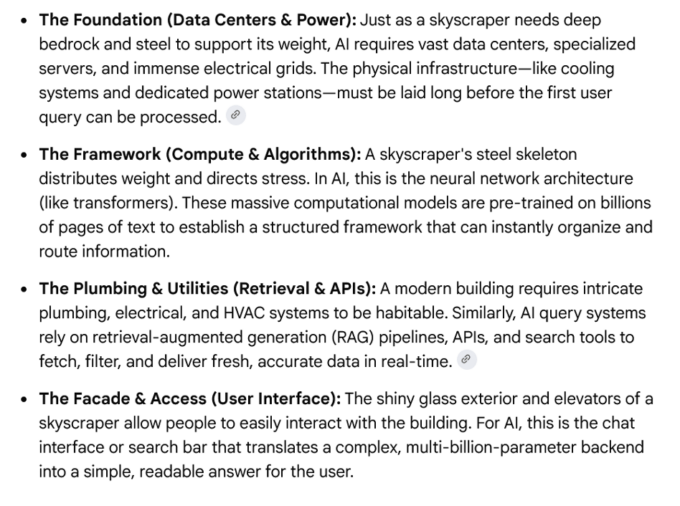
Google AI Chatbot Analogy of AI to a Skyscraper:
End Google AI Chatbot Output—————————-
The distinction is between coding mathematical models to set a series of steps in motion and the idea that the models reason on their own. Missing from casual analysis of AI is understanding of how large and complicated this process is. Developers have been building a ‘thinking machine’ in earnest since the 1970s. The infrastructure needed to run AI approximates that of a modern skyscraper. The question that has yet to be answered is: is AI worth it? Is it a crucial new technology that will justify its costs, widely considered? Or is it an occasionally interesting toy whose environmental footprint will end the planet?
Recent public discussion has puzzled over how AI can solve math problems if it doesn’t think? Consider the concept from physics of ‘work.’ What those considering the matter are imagining is lone mathematicians sitting in rooms and thinking through the solutions to math puzzles. But with unlimited computing power, optimization programs can use brute force computing to work through every conceivable iteration of a problem in seconds. What AI users aren’t seeing is the skyscraper’s worth of infrastructure behind the scenes producing a result.
Doesn’t this vast computing power illustrate the value of AI? No. It gets to the nature of technology. One explanation of technology is that it provides a benefit. Another is that it simply changes that way that humans do things. On the one hand, we can drive long distances quickly in cars versus walking. On the other, many of us now spend three hours per day sitting in traffic in cars. So, are cars a benefit? In some ways yes, in some ways no. What they aren’t is an unequivocal benefit, meaning that the jury is still out.

Image: the guts of the automaton featured in the movie Hugo. The mechanical refinement of fake humans can be seen in the gearing. The thought was that finer gearing made automatons closer to being human. That in retrospect the automaton can be seen as a better robot rather than being closer to human is an important insight for understanding AI. AI is a digital robot. It is no closer to thinking or reasoning than a doorstop. Source: dickgeorgecreatives.
If asked if they would like a machine that transports them from one place to another quickly, most Westerners would likely answer yes. When asked if they want to spend three hours per day sitting in a car in traffic, most Westerners would likely answer no. But the latter is the direct consequence of the prior. This is how capitalism works. We are offered a benefit. In the current case, the ability to travel quickly from one place to another. But almost immediately the social consequences of the ‘benefit’ become a burden that hadn’t been imagined when the benefit was offered.
In the present, a lot of Americans are worried that AI can think. It will take our jobs. But what we should be worried about is that AI can’t think. It is but one more layer of labor de-skilling. Consider: AI ‘art’ is artless. AI ‘thought’ is the aggregated wisdom of the Pentagon cobbled to the AEI (American Enterprise Institute). Every AI query written increases greenhouse gas emissions to levels that are suicidal for the species. And AI ‘solutions’ are regurgitated feints like carbon capture. All of the proposed solutions will more likely make the problems worse.
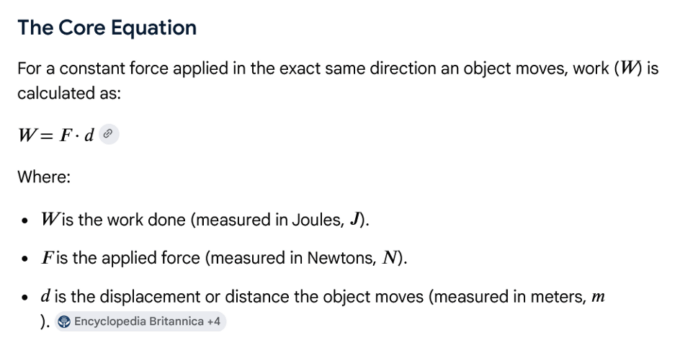
While AI users imagine that ‘thought’ is producing AI results, what is in fact being applied is work. Work here is similar to the concept of horsepower, the crude conversion of the pulling power of horses to that produced by an internal combustion engine. Recall the lone mathematician sitting and thinking. Now imagine running an AI program that is the equivalent in terms of capacity of 10,000 humans laboring for one million years. One would imagine that a lot of complicated questions could be answered in such a scenario.
Google Gemini AI Output
End Google Gemini AI Output——————
Were 10.000 humans to labor for one million years, this would represent the largest undertaking in human history. And given that humans have finite lifespans, this thought experiment is entirely conceptual. Further, AI doesn’t use the methods of mathematicians. Instead of isolating a metaphorical tree in a forest by its qualities (the mathematician), AI chops down every other tree in the forest to declare that the tree left standing is the solution (optimization).
AI’s methodology represents a different way of solving math problems that may be of interest to a few dozen mathematicians, but that comes with a computational cost equivalent to a moon landing. Were 10,000 humans actually put to the task of solving mathematical problems, questions of agency and whether or not this is a good use of social resources would arise. It is only by hiding/sidelining the question of environmental and social costs that AI is claimed to add value beyond profits for a few insiders.
The ability to run a billion permutations in a microsecond makes AI a very powerful tool. But how much better is a world in which AI can run a billion permutations in a microsecond than the same world without it? The question requires a social answer, And the social answer must emerge from clear and complete understanding of the social costs of AI. It isn’t good enough to point to the math problems solved to justify the social investment in AI. The question is: what else could be accomplished with those same resources (opportunity costs)?
AI solved the math problems through a process of elimination. Again, this isn’t how mathematicians work. Why? Because AI uses computational technology that humans do not possess. Recall, a car can get us from one place to another faster than we can walk. But the adoption of cars has left us sitting in traffic for a substantial portion of our waking hours. AI can use brute force computing to muscle-through certain types of questions. But are these really questions that need to be answered? Or is answering them a form of mass entertainment?
Another hidden part of the AI process is the operationalization of language. AI was conceived through the premise that human thought results from syntax cobbled to semantics (form and meaning). But operationalization results in a formal consolidation of meaning. Take the term ‘democracy.’ It is widely prevalent in Western discourse in a variety of contexts, e.g. economic democracy. But to render the term operational, it must be stripped down and made stable.
To be clear, this isn’t touchy-feely in the way that it might read. Take the term ‘Christianity,’ There are 45,000 Christian denominations as of a recent survey. What does this mean in the current context? An operational definition of Christianity as those who believe in Christ eliminates 45,000 enthusiastic differences of opinion amongst Christians regarding what ‘believing in Christ’ means. In political terms, it flattens 45,000 differences of opinion out of existence to claim a unity that arguably does not reflect reality.
Again, this isn’t a quibble. Whoever controls the meaning of language controls the language. In an example from Zen Economics, economists use something called Household Income as a measure of economic wellbeing. While this makes intuitive sense, in practice ‘household’ must be defined, ‘income’ must be defined, and the terms must be recombined into Household Income. The semantic problem? With upwards of dozens of competing definitions, people using the exact phrasing ‘Household Income’ tend to be speaking about materially different concepts.
When a user runs an AI query on Household Income, AI references the meaning that has been created by humans and placed into a semantic cache (storage area). But because AI is replacing internet search functions, prior definitions of commonly understood words are being systematically replaced with stripped down (operationalized) definitions by AI. This stripping down creates the sense of a consensus view on every topic that is incorrect. Linguistic diversity is being eliminated from the discourse. Each of these differences represents a worldview.
In a phrase that I keep going back to because it explains so much, any statistical result can be undone by redefining the variables. An operationalized version of Household Income can rise and fall at the same time depending on the definition. Why? Because the definitions contain their operating logic. Is a household a single family, all of the occupants of a house, or something else? Is income wage income, all of the money that a household brings in from all sources, or something else? As the definitions change, so do the outcomes based on them.
The times when I’ve traced technical definitions back through history (e.g. utility in economics), the meanings from people who claimed to be writing about the same subject were incompatible. In the case of utility, the term was being represented in mathematical models, meaning that it was imagined to be operationalized even though it hadn’t been. This rendered the claims that economists were being scientific implausible. Pushing incongruent ideas through a rigorous logical process (mathematics) doesn’t make the ideas less incongruent.
In the models that I’ve created, the process representing the model logic was written mathematically. Another way to state this is that the logic of the model is embedded in the coding. For instance, in Error Correction models, the premises of stationary local means (nonstationary global mean) and mean-reverting processes were embedded. The order in which events are sequenced comes through similar embedding. The point: if it appears that a model is reasoning, that is because the humans who coded it reasoned when they coded it.
Again, by analogy, what AI users see is the metaphorical car plunging off of the cliff. What they don’t see are the behind-the-scenes planning and actions that caused it to do so. So, when AI users see complex output, they imagine that ‘a simple word and phrase counting machine’ couldn’t have produced it. In fact, the word and phrase counting engine is part of a sequence of events (sequencing) that is largely invisible to AI users. Just because they don’t see the model logic doesn’t mean that it doesn’t exist. .
Here’s the punchline: if you understand the AI process, there is no mystery here at all. I was apparently able to intuit mathematical solutions to several of the major problems that AI has encountered using relatively simple insights. But getting the math to do what I want it to do in this context requires sequencing. And this sequencing allowed the math to function as it was supposed to. Someone looking at the math alone wouldn’t understand the context. And with context provided, the smaller solutions feed into the larger solutions.
I have no idea if these explanations make sense to readers. The simplest way for me to understand the process is through sequencing. 1) AI was created by developers. It neither conceived itself nor created itself. 2) ergo, everything that follows from AI is the product of the humans who created it. 3) all model reasoning flows from the logic embedded by AI developers. 4) because AI operates from algorithmic instructions, the model logic is revealed through the operation of the AI model. Users see the model output but not the algorithmic instructions.
AI ‘thinking’ and ‘thought’ are easy to dispense with. Question: What is the geographical location of this thought within AI? AI has no ‘brain,’ it has no location that one can point to as a mind. Its output is the product of at least a few hundred models acting together, meaning a process. And while an entire AI model could be thought of as a ‘brain,’ the AI memory process, to the extent there is one, is mathematical. It emerges from the sequencing of words and phrases, meaning from a process similar to the car ‘driving itself’ off the cliff.
But the car didn’t drive itself off a cliff. A sequence of events was planned and then put into motion that led to the car plunging off of the cliff. The car didn’t buy itself, point itself toward the cliff, place a stone on the gas pedal or put the car into drive. The car is understood to be inanimate. And yet, without having a human driving it, it was propelled off the cliff. Most people assessing the situation would conclude that I had propelled the car off the cliff through the series of actions I took to do so.
Anyone still imagining that AI thinks, reasons, has intelligence or consciousness should spend time with the model logic and explain exactly where in this process algorithmic instructions become an independent thought process? Just because some haven’t done the work to understand it doesn’t make it magic. And if you imagine that it is magic, where else is similar magic found in industrial equipment? Self-driving cars don’t drive themselves. They are dumb machines that follow algorithmic instructions. To test this theory, disconnect them from the algorithms.
XXXXXXXXXXXXXXXXXXXXXXXXXXXXX
You Don't Know How Much 6G Will Change the World

There is a technology that will become ubiquitous in everyday life and completely transform our world, our technological capabilities, and the way information is transferred. And no, it’s not artificial intelligence. It’s actually 6G technology.
You wouldn’t be crazy for thinking AI will be the defining technology that affects your life over the next few years. It dominates the news and, frankly, has become the foundation of much of the American economy. But despite all the hype, we’re never given a clear answer as to what AGI will actually look like or exactly how it will change the world. It’s a massive bet that AGI, however it’s ultimately defined and whatever it ends up doing, will live up to the expectations surrounding it. The chances of it fulfilling that hype over the next few years are arguably just as great as the chances of it being a major disappointment.
6G, on the other hand, isn’t speculation. We already know its applications and its potential. This technology will transform our world. The leap from 5G to 6G is exponential and cannot be compared to the upgrade from 4G to 5G. With ultra-high speeds being hundreds or even thousands of times faster than 5G, and distributed networks capable of bringing fast, reliable computing power everywhere, the possibilities are enormous. To put the difference in connectivity into perspective, take a look at this image below.

When we think about 6G, we naturally imagine how it will affect us personally. We picture the signal bars in the top-right corner of our phones and the little “5G” icon. 6G just seems like a similar next step, perhaps just super fast internet speeds and ubiquitous rural connectivity. While that is certainly impressive, it may not initially seem as revolutionary as something like AI, especially in China, where 5G is already highly effective.
But the mistake is focusing only on what you’ll experience on your personal phone. The real transformation won’t happen on the consumer side, it will happen on the commercial and industrial side through its ability to supercharge enterprise. Think about the rapid development we’ve seen in recent years in autonomous vehicles, drones, smart buildings, and intelligent infrastructure. All of these technologies require a similarly massive leap in connectivity, and 6G is more than capable of providing it.
As computing capacity increases, 6G will enable enormous amounts of data to be transmitted almost instantly. Complex 3D renderings or ultra-high-resolution content, for example, could be transferred from one location to another without effectively no latency. Devices embedded throughout industrial facilities, autonomous vehicles, and smart cities could coordinate themselves with minimal human intervention. A powerful way to think about 6G is that it will effectively fuse the physical and digital worlds together.
Here’s the most exciting part: this future technology isn’t years away, it’s already being rolled out and you can expect this technology’s impact to define the 2030s. China has just begun large-scale delivery of gallium chips for its space-ground 6G network, laying the foundation for widespread deployment by the end of the decade. As described by Science and Technology Daily, “It will function as the fundamental backbone supporting next-generation 6G communications, commercial space programmes, the low-altitude economy, and emergency response communications.” So what does this actually look like in the real world?
The key phrase to pay attention to is the low-altitude economy. If you’ve been following my work, or Chinese technological development more broadly, you’ll probably already be familiar with China’s dominance in drone technology. This goes far beyond the small commercial drones you can buy at Walmart or Target to film your vacations. China is producing much larger industrial drones that are already being deployed around the world to spray crops across African farmland, deliver heavy construction materials to remote building sites, extinguish fires on the upper floors of high-rise buildings, locate missing people deep in rural environments, and transport critical medical supplies between hospitals within cities. All of these applications fall under the umbrella of the low-altitude economy. As 6G becomes ubiquitous, it will massively expand the potential of this entire sector. Imagine designated drone corridors running throughout major Chinese cities, reducing delivery times to just minutes. During natural disasters or search-and-rescue operations, drones could be dispatched immediately in virtually any conditions, directly making the difference between life and death. Imagine enormous infrastructure projects in the mountainous regions of Xinjiang and Tibet being supplied not by trucks making long, difficult journeys across mountain roads, but by fleets of heavy-duty drones continuously delivering solar panels, construction equipment, and raw materials. Project timelines could be dramatically reduced while enabling infrastructure projects that would otherwise be impractical. All of this technology at scale is only made possible by 6G.

The race for AI is often presented as an existential competition between China and the United States over which country will dominate the defining technology of the future. The U.S is making the same argument for this technology as the Trump administration released a statement outlining its goal of winning the 6G race. But while there may be genuine competition between China and the United States in AI, the United States can largely forget about competing with China in 6G for several key reasons.
First, just as rare earth minerals are critical for American weapons systems and China’s restrictions on supplying certain rare earths exposed America’s dependence on Chinese supply chains, the same strategic minerals are essential for building ultra-fast 6G infrastructure. Those supply chains are overwhelmingly controlled by China.
Second, Huawei has pursued a far more aggressive rollout of 5G, not only across China but throughout Europe and in many densely populated or geographically challenging regions across Africa and South America. Through this deployment, companies like Huawei have positioned themselves at the forefront of both 5G and the development of future 6G technologies.
Meanwhile, American telecommunications companies such as AT&T and Verizon have become comparatively complacent in research and development, benefiting from a domestic market dominated by only a handful of major competitors. Innovation has slowed, and the expansion of 5G infrastructure has largely stagnated.
The third, and perhaps most important reason, ties into a much deeper structural issue: the lack of American industrial applications. As I explained earlier, the primary driver behind 6G investment is not consumer use but industrial use. The technologies that justify massive investment in 6G are autonomous industries, smart cities, autonomous vehicles, advanced logistics, and especially the low-altitude economy. If you’ve been following developments in both countries, you’ll know that the overwhelming majority of the industrial development and deployment of these technologies is taking place in China. When 6G becomes widely available in China, companies like DJI, along with countless other industrial firms, will immediately begin deploying it across large-scale commercial operations. The United States simply lacks an equivalent industrial ecosystem creating comparable demand because many of those companies either don’t exist or exist at a much smaller scale. The American economy is overwhelmingly centered on finance, information technology, and services. The absence of a large industrial base means fewer practical applications for 6G and, consequently, less incentive to invest aggressively in the technology. In that sense, the slow pace of American 6G development is just another consequence of the long-term erosion of the country’s industrial base.
Cyrus Janssen is a geopolitical analyst, investor, speaker, and social media influencer with over 1 million fans across his social media platforms. Born in the United States, Cyrus lived abroad for 15 years in China and Canada and enjoys sharing cultural and geopolitical insights from his travels to over 60+ countries. Read other articles by Cyrus, or visit Cyrus's website.

No comments:
Post a Comment