https://foodprint.org/reports/the-foodprint-of-farmed-seafood/
~~ recommended by emil karpo ~~
Published: 10/14/20, Last updated: 5/21/25
Introduction
[This report was produced in partnership with the Northwest Atlantic Marine Alliance]
If you look at the seafood section of any supermarket in the United States, about 65 percent of what you see is imported, and more than half of that comes from aquaculture: the farming of seafood.1 Even in once-active fishing communities, local, wild seafood has become less available. Meanwhile, in coastal communities from Maine to Florida, farmed shrimp, salmon and shellfish take up much of the seafood cases. Advocates for aquaculture cite the scarcity of local seafood to make a case for expanding fish farming: the United States needs more seafood production, they say, and because wild fisheries are unlikely to meet those demands, the supply will have to come from aquaculture.
Aquaculture has been practiced sustainably for thousands of years, from the traditional fishponds of Hawai’i,2 to the fish and rice rotations still practiced in Asia.3 Unfortunately, high-input/high-impact forms of modern aquaculture, such as shrimp farming and salmon farming, have given the ancient practice a bad name. Low-input forms of aquaculture such as some mollusk or seaweed farming and cyclical systems like aquaponics — the cultivation of plants and fish together — show great promise as ways to expand farmed seafood production. However, even these seemingly benign forms of aquaculture can create problems, if they are not properly scaled and regulated.
The noble promise of aquaculture — to create more food for a growing world population — has, in some cases, only repeated the errors of land-based industrial agriculture. This report aims to educate consumers about the world of farmed seafood, help them learn about the problems with much of today’s industrial aquaculture, and understand how they can buy better seafood that supports a more sustainable future. It’s important to note that ethical consumerism alone won’t stop industrial aquaculture. With this report, we hope to raise public awareness so we are all encouraged to exercise our agency, change public policy, and get more connected to our local food providers.
What Farmed Seafood and Seaweed Should Be
Aquaculture has the potential to be an industry that supplies sustainable, high-quality food at a price that’s fair for both consumers and producers. In order to fulfill this promise to provide food while protecting the environment and creating employment, aquaculture needs to follow some simple guidelines:
- Prioritize raising species that are low-input and low-impact, like marine algae, filter feeders, and animals that eat wild or naturally occurring feed.
- Establish policies that protect the ocean — a public resource — from being controlled by private investors that funnel money and opportunity away from the coastal communities that aquaculture should support.
- Be scaled appropriately so it does not damage the marine ecosystems, wild fish stocks or water quality, and not displace other activities such as fishing.
The Basics of Farmed Seafood
There are often several ways to raise the same species, but all methods come with different tradeoffs that vary with the scale and intensity of production.
Farming Free-swimming Animals
Free-swimming animals, such as fish and shrimp, can be cultivated in several different systems, and make up the largest sector of aquaculture worldwide. These systems can be low-input and low-impact depending on the scale and method. However, in reality most of these operations produce their large quantities of food at great environmental cost.
Pond Culture
Pond culture is one of the oldest forms of aquaculture, and is used to raise a variety of species. Ponds can be freshwater or saltwater, and typically draw water from a river, estuary, or ocean nearby. Fishponds can be very simple, and rely on natural algae growth to feed fish, or high-tech operations with complex infrastructure that raise high densities of fish and shrimp in small areas with the help of formulated feeds and antibiotics.
Shrimp
With more than $26 billion in annual sales, the Pacific Whitetail Shrimp is the single highest-value species in aquaculture.4 Most of that production happens in ponds across coastal Asia and Latin America and comes to the US as a frozen or processed product. These are what fill the frozen bags of shrimp at Costco and the shrimp-filled dishes at various restaurant chains. In the 1980s, the World Bank, USAID and the Asia Development Bank poured billions of dollars into advancing intensive shrimp farming in developing countries under the banner of boosting coastal economies.5 Sadly, shrimp farms have displaced ecologically important mangrove forests, and in some areas, replaced them almost entirely.6 Shrimp are either raised in hatcheries or wild-caught as larvae and transferred into ponds. Shrimp eat feeds that are mostly made from wild-caught forage fish, which are increasingly being pushed to the brink of extinction to meet demand from industrial-scale aquaculture. Overstocked ponds, similar to land-based factory farms, cause serious disease outbreaks, which ravage the industry and lead growers to overuse chemicals and antibiotics on their farms.7 Salty, chemical-laden wastewater from shrimp ponds frequently contaminates both coastal ecosystems and groundwater, harming communities who depend on these resources.
$26 billion
Annual sales for Pacific Whitetail Shrimp, the single highest-value species in aquaculture
Freshwater Fish
Herbivorous fish, like carp, catfish, and tilapia are some of the most common species in aquaculture. Carp alone make up nearly a quarter of all aquaculture production worldwide,8 and catfish makes up 51 percent of all farmed fish in the US.9 These fish are most often sold as frozen filets or processed into nuggets and fish sticks. Because these fish eat mostly plants, their diets are lower-impact compared to carnivorous fish, like salmon, which need to eat a lot of fish oil and fish meal. Careful management and appropriate stocking rates are important: overcrowded, stagnant ponds can quickly become inhumane breeding grounds for disease. However, when production is well-regulated and wastewater is effectively managed, as in US-raised catfish, pond-raised fish can be a sustainable option.10 Worldwide, however, there are concerns with fish escaping into the wild through wastewater outlets, water pollution, and chemical use in feed, especially with tilapia, carp, and catfish from Asia.11
Fish Pens
Fish pens, also sometimes called net pens, are floating or submerged cage-like structures used for raising fish in open water. While pens can be floated in lakes and rivers, they are also common in marine waters, like gulfs or open ocean areas, where they hold fish like salmon. Fish in pens are usually fed industrially-produced feed. Water flows freely through the pens, and fish waste and leftover food flow out into open water. Most net pens are in protected bays or fjords close to shore, but some producers are experimenting with submerged pens further offshore, which face risks from harsh weather and ocean conditions. Both near-shore and offshore facilities face opposition from a wide range of groups and individuals due to the many well-known economic and ecological problems they have caused globally.
Salmon Aquaculture
Atlantic Salmon farming is a $16 billion-dollar industry, the second-highest-value farmed fish after shrimp.12 Norway and Chile lead worldwide production, and ship most of their product to the United States and Europe. Most farmed salmon is raised in open net pens in bays or fjords, where water currents flush waste away from the fish. Farmed salmon are fed pellets that contain a mix of plant-based ingredients and processed wild fish, engineered to provide sufficient growth and nutritional content. Feed also contains algae extracts that make the farmed salmon’s flesh red like wild-caught salmon, which get their beautiful color from their natural diets.13 Farmed salmon are regularly treated with antibiotics and pesticides to control infections, parasites, and disease that come with the stress and overcrowding of pens.
Recirculating Aquaculture Systems and Aquaponics
In recirculating aquaculture systems (RAS), animals are raised in land-based tanks. A true RAS is an almost completely closed-loop system that filters the water from fish tanks, removes wastes, and recirculates it throughout the system to minimize water loss and chemical usage. Recirculating farmers still add feed to systems, but many take advantage of natural solutions like algae, or use food waste from other parts of the farm to raise low-impact feed like insects.14
- Recirculating Aquaculture Systems (RAS)
- A system in which animals are raised in land-based tanks. A true RAS is an almost completely closed-loop system that filters the water from fish tanks, removes wastes, and recirculates it throughout the system to minimize water loss and chemical usage.
Some recirculating systems use beneficial bacteria to turn fish waste into natural fertilizer, which feeds plants that are grown hydroponically, resting in rocks or other materials, with their roots exposed to nutrient-rich water. Recirculating aquaculture that incorporates hydroponic plants is called aquaponics. Properly designed aquaponic systems need few inputs and produce no unfiltered wastes, making freshwater aquaponics a clean and resource-efficient way to produce both fish and vegetables. Similarly, saltwater RAS can be used to grow seaweeds alongside marine fish. Ideally, a sustainable RAS will use renewable energy and efficient design to minimize heating, cooling, and other energy costs.
Not all indoor or tank-based systems are truly recirculating, however — some large-scale operations pitched as recirculating facilities flush large amounts of unfiltered water and replace it constantly. This is much less sustainable than in a true recirculating facility, where about 1 percent of the water is replaced each day.15
Farming Bivalves
Bivalves like oysters, clams, and mussels are all sessile (stationary) “filter feeders” that eat plankton and other small organisms naturally present in water. This means they don’t require external feed, and can help improve water quality by filtering out excess nutrients. Shellfish can also sequester carbon in their shells, making them a potentially useful tool in combating climate change.16 On a very large scale, however, shellfish farming can disrupt coastal habitats through the heavy use of plastic equipment and pesticides to remove pests and essential seagrass. Most oysters and mussels sold in the US are the product of aquaculture. Farmed clams and scallops, while still not as common as their wild-collected counterparts, are becoming more common and are usually clearly labeled in stores.
Bottom Culture
Bottom cultured shellfish are grown on the floors of beaches and bays, where they are often exposed at low tide. They can be in cages or bags resting on the bottom, which is common for oysters, or seeded directly into prepared sand and protected from predators by a layer of mesh. Native American tribes of the Pacific Northwest practice a form of bottom culture by arranging boulders in bays into “clam gardens,” which catch sediment and form an ideal environment for clams to spawn.
Off-bottom Culture
Shellfish grown off the bottom are suspended in the water, where they can capture more nutrients circulated by currents and are somewhat easier to harvest, without disturbing bottom habitat. Floating bags or cages that rise and fall with the tide are common for oysters and cultured scallops, while farmed mussels are often grown on long ropes that usually float vertically.
Farming Seaweeds
Seaweeds, also sometimes referred to as sea vegetables, are a diverse group of marine plants and algae. Some seaweeds, like the nori used in sushi (the “paper” used to wrap rolls), have been cultivated for thousands of years. Coastal cuisines widely incorporate seaweeds as vegetables or use them to enhance flavor in stocks and soups. Most US consumers eat or use products of seaweed aquaculture without even knowing it. Many different species are farmed for use in cosmetics and used as food additives. However, a growing kelp industry is putting more seaweed prominently on US plates.17
Like shellfish, seaweeds obtain the nutrients they need for growth from the water. However, they also require sunlight for energy, so they must be suspended higher in the water. Most cultured seaweeds are seeded onto floating ropes and left to grow in the water until they are harvested. Some species prefer shallow water, and grow in areas where they are exposed at low tide, while others, like kelp, benefit from floating in deeper and cooler water, where they are constantly submerged.
As in shellfish farming, seaweed cultivation can still displace important coastal habitat if practiced at an inappropriate scale. Some seaweed farming projects supported by oil companies and the Department of Energy aim to raise seaweed industrially to be used as biofuels and plastic alternatives.18 Although these projects are pitched as sustainable alternatives to current oil consumption, they allow oil companies to profit off their own problems, and funnel wealth out of coastal communities that can no longer use the ocean for their own purposes.
Ranching and Reseeding
Fish and other organisms are commonly bred in hatcheries and then released into the wild, where they grow to maturity alongside their wild counterparts. Sometimes this is called fish ranching. These released animals can then be caught or harvested commercially or recreationally. This is common for migratory fish, like salmon in the Pacific Northwest, and is also frequently used to increase populations of wild shellfish, like clams and oysters.
Some fish that cannot be bred in captivity are captured while immature and then raised to an adult size in confinement. Such a practice — typical for eels, and sometimes used for tuna in the Mediterranean — lowers the number of breeding adults in the wild and reduces the population’s ability to replenish itself, making this an unsustainable form of aquaculture. Practices of this kind also create conflicts among those who gather juvenile fish to raise in captivity and the fishing communities that rely on healthy wild fish stocks for their livelihoods. The practice is especially problematic when demand for young fish interferes with indigenous communities’ traditional fishing practices — the Passamaquoddy Tribe of Maine, for example, is fighting to maintain access to traditional eel fishing, as commercial demand for eels soars beyond $2000 per pound.19 This sudden rise in price has driven non-indigenous prospectors to demand fishing rights in violation of the Maine Indian Claims Settlement Act.20
The Problems with Aquaculture
While aquaculture has the potential to be a sustainable industry that supports wild fisheries and benefits coastal communities, much of today’s aquaculture is quite different. Food companies have conditioned food buyers to want and expect plentiful seafood at a low price; but this comes with an environmental and social cost that doesn’t show up on the price tag. Aquaculture facilities can be a major source of pollution, generating waste that contaminates water and threatens wildlife with a wide range of problems, like parasites, diseases, and escaped farmed fish intermixing with and changing the behaviors and genetics of wild fish. In addition, aquaculture feed is increasingly reliant on industrially farmed products, like GMO soybeans, which contribute to a wide range of land-based problems. While advocates for industrial aquaculture insist that these issues will diminish as technology improves, these systems will always look to the environment to provide both raw materials and free waste disposal, making them fundamentally unsustainable. Such practices directly harm the livelihoods of people who depend on the ocean. Meanwhile, the companies running many aquaculture operations use exploitative labor practices, which drain communities of money and opportunity. Given that so much of US seafood is imported, many of these true costs are hidden and pushed onto people in lower-income countries who don’t have the resources to advocate for better protections.
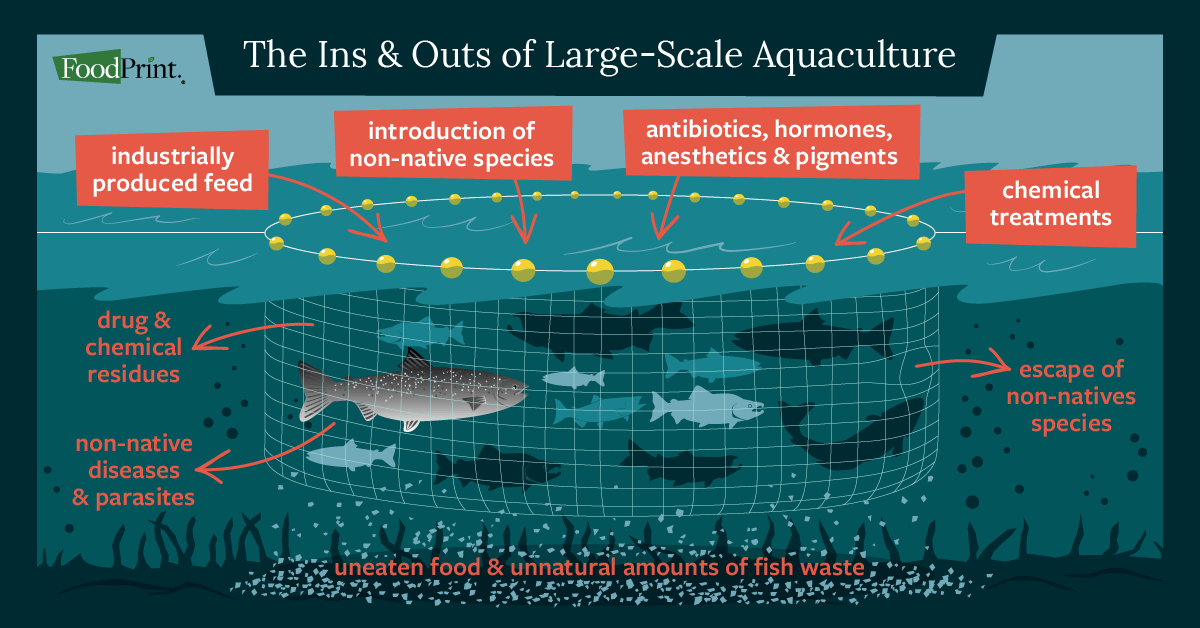 Click here to view a larger version of this graphic
Environmental Impacts
Advocates for aquaculture point to it as a solution to a variety of fisheries challenges — from overfishing to a changing climate. However, unsustainable aquaculture poses direct threats to the ocean through water pollution and habitat destruction — threats rivaling other concerns. Feeding farmed fish also has a large ecological footprint, as it involves harvesting unsustainable levels of small, wild, prey fish, leaving less in the ocean to support wildlife, while relying on environmentally destructive farming practices to produce ingredients like soy.
Water Pollution
Water pollution encompasses anything that degrades water quality and damages habitat in the surrounding area. In aquaculture, this includes fish wastes and various chemicals used in feed and for other purposes, but also contamination from diseases, parasites and escaped fish. In sustainable aquaculture, the farmed species should not negatively impact the surrounding environment and water quality. Unfortunately, to reduce operational costs so they can produce the promised “cheap seafood,” many aquaculture companies design systems that use oceans and rivers to flush waste, uneaten food, and chemicals out of their crowded facilities. This has serious consequences for the surrounding waters and habitat.
Fish Waste and Uneaten Food
Fish waste and uneaten food are major sources of pollution from aquaculture. While fish digest their food more efficiently than most other livestock, they don’t absorb everything they eat, so a significant portion of their food is excreted as waste into the ocean.21 This is especially true of nitrogen (which comes from protein): fish like salmon absorb less than half of the nitrogen-rich protein they consume.
The nutrients in fish waste and uneaten food pose a number of environmental problems. First, in high concentrations, some of the excess nutrients can be toxic to fish. Most unabsorbed nitrogen, for example, is released as toxic ammonia.22 When fish like salmon are kept in crowded pens, this can impact their health, damaging gills and reducing growth.23 Ammonia from aquaculture can also harm other species. For example, it has been linked to causing deformities and a reduced immune function in certain types of crabs.24
The concentrated nutrients from fish waste and feed also act as a fertilizer for algae and aquatic plants in the water. This leads to uncontrolled growth called an algae bloom. Because algae are not long-lived, the blooms can die off as quickly as they appear. Even though growing plants produce oxygen, the bacteria that decompose the dead algae quickly use all of the oxygen available in the water. This process is called eutrophication, and leads to low-oxygen “dead zones” in water, where fish and other wildlife die.
- Eutrophication
- The process in which bacteria within a body of water quickly use all of the oxygen available in the water which leads to low-oxygen "dead zones", where fish and other wildlife die.
Nitrogen fertilizer from industrial agriculture on land (which then runs off into waterways) is by far the biggest driver of eutrophication. In this sense, industrial aquaculture facilities, which rely on manufactured feeds, have a dual impact: not only does the fertilizer used to produce feed drive eutrophication, but waste from aquaculture facilities also contributes to localized die-offs, especially on the seafloor beneath pens or in water bodies with limited water flow.25 More than 25% of salmon facilities in Chilean fjords created low or no-oxygen environments in the sea beds under them.26 An overabundance of nutrients in water also pose a major concern for offshore net pens, where the spread and impact of fish waste is less understood.
Wastewater draining from fish and shrimp ponds on shore can also be a source of nutrient pollution. Shrimp ponds in Mexico and Southeast Asia add significant amounts of ammonia to water, contributing to eutrophication.27 28 Released wastewater from shrimp ponds can disrupt natural nutrient cycles in delicate coastal wetlands, which reduces their ability to filter water. Together, the combined nutrient pollution from shrimp farms can significantly reduce the number and variety of fish that these ecosystems can support. Researchers in Vietnam found that fish diversity was 35 percent lower in areas where shrimp wastewater was discharged.29 Wastewater from shrimp ponds can also be extremely salty, which presents risks to groundwater supplies — the development of shrimp ponds in India, for example, has caused conflicts between shrimp farmers and their communities, who can no longer use their wells for drinking and irrigation because the groundwater is too salty from leached pond salts.30
Disease
Intensive aquaculture relies on high stocking rates — confining a large number of fish in a small area — to be profitable. Unfortunately, just as in land-based concentrated animal feeding operations, these crowded conditions are also ideal for spreading parasites and disease. Sick fish are an animal welfare concern, but are also a form of pollution, because pathogens can spread into the water and harm wild fish. Researchers have discovered that the crowded and dirty conditions of many fish farms act as an amplifier for illness: not only are disease-causing organisms more common in water that flows through an aquaculture facility and likely to infect resident farm species, they are even more infectious and dangerous to nearby wildlife.31
1.5 million
The number of salmon that were killed in 1984, in Maine's Cobscook Bay, by Infectious Salmon Anemia (ISA)
Infectious Salmon Anemia, or ISA, is one example of a disease that moves back and forth between aquaculture sites and the surrounding environment. ISA is a flu-like virus that infects Atlantic salmon and similar fish. After its discovery on Norwegian salmon farms in 1984, the disease spread to salmon farms in Scotland, Chile, Canada and the US through the shipping of contaminated equipment, eggs and fish.32 In Maine, the disease killed nearly 1.5 million salmon on farms in Cobscook bay, which caused serious economic damage and fouled the water with dead fish.33 ISA still circulates today: in British Columbia, an ongoing outbreak on farms in close proximity to wild salmon migration paths is raising alarm among scientists.34
Thankfully, wild fish are less likely to be seriously sickened by the disease because they are not kept in such crowded conditions.35 Still, fish like herring and trout can be infected asymptomatically with the virus, enabling them to spread it among aquaculture facilities and fish in the wild.36 37 Meanwhile, researchers studying new viruses that move between salmon farms and wild fish suggest that emerging diseases from salmon farms could hurt wild species that already have low populations.38
Viral and bacterial diseases are also common in shrimp ponds. White Spot Syndrome Virus (WSSV) is one of the biggest threats to both shrimp farms and wild crustaceans today. As the name suggests, infected animals typically develop white spots, then die quickly from organ failure. WSSV infections can completely wipe out shrimp ponds in as little as one week.39 After its discovery in Taiwan in 1992, the virus spread quickly throughout Asia, causing the near-collapse of the shrimp industry. The disease exists worldwide today, spread by contaminated shrimp and by-products like feed.40 While the disease does not harm humans, it has been detected in frozen shrimp — one study found WSSV in 8 of 10 imported shrimp samples.41 Although it is most fatal to shrimp, WSSV can infect nearly all crustaceans — such as crabs and lobsters — which makes it a serious threat to the ocean. While the disease spreads less aggressively outside of crowded shrimp ponds, it is still prevalent in areas near shrimp farms.42 43
Crowded aquaculture facilities are also an ideal environment for parasites like sea lice. In wild salmon, sea lice occur in low numbers, causing minimal damage to the fish. In a crowded net pen, however, they can reproduce quickly, and cause serious bleeding, scarring, fin loss and death. Salmon farms act as an incubator for sea lice populations. Conservation groups in Scotland reported that sea lice populations on Scottish salmon farms doubled in a single year.44 These farms — especially those in fjords and bays where wild salmon migrate — can shed dangerous numbers of lice onto passing fish. Young fish entering the ocean are especially vulnerable to infection, and are significantly less likely to return to the rivers where they were born if they become infected.45 Removal of the accumulated parasites is difficult, and usually involves either harsh pesticides or exposure to hot water, both of which can harm and kill the fish.46 47
Antibiotics and Other Chemicals
Aquaculture facilities with high stocking rates often use antibiotics and other chemicals to control the spread of disease and parasites in crowded pens and ponds. This mirrors the misuse of preventative antibiotics on land-based factory farms. The overuse of antibiotics and other drugs in aquaculture is widespread and rapidly expanding. Researchers surveying antibiotic use in Vietnam found all sampled farms used antibiotics, and use of some drugs in Chile increased 500-fold in as little as seven years.48 Just like the overuse of antibiotics in other livestock, misuse of pharmaceuticals enables unsustainable and unhygienic production. This makes antibiotic abuse in aquaculture a serious concern for public health and the environment. Drug residues can hurt other organisms and disrupt nutrient cycles while contributing to dangerous antibiotic resistance.
Most antimicrobial and antibiotic drugs are given to fish in feed, but up to 80 percent of these drugs pass into the environment uneaten and unabsorbed.49 These residual drugs can have serious consequences for the environment. For example, wild fish that are exposed to antibiotics in the water can lose the protective effects of beneficial bacteria on their skin and in their digestive tracts. This also makes them more vulnerable to infection from harmful bacteria.50
Antimicrobials that sink into the sediment below aquaculture facilities can also change the composition of bacterial communities there. Researchers sampling bacteria from the seafloor under Chilean salmon farms found that antibiotics had significantly reduced diversity, leading to the dominance of antibiotic-resistant bacteria.51 This loss of diversity can have serious consequences, as many of these microorganisms are responsible for recycling nutrients. Disrupting these cycles can worsen problems like eutrophication.52
One of the most pressing concerns associated with antibiotic use in aquaculture is the development of antibiotic resistance. Ideally, veterinarians select antibiotics that are targeted to eliminate a specific disease. In aquaculture, however, antibiotics are sometimes used to prevent diseases before they even occur. When antibiotics are overused, bacteria quickly develop resistance to them. Many of the same antibiotics used in aquaculture are also used in medicine, and the evolution of bacteria that can resist these drugs is a serious threat to public health. Scientists have already seen antibiotic resistance develop in several bacteria that affect salmon and other fish. Because bacteria freely exchange genes, there’s potential for antibiotic resistance and other traits to be transferred from fish pathogens to those that affect humans. Genetic evidence suggests that at least one strain of salmonella that causes illness in humans acquired antibiotic resistance genes from another bacteria that affects salmon.53
The US Food and Drug Administration (FDA) is responsible for approving veterinary drugs like the ones used in US aquaculture. The FDA also monitors imports to ensure that drug residues in food are below approved levels and that illegal drugs were not used. Unsafe levels of antibiotic residues in food can disrupt beneficial bacteria in the human body, and some can increase cancer risk. Unfortunately, a 2017 report from the Government Accountability Office suggests that the FDA’s monitoring isn’t stringent enough, and that only .1 percent of imported seafood is tested for potentially harmful drug residues.54 Even with the incredibly low testing rates, hazardous chemical residues are still regularly flagged in imports of shrimp and other farmed seafood.55
Aside from the pharmaceuticals used on the fish themselves, many aquaculture facilities employ other chemicals to keep facilities clean. Much like farms on land must manage weeds, aquaculture facilities have to deal with biofouling — the growth of unwanted marine organisms on cages, pens and even the shells of animals. Some level of biofouling is inevitable, but too much can slow the growth of animals, slow waterflow and weigh down equipment.56 Control of biofouling often involves copper treatments on nets and other surfaces. Copper, which is toxic to most marine life, eventually leaches off of nets into the surrounding water, where it can harm fish, shellfish, and even plankton.57
Other biocides and disinfectants are often used to eliminate pathogens from ponds and pens. This is especially common on shrimp farms, where farmers who lack the resources to employ more precise disease control turn to harsh, chlorine-based disinfectants; one survey of shrimp farmers in Vietnam found that 90 percent of farmers relied on chemical disinfectants.58 In addition to polluting water that flows out of farms, many of these treatments are counterproductive, eliminating beneficial bacteria and clearing the way for disease-causing organisms. Disinfectants are inconsistently regulated across the world,59 and even banned chemicals like malachite green appear in samples of seafood imported into the US.60
Fish Escape
The fish and other animals used in aquaculture are often not native to the regions where they are raised. Atlantic salmon, for example, is farmed along the Pacific coast of Chile and Washington state. Even when they are native to the area, the animals in aquaculture are genetically distinct from the wild fish around them. While aquaculture facilities are designed to keep fish in, fish escapes still routinely happen, endangering the stability of the surrounding habitat.
Large-scale fish escapes are often the product of equipment failures, negligence or storms, which present an increasingly potent threat as climate change exacerbates harsh weather systems. In at least one case, a mass fish escape was the result of intentional sabotage.61 Large-scale collapses can introduce thousands of new fish into the environment at once: the collapse of net pens at a Washington state Atlantic salmon farm led to the escape of nearly a quarter million non-native fish into surrounding waters in 2017.62 Smaller-scale escapes also add up over time: nearly a million salmon escaped Scottish farms between 2002 and 2006.63 With overall rates of escape between one and five percent, researchers have estimated that millions of farmed fish make their way into the ocean every year, many of which are non-native species.64
When escaped species are not native to an area, they can outcompete native species for food, breeding grounds, and other resources. This reduces biodiversity and alters food webs in the surrounding environment, which can drive vulnerable species to near-extinction.65 Researchers studying fish escapes have found that salmon, trout and similar fish are especially prone to invading new areas and displacing native species. The risk of disruption and damage is especially high in areas like Chile where escaped salmon have few competitors for food.66
Native species introduce a different set of risks. Diseases spread more easily between farmed and wild fish when they belong to the same species. Escaped fish, which are bred in captivity, can also breed with wild fish populations. This can introduce potentially harmful genes into the population. For example, farmed fish are bred to grow quickly and need large amounts of food to do so. While these genes are helpful in the farm setting, they harm the chances of survival in the wild and ultimately make the wild species less suited to its environment.67
Genetically Modified Fish
The introduction of genetically modified Atlantic Salmon is a particular cause for concern with regard to environmental disturbance. The AquAdvantage salmon adds genes from Chinook salmon and ocean pout (an eel-like fish) into Atlantic salmon eggs. This modification allows the salmon to grow to market size in 18 months rather than the traditional three years, and AquaBounty, the company registering this salmon, says it uses up to 25 percent less feed than other farmed salmon.68 The salmon was the first genetically modified animal approved for human consumption by the FDA in 2015.
AquaBounty insists that their product is safe and has a minimal risk of escape. For the company’s initial regulatory approval, fish were raised first in an indoor hatchery in Canada and then shipped to an indoor facility in Panama where any escaped fish would not survive. While these safeguards were integral to the approval process, the company is now raising fish inland at US facilities, where they are still required to be kept only indoors. Additionally, while the fish are advertised as being sterile, the FDA review conceded that the sterilization techniques were not 100 percent effective.69
Pointing to the lower feed needs and fast growth of its product, AquAdvantage insists it is harnessing the power of technology to decrease the environmental footprint of farmed fish. However, advocates from environmental organizations and indigenous communities who rely on healthy wild fisheries worry that its approval opens the door to more transgenic fish that could pose an enormous environmental threat. The AquAdvantage salmon was the first of its kind and required a unique approval process; unlike GMO crops, which have a well-defined requirement for environmental impact evaluations, the salmon was approved as a veterinary drug to be regulated by the FDA. Plaintiffs in one suit argued that the FDA lacked the appropriate expertise to perform an effective environmental evaluation.70 While the suit was largely dismissed by a federal judge, advocates remain concerned that the salmon and future genetically modified fish might be subject to less stringent testing and oversight for environmental protections, increasing risks for escapes and other disturbances.71
In spite of financial troubles incurred by the lengthy regulatory battle, the company is preparing to make its first US harvest of the genetically modified salmon in 2020.72
Other Habitat Destruction
The various forms of water pollution associated with industrially scaled aquaculture cause serious habitat damage, but the building of aquaculture facilities themselves can cause habitat destruction. Mangroves, coastal forests common in the tropics, are often cleared to make way for shrimp ponds. In later decades of the 20th century, shrimp ponds expanded across Ecuador, Mexico and Central America, displacing up to a quarter of mangroves in many areas.73 The expansion of shrimp farms in southeast Asia is the single largest driver of such deforestation today.74
Mangroves shelter coastal areas from storms and erosion, bolster biodiversity, and sequester large amounts of carbon. Removal of mangroves for shrimp production has a number of consequences, including large greenhouse gas emissions. Researchers calculated that the mangrove deforestation associated with a single “surf and turf” shrimp dinner produces CO2 emissions that equal a road trip from New York to Los Angeles.75
Even lower-impact forms of aquaculture can cause habitat destruction when inappropriately scaled and located. Farmed shellfish require few inputs and they filter surrounding water, but they can still compete with other organisms for space. This is especially true of marine plants like eelgrass, which colonize the same shallow, sandy environments where oysters and other bivalves thrive.76 Eelgrass beds are critical habitat for many wild fish, shellfish, crustaceans and marine mammals, and the expansion of shellfish farms threatens this balance. In the Pacific Northwest, the Swinomish tribe are pursuing a lawsuit against the expansion of a shellfish farm, arguing that it would harm their ability to maintain the eelgrass beds and sustainably harvest wild shellfish.77
Feeding Farmed Fish
Although there are some aquaculture systems that use natural algae and other low impact food produced on site, like flies and worms, to feed fish in ponds, almost all intensive aquaculture systems rely on manufactured feeds. Although farmed fish are often referenced as a way to help alleviate overfishing of wild stocks, almost all aquaculture feeds rely at least partially on feed made from wild-captured fish. The plant-based portion of aquaculture feeds has increased in recent years, but the production of these ingredients — mainly soy, corn and other industrially produced and often genetically-modified crops — comes with its own large environmental and socio-economic footprints.
Some of the most common fish in aquaculture, like catfish and tilapia, are herbivores and eat mainly plant-based ingredients. Even these species still need some of the vital nutrients that come from wild fish, however, and high-value carnivorous species — like salmon and eels — need much more. Fish meal and fish oil are the two most common fish-based products in aquaculture feeds, and they provide protein and compounds, like omega-3 fatty acids, that help keep fish healthy. These beneficial ingredients in the small “forage” fish used for aquaculture originally come from plankton, and make their way up the food chain. Larger fish like salmon and tuna rely on forage fish for these vital nutrients.
Forage fish are caught on a wide scale and turned into fish meal and fish oil through a process called rendering. Due to the huge demand for farmed fish, the rendering industry has grown dramatically in the last few decades. Use of fishmeal doubled between 1995 and 2007, though this has stabilized with the introduction of more plant-based feed.78 79 This amounts to more than a quarter of fish caught today, nearly 20 million tonnes.80
Although the inclusion of more plant-based ingredients has made aquaculture feeds more efficient, many kinds of fish actually consume more fish than they produce themselves. For example, a kilogram of farmed salmon takes nearly 2 kilograms of forage fish to produce because of its high fish oil needs.81 Considering that 90 percent, or 18 million tons of the fish caught for non-human consumption is edible, rendering is an inefficient use of resources.82
These forage fish are also subject to overfishing, which can seriously disturb ocean ecosystems. Because so many wild species rely on small fish, disturbances in their population can have ripple effects on entire regions of the ocean. The fishery for Peruvian anchoveta, the world’s most-caught forage fish, has nearly collapsed several times due to the combined pressures of overfishing and weather.83 Robust populations of forage fish like anchoveta are important for almost all ocean food webs, and their removal threatens the survival of many endangered and threatened species that depend on them as prey.84
The Atlantic menhaden, the most-caught fish on the Atlantic coast of the US, is one of these keystone species. The menhaden is exclusively used for rendering into fish oil, fishmeal, and other products, and its continued overexploitation represents a threat to entire food webs in the Chesapeake and along the East coast. In light of this, the managers of the fishery recently shifted from a single species management approach to a holistic evaluation system that sets limits based on the health of the rest of the food web.85 Policies like this may help to deter the habitual overfishing, but are difficult to implement successfully as they require careful monitoring of quickly changing environmental conditions.
The Problem with Using Soybeans as Fish Feed
The inclusion of more plant-based ingredients for fish feed has successfully lowered the forage fish needs for many species, since soy and other crops can replace some of the needed protein and oils. However, the use of these ingredients to feed livestock on land is a major driver of soil loss, water pollution, chemical use, and other environmental problems, and their use in aquaculture only increases demand for these unsustainably sourced products.
The increasing presence of soy in fish feed is of particular concern. Industrial soy production is an environmentally destructive practice that degrades soil and pollutes waterways with excess fertilizer. Most of the soy produced in the US and Brazil is made from soybeans that are genetically modified for herbicide resistance, which drives chemical use on farms even higher.86 Just like increased global demand for industrially grown beef has expanded soybean production into rainforests, researchers project the increasing prevalence of soy into aquafeeds will contribute to greater demand for soy worldwide.87 This increased demand will only exacerbate deforestation and further uproot the communities who live and farm sustainably in these critical ecosystems. While some salmon producers have pledged not to use soybeans tied to deforestation in Brazil, these commitments are difficult to execute and even harder to track. Companies like Cargill, which supply soybeans to the global aquafeed market, have so far failed to deliver on promises of increased transparency and avoiding deforestation.88 Moreover, they fail to adequately address the more fundamental concerns of high chemical use and soil degradation.
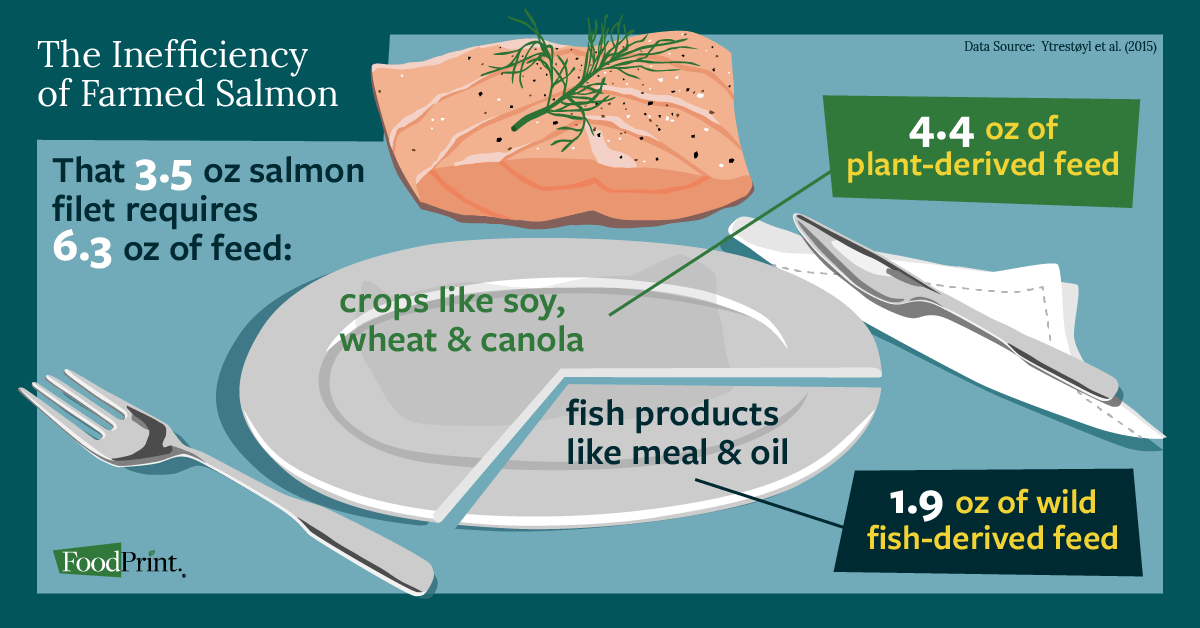 Click here to view a larger version of this graphic
Plant-heavy diets are not natural food for carnivorous fish like salmon, and too high a proportion of ingredients like soy in feed can stunt growth.89 These plant-heavy diets also have implications for human health: farmed salmon don’t always have the same levels of omega-3 fatty acids and other nutrients that make eating wild-caught seafood so beneficial.90 This allows industrial aquaculture to cash in on dietary guidelines that promote seafood without really delivering the same benefits.
Sometimes, nutrients are added to fish feeds that affect the quality of the final product. Salmon, for instance, are fed an antioxidant from algae that turns their flesh orange. This ingredient, astaxanthin, occurs naturally in the diets of wild fish. While it is sometimes falsely labeled as a dye, it does serve as an actual nutrient for the fish when it is added to feed. However, salmon producers do admit that one of its main purposes is to give the fish an appealing orange color.

No comments:
Post a Comment