1). “Moms.gov, Mifepristone, and an FDA Shakeup: Last Week in Abortion Rights”, May 17, 2026, Jessica Valenti, Abortion, Every Day, at < https://jessica.substack.com/
2). “Are You ‘Underbabied’?”, May 17, 2026, Kathleen Walsh, The Cut, at < https://www.thecut.com/
3). “Abortion 'abolitionists' in Kansas and other states wanht to charge women with murder”, Jun 23, 2023, Rose Conlon / Kansas News Service, Nebraska Public Media, at < https://nebraskapublicmedia.
4). “Mayes, GOP lawmakers on opposite sides in abortion lawsuit”, May 13, 2026 (Updated May 17, 2026), Howard Fischer, Tucson.com, at < https://tucson.com/news/state-
5). “Governor signs Oklahoma bill criminalizing providing abortion-inducing drugs”, May 07, 2026, Barbara Hoberock, Oklahoma Voice, at < https://oklahomavoice.com/
~~ recommended by desmond ~~
Introduction by desmond: In the U.S., already groaning under a fascist regime that has so far succeeded in putting Trump Abortion Bans in place in something like 20 States; fortunately there is still stiff resistance to the Forced-Pregnancy / Forced-Birth agenda, that now dominates about half the country. What is more there are constant attempts to pass laws that would criminalize women for obtaining abortions (even if done by traveling to a Blue State where abortion is legal).
In Item 1)., “Moms.gov, Mifepristone, ….”, Jessica Valenti discussed what she termed the “REPRODUCTIVE POLICE STATE”. She points out that the new website “Moms.gov” is a dangerous place for young women to frequent and it “.... redirects users to Option Line—a massive data collection tool run by Heartbeat International, the country’s largest network of crisis pregnancy centers.”
The snide and vicious agenda of the Trumpista Regime is demonstrated by the absurd question posed by Mehmet Oz (in charge of dismantling and damaging Medicare and Medicaid). Item 2)., “Are You ‘Underbabied’?”, has a short discussion and 15 comments by skeptical Women. The truly crazy Abortion abolitionists, who are itching to begin show trials and public executions of women who have obtained abortions are discussed in Item 3)., “Abortion 'abolitionists' in Kansas ….”. If you want to see some really loony stuff go to “Abolitionists Rising” at < https://www.youtube.com/
(NB note - those Forced Birther videos ^^^ are awful. And the self righteous condescending comments are worse!. ICK!!!)
There are many decent people toiling away trying to protect our liberties and rights. Just one example is here from Arizona (where the Governor, and Attorney General, and mayors of the major cities (Phoenix, Tucson, Tempe and others) are all supporters of abortion rights but the Rethugs control the State Legislature. Item 4)., “Mayes, GOP lawmakers ….”, provides some introduction to those issues in Arizona. Item 5)., “Governor signs Oklahoma bill ….”, reports that: “Gov. Kevin Stitt has signed into law a bill that criminalizes the distribution of abortion-inducing drugs.” This sort of action was first done by Louisiana, that placed Mifepristone and Misoprostol on the same level of controlled substances as heroin and morphine. An obviously false and dishonest way of contending with drugs that have been used safely since 1988 in France and since September of 2000 in the U.S.
xxxxxxxxxxxxxxxxx
Moms.gov, Mifepristone, and an FDA Shakeup: Last Week in Abortion Rights
The REPRODUCTIVE POLICE STATE was in full effect last week: the Trump administration launched Moms.gov, a government-run website that helps the anti-abortion movement collect information on pregnant Americans. Not a joke: Moms.gov redirects users to Option Line—a massive data collection tool run by Heartbeat International, the country’s largest network of crisis pregnancy centers.
For years, privacy groups, abortion rights advocates, and Democratic legislators have warned that anti-abortion extremists use Option Line to collect sensitive information on vulnerable women. And as Abortion, Every Day has reported previously—they don’t exactly treat that information with care:
This isn’t some accidental partnership—it’s been years in the making. Senate Republicans have long pushed to create a government-run website that funnels women to crisis pregnancy centers, floating names like life.gov and pregnancy.gov along the way. With Moms.gov, the White House just made those conservative dreams a reality. For American women? A nightmare.
By the way, that Moms.gov launch gave us a new ANTI-ABORTION GLOSSARY term: under-babied. Dr. Oz, administrator for the Centers for Medicare & Medicaid Services, complained that “one in three Americans are under-babied.” He even defined the term for us: “you either don’t have any children or you have less children than you would normally want to have.”
Never thought I’d miss the days of JD Vance calling us “childless cat ladies”!
TELEMEDICINE ABORTION remains safe and accessible for now, thanks to a Supreme Court order last week that sent Louisiana v. FDA back to a lower court. The case is one of the most sweeping threats to abortion access in years: it aims to shut down telehealth prescriptions for abortion pills and dismantle the shield laws protecting providers who ship them across state lines. (Republicans are truly desperate to extradite blue state abortion providers into states where they can get life in prison.)
To get up to speed on everything that’s happened over the past two weeks, start here for a breakdown of the lawsuit and the Fifth Circuit ruling, then read this for the political fallout it sparked. And if you want to understand what the Supreme Court’s move actually means—and where this is all headed—check out the explainer Kylie and I put together on Friday:
Last week’s legal chaos wasn’t helped by a major SHAKEUP AT THE FDA: Commissioner Marty Makary “resigned” mere days after rumors that Donald Trump planned to fire him.
Anti-abortion leaders have been lobbying the White House to oust Makary for months, claiming he hasn’t been aggressive enough on mifepristone. Groups like Susan B. Anthony Pro-Life America were also pretty pissed off when it came out that Makary was likely slow-walking the FDA’s ‘safety study’ of mifepristone until after the election.
I’m sure they’re much happier with Trump’s interim FDA chief—Kyle Diamantas, who immediately got on the phone with anti-abortion activists like Lila Rose of Live Action and Kristan Hawkins from Students for Life. Apparently he promised them that the government’s mifepristone review is a “top priority.”
Unfortunately, ATTACKS ON ABORTION PILLS don’t stop at the courts. Last week, Oklahoma Gov. Kevin Stitt signed legislation making the ‘trafficking’ of abortion medication a felony punishable by up to ten years in prison. And just like the law that passed in Mississippi, the language in Oklahoma’s legislation criminalizes “intent” to distribute abortion pills.
Then there’s South Carolina, where Republicans are trying to classify abortion pills as a controlled substance. The trend started in Louisiana and other anti-abortion states have been falling like dominoes ever since. This past week, the local NAACP publicly opposed H. 4760, noting that “regardless of where individuals stand on abortion, every South Carolinian should be troubled…”
In other STATE NEWS, anti-abortion legislators in Arizona are hiring their own private lawyers to defend state abortion restrictions—even though voters codified protections for abortion in 2024. What’s more, they’re not hiring the lawyers on their own dime: taxpayers will foot the bill.
xxxxxxxxxxxxxxx
Dr. Oz Is Worried About ‘Underbabied’ Americans

Photo: Shelby Tauber/Bloomberg via Getty Images
Are you one of the 30 percent of Americans who are, according to Dr. Oz, “underbabied”? Unfortunately, he does not mean “underbabied” in the sense that you’re being insufficiently pampered (you and I both, friend). During a White House event on Monday, Dr. Oz defined underbabied as having fewer children than you’d like or having no children at all. (The term didn’t catch on the first time Oz tried to make it happen in October 2025, so it’s unclear why he imagines it will take off now.) Since 2.1 children per woman is the generally accepted fertility rate required to maintain a stable population, I suppose having two or more kids could be termed “adequately babied.” I wonder what number of children would qualify a person as “overbabied.”
“We’re way below what we need just to replace the people that we have in America,” Dr. Oz said, going on to plug the Trump administration’s new website for discounted drugs including fertility medications. Oz predicted that, thanks to such efforts, there will be a wave of “Trump babies” in the near future. “You have to get moms healthy enough to do the most creative thing the universe knows,” he continued, “which is making babies.” Nowhere did Oz mention child-care costs or paid parental leave.
It is true that fertility rates in the United States have fallen below that 2.1 replacement level and are now at historic lows. However, this lacks some important context. A large part of the drop in fertility rates is due to the rapidly declining rate of teen pregnancies, which fell by 7 percent in 2025. Simultaneously, fertility rates among women in their 30s and 40s have been rising, and more women are having children in their late 40s than ever before.
Regardless, if Dr. Oz wants to get America sufficiently “babied,” I suspect it’s going to take a lot more than markdowns on Clomid to get us there.
xxxxxxxxxxxxxxxx
Abortion 'abolitionists' in Kansas and other states want to charge women with murder
By Rose Conlon / Kansas News Service
23 de Junio de 2023 a las 05:00 · 12 min read

Listen To This Story
WICHITA, Kansas — As far as T. Russell Hunter is concerned, nowhere in the U.S. has actually banned abortion yet.
From the podium of a Wichita hotel conference room, the man at the helm of one of the most zealous anti-abortion groups in the country pointed to a map of the country. Every state colored red, he said, indicated where abortions still legally took place.
“We made them all red,” Hunter said, “because in all of these states, abortions are happening.”
In the year since Roe v. Wade was overturned, more than a dozen states have made it a crime to provide abortions in most cases. But none, so far, punish women for obtaining abortions — enabling many to skirt bans by ordering abortion pills online or traveling to clinics in other states.
Hunter, who lives in Oklahoma, is determined to change that. For more than a decade, he’s pioneered an absolutist wing of the anti-abortion movement that calls for a total abortion ban without exceptions — and, notably, charging women who have abortions with murder.
They call themselves abortion abolitionists, borrowing the term from the fight to abolish slavery. “Pro-life,” to them, is a pejorative, and they blast the mainstream anti-abortion movement for settling for laws they say don’t go nearly far enough.
Their views remain unpopular in the U.S. and within most of the anti-abortion movement. But their numbers are growing. And as the country’s abortion landscape crystallizes in the wake of Roe, some see new opportunity for their ideas to take hold.
A budding movement
A few hundred people from across the country gathered in March for the unveiling of a new, national organization called Abolitionists Rising. Hunter and other leaders want to unify the movement, propel supporters to political action and build momentum for a national abortion ban. If that seems radical, Hunter says, the abolition of slavery once did, too.

Kansas was chosen, in part, because so many now travel here to get abortions, fleeing bans in their own states.
“We want to turn Wichita upside down,” said Jared Burdick, who leads an abolitionist group out of St. George, Kansas. “This is a bloody city.”
They fanned out across the city carrying graphic signs reading “Bleeding Kansas,” a nod to the state’s bitter history in the fight over slavery. Wearing body cameras, they filmed contentious arguments on sidewalks and college campuses, sharing them with hundreds of thousands on social media.
Molly Johnson, who traveled to the conference from Oklahoma City, broke down in tears outside the Trust Women clinic. She supports the death penalty for women who get abortions — so long as they get due process — just as she supports the death penalty for those convicted of rape and other capital crimes in the Bible.
“God values human life so highly that when one human chooses to murder another innocent human,” she said, “they forfeit their own life.”
Johnson used to consider herself pro-life, but became disenchanted with the movement’s refusal to discuss women’s responsibility in abortion. Her abolitionist advocacy has cost her friendships. She thinks many people in the mainstream have assumptions about women who get abortions that don’t match the reality she sees when she protests at clinics.
“They’ve never actually gone out to an abortion mill and seen that the majority of women who come in here — they have very hard hearts,” she said. “They’re flipping us off and screaming obscenities, just wicked things.”
Culpability
The question of whether and when a woman is culpable for having an abortion has long vexed the anti-abortion movement. But now, what used to be a primarily moral debate could soon come to influence criminal law.
Mainstream pro-life groups have long held that women are “second victims” of a predatory “abortion industry.” They contend that women don’t understand what they’re doing when they get abortions, are sometimes coerced into doing so by their partners or families, and often come to regret it. Instead, they focus on regulating and shutting down abortion providers.
The claim that women who get abortions don’t have agency in the decision has become more difficult to defend in recent years, especially since abortion pills took over as the leading abortion method in the U.S. It’s still somewhat easy — and legal — for women living in states with abortion bans to buy the pills online and manage their abortions themselves, something abolitionists often highlight.
Meanwhile, the abortion rights movement has increasingly framed the decision to have an abortion as not necessarily morally or emotionally fraught, but a matter of routine health care — a marked shift from the “safe, legal, rare” mantra coined by former President Bill Clinton. Organizations like We Testify and social media campaigns like #ShoutYourAbortion have sprung up in recent years with the aim of destigmatizing abortion and those who have them.
Abolitionists — who have diametrically opposed policy goals from abortion rights supporters — generally agree with them on this: women who get abortions, both camps say, are usually making free and informed decisions.
“I don’t know of any instances where an abortionist came into someone’s house, found a pregnant person and killed their baby against their will,” Hunter said.

He thinks the mainstream’s victim argument is a ploy for political sympathy.
“The pro-choice movement says (getting an abortion) is a choice. We say it’s a choice. The pro-life movement is just trying to be appealing and look like they’re loving women,” he said. “And they’re absolute nuts.”
This is a crucial distinction for abolitionists. Most recognize that undoing the notion that women are victims is essential to criminalization efforts.
“Should victims be punished? No. It’s an injustice to punish victims,” David Buboltz, an abolitionist who unsuccessfully ran for North Carolina Senate last year, told conferencegoers. “We will never succeed with an abolition bill until we thoroughly destroy the second victim narrative.”
Strategy
Abolitionist groups began cropping up over a decade ago. Hunter founded his first organization in 2011, eventually landing on the name Free The States — referencing demands that states ban abortion in defiance of Roe. In 2017, Arizona pastor Jeff Durbin began spreading abolitionist ideas more widely through his group End Abortion Now and a popular YouTube channel. Dozens of local abolitionist groups now exist across the country.
Efforts to lobby lawmakers and run primary challengers against Republicans seen as too soft on abortion have led to the introduction of abolitionist legislation in several states, including Kansas. Last year, an abolitionist bill advanced out of committee to the Louisiana House floor — a first for any state. Most of its supporters switched their votes after more than 70 pro-life organizations condemned it.
Kevan Myers, a Kansas City, Kansas, pastor and abolitionist leader, says the state’s pro-life lobby still has a strong hold on lawmakers, but some seem receptive.
“You either need a change in the legislators,” he said, “or a change of the legislators.”

Abolitionists anchor their legal strategy on the 14th Amendment of the U.S. Constitution that granted citizenship to formerly enslaved people. They say its equal protection clause already guarantees personhood rights for the “pre-born,” an argument that courts have yet to embrace. Women who get abortions, they say, should be prosecuted under existing homicide laws.
It follows, abolitionists say, that there should be no exceptions for pregnancies conceived due to rape or incest, because that would amount to punishing an innocent child for the crimes of their father. When a woman’s life is endangered by a pregnancy, they believe that should trigger triage, giving the life of the fetus equal consideration. And while they concede it would be hard to enforce laws banning women from taking abortion pills, they say it would serve as an important deterrent.
Ideological rifts
For mainstream pro-life groups, which long promised that overturning Roe would not lead to abortion patients being jailed, abolitionists represent a messaging nightmare.
“They’re in the minority,” said Kelsey Pritchard, director of state public affairs for Susan B. Anthony Pro-Life America.
The National Right to Life Committee, Students for Life and Kansans for Life declined to discuss abolitionists’ critiques, but emphasized their opposition to prosecuting abortion patients.
The split is also a matter of style. Most people active in the broader anti-abortion movement say that life begins at conception. They’re generally united behind the long-term goal of wanting to outlaw abortion at all stages of pregnancy, despite some disagreement over when to make exceptions.
But the mainstream groups — which, for decades, grew accustomed to working within Roe’s confines and focused primarily on overturning it — often concentrate on policies that restrict and reduce abortions while working toward the ultimate goal of ending it entirely. Even post-Roe, some have supported gestational age limits and heartbeat laws that abolitionists say don’t reflect their claims about when life begins.
“We would like for there to be protections throughout pregnancy, all nine months, in every state,” Pitchard said. “But we recognize the political realities that exist, and so we aim to save as many lives as we can, as fast as we can.”

Abolitionists say incrementalism stalls progress. And now that states are free to restrict abortion as they see fit, they see no excuse for holding back.
Often, they take this to an extreme that defies logic for those in the mainstream. In Kansas, for instance, Myers and others campaigned against last year’s ballot measure that would’ve undone the state Supreme Court’s recognition of abortion protections in the Kansas Constitution and allowed lawmakers to institute much harsher abortion restrictions, including a total abortion ban.
Anything short of eradicating abortion, Myers said, is unbiblical.
“If someone could kill me if I was inconvenient,” he said, “would I want legislators to gather and say, ‘We’re against killing Kevan, so we’re gonna make a law that says if you’re going to kill Kevan, you have to think about it for 24 hours?”
Longstanding frustrations
The anti-abortion movement has long dealt with internal division.
Some renegade abortion opponents, fed up with the mainstream pro-life playbook, began holding blockades and sit-ins at clinics in the 1970s. By the mid 1980s, their aggressive and sometimes violent tactics took off, spurring dozens of arson attacks and firebombings across the country. They ran the gamut from terrorist groups like the Army of God to those advocating nonviolent tactics like Operation Rescue, whose slogan was “if you believe abortion is murder, act like it’s murder.”
That came to a head in 1991, when Operation Rescue brought tens of thousands of protestors to Wichita for six weeks of civil disobedience billed as the “Summer of Mercy.” They laid in roadways and chained themselves to clinic gates, including that of George Tiller, one of the country’s few doctors who performed third-trimester abortions. More than 2,600 people were arrested.
“Operation Rescue emerged from this frustration that the tactics of the National Right to Life Committee were not ending abortion,” said Daniel Williams, a history professor at the University of West Georgia. “They believed they could bring an end to abortion much more quickly by physically disrupting the sites where it was occurring.”
The movement eventually splintered into two main organizations. The group known today as Operation Rescue began in California as one of several independent groups using similar tactics, and relocated to Wichita in 2002 to focus on shutting down Tiller’s clinic. The original group, based in North Carolina, rebranded as Operation Save America. Tiller was killed in 2009 by an anti-abortion extremist.
Troy Newman, president of the modern-day Operation Rescue, sees the rise of abolitionist groups as a result of the same internal divisions that existed decades ago. He doesn’t consider himself an abolitionist, but welcomes pressure on mainstream groups.
“The pro-life movement has become very watered down in its messaging over the years,” he said — criticizing what he sees as an overemphasis on efforts like aiding mothers through crisis pregnancy centers in a ploy to win over voters. “The movement, as an adjunct, [should] support women. But the primary objective is to end the act of murder.”

What sets abolitionists apart from the earlier, more radical wings of the anti-abortion movement is the focus on punishing women who have abortions.
Williams attributes the rapid rise of that idea, in part, to a generational shift in thinking about gender.
“The traditional pro-life movement’s claim that women who obtain abortions have limited agency reflects views of gender that would have been popular in the early 20th century but — even for many conservatives of a younger generation — are difficult to sustain,” Williams said.
The politics
Americans hold complicated views on abortion — a majority think it should be legal in many cases, but would also like to see restrictions. Doling out death-penalty sentences to abortion patients, like some abolitionists call for, is extremely unpopular.
But support for criminalization is gaining traction, particularly among white evangelical Christians. In 2021, the Southern Baptist Convention formally denounced incremental pro-life laws and called members to work toward “abolishing abortion immediately, without exception or compromise.” The issue remains contentious, but abolitionists are pressuring the country’s largest Protestant denomination to move to the right.

And ultimately, says University of California, Davis law professor Mary Ziegler, the broader anti-abortion movement is realizing that seizing legislative and judicial power might matter more than winning popular support.
“That impulse is present in a lot of the movement, but it’s really clear among abolitionists,” she said. “They’re not even trying to appeal to voters. They’re just saying, ‘This is what we ought to do, and we ought to try to find legislators who agree with us.’”
Few analysts see abolitionists getting much done any time soon. But they could help shift public opinion and make relatively extreme bans look moderate.
The mainstream anti-abortion movement might be forced to confront abolitionism if it achieves one of its long-term goals — the recognition of fetal personhood — which Ziegler says might might compel states to prosecute women who have abortions.
And some lawmakers could warm to the idea of punishing women if other attempts to make it harder to get around abortion bans don’t pan out — like challenges to the abortion pill mifepristone, or efforts to restrict interstate abortion travel for Idaho minors.
“The most powerful organizations don’t want to punish women,” Ziegler said. “But what you’re seeing is abolitionists waiting in the wings saying not only that they think it’s the right thing to do, but that they think it’s sort of necessary — because there’s skepticism about whether these other strategies will work.”
xxxxxxxxx
Mayes, GOP lawmakers on opposite sides in abortion lawsuit
PHOENIX — Democratic Attorney General Kris Mayes is once again at odds with Republican legislative leaders. And, once again, the issue surrounds the right of Arizonans to obtain an abortion.
Mayes has decided to side with the American Civil Liberties Union, which is challenging state laws that bar certain "advanced practice clinicians,'' such as specially trained nurse practitioners, from providing abortion services. They are asking a Maricopa County judge to declare the restrictions unconstitutional.
What makes that significant is that Josh Bendor, the solicitor general in Mayes' office, said Arizona law generally requires the Attorney General's Office to defend state laws when they are challenged in court. But he said that doesn't apply "when there is not a plausible argument'' to make, which he said is the case here since voters in 2024 agreed to put a right to abortion into the Arizona constitution.
In turn, that has resulted in House Speaker Steve Montenegro and Senate President Warren Petersen hiring their own private lawyers at taxpayer expense to ask the judge to toss the case.
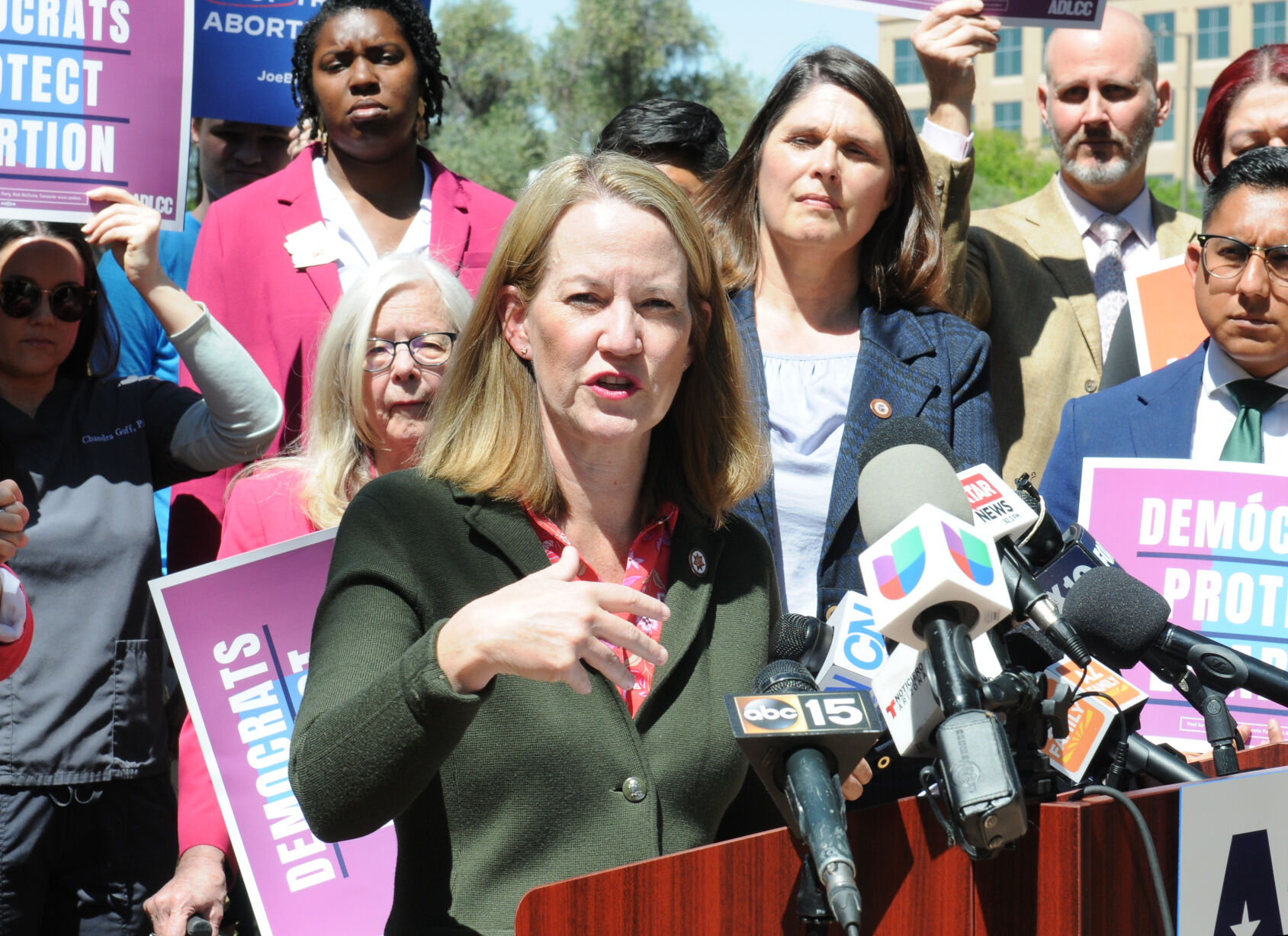
Attorney General Kris Mayes at a 2024 rally about abortion rights.
Neither GOP leader would respond to questions about their decision to defend a law that Mayes and Bendor say is legally indefensible.
"To me, the question is, why is the Legislature spending taxpayer money to defend these kinds of things in the face of the will of the voters?'' Bendor said.
How quickly there can be a ruling is unclear. At a court hearing earlier this week, attorneys provided no timeline for when they would be ready to bring the case to court.
'Fundamental right'
Central to the ACLU lawsuit is the fact that the state Board of Nursing, which regulates advanced practice nurses, concluded in 2008 that they can safely perform first-trimester abortions.
They are a subset of registered nurses who, by virtue of advanced education and training, have a broader scope of practice than registered nurses. They also can hold specific licenses, such as certified nurse midwife and nurse practitioner.
The Republican-controlled Legislature responded almost immediately with a measure stripping the nursing board of its power to decide who can perform the procedure.
What changed since then is that voters in November 2024 approved Proposition 139 by a 3-2 margin.
It added language to the Arizona Constitution providing a "fundamental right to abortion'' prior to fetal viability, generally considered between 22 and 24 weeks. ACLU attorneys say the only exception is when there is a "compelling state interest that is achieved by the least restrictive means.''
It is now up to Superior Court Judge John Blanchard to decide the scope of the voter-approved initiative.
Challengers say the wording is on their side.
"The fundamental right to abortion means little when Arizonans cannot get care from a trusted and skilled provider in their own community,'' said Lauren Beall, a staff attorney at the ACLU of Arizona. "Overturning senseless restrictions that tie the hands of advance practice clinicians is the next step to fulfill the promise of the Arizona Abortion Access Act.''
'Compelling state interest'
Montenegro and Petersen, through their lawyers, are taking a contrary position.
"None of the challenged provisions denies, restricts, or interferes with the right to abortion,'' they are telling Blanchard.
And if that argument doesn't work, they have another one — linked to the exception within the amendment.
They contend that, if nothing else, each of the restrictions "is justified by a compelling state interest that is achieved by the least restrictive means.'' But the legal papers filed so far on their behalf do not explain that claim.
Bendor, however, said the way he and Mayes see it, there is no legal basis for the GOP lawmakers to argue that the restrictions remain enforceable.
"The standards changed a lot when voters enacted Prop. 139,'' he told Capitol Media Services. "It sets a pretty high burden for laws to meet to restrict the right to abortion.''
It was that touchstone, Bendor said, that his office used to evaluate the legal restrictions on advanced practice nurses. He said these are restrictions that exist "even though nurses have done so historically, have done so elsewhere, do other gynecological things that are more complicated.''
"We determined that these restrictions don't meet the constitutional requirements,'' he said. Conversely, Bendor said, the Attorney General's Office had no good arguments why the laws would pass muster, even with the exceptions built into Prop. 139.
He said the decision to side with challengers was not made lightly.
"As a matter of process, we start with the assumption that our job is generally to defend state law,'' Bendor said.
"But when there just is not a plausible argument in defense of a given state law, then it's not in the public interest or within our responsibility to do so,'' he said. "And that's more likely to happen when you have an intervening change in constitutional law that then calls into question statutes that were enacted without that constitutional provision even in mind because it didn't exist at the time.''
All that leads to "a very different calculus'' in terms of the role of the Attorney General's Office, Bendor said
In fact, he said, that is the same sort of calculus that should have, but did not, affect the decision by GOP lawmakers to defend a law despite the intervening change of the adoption of Proposition 139.
Procedure not consistently available statewide
The fight over the restrictions, according to challengers, has real-world impacts.
In their legal filings, they said that since that ban took effect, abortion has only been consistently available in Pima and Maricopa counties, while there have been "interrupted and limited services'' at a single clinic in Coconino County. The requirement that only doctors can provide abortions, the challengers argue, means patients can often have to drive for hours.
They also claim there is no medical reason for the law, backing that up with a statement from the American College of Obstetricians and Gynecologists, which says bans like the ones in Arizona "are not based in science, improperly regulate medical practice, and impede patients' access to quality, evidence-based health care.''
Also, the U.S. Food and Drug Administration, in approving the drugs used in medication abortions, has authorized advanced clinicians to provide medication abortions.
Also involved, the challengers say, is the right of women to make choices for themselves.
"People choose their health care provider, whether a physician or an APC, for various reasons, some deeply personal,'' the lawsuit states. "Particularly when it comes to abortion care, they may have a strong preference for a trusted provider they have seen for other primary or reproductive health care.''
And sometimes, the lawsuit says, it can be as simple as people preferring a clinician to a doctor, wanting someone who can see them quicker, or who is closer to their home.
"By overriding people's choice or provider, for no medical reason, the APC ban violates their autonomy," the lawsuit says.
Previous cases
This isn't the first time Mayes has declined to defend abortion laws that were in existence when Proposition 139 was approved.
She took a similar stance when the ACLU and the Center for Reproductive Rights filed suit in 2025, challenging a series of prior existing laws.
Those laws included a 24-hour waiting period before a woman can terminate a pregnancy; and a ban on doctors performing an abortion if they have reason to believe the patient is seeking the procedure because of a fetal genetic defect. Challengers also sought to void a prohibition on the use of telemedicine in abortion cases — including a ban on the mailing of abortion pills to patients.
"We have determined that the three laws that the plaintiffs are challenging here are unconstitutional and cannot withstand tests that the voters stood up when they amended the constitution to protect abortion rights,'' Mayes said at the time.
All of those laws were later voided by a trial judge who rejected arguments by GOP lawmakers that they remained enforceable despite voter approval of Proposition 139. That ruling, however, remains on appeal.
There is also a separate but related issue playing out in federal court where Louisiana got a federal appeals court to ban telehealth abortions — and, specifically, the shipping of abortion pills — based on the argument it allowed its residents to circumvent that state's abortion ban. But that ruling has been paused by the U.S. Supreme Court.
xxxxxxxxxxxxxxxxxxx
Governor signs Oklahoma bill criminalizing providing abortion-inducing drugs • Oklahoma Voice
OKLAHOMA CITY – Gov. Kevin Stitt has signed into law a bill that criminalizes the distribution of abortion-inducing drugs.
House Bill 1168 would make it a felony to provide abortion-inducing drugs, such as misoprostol and methotrexate, to women knowing they are seeking to terminate a pregnancy.
It includes a fine not to exceed $100,000 and, 10 years in prison, or both.
It does not apply to drugs used to treat an ectopic pregnancy or spontaneous miscarriage.
The measure takes effect 90 days after lawmakers end the legislative session, according to Senate staff.
The measure could result in a parent going to jail for helping a daughter end a pregnancy, said Nimra Chowdhry, senior state legislative counsel at the Center for Reproduction Rights.
“This is a disgusting attempt to scare Oklahomans out of seeking abortion care and scare parents, friends, and doctors away from helping them,” Chowdhry said.
A spokesperson for the group said Thursday that they couldn’t disclose whether they were considering suing to challenge the constitutionality of Oklahoma’s new law.
The Center for Reproductive Rights has successfully challenged several Oklahoma laws seeking to impose additional restrictions on abortions prior to the U.S. Supreme Court’s decision to overturn Roe v. Wade, which legalized abortion.
Oklahoma already has a near-total ban on abortion, except to save the life of the mother.
Senate Minority Leader Julia Kirt, D-Oklahoma City, said the bill was political and designed to be used as a talking point on the campaign trail.
“We had a lot of speeches that were campaign prep speeches,” she said of the debate on the bill.
The measure also does not have an enforcement mechanism, said Kirt, who voted against it.
Rep. Denise Crosswhite Hader, R-Piedmont, and Sen. David Bullard, R-Durant, are the authors of the measure.
They could not immediately be reached for comment.

No comments:
Post a Comment