The Collapse is Real – Lebanon Ceasefire Marks a Historic Strategic Defeat
A ceasefire in Lebanon was announced on Thursday by US President Donald Trump, but its reality tells a very different story. The ceasefire was not the product of American diplomacy, nor Israeli strategic calculation. It was imposed—largely as a result of sustained Iranian pressure.
Washington, Tel Aviv, and their allies—including some within Lebanon itself—will continue to deny this reality. Acknowledging Iran’s role would mean admitting that a historic precedent has been set: for the first time, forces opposing the United States and Israel have succeeded in imposing conditions on both.
This is not a minor development. It is a strategic rupture. But it is not the only fundamental shift now underway: Israel’s very approach to war and diplomacy is itself changing.
After failing to secure victory through overwhelming violence, Israel is increasingly relying on coercive diplomacy to impose political outcomes.
Over the past two to three decades, this Israeli strategy has become unmistakably clear: achieving through diplomacy what it has failed to impose on the battlefield.
‘Diplomacy’ as War
Israeli ‘diplomacy’ does not conform to the conventional meaning of the term. It is not negotiation between equals, nor a genuine pursuit of peace. Rather, it is diplomacy fused with violence: assassinations, sieges, blockades, political coercion, and the systematic manipulation of internal divisions within opposing societies. It is diplomacy as an extension of war by other means.
Likewise, Israel’s conception of the ‘battlefield’ is fundamentally different. The deliberate targeting of civilians and civilian infrastructure is not incidental, nor merely ‘collateral damage’; it is central to the strategy itself.
Nowhere is this clearer than in Gaza. Following the ongoing genocide, vast swathes of Gaza have been reduced to rubble, with estimates indicating that around 90 percent of the whole of Gaza has been destroyed. According to the Gaza Ministry of Health, women and children consistently account for roughly 70 percent of all of Gaza’s casualties.
This is not collateral damage. It is the deliberate destruction of a civilian population, an act of genocide that is designed to force mass displacement and remake the political and demographic reality in Israel’s favor.
The same logic extends beyond Gaza. It shapes Israel’s wars in Lebanon against Hezbollah and its broader confrontation with Iran.
The United States, Israel’s principal ally, has historically operated within a similar paradigm. From Vietnam to Iraq, civilian populations, infrastructure, and even the environment itself have borne the brunt of American warfare.
A Faltering Model
It is often argued that Israel turned to ‘diplomacy’ following its forced withdrawal from southern Lebanon in 2000 under resistance pressure. While this moment was pivotal, it was not the beginning.
Earlier precedents exist. The First Intifada (1987–1993) demonstrated that a sustained popular uprising could not be crushed through brute force alone. Despite Israel’s extensive repression, the revolt endured.
It was in this context that the Oslo Accords emerged—not as a genuine peace process, but as a strategic lifeline. Through Oslo, Israel achieved politically what it could not impose militarily: the pacification of the uprising, the institutionalization of Palestinian political fragmentation, and the transformation of the Palestinian Authority into a mechanism for internal control.
Meanwhile, settlement expansion accelerated, and Israel reaped the global legitimacy of appearing as a ‘peace-seeking’ state.
Yet the last two decades have exposed the limits of this model.
From Lebanon in 2006 to repeated wars on Gaza (2008–09, 2012, 2014, 2021, and the ongoing genocide since 2023), Israel has failed to secure decisive strategic victories. Its ongoing confrontations with Hezbollah and Iran further underscore this failure.
Not only has Israel been unable to achieve its stated military objectives, but it has also failed to translate overwhelming firepower—even genocide—into lasting political gains.
Some interpret this as a shift toward perpetual war under Prime Minister Benjamin Netanyahu. But this reading is incomplete.
Perpetual War?
Netanyahu understands that these wars cannot be sustained indefinitely. Yet ending them without victory would carry even greater consequences: the collapse of Israel’s deterrence doctrine and, potentially, the unraveling of its broader project of regional dominance.
This dilemma strikes at the heart of Zionist ideology, particularly Ze’ev Jabotinsky’s concept of the ‘Iron Wall’—the belief that overwhelming, unrelenting force would eventually compel indigenous resistance to surrender.
Today, that premise is being tested—and found wanting.
Netanyahu has repeatedly framed current wars as existential, comparable in significance to 1948—the war that resulted in the ethnic cleansing of Palestinians during the Nakba and the establishment of Israel.
Indeed, the parallels are unmistakable: mass displacement, civilian terror, systematic destruction, and unwavering Western backing—once from Britain, now from the United States.
But there is a critical difference: The 1948 war led to the creation of Israel; the current wars are about its survival as an exclusivist settler colonial project.
And herein lies the paradox: the longer these wars continue, the more they expose Israel’s inability to secure decisive outcomes. Yet ending them without victory risks a historic defeat—not only for Netanyahu, but for the ideological foundations of the Israeli state itself.
Israeli society appears to recognize the stakes. Polls throughout 2024 and 2025 have shown overwhelming support among Israeli Jews for continued military campaigns in Gaza and confrontations with Iran and Lebanon.
Public discourse frames this support in terms of ‘security’ and ‘deterrence’. But the underlying reality is deeper: a collective recognition that the long-standing project of military supremacy is faltering.
Having failed to subdue Gaza despite the genocide, Israel is now attempting to achieve through diplomatic maneuvering what it could not secure through war. Proposals for international oversight, stabilization forces, and externally imposed governance structures are all variations of this approach.
But these efforts are unlikely to succeed.
Gaza is no longer isolated. The regional dimension of the conflict has expanded, linking Lebanon, Iran, and other actors into a broader, interconnected front.
Balance is Shifting
In Lebanon, Israel has been repeatedly forced toward ceasefire arrangements not out of choice, but because it failed to defeat Hezbollah or break the will of the Lebanese people.
This dynamic extends to Iran. Following the joint aggression on Iran starting February 28, both the United States and Israel were compelled to accept de-escalation frameworks after failing to achieve rapid or decisive outcomes.
The expectation that Iran could be quickly destabilized—replicating the models of Iraq or Libya—proved illusory. Instead, the confrontation revealed the limits of military escalation and forced a return to negotiations.
This is the essence of Israel’s current predicament.
Diplomacy, in this model, is not an alternative to war—it is a pause within it. A temporary tool used to regroup before the next phase of confrontation.
But in Israel’s case, this aggressive ‘diplomacy’ is increasingly becoming the only available tool, precisely because its military strategy has failed to deliver victory.
Lebanon was meant to be the exception—a theater where Israel could isolate and defeat Hezbollah. Instead, it became further evidence of strategic failure.
Efforts to separate the fronts—Gaza, Lebanon, Yemen, Iran—have collapsed. Iran has explicitly linked its diplomatic engagement to developments on other fronts, forcing Israel into a broader strategic entanglement it cannot control.
This marks a profound shift.
The foundational pillars of Israeli strategy—overwhelming force, fragmentation of adversaries, narrative control, and political engineering—are no longer functioning as they once did.
Yet Netanyahu continues to project victory, declaring success at regular intervals, invoking deterrence, and framing ongoing wars as strategic achievements.
But these narratives ring hollow.
The reality, increasingly evident to observers across the region and beyond, is that the balance is finally shifting.
For the first time in decades, the trajectory of history is no longer bending in Israel’s favor.
xxxxxxxxxxxxxx
The Case for Using ‘Jewish Supremacy’ to Describe Zionism
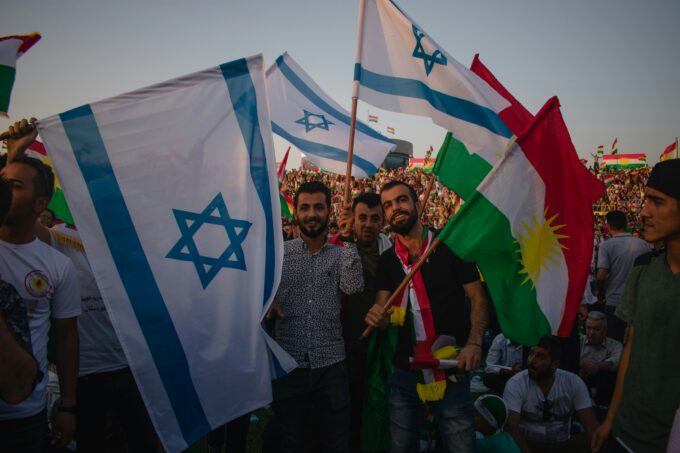
Image by Levi Meir Clancy.
While a prominent Israeli human rights organisation and a well-known New York Times columnist use the term ‘Jewish supremacy’, some North American or European self-proclaimed leftist supporters of Palestinian rights object to these words. Typically, they claim the description is inaccurate and/or antisemitic. Some argue that “white supremacy” or “Zionism” are the terms we should use when describing the Israeli regime.
But Jewish supremacy over the original inhabitants of Palestine is at the core of Zionism and the Israeli colonial project, just as European (white) supremacy was at the core of the Americas’ colonial projects. An apartheid system favors Jews at the expense of other citizens and offers no rights to those controlled by the state but deemed non-citizens. Jews can emigrate from anywhere in the world to Israel, while Palestinians expelled by military force and their descendants are not allowed to return. Laws and propaganda proclaim Israel as the Jewish state.
Describing Israel as a Jewish supremacist state and Zionism as a Jewish supremacist ideology is both accurate and necessary. It is necessary because Palestinians, who are the primary victims of Israel’s colonialism, experience their oppression as Jewish supremacism. It is at the ideological center of their political, economic and cultural oppression. To be useful allies of Palestinians, we must see their oppression as they experience it, certainly not as their oppressors want us to see it.
But there is another important reason to use the term Jewish supremacy. Tactically, as supporters of Palestinians, calling what is happening in Israel Jewish supremacy is more effective politically. It helps people from a wide political spectrum — from the center right to mainstream liberals to the left — understand what Zionism really is. It is a form of ethno-religious nationalism akin to white-Christian nationalism. It is an enemy of secularism and the fundamental democratic notion that the state should not favour a particular religion or ethnicity. Labelling the core ideology of Israel “Jewish supremacism” has the benefit of being both accurate and more helpful to Palestinian liberation. It also makes sense to millions of Jews around the world whose diverse communities have historically fought for secular states that have proved best at protecting the rights of all minorities.
The language of racial supremacism, rather than the abstract term Zionism, puts Israel supporters on the back foot. Naming Jewish supremacism is more politically biting. This is especially important when supporters of Israeli apartheid and genocide often seek to present themselves as victims.
As for those who object to the term “Jewish supremacism” they are primarily concerned about the potential spill back effects on Jewish communities around the world. They argue using the term Jewish supremacy contributes to a rise in antisemitism. But this is blaming the messenger. Israel’s actions and ideology, not accurate descriptions of its ideology and actions, are the problem. In so far as antisemitism is growing around the world, it is primarily because of the self-proclaimed ‘Jewish state’s’ actions. Those actions give ammunition to real antisemites. Supporters of Israel labelling anyone who criticizes those actions as antisemites gives ammunition to real antisemites. Mainstream self-described “Jewish organizations” such as schools, community centres, charities that support Israel no matter what it does give ammunition to real antisemitic racists.
Self-described “leftists” who argue Palestinians and their supporters must always consider the feelings of their oppressors while fighting their oppression are being poor allies at best and racist at worst.
Since at least the time of the French Revolution ‘the left’ around the world has stood for equality of economic and political rights for everyone. At times, this has meant supporting the “lifting up” of oppressed peoples when that is necessary to achieve equality. Some on the “western” left once argued this was the motivation of Zionism. Others insisted Zionism would lead to a state of Jewish supremacism which would inevitably use aggression, violence and oppression to assert itself. Historical evidence strongly suggests who was right.

and
https://www.counterpunch.org/2026/04/16/the-case-for-using-jewish-supremacy-to-describe-zionism/