1). “Nuclear Power Plant Attack, Oil War Escalation, Restraint Off | Larry C. Johnson”, Mar 20, 2026, Pascal Lottaz interviews Larry C. Johnson, Neutrality Studies, duration of video 48:48, at < https://www.youtube.com/live/
Introduction by desmond: The U.S. / Israeli war on Iran seems to be stalling out from the U.S. / Israeli perspective. The Israelis bombed the major Iranian Pars Gas Field and predictably the Iranians retaliated by sending missile attacks against their . The Iranians had prepared themselves for a long war of 6 months to perhaps 2 years. The U.S. ruling class, as led by the Trump Regime, needs to win this war in the first month or two.
So far the Iranians have destroyed or seriously damaged the major $1.1 Billion radar and information computers located in Qatar (one of 5 or 6 total type super long-range radars the U.S. military operates in the world (including 1 in California, 1 in Greenland, and 1 in England). That radar has(had) an effective radius of 5,000 Kilometers and coordinated and supplied data to ships, aircraft, and missile batteries like the Patriot and THAAD anti-missile installations. Apparently elements within the next couple of layers down, including THAAD and Patriot missile batteries, have also been damaged or destroyed. In the first few days of the war 4 THAAD batteries (out of a total of 11 such batteries world wide) have been either obliterated or damaged to a degree that they were not functional.
Effectively the U.S. and allied militaries are now relying on technology, such as AWACS aircraft, from the 1970s. Item 1)., “Nuclear Power Plant Attack, ….”, discusses these issues among others.
In Item 2)., “The US already LOST ….”, British Naval Expert Commodore Steve Jermy discusses changes in Naval Technolgy and Tactics and how the trends in technological advancement have greatly reduced the effectiveness of the U.S. Navy, including its iconic Super Aircraft Carriers, in the sort of war being waged in the Middle East now.
The entire story of the deployment of the super aircraft carrier USS Gerald R. Ford is instructive. First the Naval High Command decided to send the USS George H. W. Bush but then, without much explanation, they decided to send the Ford instead (that ship had been continuously on patrol for 8 months and was due to go home). According to Larry Johnson (a former CIA Analyst whose interviews I occasionally post here on TCS) there were some sort of crew issues on the USS George H. W. Bush that kept the ship from functioning normally. Thus the USS Gerald R. Ford was sent.
This deployment was despite the problems the Ford has had with its sewage/toilet system; and also perhaps now resolved problems with the electrical/magnetic catapaults (that replaced the steam powered catapaults were used on the Nimitz class Super Carriers for 50 years). The Ford stopped at Souda Bay Crete for a $400 million acid clean out of its plumbing system, on its way to its battle station in the Eastern Mediterranean in late February.
It appears that the breakdown of the Ford, that included a serious fire that damaged the kitchens and the sleeping quarters of 600 of its 5,000 member crew, and that took 30 hours to bring under control. That fire took place on about March 10th or 11th. However, that was not much reported in the mainstream or alternative media.
The withdrawal of the USS Gerald R. Ford from the war and its subsequent dispatch to Crete and then to the U.S. was mentioned in “Matthew Hoh: The Iran War Narrative Is Falling Apart”, Dialogue Works, Mar 11, 2026, at < https://www.youtube.com/watch?
The USS George H. W. Bush is now on its way to replace the Ford (crew problems presumably solved?). What seems to never be discussed is the fact that the U.S. Navy has a total of 11 Super Aircraft Carriers; that leaves the question of just what are the other 8 Super Carriers doing?? The anondyne comment about questions on the situation is always that the 8 other Super Carriers are “undergoing repairs”. We could reasonably expect that 2 or 3 might be undergoing their cyclical process of major refitting and repairs, but all 8 of these $15 billion ships are undergoing repairs simultaneously?? Then, there is the question of the British sending one of their two super carriers to assist the U.S. Navy. Trump dismissed the gesture as reported in The Hill:
“The United Kingdom, our once Great Ally, maybe the Greatest of them all, is finally giving serious thought to sending two aircraft carriers to the Middle East,” Trump wrote on Truth Social.
“That’s OK, Prime Minister [Keir] Starmer, we don’t need them any longer — But we will remember,” he added. 'We don’t need people that join Wars after we’ve already won!'
“Trump’s statement comes after the U.K. Ministry of Defense said it was preparing an aircraft carrier before a possible deployment, The Guardian reported earlier Saturday.”
Clearly the U.S. and Israel will continue to bomb Iran. The Question becomes which society will break first: The deindustrialized U.S. that cannot produce weapons on anything resembling the scale of production of “The Arsenal of Democracy”, that the U.S. propaganda and mythology machine has portrayed the country during World War 2. Under any circumstances that society no longer exists.
It increasingly looks like the U.S. will end up getting forced out of the Middle East, and the influence and control over those resources will devolve to the states, including Iran, that exist there; in some sort of alliance with China and Russia. If so we can compare what is going on in the Middle East now with what happened when a combined Israeli / British / French military operation attacked Egypt and advanced to the Western Bank of the Suez Canal in 1956. The President of Egypt, the Pan-Arabian Nationalist general Gamal Abdul Nasser responded by closing the Suez Canal. It remained closed for several years full of wrecked ships. And the U.S. President Eisenhower warned the 3 nation military forces to return home. That event was a milestone in the decline and virtual end of the British Empire as any sort of important independent force in world affairs. The Pound Sterling, once the world reserve currency, lost a lot of ground in the wake of the Suez Crisis.
1). “Nuclear Power Plant Attack, Oil War Escalation, Restraint Off | Larry C. Johnson”, Mar 20, 2026, Pascal Lottaz interviews Larry C. Johnson, Neutrality Studies, duration of video 48:48, at < https://www.youtube.com/live/
Fire damage, clogged toilets, and sinking morale: USS Gerald R Ford to set sail for repairs in Crete
A fire onboard the USS Gerald R Ford, injuring sailors and destroying 100 beds, is the latest mishap to plague the world’s largest aircraft carrier on a marathon deployment some argue has sapped crew morale.
At sea for almost nine months, and currently stationed in the Red Sea to support the war on Iran, the carrier will reportedly set sail for Crete for repairs.
The length of the deployment has raised questions about morale of the sailors on board and the readiness of the warship.
Officials, who spoke to Reuters on the condition of anonymity, did not say how long the $13bn vessel was expected to remain in Crete.
One of the officials said nearly 200 sailors were treated for smoke-related injuries when the fire broke out in the ship’s main laundry area. The fire took hours to bring under control and had an impact on roughly 100 sleeping berths.
One service member was flown off the ship with injuries, the official said. The Pentagon did not immediately respond to a request for comment. The New York Times reported two sailors received treatment for “non-life-threatening injuries”, citing the US military’s Central Command. After the fire initially broke out, the US military had said that there was no damage to the ship’s propulsion plant and the aircraft carrier was fully operational.
The carrier, crewed by more than 4,000 sailors, has reportedly suffered significant problems with its toilet system while at sea, with US media describing clogged systems and long lines for restrooms on the ship.
The issue is not new – a 2020 report from the US Government Accountability Office said the ship’s toilet system was subject to “unexpected and frequent clogging” and requires acid flushes on a regular basis to clear it, at a cost of $400,000 each time.
The Navy acknowledged the reports of toilet problems in a statement last month, but cited ship leadership as saying that “clog incidents are addressed promptly by trained damage control and engineering personnel, with minimal downtime”.
Senator Mark Warner, the vice-chair of the Senate Intelligence Committee, on Tuesday sharply criticised the extended deployment of the ship.
“The Ford and its crew have been pushed to the brink after nearly a year at sea, and they have been paying the price for President Donald Trump’s reckless military decisions,” he said in a statement.
In a statement to the Guardian last month, the Navy said its operations “in dynamic environments requires immense dedication” from all sailors, “who consistently demonstrate their commitment to the mission”. It added maintenance demands on the ship “have decreased as the deployment has progressed”.
The withdrawal of the Ford would leave a significant gap in US forces in the region, where the dozens of warplanes it carries have taken part in strikes against Iran.
But the New York Times, which first reported the extent of the fire damage, quoted a military official saying the Ford will probably be relieved by another carrier – the USS George HW Bush – which is preparing to deploy to the Middle East.
The US has carried out strikes against more than 7,000 targets since it started operations against Iran on 28 February.
The Ford carries more than 75 military aircraft, including F-18 Super Hornets, and operates a sophisticated radar system to control air traffic and navigation.
Prior to its Middle East deployment, the carrier took part in US operations in the Caribbean, where US forces carried out strikes on alleged drug-smuggling boats, interdicted sanctioned tankers and seized Venezuelan leader Nicolás Maduro.
With Agence France-Presse and Reuters
xxxxxxxxxxxxxxxxxx
US Navy’s 100,000-ton nuclear-powered warship exits Iran war after onboard fire
The USS Gerald R. Ford, the U.S. Navy's most advanced nuclear-powered aircraft carrier, is departing the Red Sea for Naval Support Activity Souda Bay in Crete after a fire broke out in its aft laundry facility on March 12.
The fire disabled berthing for over 600 sailors and prompted a significant damage control effort amid ongoing combat operations against Iran.
Fire below deck
The fire, which was confirmed as non-combat-related, started on March 12 and spread through ventilation into adjacent sleeping quarters, destroying over 100 beds and displacing sailors shipwide that same day.
Two sailors were initially treated for non-life-threatening injuries, with one medically evacuated ashore. More than 200 others received treatment for smoke inhalation before returning to duty.
By March 13, the Navy had airlifted 1,000 replacement mattresses from the USS John F. Kennedy in Norfolk, Virginia, along with spare clothing, since the carrier's laundry facilities remained largely out of service.
Clarifying initial reports, a U.S. official stated that although damage control lasted over a day, the fire itself did not burn for 30 hours. Instead, the 30-hour period included firefighting, water-damage cleanup, and flare-up prevention. However, the U.S. Navy is formally investigating whether sailors aboard the Ford deliberately started the fire.
A depleted ship in an active war
The Ford departed Norfolk, Virginia, on June 24, 2025. Over the following nine months, it operated across the Caribbean, the Mediterranean, and the Red Sea. On March 5, it transited the Suez Canal, then carried out sustained strike sorties under Operation Epic Fury.
Following the fire, the crew kept up combat sorties until the withdrawal decision. If the carrier remains deployed through mid-April, it will break the post-Vietnam War record of 294 days set by USS Abraham Lincoln in 2020.
The Ford's deployment is notable not only for its length but also its pace, with operations in two hemispheres, combat in the Middle East, and maintenance challenges, including recurring plumbing failures that drew public attention.
Adding to these challenges, Iran's Islamic Revolutionary Guard Corps has formally designated the Ford carrier strike group a military target. This designation introduces an additional layer of operational pressure to what is already an unusually strained deployment.
What happens next
The Ford will spend over a week at Souda Bay for pierside repairs. This stop will assess what can be fixed immediately and what requires attention at its home port in Norfolk. The rest of the Ford strike group—USS Mahan, USS Bainbridge, and USS Winston S. Churchill—will remain in the Red Sea and not follow the carrier to Crete.
The USS Abraham Lincoln carrier strike group is already in the region to maintain combat operations. The USS George H.W. Bush has finished workup at Norfolk and is expected to deploy as relief for the Ford.
Gen.Dan Caine, Chairman of the Joint Chiefs, addressed the crew's situation directly at a Pentagon briefing: "We're thinking about the crew there who were injured in the fire. We believe and hope that everyone will be OK, and we're grateful for that."
xxxxxxxxxxxxxxxxxxxx
US carrier involved in Iran fight heads back to port after fire
(Bloomberg) -- The US Navy’s most advanced aircraft carrier is retreating from the Red Sea after a fire broke out in its laundry room, scuttling plans for the 100,000-ton nuclear-powered vessel to project power in the war with Iran.
Following the incident, which left at least two of the ship’s 4,000 crew members with non-life-threatening injuries, the USS Gerald R. Ford will travel to the Greek island of Crete, according to a US official familiar with the matter. The ship had stopped there in late February on its way to the region.
The incident underscores how even the Navy’s most advanced assets are under strain as the US expands its military endeavors. The Ford — the most expensive warship ever built — has spent months beyond a standard deployment at sea.
The US military declined to comment on the details of the fire, but The New York Times reported that sailors needed more than 30 hours to put it out, and more than 600 crew members lost their bunk space.
When reached for comment, the Navy declined to comment on the carrier’s condition, or whether its escort ships will remain in the Red Sea. A defense official who asked not to be identified said the Ford’s strike group will continue to operate in the region. The Ford’s departure leaves only one US carrier, the USS Abraham Lincoln, to support the Iran campaign.
Aircraft carriers are among the US military’s most in-demand assets. They function as mobile airbases, allowing the US to launch strikes and project air power far from home, but only a limited number are available at any given time due to global commitments and maintenance cycles.


 Dark Seas Official
 Fluctus - Video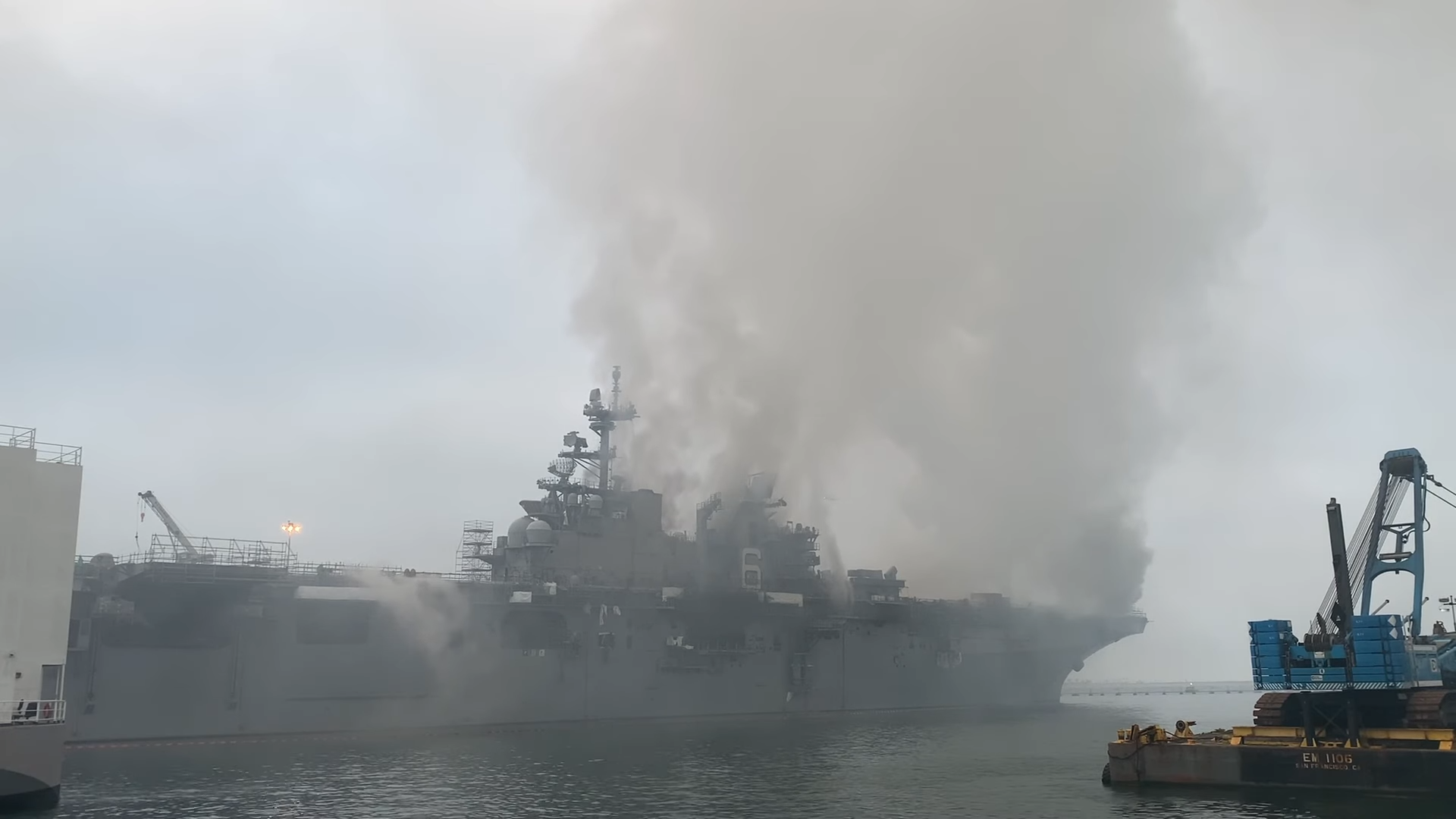
 The Navy Channel
They also come with significant military support: The Ford is accompanied by guided missile destroyers, and its associated air wing includes F/A-18E and F/A-18F Super Hornets, E-2D airborne early-warning aircraft, as well as MH-60S and MH-60R Seahawk helicopters and C-2A Greyhounds.
The warship was participating in US operations against Venezuela when President Donald Trump ordered it to the Middle East ahead of the Iran campaign. While a normal tour lasts only six months, the Ford has been at sea since June last year.
Extended tours can sap sailors’ morale and strain their families, a fact that the Navy acknowledged in a press release last month heralding the resilience and readiness of the Ford’s crew during its “extended deployment.”
“Navy leaders acknowledge that extended time away from families carries real and measurable sacrifice,” it read.
The Ford is also struggling with practical challenges. In January, National Public Radio reported that the warship was dealing with a faulty plumbing system that had failed repeatedly while at sea. The Navy acknowledged the issue, but said the ship had “processed more than 6 million toilet flushes,” and added that sailors were usually to blame.
“In most instances, clogs are the result of items being flushed that should not be introduced into the system,” the Navy said in a press release, citing the Ford’s commanding officer. “When sailors follow proper procedures, the system performs reliably.”

No comments:
Post a Comment