1). “Trump’s Iran war burns $1 billion a day”, Mar 7, 2026, Gary Wilson, Struggle*La Lucha, at < https://www.struggle-la-lucha.
2). “Oil price jumps despite deal to release record amount of reserves”, Mar 12, 2026, Osmond Chia, Business reporter, BBC, at < https://www.bbc.com/news/
3). “The Trump Administration’s Untrustworthy War Messaging Causes Market Chaos”, Mar 11, 2026, Andrew C. McCarthy, The National Review, at < https://www.nationalreview.
4). “U.S. support for Israel continues to plummet, despite media’s best efforts: A fake scandal involving Rama Duwaji’s Instagram likes reveals how desperate pro-Israel pundits are grasping at straws as support for the country plummets in the U.S.”, Mar 10, 2026, Michael Arria, Mondoweiss, at < https://mondoweiss.net/2026/
5). “ ‘We cannot separate imperialism from domestic militarization’: Understanding the links between ICE, Gaza, and U.S. foreign policy: Mondoweiss interviews author Harsha Walia about the history of ICE and how Trump's immigration crackdown is closely linked to U.S. imperialism abroad, including in Palestine”, Jan 28, 2026, Michael Arria, Mondoweiss, at < https://mondoweiss.net/2026/
6). “Iran destroys the radar systems at the heart of U.S. missile defense”, Mar 8, 2026, Anon, Struggle-La Lucha, Reposted by MRonline, Mar 11, 2026, at < https://mronline.org/2026/03/
7). Iran War Cost Tracker: Estimated U.S. Taxpayer Spending, Based on the Pentagon's briefing to Congress: Currently around $17,730 Billion, at < https://iran-cost-ticker.com/ >
~~ recommended by dmorista ~~
Introduction by desmond: The attacks on Iran continue and it is costing around $1 Billion per day, with the amount currently spent at around $17.8 Billion. Enough to pay for Medicaid for all the poor people forced off by the Trump Regime. Soon the expense would also pay. From Item 1)., “Trump’s Iran war burns ….”, we are informed that:
“At $891 million per day, the arithmetic of Operation Epic Fury is simple. One week of the war costs roughly $6.2 billion.
“That amount alone would fund universal pre-K for every three- and four-year-old in the United States for a full year, according to estimates from the National Education Association. One month of the war at the same burn rate — about $27 billion — would come close to fully funding the federal government’s annual contribution to Medicaid. (Emphasis Added)
“Yet in the weeks before Operation Epic Fury began, the Trump administration was telling the public there was no money for health care, housing assistance or public education. Those claims had already sparked protests from unions, health care workers and educators across the country.”
Item 2)., “Oil price jumps ….”, from the BBC, shows increasing skepticism even from the Establishment publications both state owned and as in Item 3). “The Trump Administration’s Untrustworthy ….”, from a prominent privately owned right-wing corporate controlled media outlet. Item 4)., “U.S. support for Israel ….”, points out that a struggle is going for control of the war narrative, and despite the purchases of Tik Tok, CBS News, and the pending change in ownership at CNN, by right-wing Zionists; sentiment and opinions, of Americans, about Israel continue to be unfavorable, and increasingly so.
The history of legal enforcement and violent operations against people, both in and outside of the U.S. is discussed in Item 5)., “ ‘We cannot separate imperialism ….”, the author Michael Arria spoke with Canadian activist and writer Harsha Walia who pointed out that:
“The war on migrants is intensifying around the world, whether that is in the Mediterranean, which is. the deadliest border on the planet, or in Eastern Europe, India, Bangladesh, New Zealand, Australia, etc.
“This is all happening in the context of climate catastrophe and growing inequality due to capitalism and colonialism. Border policing and enforcement are now increasingly maintained through warfare technologies, and it’s escalating around the world.
“So, I think ICE has to be looked at in this wider global context.”.
Item 6)., “Iran destroys the radar systems ….”, provides a review of the successes of the Iranian forces in damaging the advanced technological and radar installations the U.S. has around the Middle East.
Finally Item 7)., “Iran War Cost Tracker: ….”, provides a running and constantly updated tally of American taxpayer supplied funds that have been expended on this war so far.
xxxxxxxxxxxxxxxxxxxxxxxxxxxxxx
Trump’s Iran war burns $1 billion a day – Struggle – La Lucha
Press play to listen to this content
Plays:-Audio plays count
1x
Playback Speed
- 0.5
- 0.6
- 0.7
- 0.8
- 0.9
- 1
- 1.1
- 1.2
- 1.3
- 1.5
- 2
Open text
Trump’s Iran war burns $1 billion a day. Eight days into Operation Epic Fury, the United States has struck more than 3,000 targets in Iran and killed at least 1,332 civilians — a figure reported by regional media but impossible to independently verify under wartime restrictions. Iranian officials and Islamic Revolutionary Guard Corps spokespeople say retaliatory strikes have killed hundreds of U.S. and some Israeli troops, though Washington has not confirmed those claims. As in most wars, reliable casualty figures are among the first facts to disappear. The cost of the war is easier to measure. In the first 100 hours of the bombing campaign, the United States spent an estimated $3.7 billion — about $891 million every day. Eight days into the war, the real cost is certainly higher. The most widely cited public estimate so far covers only the opening phase of the assault. Nearly all of that money — about $3.5 billion — was not specifically appropriated for this war. The estimate comes from the Center for Strategic and International Studies, a Washington think tank closely tied to the U.S. national security establishment. The picture is stark: a war launched without a congressional declaration, financed without a congressional appropriation, against a country that had not attacked the United States itself. See the Iran War Cost Tracker at iran-cost-ticker.com. For working people across the United States — teachers striking for wages that keep up with rent, nurses fighting for safe staffing ratios, families told there is no money for health care or housing — the number raises a simple question: unaffordable for whom? A war nobody voted for — twice. The constitutional framework governing war has been bypassed on two fronts. Under Article I, Congress holds the power to declare war. Under the 1973 War Powers Act, the president must seek congressional authorization within 60 days of deploying forces into hostilities. Neither happened when U.S. and Israeli forces launched coordinated strikes on Iran on Feb. 28. Congress had the opportunity to reassert that authority this week. It declined. The Senate rejected a war powers resolution 47–53 on March 4. This was the eighth war powers vote since June. All eight have failed. The same day the House rejected the war powers resolution, it passed a nonbinding resolution reaffirming Iran as the world’s leading state sponsor of terrorism — 372 to 53. The bipartisan consensus is not for or against the war. It is for the war, against accountability for the war. Congress controls the purse strings for war, yet it has approved no funding for this one. Instead, the administration is pulling money from existing Pentagon accounts — or simply adding to the deficit — and Congress lets the war continue. The budget nobody is comparing. At $891 million per day, the arithmetic of Operation Epic Fury is simple. One week of the war costs roughly $6.2 billion. That amount alone would fund universal pre-K for every three- and four-year-old in the United States for a full year, according to estimates from the National Education Association. One month of the war at the same burn rate — about $27 billion — would come close to fully funding the federal government’s annual contribution to Medicaid. Yet in the weeks before Operation Epic Fury began, the Trump administration was telling the public there was no money for health care, housing assistance or public education. Those claims had already sparked protests from unions, health care workers and educators across the country. These are not the comparisons that usually appear in mainstream coverage. Most reporting accepts the war’s framework: Is it working? That is the question of war planners. The question for working people is simpler: Where is the money going? Trump said this week that defense manufacturers will “quadruple” weapons production to sustain the campaign. That is a jobs program for Raytheon, Lockheed Martin and Boeing. It is a very different kind of industrial policy than the social investment working people have been demanding. A pattern, not an exception. Iran is not the only front. Since January, the United States has been conducting active military operations in Venezuela (Operation Absolute Resolve), in maritime Caribbean and Pacific waters (Operation Southern Spear), and — as of March 3 — in Ecuador, while tightening an economic siege on Cuba by cutting off the island’s fuel supply. Trump has said openly that after Iran, Cuba is next. Each of these operations has been justified on law-enforcement or counterterrorism grounds — a legal framing meant to claim the actions are not “hostilities” under the War Powers Act. The Venezuela operation was described as a law-enforcement action with military support. The Ecuador operations are framed as counter-narcoterrorism. The Iran strikes were initially described in counter-proliferation terms before Trump made clear on Truth Social that the objective was regime change. Venezuela offers a preview. On Jan. 29, Venezuela enacted a hydrocarbons law weakening the nationalization framework established under Hugo Chávez and opening the oil sector to private foreign companies. Within weeks, U.S. Energy Secretary Chris Wright was touring Venezuelan oil facilities. The Trump administration has not articulated a consistent end-state for Iran, with officials giving conflicting statements on whether the goal is behavioral change by new leadership or the complete toppling of the Islamic Republic. Based on the Venezuela precedent, one question is unavoidable: What economic restructuring will be demanded of whatever government emerges from Tehran? The answer is not hard to see. The working class is connecting the dots. The movement that fought ICE enforcement in Minneapolis — producing a citywide general strike on Jan. 23 — is now part of the coalition organizing against the Iran war. Anti-war and solidarity organizations have issued joint statements using the same anti-imperialist framework they applied to ICE enforcement and Washington’s military and economic campaign against Venezuela. The Iran war has added an explicit anti-war demand to what began as a domestic labor and immigrant-rights campaign. This convergence — labor, immigrant rights and anti-war organizing — reflects a simple reality. These are not separate crises. ICE enforcement depresses wages and keeps immigrant workers living under the threat of raids and deportation. Military adventurism drains the public treasury and forecloses the social investment workers are fighting for. In Venezuela and Iran, the objective is the same: forcing governments to open their energy sectors to U.S. and allied corporate control. What the numbers demand. In the first 100 hours of Operation Epic Fury, the United States spent about $3.7 billion, according to estimates from the Center for Strategic and International Studies. Of that total, roughly $3.5 billion had not been budgeted for the war. “Unbudgeted” is a bureaucratic word. What it describes is simple: social wealth produced by working people transferred into the machinery of war. Those numbers translate quickly into human consequences. In the first eight days of the war, more than 330,000 people across the region have been displaced. Hospitals in Gaza cannot receive medical supplies after Israel escalated its military operations against Iran and closed the crossings. Six U.S. service members were killed in Kuwait when a missile struck a makeshift operations center that had barriers against car bombs but nothing that could stop an incoming strike. Iranian international journalist Khyal Muazzin has also reported that 30 U.S. and Israeli soldiers were killed while attempting to enter Iran. According to Muazzin, the troops — including members of U.S. SEAL and Delta special forces units — were part of a mission to cross into Iranian territory and attack designated targets. Muazzin said some of the personnel involved had also taken part in the earlier U.S. operation that captured Venezuela’s President Nicolás Maduro and Cilia Flores — a large-scale assault that used more than 150 aircraft, electronic warfare and airstrikes to break through Venezuelan defenses. Muazzin contrasted the situations, suggesting Iran would not be so easily overrun. Muazzin wrote defiantly on social media: “Yes, this is Iran, not Venezuela. We will receive guests.”. During the Vietnam War, the anti-war movement used a simple slogan: The money for bombs comes from schools and clinics. Sixty years later, the arithmetic is the same — only the numbers are bigger. Join the Struggle-La Lucha Telegram channel
Trump’s Iran war burns $1 billion a day. Eight days into Operation Epic Fury, the United States has struck more than 3,000 targets in Iran and killed at least 1,332 civilians — a figure reported by regional media but impossible to independently verify under wartime restrictions. Iranian officials and Islamic Revolutionary Guard Corps spokespeople say retaliatory strikes have killed hundreds of U.S. and some Israeli troops, though Washington has not confirmed those claims. As in most wars, reliable casualty figures are among the first facts to disappear. The cost of the war is easier to measure. In the first 100 hours of the bombing campaign, the United States spent an estimated $3.7 billion — about $891 million every day. Eight days into the war, the real cost is certainly higher. The most widely cited public estimate so far covers only the opening phase of the assault. Nearly all of that money — about $3.5 billion — was not specifically appropriated for this war. The estimate comes from the Center for Strategic and International Studies, a Washington think tank closely tied to the U.S. national security establishment. The picture is stark: a war launched without a congressional declaration, financed without a congressional appropriation, against a country that had not attacked the United States itself. See the Iran War Cost Tracker at iran-cost-ticker.com. For working people across the United States — teachers striking for wages that keep up with rent, nurses fighting for safe staffing ratios, families told there is no money for health care or housing — the number raises a simple question: unaffordable for whom? A war nobody voted for — twice. The constitutional framework governing war has been bypassed on two fronts. Under Article I, Congress holds the power to declare war. Under the 1973 War Powers Act, the president must seek congressional authorization within 60 days of deploying forces into hostilities. Neither happened when U.S. and Israeli forces launched coordinated strikes on Iran on Feb. 28. Congress had the opportunity to reassert that authority this week. It declined. The Senate rejected a war powers resolution 47–53 on March 4. This was the eighth war powers vote since June. All eight have failed. The same day the House rejected the war powers resolution, it passed a nonbinding resolution reaffirming Iran as the world’s leading state sponsor of terrorism — 372 to 53. The bipartisan consensus is not for or against the war. It is for the war, against accountability for the war. Congress controls the purse strings for war, yet it has approved no funding for this one. Instead, the administration is pulling money from existing Pentagon accounts — or simply adding to the deficit — and Congress lets the war continue. The budget nobody is comparing. At $891 million per day, the arithmetic of Operation Epic Fury is simple. One week of the war costs roughly $6.2 billion. That amount alone would fund universal pre-K for every three- and four-year-old in the United States for a full year, according to estimates from the National Education Association. One month of the war at the same burn rate — about $27 billion — would come close to fully funding the federal government’s annual contribution to Medicaid. Yet in the weeks before Operation Epic Fury began, the Trump administration was telling the public there was no money for health care, housing assistance or public education. Those claims had already sparked protests from unions, health care workers and educators across the country. These are not the comparisons that usually appear in mainstream coverage. Most reporting accepts the war’s framework: Is it working? That is the question of war planners. The question for working people is simpler: Where is the money going? Trump said this week that defense manufacturers will “quadruple” weapons production to sustain the campaign. That is a jobs program for Raytheon, Lockheed Martin and Boeing. It is a very different kind of industrial policy than the social investment working people have been demanding. A pattern, not an exception. Iran is not the only front. Since January, the United States has been conducting active military operations in Venezuela (Operation Absolute Resolve), in maritime Caribbean and Pacific waters (Operation Southern Spear), and — as of March 3 — in Ecuador, while tightening an economic siege on Cuba by cutting off the island’s fuel supply. Trump has said openly that after Iran, Cuba is next. Each of these operations has been justified on law-enforcement or counterterrorism grounds — a legal framing meant to claim the actions are not “hostilities” under the War Powers Act. The Venezuela operation was described as a law-enforcement action with military support. The Ecuador operations are framed as counter-narcoterrorism. The Iran strikes were initially described in counter-proliferation terms before Trump made clear on Truth Social that the objective was regime change. Venezuela offers a preview. On Jan. 29, Venezuela enacted a hydrocarbons law weakening the nationalization framework established under Hugo Chávez and opening the oil sector to private foreign companies. Within weeks, U.S. Energy Secretary Chris Wright was touring Venezuelan oil facilities. The Trump administration has not articulated a consistent end-state for Iran, with officials giving conflicting statements on whether the goal is behavioral change by new leadership or the complete toppling of the Islamic Republic. Based on the Venezuela precedent, one question is unavoidable: What economic restructuring will be demanded of whatever government emerges from Tehran? The answer is not hard to see. The working class is connecting the dots. The movement that fought ICE enforcement in Minneapolis — producing a citywide general strike on Jan. 23 — is now part of the coalition organizing against the Iran war. Anti-war and solidarity organizations have issued joint statements using the same anti-imperialist framework they applied to ICE enforcement and Washington’s military and economic campaign against Venezuela. The Iran war has added an explicit anti-war demand to what began as a domestic labor and immigrant-rights campaign. This convergence — labor, immigrant rights and anti-war organizing — reflects a simple reality. These are not separate crises. ICE enforcement depresses wages and keeps immigrant workers living under the threat of raids and deportation. Military adventurism drains the public treasury and forecloses the social investment workers are fighting for. In Venezuela and Iran, the objective is the same: forcing governments to open their energy sectors to U.S. and allied corporate control. What the numbers demand. In the first 100 hours of Operation Epic Fury, the United States spent about $3.7 billion, according to estimates from the Center for Strategic and International Studies. Of that total, roughly $3.5 billion had not been budgeted for the war. “Unbudgeted” is a bureaucratic word. What it describes is simple: social wealth produced by working people transferred into the machinery of war. Those numbers translate quickly into human consequences. In the first eight days of the war, more than 330,000 people across the region have been displaced. Hospitals in Gaza cannot receive medical supplies after Israel escalated its military operations against Iran and closed the crossings. Six U.S. service members were killed in Kuwait when a missile struck a makeshift operations center that had barriers against car bombs but nothing that could stop an incoming strike. Iranian international journalist Khyal Muazzin has also reported that 30 U.S. and Israeli soldiers were killed while attempting to enter Iran. According to Muazzin, the troops — including members of U.S. SEAL and Delta special forces units — were part of a mission to cross into Iranian territory and attack designated targets. Muazzin said some of the personnel involved had also taken part in the earlier U.S. operation that captured Venezuela’s President Nicolás Maduro and Cilia Flores — a large-scale assault that used more than 150 aircraft, electronic warfare and airstrikes to break through Venezuelan defenses. Muazzin contrasted the situations, suggesting Iran would not be so easily overrun. Muazzin wrote defiantly on social media: “Yes, this is Iran, not Venezuela. We will receive guests.”. During the Vietnam War, the anti-war movement used a simple slogan: The money for bombs comes from schools and clinics. Sixty years later, the arithmetic is the same — only the numbers are bigger. Join the Struggle-La Lucha Telegram channel
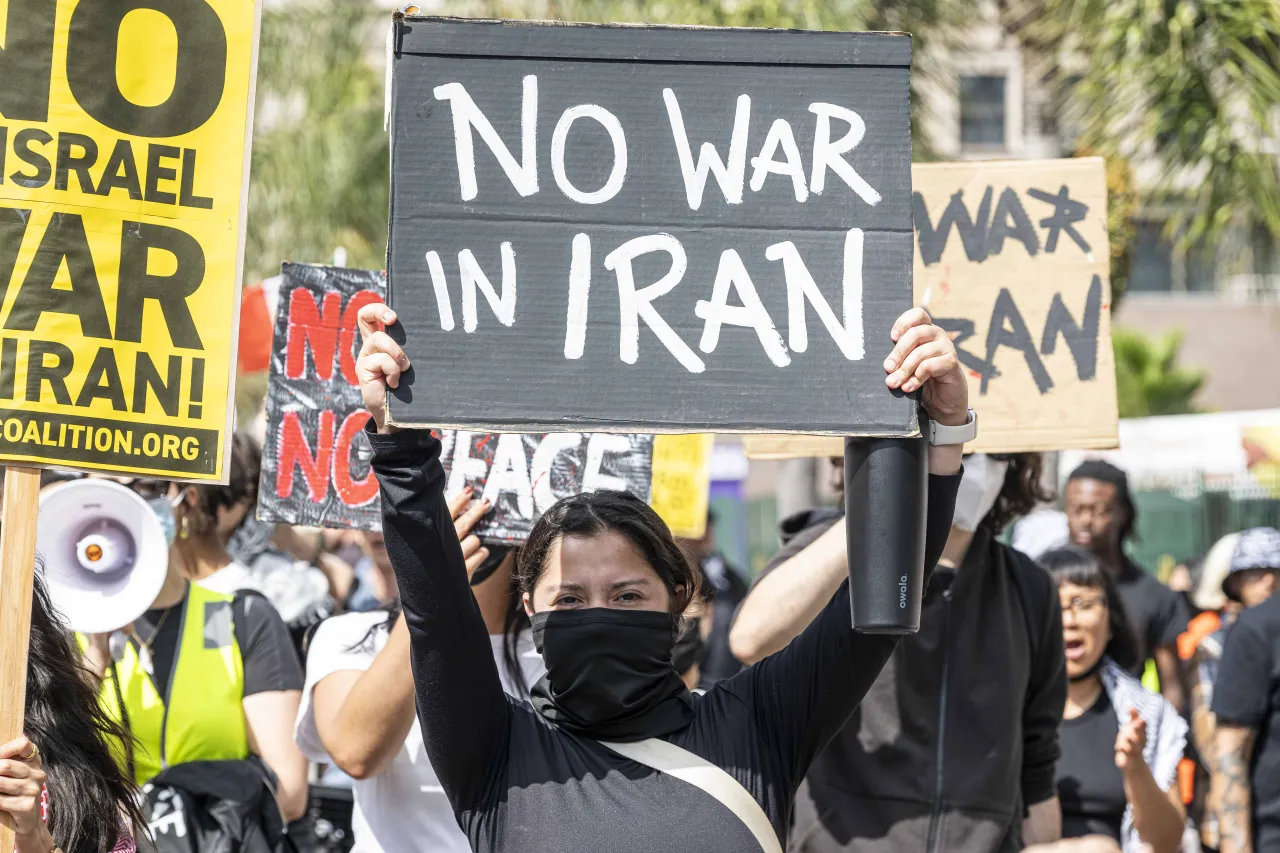
Eight days into Operation Epic Fury, the United States has struck more than 3,000 targets in Iran and killed at least 1,332 civilians — a figure reported by regional media but impossible to independently verify under wartime restrictions.
Iranian officials and Islamic Revolutionary Guard Corps spokespeople say retaliatory strikes have killed hundreds of U.S. and some Israeli troops, though Washington has not confirmed those claims. As in most wars, reliable casualty figures are among the first facts to disappear.
The cost of the war is easier to measure.
In the first 100 hours of the bombing campaign, the United States spent an estimated $3.7 billion — about $891 million every day. Eight days into the war, the real cost is certainly higher. The most widely cited public estimate so far covers only the opening phase of the assault.
Nearly all of that money — about $3.5 billion — was not specifically appropriated for this war. The estimate comes from the Center for Strategic and International Studies, a Washington think tank closely tied to the U.S. national security establishment. The picture is stark: a war launched without a congressional declaration, financed without a congressional appropriation, against a country that had not attacked the United States itself.
See the Iran War Cost Tracker at iran-cost-ticker.com
For working people across the United States — teachers striking for wages that keep up with rent, nurses fighting for safe staffing ratios, families told there is no money for health care or housing — the number raises a simple question: unaffordable for whom?
A war nobody voted for — twice
The constitutional framework governing war has been bypassed on two fronts. Under Article I, Congress holds the power to declare war. Under the 1973 War Powers Act, the president must seek congressional authorization within 60 days of deploying forces into hostilities. Neither happened when U.S. and Israeli forces launched coordinated strikes on Iran on Feb. 28.
Congress had the opportunity to reassert that authority this week. It declined.
The Senate rejected a war powers resolution 47–53 on March 4. This was the eighth war powers vote since June. All eight have failed.
The same day the House rejected the war powers resolution, it passed a nonbinding resolution reaffirming Iran as the world’s leading state sponsor of terrorism — 372 to 53. The bipartisan consensus is not for or against the war. It is for the war, against accountability for the war.
Congress controls the purse strings for war, yet it has approved no funding for this one. Instead, the administration is pulling money from existing Pentagon accounts — or simply adding to the deficit — and Congress lets the war continue.
The budget nobody is comparing
At $891 million per day, the arithmetic of Operation Epic Fury is simple. One week of the war costs roughly $6.2 billion.
That amount alone would fund universal pre-K for every three- and four-year-old in the United States for a full year, according to estimates from the National Education Association. One month of the war at the same burn rate — about $27 billion — would come close to fully funding the federal government’s annual contribution to Medicaid.
Yet in the weeks before Operation Epic Fury began, the Trump administration was telling the public there was no money for health care, housing assistance or public education. Those claims had already sparked protests from unions, health care workers and educators across the country.
These are not the comparisons that usually appear in mainstream coverage. Most reporting accepts the war’s framework: Is it working?
That is the question of war planners. The question for working people is simpler: Where is the money going?
Trump said this week that defense manufacturers will “quadruple” weapons production to sustain the campaign. That is a jobs program for Raytheon, Lockheed Martin and Boeing. It is a very different kind of industrial policy than the social investment working people have been demanding.
A pattern, not an exception
Iran is not the only front. Since January, the United States has been conducting active military operations in Venezuela (Operation Absolute Resolve), in maritime Caribbean and Pacific waters (Operation Southern Spear), and — as of March 3 — in Ecuador, while tightening an economic siege on Cuba by cutting off the island’s fuel supply. Trump has said openly that after Iran, Cuba is next.
Each of these operations has been justified on law-enforcement or counterterrorism grounds — a legal framing meant to claim the actions are not “hostilities” under the War Powers Act. The Venezuela operation was described as a law-enforcement action with military support. The Ecuador operations are framed as counter-narcoterrorism. The Iran strikes were initially described in counter-proliferation terms before Trump made clear on Truth Social that the objective was regime change.
Venezuela offers a preview. On Jan. 29, Venezuela enacted a hydrocarbons law weakening the nationalization framework established under Hugo Chávez and opening the oil sector to private foreign companies. Within weeks, U.S. Energy Secretary Chris Wright was touring Venezuelan oil facilities.
The Trump administration has not articulated a consistent end-state for Iran, with officials giving conflicting statements on whether the goal is behavioral change by new leadership or the complete toppling of the Islamic Republic.
Based on the Venezuela precedent, one question is unavoidable: What economic restructuring will be demanded of whatever government emerges from Tehran? The answer is not hard to see.
The working class is connecting the dots
The movement that fought ICE enforcement in Minneapolis — producing a citywide general strike on Jan. 23 — is now part of the coalition organizing against the Iran war.
Anti-war and solidarity organizations have issued joint statements using the same anti-imperialist framework they applied to ICE enforcement and Washington’s military and economic campaign against Venezuela. The Iran war has added an explicit anti-war demand to what began as a domestic labor and immigrant-rights campaign.
This convergence — labor, immigrant rights and anti-war organizing — reflects a simple reality. These are not separate crises.
ICE enforcement depresses wages and keeps immigrant workers living under the threat of raids and deportation. Military adventurism drains the public treasury and forecloses the social investment workers are fighting for. In Venezuela and Iran, the objective is the same: forcing governments to open their energy sectors to U.S. and allied corporate control.
What the numbers demand
In the first 100 hours of Operation Epic Fury, the United States spent about $3.7 billion, according to estimates from the Center for Strategic and International Studies. Of that total, roughly $3.5 billion had not been budgeted for the war.
“Unbudgeted” is a bureaucratic word. What it describes is simple: social wealth produced by working people transferred into the machinery of war.
Those numbers translate quickly into human consequences. In the first eight days of the war, more than 330,000 people across the region have been displaced. Hospitals in Gaza cannot receive medical supplies after Israel escalated its military operations against Iran and closed the crossings.
Six U.S. service members were killed in Kuwait when a missile struck a makeshift operations center that had barriers against car bombs but nothing that could stop an incoming strike. Iranian international journalist Khyal Muazzin has also reported that 30 U.S. and Israeli soldiers were killed while attempting to enter Iran. According to Muazzin, the troops — including members of U.S. SEAL and Delta special forces units — were part of a mission to cross into Iranian territory and attack designated targets.
Muazzin said some of the personnel involved had also taken part in the earlier U.S. operation that captured Venezuela’s President Nicolás Maduro and Cilia Flores — a large-scale assault that used more than 150 aircraft, electronic warfare and airstrikes to break through Venezuelan defenses. Muazzin contrasted the situations, suggesting Iran would not be so easily overrun.
Muazzin wrote defiantly on social media: “Yes, this is Iran, not Venezuela. We will receive guests.”
During the Vietnam War, the anti-war movement used a simple slogan: The money for bombs comes from schools and clinics. Sixty years later, the arithmetic is the same — only the numbers are bigger.
xxxxx
Oil price jumps despite deal to release record amount of reserves
 AFP via Getty Images
Dearbail Jordan
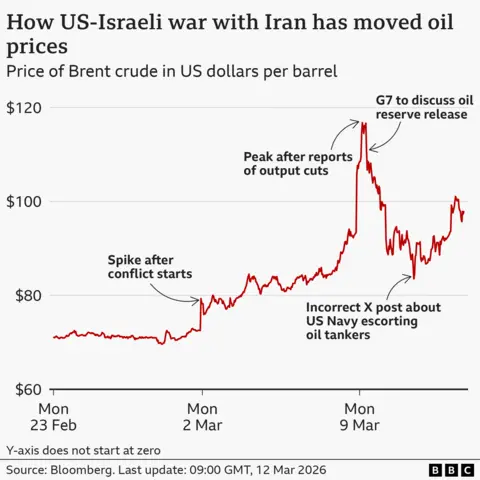
Oil prices climbed back above $100 a barrel and stock markets fell after three more cargo vessels were hit in the Gulf and Iran's new supreme leader vowed to keep blocking the key Strait of Hormuz shipping route.
Brent crude rose by more than 9% on Thursday to $101.59 before easing slightly to $99.44.
The jump came despite the International Energy Agency (IEA) saying on Wednesday that it will release a record 400 million barrels of oil in an attempt to curb the economic impact of the US-Israel war with Iran.
Investors are increasingly concerned that the global economy will take longer to recover if strikes to shipping and energy infrastructure in and around the Strait of Hormuz continue.
In his first public comment since being named as supreme leader, Mojtaba Khamenei said the "lever of blocking the Strait of Hormuz" should still be used by Iran.
The strait is a key waterway for energy shipments but is effectively closed over concerns that vessels could be attacked.
As well as transporting oil, liquefied natural gas is shipped through the passage and surrounding countries operate refineries which produce jet fuel and diesel.
An Islamic Revolutionary Guard Corps spokesperson said on Wednesday that any vessel linked to the US, Israel or their allies would be targeted.
"You will not be able to artificially lower the price of oil. Expect oil at $200 per barrel," they said.
"The price of oil depends on regional security, and you are the main source of insecurity in the region."
Stock market indexes in the US and Europe fell on Thursday. The US Dow Jones Industrial Average and the S&P 500 both opened 1.3% lower while the Nasdaq dropped by 1.7%.
London's FTSE 100 slid 0.7% while Germany's Dax, France's Cac and Spain Ibex all dropped. In Japan, the Nikkei share index closed down 1%.
On Thursday, the IEA said the war in the Middle East was "creating the largest supply disruption in the history of the global oil market".
It said that Iraq, Qatar, Kuwait, the United Arab Emirates and Saudi Arabia have cut total oil production by at least 10 million barrels per day.
It added that "production will take weeks and, in some cases, months to return to pre-crisis levels depending on the degree of field complexity and the timing for workers, equipment and resources to return to the region".
This week, the IEA announced that all 32 countries who are members of the agency had agreed to release a record of amount of oil to tackle supply shortages and higher prices.
However, while Brent crude prices ticked a little lower following the IEA's announcement it rose again, worsening after Iran attacked ships and Khamenei made his remarks.
Bill Farren-Price, senior research fellow at the Oxford Institute for Energy Studies, told the BBC's Today programme that markets had already expected the IEA oil reserves release so had "priced it in".
But he added that while the IEA's action helps: "It is a sticking plaster on a much bigger problem.
"The problem is we're losing about 20 million barrels a day of supply from the Gulf and 400 million is a lot but, in the context of a global market that consumes over 100 million barrels of oil per day, you can see the scale of the challenge."
Martin Ma from the Singapore Institute of Technology said that oil prices would stay high as long as there is a risk to supplies and the latest jump suggested that traders are still expecting a "prolonged" disruption.

 Reuters
Global oil markets have been extremely volatile since the US and Israel launched airstrikes against Iran on 28 February, with Brent crude reaching almost $120 a barrel earlier this week.
On the day before the conflict began, Brent was $73 a barrel.
There are concerns that higher energy prices - with gas also now more expensive than it was before the war - could cause inflation to rise and stop central banks from lowering interest rates.
In the UK, the Bank of England had been forecast to cut interest rates this year. The rate is currently 3.75% and the bank will meet next week to decide its next move.
Maike Currie, head of personal finance for Pensionbee, said: "We were expecting two interest rate cuts this year, now we're expecting none and there's even the possibility of rate rises."
Elsewhere in the world, the knock-on impact of the war and suspended oil supplies are being felt.
Many countries in Asia, which are heavily reliant on energy from the Middle East, have been hit particularly hard.
Long queues were seen at petrol stations in the Philippines, Thailand and Vietnam this week as people raced to fill up with fuel.
Thai authorities have called for staff at most government agencies to work from home to conserve energy. Officials are also being discouraged from non-essential overseas travel.
The Philippines has also started a four-day work week for its government to help cut down on energy use.
xxxxxxxxxxxxxxxxxxxxxxxx
The Trump Administration’s Untrustworthy War Messaging Causes Market Chaos

xxxxx
U.S. support for Israel continues to plummet, despite media’s best efforts
During a recent podcast interview, California Governor and presidential hopeful Gavin Newsom likened Israel to an apartheid state and suggested that the U.S. might need to condition military aid to the country over its human rights record.
Newsom’s comments were notable for signaling the Democratic Party’s shifting rhetoric on the issue, but they certainly aren’t controversial. Even the most mainstream of human rights organizations have been acknowledging Israel’s apartheid for years, and the country’s reputation has completely plummeted within the United States.
Last month, a Gallup poll found that 41% Americans now sympathize more with Palestinians, compared to 36% who say they sympathize more with Israelis. It’s the first time, in over 25 years of polling, that Israel has lagged behind in overall sympathy. These numbers are even more stark among young people. 53% of respondents aged 18 to 34 said they sympathize more with the Palestinians.
Newsom’s comments on conditioning aid are firmly in the mainstream. Despite virtually no progress on the issue from lawmakers, Democratic voters have overwhelmingly backed such measures for years. A YouGov/IMEU Policy Project poll from last December even found that a plurality of Republican voters now support ending aid to Israel.
Support for Israel is becoming tougher sell, but that hasn’t stopped media outlets from trying their best.
The editorial board of the Wall Street Journal decries Newsom for having the temerity to criticize Israel while the Trump administration attacks Iran. The editors admit that Democratic voters have turned on Israel, but believe Newsom’s comments still represent a bridge too far.
“The timing of Mr. Newsom’s anti-Israel musing is contrary to U.S. security interests as the two countries work together as allies in a common military campaign against Iran’s terrorist government,” insists the paper. “Missions that Israelis fly are bombing runs that American pilots don’t have to. Whatever one thinks of Israel’s domestic politics, a call to cut off arms to an ally in wartime ought to be disqualifying for someone who wants to be the U.S. Commander in Chief.”
There’s reason to believe the American people have soured on the Bush-era idea of dissent being unpatriotic, let alone the idea that lawmakers should refrain from criticizing a foreign country during a war.
By the same token, it’s hard to believe that the pseudo-scandal surrounding NYC Mayor Zohran Mamdani’s wife, Rama Duwaji, is destined to gain much traction.
Jewish Insider purported to break an “exposé” revealing that Duwaji had liked a number of pro-Palestinian posts on social media. The biggest infraction was a Slow Factory post made shortly after the October 7 attack, which warned that “occupation forces retaliate against this resistance” and that Gazans will be “punished for wanting freedom from apartheid.”
She also liked posts that declared, “WHEN PEOPLE ARE OCCUPIED, RESISTANCE IS JUSTIFIED, “RESISTANCE AGAINST OCCUPATION IS A HUMAN RIGHT,” and other sentiments recognized by United Nations General Assembly Resolution 2625.
Writing in Bari Weiss’s The Free Press, Olivia Reingold tries to raise the stakes by documenting more than 70 problematic likes from Duwaji. These include the assertion that Israel is carrying out a “vile land grab,” a post declaring that former President Joe Biden was complicit in a genocide, and other verifiable facts.
The hook of the piece is a tweet Duwaji liked from the account @zei_squirrel, which attacked journalist Adam Sella for co-authoring “Screams Without Words“, the New York Times‘ December 2023 article claiming that Hamas weaponized sexual violence on October 7.
“If I told you that The New York Times hired a recently graduated college student with only a couple prior articles written on the subject of food and cooking to be their lead on the ground ‘reporter’ on the ‘mass rape’ hoax they fabricated, would you believe it? That’s Adam Sella,” it read.
Reingold’s article fails to mention that the reporting in the New York Times piece was challenged by The Intercept, Mondoweiss, and other publications.
It’s not particularly surprising to see this kind of stuff in Jewish Insider or The Free Press, but of course, CBS News, now led by the aforementioned Bari Weiss, a right-wing journalist and self-described “Zionist fanatic.”
The network posted a video on social media highlighting the report, and said they verified Duwaji’s likes.
“The report focusing on the social media use of the mayor’s wife—who does not hold public office—more than two years ago, struck many as peculiar,” writes Natalie Korach in Status.
Multiple CBS staffers, who spoke to Korach on condition of anonymity, expressed concern that Weiss, “who has been an outspoken supporter of Israel, was making editorial decisions more in line with the type of content published by The Free Press, blurring the ideological lines between the two and fundamentally altering CBS News’ DNA in the process.”
Again, it’s hard to envision this ham-fisted effort converting anyone to the anti-Palestine cause. Mamdani’s net favorable rating is up to +48 pts in New York City, making him the most popular Democrat in the state.
Newsome might be an opportunist, but it’s clear he knows which way the wind is blowing. Attempts to smear a politician (or a politician’s spouse) over their criticisms of Israel are no longer going to stick.
xxxxxxxxxxxxxxxxxxxx
‘We cannot separate imperialism from domestic militarization’: Understanding the links between ICE, Gaza, and
This week, over 1,000 advocacy organizations sent a letter to Congress demanding that lawmakers stop funding United States Immigration and Customs Enforcement (ICE) and Border Patrol.
The call comes amid widespread protests over the killing of Renee Good and Alex Pretti in Minneapolis.
“How many more people have to die, how many more lies have to be told, and how many more children must be used as bait and abducted before Congress fulfills its responsibilities and stops these out-of-control agencies from continuing to violently attack our immigrant communities and communities of color, as well as their many allies and supporters?” asks the letter.
Does Trump’s ICE represent a shift in U.S. immigration policy, or is it merely a continuation of the existing strategy? How do these tactics connect to U.S. policy abroad and the country’s wider imperial designs?
Mondoweiss U.S. correspondent Michael Arria spoke with Canadian activist and writer Harsha Walia, author of Border and Rule: Global Migration, Capitalism, and the Rise of Racist Nationalism and Undoing Border Imperialism, about the current moment.
Mondoweiss: I am wondering if you see ICE under Trump as a specific development within the history of U.S. immigration policy, or merely a continuation of existing policies?
Harsha Walia: It’s good question. I do think both are true. I don’t think it’s an either-or.
I think it’s important to note that the infrastructure of border enforcement certainly predates Trump. Border enforcement is a bipartisan practice. The groundwork for ICE, for DHS [Department of Homeland Security], for CBP [U.S. Customs and Border Protection], and this entire infrastructure of border policing is not new.

However, it is also the case that it has escalated in very particular ways under the current administration, particularly because the current administration really relies on, as all fascists do, the spectacle of overt dehumanizing violence.
So I do think that is different because explicitly right-wing rhetoric relies on a particular kind of racial terror in order to keep reproducing itself.
The last thing I’ll say is that it’s also important to know that what’s happening in the U.S. can’t be isolated from attacks on migrants around the world. I think it’s a bit of a mistake to only read what’s happening in the U.S. in relation to the U.S.
The war on migrants is intensifying around the world, whether that is in the Mediterranean, which is. the deadliest border on the planet, or in Eastern Europe, India, Bangladesh, New Zealand, Australia, etc.
This is all happening in the context of climate catastrophe and growing inequality due to capitalism and colonialism. Border policing and enforcement are now increasingly maintained through warfare technologies, and it’s escalating around the world.
So, I think ICE has to be looked at in this wider global context.
People often talk about ICE as if it had existed for many decades, but of course, it was founded under the Bush administration during the “War on Terror.”
Can you talk about ICE’s history and the political climate it emerged from?
I think it’s critical to understand that ICE emerges from the post-9/11 so-called “War on Terror “context. The post-9/11 policies were a continuation of the war at home and the war abroad.
So in the 90s and the 80s, we kind of saw that the war on migrants was deeply connected to U.S. foreign policy and coups and interventions in South and Central America. In the post-9/11 climate, we saw that the war at home was a war on migrants through “anti-terror” arrests, security detentions, and Guantanamo Bay.
The war at home and the war abroad were completely merged together. ICE was, in fact, the domestic arm of this imperial warfare.
All of that was completely connected to imperialism in Iraq, in Afghanistan, in Somalia. the expansion of AFRICOM [United States Africa Command], etc. The war at home and the war abroad were completely merged together.
ICE was, in fact, the domestic arm of this imperial warfare. I think, as we look at ICE’s expansion over the past 20-plus years, it’s important to note similar reverberations. Right now, we see U.S. imperialism in Gaza, in Palestine, in support of the Zionist entity. Also, in the recent U.S. interventions in Venezuela.
These different moments remind us that we cannot separate imperialism from domestic militarization, whether that’s the militarization at the border, whether it’s the militarization inland through carceral systems and all forms of policing, or it’s immigration enforcement. These are completely connected to U.S. foreign imperial policy.
I wanted to stay on your point about Gaza. People are making connections between what’s happening now in places like Minnesota and what’s happened in Gaza for decades. Most people know about the military and economic connections between the U.S. and Israel, but they are also connected through settler colonialism, which you have written about.
Can you talk about those parallels?
I think the connections are that these are settler-colonial societies. So these are societies that are intrinsically based on expanding the frontier and intrinsically based on the logic of genocidal elimination, on supremacy, on ethno-nationalism. These are ideologies that are baked in. These are not about singular regimes, even though singular regimes are particularly violent and genocidal. These are about structures that are baked into the foundation of the so-called United States and the Zionist entity.
I think those are the deeper similarities that allow us to unearth, particularly for those of us doing movement organizing and committed to justice and liberation, that we need to dismantle settler colonial structures and social ways of being. That’s incredibly important.
It is important not to lose sight of the fact that it is not just companies that are invested in genocide and occupation. It is also entire state structures.
This is connected to immigration enforcement in several ways. The same technologies are used. Even some of the same companies are complicit, whether it’s Palantir or Elbit. There are many more. Many of these technologies are shared across agencies. Training is shared between the IOF and various policing agencies, as well as with ICE and border policing. Some of the same companies that literally built the apartheid wall in Palestine were building the border wall on the southern US-Mexico border, Elbit in particular.
Some of that is looking at how transnational capital accumulation moves across these geographies of occupation and settler colonialism, but I do think it is important not to lose sight of the fact that it is not just companies that are invested in genocide and occupation. It is also entire state structures that are built on genocide and occupation.
We often see ICE framed as an issue specific to Trump, in the same way that people refer to Israel as specific to the Netanyahu government. However, ICE existed under Democratic administrations, and these kinds of policies have been supported by many Democrats. Can you talk about how this has been a bipartisan project?
It’s crucial to recognize that ICE, border enforcement, and border policing in general have always been bipartisan in practice. While there are calls to abolish ICE, it is important to know that movements rooted in migrant justice and immigrant rights have long called for the abolition of this entire structure.
We don’t want to let the Democrats off the hook when it comes to their role in building up ICE specifically. But also more generally, this is not only about ICE. This is about border enforcement, which is carried out by a number of agencies. In a few years, the Democrats could ride the coattails of the Abolish ICE movement, co-opt it, and say, We’re abolishing ICE, but actually transform it and give all of those functions to a different agency.
So it is important to recognize that the calls to abolish ICE have to be located and placed within a broader call for the abolition of border enforcement and for the abolition of the harms of the border, because the issue is actually the ideology of the border, the material structure of the border that even creates the category of migrant. That creates this idea of a non-citizen who does not belong, who is racialized.
That is the deeper bipartisan commitment to border enforcement that must be dismantled. In different moments, it looks like different things. Right now, the most spectacular violence of border enforcement looks like the horrors of ICE raids, and at other times, it has looked like the horror of border deaths and the building of the border wall. At other times, it has looked like the detention and incarceration at the maritime border with the Caribbean.
All of these systems are part of the same structure of border enforcement that every regime, every government, and every administration in the United States has been committed to. So our task as social movements is to uproot the system of immigration enforcement, whether it’s ICE or CBP or DHS or the border itself.
xxxxxxx
Iran destroys the radar systems at the heart of U.S. missile defense – Struggle – La Lucha
Press play to listen to this content
Plays:-Audio plays count
1x
Playback Speed
- 0.5
- 0.6
- 0.7
- 0.8
- 0.9
- 1
- 1.1
- 1.2
- 1.3
- 1.5
- 2
Open text
Iran destroys the radar systems at the heart of U.S. missile defense. Washington launched Operation Epic Fury on Feb. 28, killing Iranian Supreme Leader Ali Khamenei and several top commanders in a joint U.S.-Israeli strike. What followed was not the collapse and capitulation that U.S. war planners had assumed. Iran’s Armed Forces launched what they designated Operation True Promise 4 — a sustained, methodical campaign targeting the infrastructure of U.S. military power across West Asia. One week in, the damage is documented, and in at least one critical case, confirmed by the Pentagon itself. Strike the radar, stop the system. Iran did not attempt to overwhelm U.S. missile defenses through sheer volume. Instead, the Iranian military executed a counter-sensor campaign: targeting the detection and fire-control systems that make the entire defensive architecture function. The primary target was the AN/TPY-2 radar — the X-band surveillance array that serves as the nerve center of the Terminal High Altitude Area Defense system. Without it, a THAAD battery cannot acquire targets or direct interceptors. “The AN/TPY-2 radar is essentially the heart of the THAAD battery, enabling the launch of interceptor missiles and contributing to a networked air defence picture,” munitions specialist N.R. Jenzen-Jones of Armament Research Services told CNN. To put it in plain terms: THAAD is a missile defense system — a battery of interceptor rockets designed to shoot down incoming missiles before they hit their targets. But THAAD cannot function without its radar. The radar is what scans the sky, spots an incoming missile, calculates where it’s going, and tells the interceptors what to shoot at. Destroy the radar and the interceptor rockets are useless — expensive machinery with nothing to direct them. Iran targeted the radar systems directly. Satellite imagery reviewed by the open-source publication Islander Reports shows strike damage at four AN/TPY-2 sites across the Arabian Peninsula: Prince Sultan Air Base in Saudi Arabia, Al Ruwais in the UAE, Al Dhafra Air Base near Abu Dhabi, and Muwaffaq Salti Air Base in Jordan. The U.S. confirmed the Jordan strike, acknowledging that Iran destroyed a radar system at Muwaffaq Salti valued at $300 million. The AN/TPY-2 component alone carries a unit cost of approximately $500 million. Also struck: the AN/FPS-132 early warning radar in Qatar — a $1.1 billion installation hit by a ballistic missile. Iranian strikes have damaged or destroyed facilities at 11 confirmed U.S. military sites across the region since Feb. 28, including at Bahrain, Kuwait, Qatar, Saudi Arabia, the UAE, and Jordan. The campaign extended beyond missile defense radar to the communications infrastructure that holds the entire U.S. military network together. A New York Times analysis of satellite imagery confirmed that Iranian strikes destroyed two AN/GSC-52B SATCOM terminals at the U.S. Navy’s Fifth Fleet headquarters in Bahrain — high-capacity satellite systems used for near real-time military communication and coordination. At Al Udeid Air Base in Qatar — the largest U.S. installation in the region and the regional headquarters of CENTCOM — a tent housing satellite dishes was destroyed. At Camp Arifjan in Kuwait, at least three radomes were damaged or destroyed. At Ali Al Salem Air Base, also in Kuwait, six additional structures adjacent to satellite communications equipment were hit, then struck again days later. Many of these attacks were carried out with low-cost one-way Shahed drones — far cheaper than the interceptor missiles designed to stop them. Pentagon-aligned analysts insist the overall picture remains manageable. Ravi Chaudhary, a former assistant secretary of the Air Force, acknowledged that Iran has “a sense of what type of targets they want to continue to press against,” but maintained that “overall, our defenses are doing quite well.” The satellite imagery tells a different story. The arithmetic of overextension. The vulnerability of this architecture is a matter of numbers. The United States operates eight THAAD batteries in total, with seven currently operational. Before the first Iranian missile flew on Feb. 28, those seven were already stretched across the globe: two committed to Israel, one in South Korea, one in Guam. That left three batteries to cover everything else — the broader Indo-Pacific, the Gulf region, and the continental United States itself. Those three Gulf-region batteries are the ones Iran went after. The four AN/TPY-2 radar systems struck at Prince Sultan in Saudi Arabia, Al Ruwais and Al Dhafra in the UAE, and Muwaffaq Salti in Jordan were the detection and fire-control systems for those batteries. With their radars destroyed, the launchers they served cannot function. The math is simple and brutal: The United States entered this war with three THAAD batteries available to defend the Gulf, and Iran has rendered them operationally compromised. Imperialism produces exactly this result. A system driven by the compulsion to dominate every region of strategic economic importance — to control the oil, the shipping lanes, the markets — cannot concentrate its forces. It must spread them. Washington has troops, bases and missile batteries in dozens of countries simultaneously because the system requires a global military presence to back up a global economic order. The generals are doing what the system demands of them. The overextension is imperialism in practice. With four AN/TPY-2 radar systems now struck across the Gulf region, those remaining batteries face an additional problem. A THAAD launcher without its radar cannot engage targets. Lockheed Martin produces THAAD interceptors at a rate of approximately 11 to 12 per year — a figure that was inadequate before the current war began. During the 12-day war of June 2025, the United States burned through approximately 25% of its entire THAAD interceptor stockpile in under a fortnight. That production rate is also not an accident. The U.S. defense-industrial complex is built to generate profit, not to replace what war destroys. Long contracts, high unit costs, concentrated production at a handful of giant corporations — Lockheed Martin, Raytheon, Boeing — this is a system optimized for shareholder returns, not for the logistics of sustained combat. Trump has called on defense manufacturers to “quadruple” production to sustain the campaign. That means windfall profits for Lockheed Martin, Raytheon and Boeing. It will not solve the problem in any timeline that matters to this war. Replacing destroyed high-end radar systems will take three to eight years at current production rates. There is no emergency production surge available. What precision munitions can destroy in an afternoon cannot be rebuilt in a decade at the pace the industry is structured to maintain. Casualties and claims. The Iranian military’s Khatam al-Anbiya Central Headquarters spokesperson, Lt. Col. Ibrahim Zolfaghari, reported on March 7 that 21 U.S. service members were killed and additional personnel wounded during strikes on the U.S. Navy’s Fifth Fleet in Bahrain, with approximately 200 more killed or wounded at Al Dhafra Air Base in the UAE. The U.S. military has not confirmed these figures. Washington has not, to date, provided its own casualty accounting. Ali Larijani, secretary of Iran’s Supreme National Security Council, posted on X on March 8 that several U.S. soldiers had been taken prisoner, alleging that Washington was misrepresenting the captures as combat deaths. Washington has publicly acknowledged six soldiers killed on March 1 in a drone strike on a port in Kuwait and CENTCOM denied the prisoner claim. But the Trump administration has given multiple contradictory accounts of the operation since it began, and Trump’s record of deliberate falsehood is well established. The U.S. government has offered no comprehensive accounting of its casualties, and there is no basis for taking its denials at face value. Iranian officials have stated that only U.S. and Israeli assets are being targeted and that Iran has no enmity toward the host governments whose territory houses those installations. Bombing on emergency. As the military situation deteriorated, the State Department on March 6 invoked emergency authority to bypass the congressional review period under the Arms Export Control Act, approving a $151.8 million sale of 12,000 BLU-110A/B 1,000-lb bomb bodies to Israel. The manufacturer is Repkon USA, a subsidiary of Repkon, a Turkish firm. According to U.S. officials speaking with the New York Times, the broader package includes 10,000 500-lb bombs and 5,000 small-diameter bombs, with the total valued at over $500 million. This marks the first time the Trump administration has formally declared an arms sale emergency under the Arms Export Control Act. The State Department justified the sale on the grounds that Israel is “an important force for political stability and economic progress in the Middle East” — a claim issued as Iranian strikes were demolishing U.S. military infrastructure from Saudi Arabia to Jordan. The Strait and the clock. The war’s economic consequences are already global. Since Feb. 28, maritime traffic through the Strait of Hormuz — the narrow waterway through which roughly 20% of the world’s oil supply passes — has dropped 70%, according to ship-tracking service MarineTraffic. Around 400 tankers are stranded in the Gulf with nowhere to go. U.S. oil prices have surged 28%. The IRGC has warned that any vessel attempting transit will be targeted and destroyed. Trump announced on Truth Social that the U.S. Navy would escort tankers through the Strait “if necessary, as soon as possible.” The U.S. Navy privately told shipping industry leaders it does not have the assets available to do it — its destroyers in the region are committed to protecting aircraft carriers, with little left over for convoy duty. The gap between the Truth Social post and the operational reality was confirmed by a U.S. official who told Fox News Digital: “We are not escorting ships through the Strait of Hormuz.”. The administration then announced a $20 billion reinsurance program through the U.S. International Development Finance Corporation — an agency built for development lending, not war-risk underwriting, which analysts described as a “profound departure” from its mandate. Analysts say it won’t move the tankers. “There needs to be some confidence that Iran’s ability to continue to wage war has diminished,” Helima Croft of RBC Capital Markets told clients. Washington has offered no timeline for when that might happen. Iraq has already cut oil production by 1.5 million barrels per day, having run out of storage as its exports are blocked. Oil topped $100 a barrel on March 8 — a threshold analysts had warned would signal serious global economic stress. JPMorgan has cautioned that if Gulf producers are forced to shut down production entirely, Brent crude could spike to $120 per barrel, pushing the global economy into recession. The war Washington launched to assert control over the region’s energy flows has instead shut them down. Troops push back. The war is generating resistance within the U.S. military itself. Mike Prysner, executive director of the Center on Conscience and War and an Iraq War veteran, reported that his organization has been fielding a surge of calls from soldiers and their families seeking to avoid deployment to the Iran theater. Prysner described a service member who told his mother, in a final call before phones were confiscated, that his unit was going “boots on the ground” — having been told until the last moment that the deployment was for training. Prysner stated that the number of units being deployed is substantially larger than what has been publicly reported. U.S. service members have filed dozens of complaints alleging that senior officers described the war on Iran as part of “God’s divine plan,” with some officers claiming President Trump was “anointed by Jesus” to bring about Armageddon. This is the language of a military command that has run out of rational justifications to offer the soldiers it is asking to die. What has been built, and what has been destroyed. The United States spent decades and trillions of dollars constructing a layered surveillance and interception grid across West Asia — a physical infrastructure of power projection built on the premise that U.S. reach was effectively unlimited and U.S. defenses effectively impenetrable. Iran spent those same decades studying that grid: mapping every radar array, every satellite communications terminal, every fire-control node. The strikes of the past week are the result of that study applied with precision across seven countries simultaneously. The financial cost of the war to workers in the United States is already staggering. In the first 100 hours of Operation Epic Fury alone, the United States spent an estimated $3.7 billion — nearly $900 million per day — according to estimates from the Center for Strategic and International Studies. Nearly all of that, some $3.5 billion, was not budgeted for this war. It is being drawn from existing Pentagon accounts or added to the deficit. As Struggle-La Lucha reported March 7, one week of the war at that burn rate costs roughly $6.2 billion — enough to fund universal pre-K for every three- and four-year-old in the country for a full year. The same government that says there is no money for health care and schools is spending nearly a billion dollars a day on this. The workers and poor of the United States bear the cost of this war in blood and in the debt that finances every bomb and every $500 million radar. They are also, in uniform, beginning to refuse it. The mass protests that have swept U.S. cities under the banner “No War with Iran” represent the same class interests in a different form. Washington’s assumption — that a decapitation strike against Iranian leadership would produce immediate submission — has produced the opposite. The infrastructure of dominance it spent 30 years assembling is being dismantled, node by node, in the desert. Join the Struggle-La Lucha Telegram channel
Iran destroys the radar systems at the heart of U.S. missile defense. Washington launched Operation Epic Fury on Feb. 28, killing Iranian Supreme Leader Ali Khamenei and several top commanders in a joint U.S.-Israeli strike. What followed was not the collapse and capitulation that U.S. war planners had assumed. Iran’s Armed Forces launched what they designated Operation True Promise 4 — a sustained, methodical campaign targeting the infrastructure of U.S. military power across West Asia. One week in, the damage is documented, and in at least one critical case, confirmed by the Pentagon itself. Strike the radar, stop the system. Iran did not attempt to overwhelm U.S. missile defenses through sheer volume. Instead, the Iranian military executed a counter-sensor campaign: targeting the detection and fire-control systems that make the entire defensive architecture function. The primary target was the AN/TPY-2 radar — the X-band surveillance array that serves as the nerve center of the Terminal High Altitude Area Defense system. Without it, a THAAD battery cannot acquire targets or direct interceptors. “The AN/TPY-2 radar is essentially the heart of the THAAD battery, enabling the launch of interceptor missiles and contributing to a networked air defence picture,” munitions specialist N.R. Jenzen-Jones of Armament Research Services told CNN. To put it in plain terms: THAAD is a missile defense system — a battery of interceptor rockets designed to shoot down incoming missiles before they hit their targets. But THAAD cannot function without its radar. The radar is what scans the sky, spots an incoming missile, calculates where it’s going, and tells the interceptors what to shoot at. Destroy the radar and the interceptor rockets are useless — expensive machinery with nothing to direct them. Iran targeted the radar systems directly. Satellite imagery reviewed by the open-source publication Islander Reports shows strike damage at four AN/TPY-2 sites across the Arabian Peninsula: Prince Sultan Air Base in Saudi Arabia, Al Ruwais in the UAE, Al Dhafra Air Base near Abu Dhabi, and Muwaffaq Salti Air Base in Jordan. The U.S. confirmed the Jordan strike, acknowledging that Iran destroyed a radar system at Muwaffaq Salti valued at $300 million. The AN/TPY-2 component alone carries a unit cost of approximately $500 million. Also struck: the AN/FPS-132 early warning radar in Qatar — a $1.1 billion installation hit by a ballistic missile. Iranian strikes have damaged or destroyed facilities at 11 confirmed U.S. military sites across the region since Feb. 28, including at Bahrain, Kuwait, Qatar, Saudi Arabia, the UAE, and Jordan. The campaign extended beyond missile defense radar to the communications infrastructure that holds the entire U.S. military network together. A New York Times analysis of satellite imagery confirmed that Iranian strikes destroyed two AN/GSC-52B SATCOM terminals at the U.S. Navy’s Fifth Fleet headquarters in Bahrain — high-capacity satellite systems used for near real-time military communication and coordination. At Al Udeid Air Base in Qatar — the largest U.S. installation in the region and the regional headquarters of CENTCOM — a tent housing satellite dishes was destroyed. At Camp Arifjan in Kuwait, at least three radomes were damaged or destroyed. At Ali Al Salem Air Base, also in Kuwait, six additional structures adjacent to satellite communications equipment were hit, then struck again days later. Many of these attacks were carried out with low-cost one-way Shahed drones — far cheaper than the interceptor missiles designed to stop them. Pentagon-aligned analysts insist the overall picture remains manageable. Ravi Chaudhary, a former assistant secretary of the Air Force, acknowledged that Iran has “a sense of what type of targets they want to continue to press against,” but maintained that “overall, our defenses are doing quite well.” The satellite imagery tells a different story. The arithmetic of overextension. The vulnerability of this architecture is a matter of numbers. The United States operates eight THAAD batteries in total, with seven currently operational. Before the first Iranian missile flew on Feb. 28, those seven were already stretched across the globe: two committed to Israel, one in South Korea, one in Guam. That left three batteries to cover everything else — the broader Indo-Pacific, the Gulf region, and the continental United States itself. Those three Gulf-region batteries are the ones Iran went after. The four AN/TPY-2 radar systems struck at Prince Sultan in Saudi Arabia, Al Ruwais and Al Dhafra in the UAE, and Muwaffaq Salti in Jordan were the detection and fire-control systems for those batteries. With their radars destroyed, the launchers they served cannot function. The math is simple and brutal: The United States entered this war with three THAAD batteries available to defend the Gulf, and Iran has rendered them operationally compromised. Imperialism produces exactly this result. A system driven by the compulsion to dominate every region of strategic economic importance — to control the oil, the shipping lanes, the markets — cannot concentrate its forces. It must spread them. Washington has troops, bases and missile batteries in dozens of countries simultaneously because the system requires a global military presence to back up a global economic order. The generals are doing what the system demands of them. The overextension is imperialism in practice. With four AN/TPY-2 radar systems now struck across the Gulf region, those remaining batteries face an additional problem. A THAAD launcher without its radar cannot engage targets. Lockheed Martin produces THAAD interceptors at a rate of approximately 11 to 12 per year — a figure that was inadequate before the current war began. During the 12-day war of June 2025, the United States burned through approximately 25% of its entire THAAD interceptor stockpile in under a fortnight. That production rate is also not an accident. The U.S. defense-industrial complex is built to generate profit, not to replace what war destroys. Long contracts, high unit costs, concentrated production at a handful of giant corporations — Lockheed Martin, Raytheon, Boeing — this is a system optimized for shareholder returns, not for the logistics of sustained combat. Trump has called on defense manufacturers to “quadruple” production to sustain the campaign. That means windfall profits for Lockheed Martin, Raytheon and Boeing. It will not solve the problem in any timeline that matters to this war. Replacing destroyed high-end radar systems will take three to eight years at current production rates. There is no emergency production surge available. What precision munitions can destroy in an afternoon cannot be rebuilt in a decade at the pace the industry is structured to maintain. Casualties and claims. The Iranian military’s Khatam al-Anbiya Central Headquarters spokesperson, Lt. Col. Ibrahim Zolfaghari, reported on March 7 that 21 U.S. service members were killed and additional personnel wounded during strikes on the U.S. Navy’s Fifth Fleet in Bahrain, with approximately 200 more killed or wounded at Al Dhafra Air Base in the UAE. The U.S. military has not confirmed these figures. Washington has not, to date, provided its own casualty accounting. Ali Larijani, secretary of Iran’s Supreme National Security Council, posted on X on March 8 that several U.S. soldiers had been taken prisoner, alleging that Washington was misrepresenting the captures as combat deaths. Washington has publicly acknowledged six soldiers killed on March 1 in a drone strike on a port in Kuwait and CENTCOM denied the prisoner claim. But the Trump administration has given multiple contradictory accounts of the operation since it began, and Trump’s record of deliberate falsehood is well established. The U.S. government has offered no comprehensive accounting of its casualties, and there is no basis for taking its denials at face value. Iranian officials have stated that only U.S. and Israeli assets are being targeted and that Iran has no enmity toward the host governments whose territory houses those installations. Bombing on emergency. As the military situation deteriorated, the State Department on March 6 invoked emergency authority to bypass the congressional review period under the Arms Export Control Act, approving a $151.8 million sale of 12,000 BLU-110A/B 1,000-lb bomb bodies to Israel. The manufacturer is Repkon USA, a subsidiary of Repkon, a Turkish firm. According to U.S. officials speaking with the New York Times, the broader package includes 10,000 500-lb bombs and 5,000 small-diameter bombs, with the total valued at over $500 million. This marks the first time the Trump administration has formally declared an arms sale emergency under the Arms Export Control Act. The State Department justified the sale on the grounds that Israel is “an important force for political stability and economic progress in the Middle East” — a claim issued as Iranian strikes were demolishing U.S. military infrastructure from Saudi Arabia to Jordan. The Strait and the clock. The war’s economic consequences are already global. Since Feb. 28, maritime traffic through the Strait of Hormuz — the narrow waterway through which roughly 20% of the world’s oil supply passes — has dropped 70%, according to ship-tracking service MarineTraffic. Around 400 tankers are stranded in the Gulf with nowhere to go. U.S. oil prices have surged 28%. The IRGC has warned that any vessel attempting transit will be targeted and destroyed. Trump announced on Truth Social that the U.S. Navy would escort tankers through the Strait “if necessary, as soon as possible.” The U.S. Navy privately told shipping industry leaders it does not have the assets available to do it — its destroyers in the region are committed to protecting aircraft carriers, with little left over for convoy duty. The gap between the Truth Social post and the operational reality was confirmed by a U.S. official who told Fox News Digital: “We are not escorting ships through the Strait of Hormuz.”. The administration then announced a $20 billion reinsurance program through the U.S. International Development Finance Corporation — an agency built for development lending, not war-risk underwriting, which analysts described as a “profound departure” from its mandate. Analysts say it won’t move the tankers. “There needs to be some confidence that Iran’s ability to continue to wage war has diminished,” Helima Croft of RBC Capital Markets told clients. Washington has offered no timeline for when that might happen. Iraq has already cut oil production by 1.5 million barrels per day, having run out of storage as its exports are blocked. Oil topped $100 a barrel on March 8 — a threshold analysts had warned would signal serious global economic stress. JPMorgan has cautioned that if Gulf producers are forced to shut down production entirely, Brent crude could spike to $120 per barrel, pushing the global economy into recession. The war Washington launched to assert control over the region’s energy flows has instead shut them down. Troops push back. The war is generating resistance within the U.S. military itself. Mike Prysner, executive director of the Center on Conscience and War and an Iraq War veteran, reported that his organization has been fielding a surge of calls from soldiers and their families seeking to avoid deployment to the Iran theater. Prysner described a service member who told his mother, in a final call before phones were confiscated, that his unit was going “boots on the ground” — having been told until the last moment that the deployment was for training. Prysner stated that the number of units being deployed is substantially larger than what has been publicly reported. U.S. service members have filed dozens of complaints alleging that senior officers described the war on Iran as part of “God’s divine plan,” with some officers claiming President Trump was “anointed by Jesus” to bring about Armageddon. This is the language of a military command that has run out of rational justifications to offer the soldiers it is asking to die. What has been built, and what has been destroyed. The United States spent decades and trillions of dollars constructing a layered surveillance and interception grid across West Asia — a physical infrastructure of power projection built on the premise that U.S. reach was effectively unlimited and U.S. defenses effectively impenetrable. Iran spent those same decades studying that grid: mapping every radar array, every satellite communications terminal, every fire-control node. The strikes of the past week are the result of that study applied with precision across seven countries simultaneously. The financial cost of the war to workers in the United States is already staggering. In the first 100 hours of Operation Epic Fury alone, the United States spent an estimated $3.7 billion — nearly $900 million per day — according to estimates from the Center for Strategic and International Studies. Nearly all of that, some $3.5 billion, was not budgeted for this war. It is being drawn from existing Pentagon accounts or added to the deficit. As Struggle-La Lucha reported March 7, one week of the war at that burn rate costs roughly $6.2 billion — enough to fund universal pre-K for every three- and four-year-old in the country for a full year. The same government that says there is no money for health care and schools is spending nearly a billion dollars a day on this. The workers and poor of the United States bear the cost of this war in blood and in the debt that finances every bomb and every $500 million radar. They are also, in uniform, beginning to refuse it. The mass protests that have swept U.S. cities under the banner “No War with Iran” represent the same class interests in a different form. Washington’s assumption — that a decapitation strike against Iranian leadership would produce immediate submission — has produced the opposite. The infrastructure of dominance it spent 30 years assembling is being dismantled, node by node, in the desert. Join the Struggle-La Lucha Telegram channel
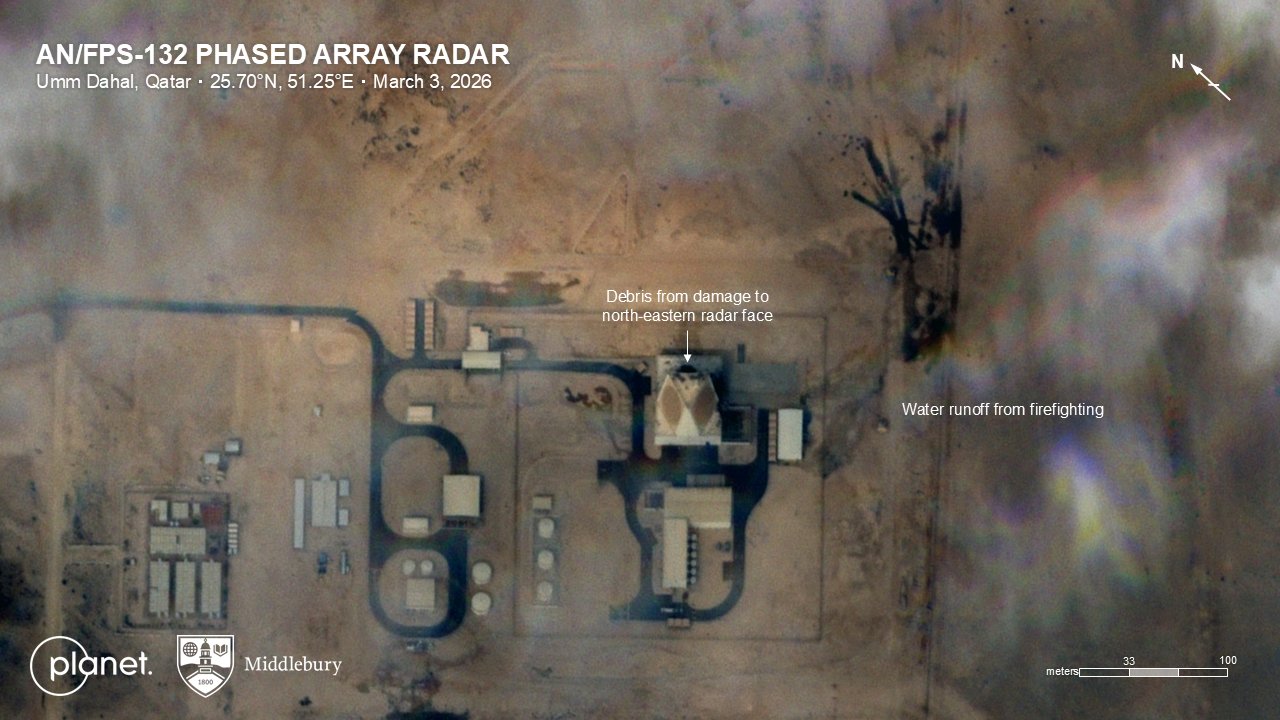
Washington launched Operation Epic Fury on Feb. 28, killing Iranian Supreme Leader Ali Khamenei and several top commanders in a joint U.S.-Israeli strike. What followed was not the collapse and capitulation that U.S. war planners had assumed. Iran’s Armed Forces launched what they designated Operation True Promise 4 — a sustained, methodical campaign targeting the infrastructure of U.S. military power across West Asia. One week in, the damage is documented, and in at least one critical case, confirmed by the Pentagon itself.
Strike the radar, stop the system
Iran did not attempt to overwhelm U.S. missile defenses through sheer volume. Instead, the Iranian military executed a counter-sensor campaign: targeting the detection and fire-control systems that make the entire defensive architecture function.
The primary target was the AN/TPY-2 radar — the X-band surveillance array that serves as the nerve center of the Terminal High Altitude Area Defense system. Without it, a THAAD battery cannot acquire targets or direct interceptors. “The AN/TPY-2 radar is essentially the heart of the THAAD battery, enabling the launch of interceptor missiles and contributing to a networked air defence picture,” munitions specialist N.R. Jenzen-Jones of Armament Research Services told CNN.
To put it in plain terms: THAAD is a missile defense system — a battery of interceptor rockets designed to shoot down incoming missiles before they hit their targets. But THAAD cannot function without its radar. The radar is what scans the sky, spots an incoming missile, calculates where it’s going, and tells the interceptors what to shoot at. Destroy the radar and the interceptor rockets are useless — expensive machinery with nothing to direct them. Iran targeted the radar systems directly.
Satellite imagery reviewed by the open-source publication Islander Reports shows strike damage at four AN/TPY-2 sites across the Arabian Peninsula: Prince Sultan Air Base in Saudi Arabia, Al Ruwais in the UAE, Al Dhafra Air Base near Abu Dhabi, and Muwaffaq Salti Air Base in Jordan. The U.S. confirmed the Jordan strike, acknowledging that Iran destroyed a radar system at Muwaffaq Salti valued at $300 million. The AN/TPY-2 component alone carries a unit cost of approximately $500 million.
Also struck: the AN/FPS-132 early warning radar in Qatar — a $1.1 billion installation hit by a ballistic missile. Iranian strikes have damaged or destroyed facilities at 11 confirmed U.S. military sites across the region since Feb. 28, including at Bahrain, Kuwait, Qatar, Saudi Arabia, the UAE, and Jordan.
The campaign extended beyond missile defense radar to the communications infrastructure that holds the entire U.S. military network together. A New York Times analysis of satellite imagery confirmed that Iranian strikes destroyed two AN/GSC-52B SATCOM terminals at the U.S. Navy’s Fifth Fleet headquarters in Bahrain — high-capacity satellite systems used for near real-time military communication and coordination. At Al Udeid Air Base in Qatar — the largest U.S. installation in the region and the regional headquarters of CENTCOM — a tent housing satellite dishes was destroyed. At Camp Arifjan in Kuwait, at least three radomes were damaged or destroyed. At Ali Al Salem Air Base, also in Kuwait, six additional structures adjacent to satellite communications equipment were hit, then struck again days later. Many of these attacks were carried out with low-cost one-way Shahed drones — far cheaper than the interceptor missiles designed to stop them.
Pentagon-aligned analysts insist the overall picture remains manageable. Ravi Chaudhary, a former assistant secretary of the Air Force, acknowledged that Iran has “a sense of what type of targets they want to continue to press against,” but maintained that “overall, our defenses are doing quite well.” The satellite imagery tells a different story.
The arithmetic of overextension
The vulnerability of this architecture is a matter of numbers. The United States operates eight THAAD batteries in total, with seven currently operational. Before the first Iranian missile flew on Feb. 28, those seven were already stretched across the globe: two committed to Israel, one in South Korea, one in Guam. That left three batteries to cover everything else — the broader Indo-Pacific, the Gulf region, and the continental United States itself.
Those three Gulf-region batteries are the ones Iran went after. The four AN/TPY-2 radar systems struck at Prince Sultan in Saudi Arabia, Al Ruwais and Al Dhafra in the UAE, and Muwaffaq Salti in Jordan were the detection and fire-control systems for those batteries. With their radars destroyed, the launchers they served cannot function. The math is simple and brutal: The United States entered this war with three THAAD batteries available to defend the Gulf, and Iran has rendered them operationally compromised.
Imperialism produces exactly this result. A system driven by the compulsion to dominate every region of strategic economic importance — to control the oil, the shipping lanes, the markets — cannot concentrate its forces. It must spread them. Washington has troops, bases and missile batteries in dozens of countries simultaneously because the system requires a global military presence to back up a global economic order. The generals are doing what the system demands of them. The overextension is imperialism in practice.
With four AN/TPY-2 radar systems now struck across the Gulf region, those remaining batteries face an additional problem. A THAAD launcher without its radar cannot engage targets. Lockheed Martin produces THAAD interceptors at a rate of approximately 11 to 12 per year — a figure that was inadequate before the current war began. During the 12-day war of June 2025, the United States burned through approximately 25% of its entire THAAD interceptor stockpile in under a fortnight.
That production rate is also not an accident. The U.S. defense-industrial complex is built to generate profit, not to replace what war destroys. Long contracts, high unit costs, concentrated production at a handful of giant corporations — Lockheed Martin, Raytheon, Boeing — this is a system optimized for shareholder returns, not for the logistics of sustained combat. Trump has called on defense manufacturers to “quadruple” production to sustain the campaign. That means windfall profits for Lockheed Martin, Raytheon and Boeing. It will not solve the problem in any timeline that matters to this war.
Replacing destroyed high-end radar systems will take three to eight years at current production rates. There is no emergency production surge available. What precision munitions can destroy in an afternoon cannot be rebuilt in a decade at the pace the industry is structured to maintain.
Casualties and claims
The Iranian military’s Khatam al-Anbiya Central Headquarters spokesperson, Lt. Col. Ibrahim Zolfaghari, reported on March 7 that 21 U.S. service members were killed and additional personnel wounded during strikes on the U.S. Navy’s Fifth Fleet in Bahrain, with approximately 200 more killed or wounded at Al Dhafra Air Base in the UAE. The U.S. military has not confirmed these figures. Washington has not, to date, provided its own casualty accounting.
Ali Larijani, secretary of Iran’s Supreme National Security Council, posted on X on March 8 that several U.S. soldiers had been taken prisoner, alleging that Washington was misrepresenting the captures as combat deaths. Washington has publicly acknowledged six soldiers killed on March 1 in a drone strike on a port in Kuwait and CENTCOM denied the prisoner claim. But the Trump administration has given multiple contradictory accounts of the operation since it began, and Trump’s record of deliberate falsehood is well established. The U.S. government has offered no comprehensive accounting of its casualties, and there is no basis for taking its denials at face value.
Iranian officials have stated that only U.S. and Israeli assets are being targeted and that Iran has no enmity toward the host governments whose territory houses those installations.
Bombing on emergency
As the military situation deteriorated, the State Department on March 6 invoked emergency authority to bypass the congressional review period under the Arms Export Control Act, approving a $151.8 million sale of 12,000 BLU-110A/B 1,000-lb bomb bodies to Israel. The manufacturer is Repkon USA, a subsidiary of Repkon, a Turkish firm. According to U.S. officials speaking with the New York Times, the broader package includes 10,000 500-lb bombs and 5,000 small-diameter bombs, with the total valued at over $500 million.
This marks the first time the Trump administration has formally declared an arms sale emergency under the Arms Export Control Act. The State Department justified the sale on the grounds that Israel is “an important force for political stability and economic progress in the Middle East” — a claim issued as Iranian strikes were demolishing U.S. military infrastructure from Saudi Arabia to Jordan.
The Strait and the clock
The war’s economic consequences are already global. Since Feb. 28, maritime traffic through the Strait of Hormuz — the narrow waterway through which roughly 20% of the world’s oil supply passes — has dropped 70%, according to ship-tracking service MarineTraffic. Around 400 tankers are stranded in the Gulf with nowhere to go. U.S. oil prices have surged 28%. The IRGC has warned that any vessel attempting transit will be targeted and destroyed.
Trump announced on Truth Social that the U.S. Navy would escort tankers through the Strait “if necessary, as soon as possible.” The U.S. Navy privately told shipping industry leaders it does not have the assets available to do it — its destroyers in the region are committed to protecting aircraft carriers, with little left over for convoy duty. The gap between the Truth Social post and the operational reality was confirmed by a U.S. official who told Fox News Digital: “We are not escorting ships through the Strait of Hormuz.”
The administration then announced a $20 billion reinsurance program through the U.S. International Development Finance Corporation — an agency built for development lending, not war-risk underwriting, which analysts described as a “profound departure” from its mandate. Analysts say it won’t move the tankers. “There needs to be some confidence that Iran’s ability to continue to wage war has diminished,” Helima Croft of RBC Capital Markets told clients. Washington has offered no timeline for when that might happen.
Iraq has already cut oil production by 1.5 million barrels per day, having run out of storage as its exports are blocked. Oil topped $100 a barrel on March 8 — a threshold analysts had warned would signal serious global economic stress. JPMorgan has cautioned that if Gulf producers are forced to shut down production entirely, Brent crude could spike to $120 per barrel, pushing the global economy into recession. The war Washington launched to assert control over the region’s energy flows has instead shut them down.
Troops push back
The war is generating resistance within the U.S. military itself. Mike Prysner, executive director of the Center on Conscience and War and an Iraq War veteran, reported that his organization has been fielding a surge of calls from soldiers and their families seeking to avoid deployment to the Iran theater. Prysner described a service member who told his mother, in a final call before phones were confiscated, that his unit was going “boots on the ground” — having been told until the last moment that the deployment was for training. Prysner stated that the number of units being deployed is substantially larger than what has been publicly reported.
U.S. service members have filed dozens of complaints alleging that senior officers described the war on Iran as part of “God’s divine plan,” with some officers claiming President Trump was “anointed by Jesus” to bring about Armageddon. This is the language of a military command that has run out of rational justifications to offer the soldiers it is asking to die.
What has been built, and what has been destroyed
The United States spent decades and trillions of dollars constructing a layered surveillance and interception grid across West Asia — a physical infrastructure of power projection built on the premise that U.S. reach was effectively unlimited and U.S. defenses effectively impenetrable.
Iran spent those same decades studying that grid: mapping every radar array, every satellite communications terminal, every fire-control node. The strikes of the past week are the result of that study applied with precision across seven countries simultaneously.
The financial cost of the war to workers in the United States is already staggering. In the first 100 hours of Operation Epic Fury alone, the United States spent an estimated $3.7 billion — nearly $900 million per day — according to estimates from the Center for Strategic and International Studies. Nearly all of that, some $3.5 billion, was not budgeted for this war. It is being drawn from existing Pentagon accounts or added to the deficit. As Struggle-La Lucha reported March 7, one week of the war at that burn rate costs roughly $6.2 billion — enough to fund universal pre-K for every three- and four-year-old in the country for a full year. The same government that says there is no money for health care and schools is spending nearly a billion dollars a day on this.
The workers and poor of the United States bear the cost of this war in blood and in the debt that finances every bomb and every $500 million radar. They are also, in uniform, beginning to refuse it. The mass protests that have swept U.S. cities under the banner “No War with Iran” represent the same class interests in a different form.
Washington’s assumption — that a decapitation strike against Iranian leadership would produce immediate submission — has produced the opposite. The infrastructure of dominance it spent 30 years assembling is being dismantled, node by node, in the desert.
7). Iran War Cost Tracker: Estimated U.S. Taxpayer Spending, Based on the Pentagon's briefing to Congress: Currently around $17,730 Billion, at < https://iran-cost-ticker.com/ >
The current cost of Trump's war at time of posting - 1130 am was $17,774 Billion and counting. - or $11,574 per second.
3300 Iranian dead

No comments:
Post a Comment