https://www.counterpunch.org/2026/02/24/white-supremacy-protects-power-not-white-people/
~~recommended by collectivist action ~~
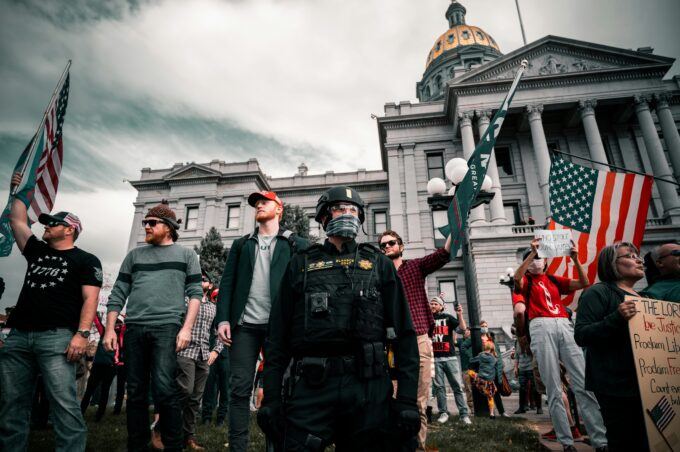
Image by Colin Lloyd.
White supremacy is named for race, but its organizing logic is the preservation of power.
Public conversation about Jeffrey Epstein tends to settle in a predictable place. The focus turns to personalities: who visited the island, who exercised poor judgment, who should have known better. We end up arguing about people like Noam Chomsky instead of asking how the structure allowed it to happen. Attention remains fixed on individuals.
What falls out of view is the system that made Epstein’s protection possible: white supremacy.
By white supremacy I mean the racial order that shaped American institutions — organizing property, citizenship and state violence through slavery, Indigenous dispossession, the exploitation of racialized labor and exclusionary immigration law. In the United States, elite preservation has never operated outside racial hierarchy; the institutions themselves were built inside that hierarchy.
Elite protection is not unique to racially ordered societies. Oligarchies and authoritarian regimes also insulate power. The question is not whether protection occurs but within what historical architecture it operates.
Epstein moved inside elite financial and political networks that have long been structured by race and class power. When things started to surface, it followed a predictable pattern: delays, gentler media coverage and quiet protection of reputations to contain the damage and protect the system. Institutions tend to stabilize the order from which they benefit.
Epstein’s victims were young, often economically vulnerable and the harm was severe.
Public recognition clustered around victims whose suffering could be acknowledged without forcing a broader structural reckoning. The harm and the outrage were both real. But the story stayed focused on individual wrongdoing instead of looking at how the system itself is built.
When elites hurt their own, cohesion weakens. Containment becomes harder when the harmed have access to the same power networks.
When racialized exploitation is involved, two things usually happen at the same time. Racialized women aren’t believed at the same rate. Black girls are treated as older and less innocent. Migrant women risk deportation if they speak. racialized victims receive less media amplification and urgency. The pattern shows up across policing, immigration and child welfare systems. That credibility gap helps contain fallout before it spreads.
Second, when exploitation is framed as structurally produced — through immigration enforcement, labor precarity, foster systems, carceral pipelines, global extraction — the indictment widens beyond individual depravity to the architecture of property, borders and racial hierarchy itself. Such framing increases institutional risk because it implicates system design rather than isolated actors.
Instead, the most publicly visible victims in the Epstein case occupied a position that allowed moral outrage without destabilizing the hierarchy itself: racially inside the dominant order, economically outside elite insulation. This is not a measure of their suffering. It is a measure of what the system could safely acknowledge.
This doesn’t take a conspiracy. Institutions amplify what they can manage without dismantling themselves.
Patriarchy explains the gendered violence. It does not, on its own, explain why certain victims become nationally grievable while others remain structurally invisible. What this reveals is that accountability operates within boundaries the system sets for itself — exposure that never reaches the level of structural change.
Outrage was permitted precisely because structural accountability didn’t go very far. This is how white supremacy sustains itself: by grading protection in ways that insulate power while allowing managed outrage.
Elite white men receive the most consistent insulation.
Some white people are conditionally included.
Poor and precarious white people remain expendable.
Black and brown communities are structurally positioned outside reliable protection and subject to disproportionate surveillance and force.
The expendability of some white people clarifies the design: white supremacy does not protect white people. It protects power.
If whiteness guaranteed safety across the board, elite authority would face meaningful constraint. It isn’t, and that is the design.
The same logic doesn’t end with Epstein. It surfaces again in how the state uses force.
The killings of Renée Good and Alex Pretti by ICE agents underscored how many people assumed a white supremacist order would automatically protect white individuals. Much of the public commentary treated the events as one-off tragedies or errors in judgment rather than asking broader questions about immigration enforcement as an institution. But white supremacy doesn’t mean universal safety for white people. It’s a hierarchy where proximity to power and institutional authority shape who is actually protected. When someone’s actions are framed as undermining the racialized architecture of enforcement, that protection can fall away.
Border enforcement is not merely domestic policing. It operates within an imperial framework that still determines who gets to move, who gets to belong and who remains disposable. Immigration regimes historically sorted populations along racial and colonial lines; today’s enforcement continues to run on those same logics — regardless of who wears the uniform, including when some are Black or brown.
Anyone can be positioned to enforce this hierarchy, and anyone can be rendered expendable within it. Alignment with institutional power — not racial identity alone — determines who carries out enforcement and who receives protection.
Across both cases, a consistent dynamic appears:
Does this person’s suffering threaten elite power?
When it does not, damage is absorbed through plea deals, narrowed charges, scandal containment and reputational buffering while preserving hierarchy intact.
When it does threaten legitimacy at the top, public adjustment follows: selective prosecutions, reputational sacrifice or policy reform. Sufficient to restore confidence without dismantling the underlying structure.
In Epstein’s case, absorption dominated for years. Even later prosecutions did not meaningfully disrupt elite networks or alter the structures that enabled them.
Focusing exclusively on individual morality obscures institutional design. Structural analysis reveals the architecture.
White supremacy takes its name from race but its enduring function is the preservation of power. Black and brown communities remain structurally positioned outside consistent protection. At the same time, hierarchy requires gradation within whiteness itself; certain white bodies can be sacrificed when maintaining authority demands it.
When harm is treated as an individual failure rather than a systemic problem, accountability ends with punishment. Without structural change, reform is just cosmetic.
White supremacy does not guarantee universal safety.
It guarantees continuity of power.
Until analysis shifts from personalities to structures, accountability will remain partial.

No comments:
Post a Comment