Parents being Deported without knowing where their kids are
~~ recommended by newestbeginning ~~
A new method of detaining and deporting immigrants seems “engineered to lead to family separation,” one advocate told HuffPost.

Illustration: Kelly Caminero/HuffPost; Photo: Getty Images
A mother was forced to leave her 6-month-old with her sister when she was deported and flown to Honduras. By the time she landed, her sister had also been detained — and she had no idea where her child was.
A father begged immigration agents for one phone call when he was detained at work because his child was with a babysitter. He made the call, and the babysitter was able to stay a few extra days, but he was deported without his child.
A 22-year-old pregnant woman in Florida was picked up by immigration agents while traveling in Louisiana and detained for a month before being deported without her 2-year-old daughter. “They didn’t ask me anything. They didn’t talk to me, just to yell at me, to humiliate me. They never told me, ‘You have a daughter, you can bring her,’ because I would have brought her to [Honduras], she is glued to me,” she said.
Another woman was detained while dropping off her son, who is disabled, at school. “He doesn’t even know that I was deported,” she said, adding that she was never given the option to bring him with her.
These are just some of the stories immigrants deported from the United States to Honduras told the Women’s Refugee Commission, a nonprofit organization that interviewed people as they arrived. Every day for the last year, at least 300 immigrants have landed at La Lima airport, many without their children — and without knowing where their kids are or who is taking care of them.
Zain Lakhani, WRC’s director of migrant rights and justice, estimates hundreds of parents deported to Honduras have been separated from their families.
Immigration advocates say what’s happening is tantamount to a new form of forcible family separation — one that stands out because of the speed and scale at which it’s happening, and the particular way in which immigrants are being targeted. People are being picked up during routine traffic stops, apprehended outside of their kids’ schools or disappeared on their way to work, then forced out of the country within days, often leaving their children and loved ones completely unaware that they were taken.
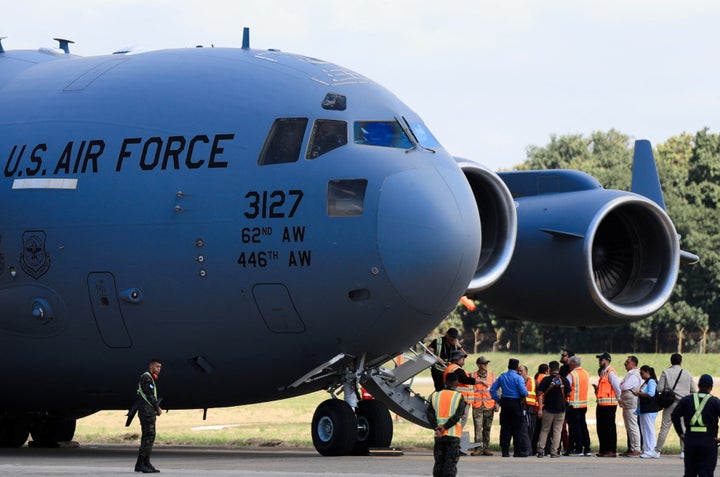
Yoseph Amaya / Reuters
“I would say these are very different types of deportation, engineered to lead to family separation,” said Michele Heisler, the medical director at Physicians for Human Rights, an international NGO that traveled to Honduras alongside WRC to document human rights abuses.
Tricia McLaughlin, assistant secretary at the Department of Homeland Security, told HuffPost that Immigration and Customs Enforcement does not separate families when the agency deports a parent or primary caregiver. “Parents are asked if they want to be removed with their children or ICE will place the children with a safe person the parent designates,” she said. “This is consistent with past administrations’ immigration enforcement.”
DHS did not answer a question about whether it is currently tracking family separations. The White House referred HuffPost to DHS when reached for comment.
This form of family separation is distinct from what happened during Trump’s first term, when his administration notoriously separated families at the U.S.-Mexico border, holding kids and parents in different detention facilities upon arrival.
But even during that time —the most notorious and sweeping example of family separation in recent history — there were more robust directives in place that were meant to minimize family separation.
In 2013, then-President Barack Obama created a federal immigration policy called parental interest directives, which said ICE and Customs and Border Protection should not detain someone who identifies as a parent or a primary caregiver in hopes of keeping families together. The policy stayed largely the same through the Obama and Biden administrations (though both still separated many migrant families), and Trump adopted a somewhat weaker but overall similar policy during his first administration.
That changed last July, when Trump issued a new parental interest directive that contains only two mandatory requirements for immigration agents when detaining parents: They must ask people they detain whether they are parents, and they need to give detained immigrants the opportunity to decide if they want to be deported with their kids.
But in practice, advocates say the Trump administration is not even complying with its own watered-down policy.
“Those are the only two ironclad obligations or requirements that remain … and they’re not even doing that,” Lakhani said.
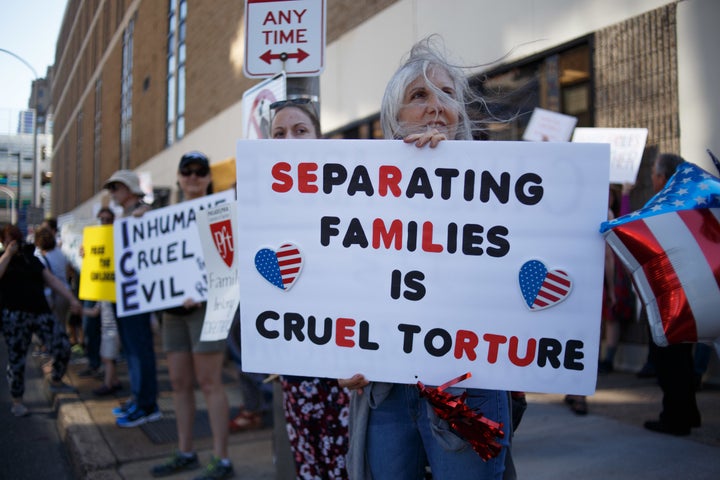
Michael Candelori/Pacific Press/LightRocket via Getty Images
And because there has been so much focus from the administration on finding and detaining people who have been living in the U.S. for a long time, rather than stopping people as they attempt to enter the country, officials have been detaining more immigrants when they aren’t with their children.
More than 30 children in seven states have entered foster care after their parents were deported, a NOTUS investigation found, and there are likely many more since there’s no comprehensive national database that tracks where kids end up after their parents are deported.
The lack of data around how many families have been torn apart leaves advocates struggling to understand how to help, and could lead to families being separated for longer periods of time or never reunited at all. The number of children separated under the first Trump administration was unknown for years because there was no formal tracking system and a lack of coordination between relevant agencies. A 2020 government report revealed that at least 2,700 children were separated from their parents at the U.S. southern border between 2018 and 2019.
During a six-day trip to Honduras, WRC and PHR advocates spoke to dozens of immigrants stepping off planes from the U.S. who were not given the option to either contact their children or bring their kids with them. Honduran service providers doing intake of immigrants at the airport and documenting cases of family separation said that they have seen hundreds of adults separated from their children, according to WRC’s report. Service providers include social workers, physicians and psychologists doing intake as part of a Honduras government initiative to support people returning to the country.
“All one could see was women crying because their children were taken from them… We were all crying on the plane, all of us, thinking about our children,” a 38-year-old mother separated from her 5-year-old child told WRC and PHR.
“Women would come in just sobbing, saying they weren’t even asked if they had kids.”
- Michele Heisler, medical director at Physicians for Human Rights
One service provider who works at La Lima’s reception area, interviewing recently deported immigrants, said that around 80% of the people they spoke to had similar stories of family separation, according to WRC.
“We didn’t go in thinking we were going to find so many instances of really forcible family separation,” Heisler said. “Women would come in just sobbing, saying they weren’t even asked if they had kids.”
With at least 300 migrants being deported to La Lima every day, and Trump’s deportation agenda accelerating in the last six months, the lowest estimate of how many people landed at La Lima airport since July is just over 54,000. This is a shocking and unprecedented number of people being removed from the U.S., advocates said.
It’s common for people to languish in detention centers for months after being apprehended by federal agents. Long detentions present their own problems, but, in theory, they give parents more time to advocate for themselves and alert ICE that they have children.
But WRC and PHR spoke to dozens of parents who were detained and deported in four or five days, during which time they were moved around to multiple facilities. “You have no opportunity to really advocate for yourself, or to be able to tell anyone: ‘I have children. I want to bring my children with me,’” Lakhani said.
Once someone is deported without their child, the process and possibility for reunification is extremely difficult. Of the 2,700 children who were separated from their parents under the first Trump administration, more than 1,300 have still not been reunited with their parents, according to a 2024 DHS report.
Honduras doesn’t have the infrastructure or resources to try to facilitate reunification of parents and children, advocates told HuffPost. Child welfare agencies in the U.S. do not have the resources needed to do this type of work, which often involves complicated third-country reunifications that take time.
Trump’s hard-line immigration enforcement is hurting families across the U.S., even those who are still together. Many parents have chosen to be detained with their children in order to give them the best chance of staying together.
There are now six times as many children detained in ICE detention centers as there were at the beginning of 2025, according to The Marshall Project. Children as young as 18 months old are being detained in facilities like the one in Dilley, Texas, where 5-year-old Liam Conejo Ramos was held after ICE took the preschooler and his dad into custody in a Minneapolis suburb. Many of these children are being held far beyond the 20-day legal limit.
“The levels of psychological trauma that the children are facing and will face is really heartbreaking,” Heisler said. “We’re going to have a generation of children who are deeply, deeply traumatized.”

No comments:
Post a Comment