https://www.huffpost.com/entry/marimar-marinez-dhs-renee-good_n_696181d6e4b024bfe0b93fa6?origin=home-latest-news-unit
~~ recommended by newestbeginning ~~
The Regime's war against America (and the world) - its pattern of violence, victim blaming and cover up of its violent crimes.
They denied medical care to Renee Good after they shot her. What was the point of that? To inflict more suffering?
How Extrajudicial Killings Became Legal
And how we can change that without waiting for a single election.

Image from CBS/Getty Images Bottom Line Up Front for Hardcore Activists
Here are three clear demands:
One: Agents identify or face arrest. Badge number, name, agency. Refusal means you have no authority. Prosecute accordingly.
Two: States prosecute federal agents who commit crimes. When the feds intervene, keep prosecuting. Stopping is acquiescence. Continuing is justice.
Three: Prosecute Jonathan Ross for the murder of Renee Nicole Good.
In February 2013, the Police Executive Research Forum completed an internal review that Customs and Border Protection had commissioned. The nonprofit organization, which develops best practices for law enforcement agencies, examined use-of-force incidents along the border.¹
Among its findings: Border Patrol agents had deliberately stepped in front of moving vehicles to manufacture justification for shooting the drivers. Agents had fired across the border at rock throwers when simply moving away would have resolved the situation. The agency demonstrated what the review called a “lack of diligence” in investigating incidents where agents discharged their weapons.¹
The report recommended that Border Patrol bar agents from shooting at vehicles unless lives were threatened and prohibit firing at rock throwers entirely. Customs and Border Protection rejected both recommendations. Border Patrol Chief Mike Fisher told the Associated Press that implementing such restrictions would be “very problematic” and “potentially put Border Patrol agents in danger.”²
The agency then attempted to suppress the scathing twenty-one page report from public view.³
That sequence of events captures something essential about how the United States arrived at a system where federal agents can kill without meaningful legal consequence. The mechanisms that permit this did not emerge from legislation or executive policy. They emerged from decades of judicial decisions that gradually erected an architecture of impunity so thorough that it has become the norm rather than the exception.
The doctrine of qualified immunity provides the first layer of protection. In 1967, the Supreme Court decided Pierson v. Ray and held that police officers could claim immunity from civil suits if they acted in “good faith” and with “probable cause.”⁴ The Court reasoned that officers should not face financial ruin for doing their jobs. This seemed reasonable enough at the time.
But in 1982, the Court transformed the doctrine in Harlow v. Fitzgerald.⁵ It eliminated the good faith requirement entirely. Government officials would now receive immunity unless their conduct violated “clearly established law,” which courts have interpreted to mean a prior decision involving nearly identical facts.
The perverse result is that constitutional violations can go unremedied indefinitely. A victim must point to a previous case where another official engaged in essentially the same conduct and was held accountable. If no such case exists, the official receives immunity regardless of how egregious the behavior. Courts sometimes acknowledge that an official violated the Constitution and then grant immunity anyway because no sufficiently similar case preceded it.
As Judge Carlton Reeves wrote in a 2024 opinion denying qualified immunity, the doctrine means government agents “can get away with violating your rights as long as they do so in a novel way.”⁶
Justice Sonia Sotomayor has repeatedly criticized this framework. In her dissent in Kisela v. Hughes, she described a “disturbing trend” of courts siding with officers who use excessive force, noting that qualified immunity has become “an absolute shield” that “tells officers that they can shoot first and think later.”⁷
The case involved an Arizona officer who shot a mentally impaired woman four times as she stood stationary in her driveway holding a kitchen knife at her side. The Court granted immunity because no prior decision had established that this precise conduct was unconstitutional.⁷
Federal agents enjoy additional protections beyond qualified immunity. Civil suits against federal officers arise under Bivens v. Six Unknown Named Agents, a 1971 decision that created a damages remedy for constitutional violations by federal officials.⁸ But the Supreme Court has spent the past two decades severely restricting when Bivens claims can proceed.
In Ziglar v. Abbasi, decided in 2017, the Court held that extending Bivens to any “new context” requires courts to exercise extreme caution.⁹ What counts as a new context has proven remarkably broad.
The case of Hernandez v. Mesa demonstrates how these doctrines combine to produce complete immunity for federal agents who kill.¹⁰ In June 2010, Border Patrol Agent Jesus Mesa Jr. shot and killed Sergio Adrián Hernández Güereca, a fifteen-year-old Mexican boy. Mesa stood on American soil in El Paso. Hernández stood on Mexican soil in Ciudad Juarez. Video footage contradicted Mesa’s claim that Hernández had thrown rocks at him.
The Department of Justice investigated and concluded that Mesa had not violated agency policy, declining to bring charges.¹⁰
When Hernández’s parents sued Mesa under Bivens, the Supreme Court held in 2020 that they could not proceed because a cross-border shooting constituted a “new context” with “foreign relations and national security implications.” Justice Samuel Alito’s majority opinion acknowledged that extending Bivens might provide justice to the family but concluded that doing so would interfere with the executive branch’s authority over border security and foreign policy.¹⁰
The Court suggested that if such families deserved a remedy, Congress should create one.¹⁰
This is the system we inherited. And now we are watching it metastasize.
Since January 2025, Immigration and Customs Enforcement agents have conducted raids across the country while masked, in plainclothes, and without visible identification. Human Rights Watch documented agents concealing agency insignias and using unmarked vehicles to detain people at courthouses, schools, workplaces, homes, and on public transport.¹¹
ICE justifies the practice as necessary “to prevent doxing.” One federal district court judge dismissed that rationale as “disingenuous, squalid and dishonorable,” writing that “ICE goes masked for a single reason: to terrorize Americans into quiescence. We have never tolerated an armed masked secret police.”¹¹
Except we have been tolerating it for the past year. Are we going to tolerate it for another year? And if the next election does not go our way, or gets stolen, then what? We wait another two years after that?
The Center for American Progress reported agents swinging batons, smashing car windows, using explosives to blow doors off homes with children inside, emerging from unmarked vehicles with weapons drawn, and grabbing people off the street.¹²
Criminals have exploited this chaos. A South Carolina man was charged with kidnapping after posing as an agent and confronting a Latino driver. A Florida woman kidnapped her ex-boyfriend’s wife while wearing an “ICE” shirt and a mask. In Philadelphia, a man posing as an agent robbed an automobile shop. In Minnesota, a man allegedly disguised as law enforcement murdered a state legislator and her husband.¹³
On January 7, 2026, ICE agent Jonathan Ross shot and killed Renee Nicole Good, a thirty-seven-year-old woman whose car had briefly blocked traffic during an enforcement operation.¹⁴ Video shows Ross drawing his weapon and firing three shots as she drove away. The car crashed into a light pole about one hundred feet down the road.
ICE is not law enforcement. It is an immigration enforcement agency with jurisdiction limited to immigration matters. A woman blocking traffic is not an immigration matter. These agents operate as though they possess general police powers. They do not.
President Trump immediately claimed on social media that Ross acted in “self defense.” There will be no federal prosecution. Everyone knows that, even the GOP.
The legal architecture works precisely as intended. Qualified immunity blocks civil suits unless a victim can point to a prior case with nearly identical facts. Bivens restrictions prevent extending damages remedies to any new context, which proves remarkably easy to manufacture. Local prosecutors face pressure not to pursue charges, or to overcharge to sabotage potential convictions. Federal investigators with integrity have been fired or resigned.
The Heritage Foundation Supreme Court wants this.
We cannot wait until the next election to address the “secret police abducting and murdering people without anyone stopping them” problem.
We do not get to operate in this environment for years and remain a democracy. Masked, unidentified agents snatching people off streets in unmarked vehicles is not compatible with constitutional governance. The FBI will not hold these agents accountable. The Department of Justice will not prosecute them.
These organizations are not going to hold themselves accountable.
Part of why we have lost so much ground is the mismatch between how our side operates and how theirs does. The attorney mindset says: we will pass legislation creating a ten thousand dollar fine for agents who refuse to identify themselves. We will establish a hotline for reporting misconduct. We will form a commission to study the problem.
In the months it takes institutionalists to draft legislation, hold hearings, negotiate amendments, and celebrate incremental progress, fascists enact massive structural changes that render those incremental gains meaningless.
An effective response means stepping up with the same urgency. An executive order at the state level: if you claim authority to detain people or use force in this state and refuse to identify yourself when asked, we treat you as a criminal acting with malintent.
If you are a local or state law enforcement officer who refuses to enforce state law against federal agents committing crimes, you lose your job. If you obstruct state prosecutions, you face charges yourself. Police departments that refuse to cooperate get their leadership replaced. Everyone who breaks the law faces prosecution to the fullest extent.
Local and state law enforcement should respond to reports of armed, masked individuals grabbing people off the street as what they appear to be: kidnappings and assaults in progress. If someone claiming to be law enforcement refuses to identify themselves, they have not established that they are law enforcement. Dispatch should treat these calls as high priority. Officers should respond as they would to any violent crime.
If local police departments refuse to respond, governors should engage the National Guard. The safety of residents cannot depend on taking the word of someone masked, armed, wearing gear you can buy off eBay, and screaming “get the fuck out of the car bitch.”
Nobody gets to be above the law.
Yes, this is disruptive. It is disruptive because it reinstitutes rule of law when the more powerful actor in the situation has abandoned it.
This is what wins. We are using these tactics to enforce accountability and protect constitutional rights, not to destroy them. We are not seizing power to abuse it. We are wielding power to prevent abuse. That distinction matters.
But the tactical reality remains: incremental measures designed to avoid conflict do not work against adversaries who embrace conflict. We either match their willingness to act decisively or we lose.
If the pearl clutchers need to sit this one out, please do so.
States can prosecute federal agents who commit criminal acts. The Supremacy Clause provides some protection for federal officials, but only when they are reasonably acting within the bounds of lawful federal duties.¹⁵
Shooting into a vehicle at a driver who poses no threat to anyone is not a lawful federal duty. Smashing windows, beating civilians, and conducting home invasions without identification are not lawful federal duties.
Minnesota has successfully prosecuted police officers for murder before. States can prosecute ICE agents too.¹⁶
The process will be contested. Federal law allows defendants to remove state criminal prosecutions to federal court. The Trump administration will fight every prosecution with every tool available.
Deputy Attorney General Todd Blanche has already claimed that prosecuting federal agents constitutes conspiracy to interfere with immigration enforcement. Deputy Chief of Staff Stephen Miller told ICE officers that “anybody who lays a hand on you or tries to stop you or tries to obstruct you is committing a felony.”¹⁵
He is lying.
Multiple states have indicted, charged, and arrested federal officers for conduct that exceeded their official duties. Virginia charged a federal tax collector posse with shooting horses and cattle during an 1898 shootout. The history of state prosecution of federal officials stretches back to the War of 1812.¹⁶
States possess this authority. The federal government will try to remove cases to federal court and sabotage them through sympathetic judges. So let them. Run the prosecutions anyway. Build the record. Make the arguments. Create the precedent. Even if individual prosecutions fail in hostile federal courts, the documentation establishes facts that may support future prosecution when the political environment changes.
The conflict has to happen. There is no path through this that avoids it. They are the ones writing rules that place themselves above the law.
If the federal government will not provide accountability, and if federal courts have constructed an architecture specifically designed to prevent accountability, then states must provide it instead. That is what federalism means. That is what it has always meant.
State attorneys general should establish portals for civilians to report encounters with unidentified federal agents and should investigate every report. Prosecutors should bring charges where evidence supports them.
We are not asking permission. The administration has made clear that it considers itself above accountability. It has constructed an enforcement apparatus designed to terrorize communities while remaining invisible to legal consequence.
The response cannot be to wait politely for the next election while masked agents assault, kidnap, and murder innocent people. The response must be to use every tool available to impose the consequences that the federal government refuses to impose.
Some of this will fail. Federal courts will block some prosecutions. The administration will retaliate against states that resist. There will be chaos and conflict and uncertainty.
But the alternative is acquiescence to a system where government agents can kill without identification, without accountability, and without consequence. That is not a system compatible with constitutional democracy.
We either resist it or we accept it. There is no third option.
Three demands. There is no legal rule that says anyone is above the law. Not the Supremacy Clause. Not qualified immunity.
One: Identify or be arrested. Badge number, name, agency. Refusal means you have no authority. Prosecute accordingly.
Two: States prosecute federal agents who commit crimes. When the feds intervene, keep prosecuting. Stopping is acquiescence. Continuing is justice.
Three: Prosecute Jonathan Ross for the murder of Renee Nicole Good.
State prosecution of federal agents is one piece of a larger strategy. The Introduction to Soft Secession lays out the rest. Free at BuyMeACoffee.com/TheER along with the Opposition Guide to Tax Warfare and more. Physical copies and merch at TheExistentialistRepublic.com.
References
Police Executive Research Forum. (2013). U.S. Customs and Border Protection use of force review: Cases and policies. https://www.cbp.gov/sites/
Hsieh, S. (2014, February 28). US border agents intentionally stepped in front of moving vehicles to justify shooting at them. The Nation. https://www.thenation.com/
American Civil Liberties Union of San Diego and Imperial Counties. (2014, February 28). ACLU statement on reported audit of Border Patrol’s use-of-force policies. https://www.aclu-sdic.org/
Pierson v. Ray, 386 U.S. 547 (1967).
Harlow v. Fitzgerald, 457 U.S. 800 (1982).
Equal Justice Initiative. (2024, May 23). Federal court denies qualified immunity and explains doctrine’s fatal flaws. https://eji.org/news/federal-
Kisela v. Hughes, 584 U.S. ___ (2018).
Bivens v. Six Unknown Named Agents, 403 U.S. 388 (1971).
Ziglar v. Abbasi, 582 U.S. ___ (2017).
Hernandez v. Mesa, 589 U.S. 93 (2020).
Human Rights Watch. (2025, December 18). US: Masked federal agents undermine rule of law. https://www.hrw.org/news/2025/
Center for American Progress. (2025, August 28). Masked and unidentifiable: The risks of federal law enforcement operating without identification. https://www.americanprogress.
Truthout. (2025, July 19). By refusing to show faces or badges, ICE opens door to vigilante impersonators. https://truthout.org/articles/
Sweet, J., Hurowitz, N., & Washington, J. (2026, January 8). ICE agent who shot Renee Nicole Good identified as Jonathan Ross. The Intercept. https://theintercept.com/2026/
Lawfare. (2025, November 6). Are federal officials immune from state prosecution? https://www.lawfaremedia.org/
Dayen, D. (2026, January 7). ICE agents can be charged with murder. The American Prospect. https://prospect.org/2026/01/


|
Bottom Line Up Front for Hardcore Activists
Here are three clear demands:
One: Agents identify or face arrest. Badge number, name, agency. Refusal means you have no authority. Prosecute accordingly.
Two: States prosecute federal agents who commit crimes. When the feds intervene, keep prosecuting. Stopping is acquiescence. Continuing is justice.
Three: Prosecute Jonathan Ross for the murder of Renee Nicole Good.
In February 2013, the Police Executive Research Forum completed an internal review that Customs and Border Protection had commissioned. The nonprofit organization, which develops best practices for law enforcement agencies, examined use-of-force incidents along the border.¹
Among its findings: Border Patrol agents had deliberately stepped in front of moving vehicles to manufacture justification for shooting the drivers. Agents had fired across the border at rock throwers when simply moving away would have resolved the situation. The agency demonstrated what the review called a “lack of diligence” in investigating incidents where agents discharged their weapons.¹
The report recommended that Border Patrol bar agents from shooting at vehicles unless lives were threatened and prohibit firing at rock throwers entirely. Customs and Border Protection rejected both recommendations. Border Patrol Chief Mike Fisher told the Associated Press that implementing such restrictions would be “very problematic” and “potentially put Border Patrol agents in danger.”²
The agency then attempted to suppress the scathing twenty-one page report from public view.³
That sequence of events captures something essential about how the United States arrived at a system where federal agents can kill without meaningful legal consequence. The mechanisms that permit this did not emerge from legislation or executive policy. They emerged from decades of judicial decisions that gradually erected an architecture of impunity so thorough that it has become the norm rather than the exception.
The doctrine of qualified immunity provides the first layer of protection. In 1967, the Supreme Court decided Pierson v. Ray and held that police officers could claim immunity from civil suits if they acted in “good faith” and with “probable cause.”⁴ The Court reasoned that officers should not face financial ruin for doing their jobs. This seemed reasonable enough at the time.
But in 1982, the Court transformed the doctrine in Harlow v. Fitzgerald.⁵ It eliminated the good faith requirement entirely. Government officials would now receive immunity unless their conduct violated “clearly established law,” which courts have interpreted to mean a prior decision involving nearly identical facts.
The perverse result is that constitutional violations can go unremedied indefinitely. A victim must point to a previous case where another official engaged in essentially the same conduct and was held accountable. If no such case exists, the official receives immunity regardless of how egregious the behavior. Courts sometimes acknowledge that an official violated the Constitution and then grant immunity anyway because no sufficiently similar case preceded it.
As Judge Carlton Reeves wrote in a 2024 opinion denying qualified immunity, the doctrine means government agents “can get away with violating your rights as long as they do so in a novel way.”⁶
Justice Sonia Sotomayor has repeatedly criticized this framework. In her dissent in Kisela v. Hughes, she described a “disturbing trend” of courts siding with officers who use excessive force, noting that qualified immunity has become “an absolute shield” that “tells officers that they can shoot first and think later.”⁷
The case involved an Arizona officer who shot a mentally impaired woman four times as she stood stationary in her driveway holding a kitchen knife at her side. The Court granted immunity because no prior decision had established that this precise conduct was unconstitutional.⁷
Federal agents enjoy additional protections beyond qualified immunity. Civil suits against federal officers arise under Bivens v. Six Unknown Named Agents, a 1971 decision that created a damages remedy for constitutional violations by federal officials.⁸ But the Supreme Court has spent the past two decades severely restricting when Bivens claims can proceed.
In Ziglar v. Abbasi, decided in 2017, the Court held that extending Bivens to any “new context” requires courts to exercise extreme caution.⁹ What counts as a new context has proven remarkably broad.
The case of Hernandez v. Mesa demonstrates how these doctrines combine to produce complete immunity for federal agents who kill.¹⁰ In June 2010, Border Patrol Agent Jesus Mesa Jr. shot and killed Sergio Adrián Hernández Güereca, a fifteen-year-old Mexican boy. Mesa stood on American soil in El Paso. Hernández stood on Mexican soil in Ciudad Juarez. Video footage contradicted Mesa’s claim that Hernández had thrown rocks at him.
The Department of Justice investigated and concluded that Mesa had not violated agency policy, declining to bring charges.¹⁰
When Hernández’s parents sued Mesa under Bivens, the Supreme Court held in 2020 that they could not proceed because a cross-border shooting constituted a “new context” with “foreign relations and national security implications.” Justice Samuel Alito’s majority opinion acknowledged that extending Bivens might provide justice to the family but concluded that doing so would interfere with the executive branch’s authority over border security and foreign policy.¹⁰
The Court suggested that if such families deserved a remedy, Congress should create one.¹⁰
This is the system we inherited. And now we are watching it metastasize.
Since January 2025, Immigration and Customs Enforcement agents have conducted raids across the country while masked, in plainclothes, and without visible identification. Human Rights Watch documented agents concealing agency insignias and using unmarked vehicles to detain people at courthouses, schools, workplaces, homes, and on public transport.¹¹
ICE justifies the practice as necessary “to prevent doxing.” One federal district court judge dismissed that rationale as “disingenuous, squalid and dishonorable,” writing that “ICE goes masked for a single reason: to terrorize Americans into quiescence. We have never tolerated an armed masked secret police.”¹¹
Except we have been tolerating it for the past year. Are we going to tolerate it for another year? And if the next election does not go our way, or gets stolen, then what? We wait another two years after that?
The Center for American Progress reported agents swinging batons, smashing car windows, using explosives to blow doors off homes with children inside, emerging from unmarked vehicles with weapons drawn, and grabbing people off the street.¹²
Criminals have exploited this chaos. A South Carolina man was charged with kidnapping after posing as an agent and confronting a Latino driver. A Florida woman kidnapped her ex-boyfriend’s wife while wearing an “ICE” shirt and a mask. In Philadelphia, a man posing as an agent robbed an automobile shop. In Minnesota, a man allegedly disguised as law enforcement murdered a state legislator and her husband.¹³
On January 7, 2026, ICE agent Jonathan Ross shot and killed Renee Nicole Good, a thirty-seven-year-old woman whose car had briefly blocked traffic during an enforcement operation.¹⁴ Video shows Ross drawing his weapon and firing three shots as she drove away. The car crashed into a light pole about one hundred feet down the road.
ICE is not law enforcement. It is an immigration enforcement agency with jurisdiction limited to immigration matters. A woman blocking traffic is not an immigration matter. These agents operate as though they possess general police powers. They do not.
President Trump immediately claimed on social media that Ross acted in “self defense.” There will be no federal prosecution. Everyone knows that, even the GOP.
The legal architecture works precisely as intended. Qualified immunity blocks civil suits unless a victim can point to a prior case with nearly identical facts. Bivens restrictions prevent extending damages remedies to any new context, which proves remarkably easy to manufacture. Local prosecutors face pressure not to pursue charges, or to overcharge to sabotage potential convictions. Federal investigators with integrity have been fired or resigned.
The Heritage Foundation Supreme Court wants this.
We cannot wait until the next election to address the “secret police abducting and murdering people without anyone stopping them” problem.
We do not get to operate in this environment for years and remain a democracy. Masked, unidentified agents snatching people off streets in unmarked vehicles is not compatible with constitutional governance. The FBI will not hold these agents accountable. The Department of Justice will not prosecute them.
These organizations are not going to hold themselves accountable.
Part of why we have lost so much ground is the mismatch between how our side operates and how theirs does. The attorney mindset says: we will pass legislation creating a ten thousand dollar fine for agents who refuse to identify themselves. We will establish a hotline for reporting misconduct. We will form a commission to study the problem.
In the months it takes institutionalists to draft legislation, hold hearings, negotiate amendments, and celebrate incremental progress, fascists enact massive structural changes that render those incremental gains meaningless.
An effective response means stepping up with the same urgency. An executive order at the state level: if you claim authority to detain people or use force in this state and refuse to identify yourself when asked, we treat you as a criminal acting with malintent.
If you are a local or state law enforcement officer who refuses to enforce state law against federal agents committing crimes, you lose your job. If you obstruct state prosecutions, you face charges yourself. Police departments that refuse to cooperate get their leadership replaced. Everyone who breaks the law faces prosecution to the fullest extent.
Local and state law enforcement should respond to reports of armed, masked individuals grabbing people off the street as what they appear to be: kidnappings and assaults in progress. If someone claiming to be law enforcement refuses to identify themselves, they have not established that they are law enforcement. Dispatch should treat these calls as high priority. Officers should respond as they would to any violent crime.
If local police departments refuse to respond, governors should engage the National Guard. The safety of residents cannot depend on taking the word of someone masked, armed, wearing gear you can buy off eBay, and screaming “get the fuck out of the car bitch.”
Nobody gets to be above the law.
Yes, this is disruptive. It is disruptive because it reinstitutes rule of law when the more powerful actor in the situation has abandoned it.
This is what wins. We are using these tactics to enforce accountability and protect constitutional rights, not to destroy them. We are not seizing power to abuse it. We are wielding power to prevent abuse. That distinction matters.
But the tactical reality remains: incremental measures designed to avoid conflict do not work against adversaries who embrace conflict. We either match their willingness to act decisively or we lose.
If the pearl clutchers need to sit this one out, please do so.
States can prosecute federal agents who commit criminal acts. The Supremacy Clause provides some protection for federal officials, but only when they are reasonably acting within the bounds of lawful federal duties.¹⁵
Shooting into a vehicle at a driver who poses no threat to anyone is not a lawful federal duty. Smashing windows, beating civilians, and conducting home invasions without identification are not lawful federal duties.
Minnesota has successfully prosecuted police officers for murder before. States can prosecute ICE agents too.¹⁶
The process will be contested. Federal law allows defendants to remove state criminal prosecutions to federal court. The Trump administration will fight every prosecution with every tool available.
Deputy Attorney General Todd Blanche has already claimed that prosecuting federal agents constitutes conspiracy to interfere with immigration enforcement. Deputy Chief of Staff Stephen Miller told ICE officers that “anybody who lays a hand on you or tries to stop you or tries to obstruct you is committing a felony.”¹⁵
He is lying.
Multiple states have indicted, charged, and arrested federal officers for conduct that exceeded their official duties. Virginia charged a federal tax collector posse with shooting horses and cattle during an 1898 shootout. The history of state prosecution of federal officials stretches back to the War of 1812.¹⁶
States possess this authority. The federal government will try to remove cases to federal court and sabotage them through sympathetic judges. So let them. Run the prosecutions anyway. Build the record. Make the arguments. Create the precedent. Even if individual prosecutions fail in hostile federal courts, the documentation establishes facts that may support future prosecution when the political environment changes.
The conflict has to happen. There is no path through this that avoids it. They are the ones writing rules that place themselves above the law.
If the federal government will not provide accountability, and if federal courts have constructed an architecture specifically designed to prevent accountability, then states must provide it instead. That is what federalism means. That is what it has always meant.
State attorneys general should establish portals for civilians to report encounters with unidentified federal agents and should investigate every report. Prosecutors should bring charges where evidence supports them.
We are not asking permission. The administration has made clear that it considers itself above accountability. It has constructed an enforcement apparatus designed to terrorize communities while remaining invisible to legal consequence.
The response cannot be to wait politely for the next election while masked agents assault, kidnap, and murder innocent people. The response must be to use every tool available to impose the consequences that the federal government refuses to impose.
Some of this will fail. Federal courts will block some prosecutions. The administration will retaliate against states that resist. There will be chaos and conflict and uncertainty.
But the alternative is acquiescence to a system where government agents can kill without identification, without accountability, and without consequence. That is not a system compatible with constitutional democracy.
We either resist it or we accept it. There is no third option.
Three demands. There is no legal rule that says anyone is above the law. Not the Supremacy Clause. Not qualified immunity.
One: Identify or be arrested. Badge number, name, agency. Refusal means you have no authority. Prosecute accordingly.
Two: States prosecute federal agents who commit crimes. When the feds intervene, keep prosecuting. Stopping is acquiescence. Continuing is justice.
Three: Prosecute Jonathan Ross for the murder of Renee Nicole Good.
State prosecution of federal agents is one piece of a larger strategy. The Introduction to Soft Secession lays out the rest. Free at BuyMeACoffee.com/TheER along with the Opposition Guide to Tax Warfare and more. Physical copies and merch at TheExistentialistRepublic.com.
References
Police Executive Research Forum. (2013). U.S. Customs and Border Protection use of force review: Cases and policies. https://www.cbp.gov/sites/
default/files/documents/ PERFReport.pdf Hsieh, S. (2014, February 28). US border agents intentionally stepped in front of moving vehicles to justify shooting at them. The Nation. https://www.thenation.com/
article/archive/us-border- agents-intentionally-stepped- front-moving-vehicles-justify- shooting-them/ American Civil Liberties Union of San Diego and Imperial Counties. (2014, February 28). ACLU statement on reported audit of Border Patrol’s use-of-force policies. https://www.aclu-sdic.org/
news/aclu-statement-reported- audit-border-patrols-use- force-policies/ Pierson v. Ray, 386 U.S. 547 (1967).
Harlow v. Fitzgerald, 457 U.S. 800 (1982).
Equal Justice Initiative. (2024, May 23). Federal court denies qualified immunity and explains doctrine’s fatal flaws. https://eji.org/news/federal-
court-denies-qualified- immunity-and-explains- doctrines-fatal-flaws/ Kisela v. Hughes, 584 U.S. ___ (2018).
Bivens v. Six Unknown Named Agents, 403 U.S. 388 (1971).
Ziglar v. Abbasi, 582 U.S. ___ (2017).
Hernandez v. Mesa, 589 U.S. 93 (2020).
Human Rights Watch. (2025, December 18). US: Masked federal agents undermine rule of law. https://www.hrw.org/news/2025/
12/18/us-masked-federal- agents-undermine-rule-of-law Center for American Progress. (2025, August 28). Masked and unidentifiable: The risks of federal law enforcement operating without identification. https://www.americanprogress.
org/article/masked-and- unidentifiable-the-risks-of- federal-law-enforcement- operating-without- identification/ Truthout. (2025, July 19). By refusing to show faces or badges, ICE opens door to vigilante impersonators. https://truthout.org/articles/
by-refusing-to-show-faces-or- badges-ice-opens-door-to- vigilante-impersonators/ Sweet, J., Hurowitz, N., & Washington, J. (2026, January 8). ICE agent who shot Renee Nicole Good identified as Jonathan Ross. The Intercept. https://theintercept.com/2026/
01/08/ice-agent-identified- shooting-minneapolis-jonathan- ross/ Lawfare. (2025, November 6). Are federal officials immune from state prosecution? https://www.lawfaremedia.org/
article/are-federal-officials- immune-from-state-prosecution Dayen, D. (2026, January 7). ICE agents can be charged with murder. The American Prospect. https://prospect.org/2026/01/
07/ice-agents-can-be-charged- with-murder/
A Disturbing Pattern Has Emerged In Trump's Second Term — And It's Playing Out With Renee Good
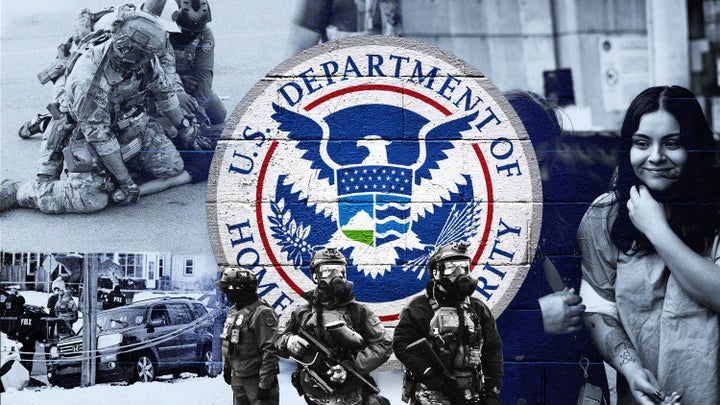
Illustration: Kelly Caminero/HuffPost; Photo: Getty Images
Marimar Martinez was on her way to donate clothing last October when she noticed federal immigration agents in Brighton Park, a predominantly Latino neighborhood in Chicago. They were there as part of “Operation Midway Blitz,” which had terrorized the city with raids. When Martinez saw them, she and others started following them in their vehicles, honking and shouting “la migra,” warning others they were immigration agents. Moments later, her vehicle and that of a Border Patrol officer briefly made contact. He got out of his car and opened fire, shooting her five times.
The Department of Homeland Security called Martinez a “domestic terrorist” and laid out their version of events: The officer, Charles Exum, acted in self-defense after he was “rammed by vehicles and boxed in by 10 cars,” spokesperson Tricia McLaughlin said in a statement. Martinez, who had supposedly appeared in an intelligence bulletin the week prior “for doxing agents” and posting threats online, was accused of threatening the officer with a “semi-automatic weapon.”
She was charged with assaulting, impeding and interfering with a federal law enforcement officer.
Martinez survived, unlike Renee Good, who died after she was shot by a federal agent in Minneapolis this week. Good “was harassing and impeding law enforcement operations” before trying to “run them over,” said Homeland Security Secretary Kristi Noem. “It was an act of domestic terrorism,” she added. President Donald Trump called Good a “professional agitator” and claimed she “viciously ran over the ICE officer.”
Good’s death is part of a larger pattern in Trump’s second term: Federal agents shoot, then the government begins a campaign of lies and propaganda.
“They’re doing the exact same thing now because they have to, because how else do you justify shooting a stay-at-home mom with stuffed animals in her car?” Christopher Parente, Martinez’s attorney, told HuffPost, referring to Good’s killing.
“You’ve turned Montessori school teachers and stay-at-home moms into Timothy McVeigh in the minds of these agents, so of course their first reaction is to shoot.”
In response to a request for comment on Friday, McLaughlin repeated the same claims from months ago that have since been debunked, referring to Martinez as a “domestic terrorist” and saying she had “rammed federal agents” with her vehicle.
Immigration officers have opened fire 16 times over the past year, resulting in four deaths, according to The Trace. The government often tells similar stories about the incidents: A person stopped by officers tried to run them over, or injured them with their car, necessitating the use of deadly force.
When an ICE officer shot and killed Silverio Villegas Gonzalez after he tried to flee a traffic stop in his car in Chicago in September, DHS claimed that the officer suffered “severe back injuries, lacerations to hands and substantial tears in knee,” but body-camera footage later showed the officer said the sole cut he suffered was “nothing major.” Video evidence also disproved claims that officers faced life-threatening danger when they shot and wounded two men in separate incidents in California – Carlitos Ricardo Parias and Francisco Longoria. Carlos Jimenez, another ICE shooting victim in California, was charged with assaulting officers with his car, but has argued in court that he was driving around an ICE vehicle when officers shot him in the back.
The claims DHS made against Martinez, a 30-year-old teacher, were so thin they didn’t even make it into court. The charging documents noted only two cars following the Border Patrol officers and did not mention a gun at all. In court, Martinez’s lawyer argued that body-camera footage showed that Exum swerved to hit Martinez’s car and not the other way around. And Exum himself acknowledged that the vehicle contact “was side to side” rather than a “head-on” ramming maneuver. After the collision, he yelled “Do something, bitch,” before opening fire, Parente argued in court. And Martinez had not posted a threat against federal agents, contrary to McLaughlin’s statement, her lawyer said prosecutors told him.
Meanwhile, the government vehicle involved in the incident was driven to Maine, more than 1,000 miles from Chicago. DHS “ordered the Border Patrol in-house mechanic to buff out all of the alleged damage — in this case, a paint swap, essentially,” Parente alleged to HuffPost. “At which point, we were unable to have our expert look at it and show that it was actually the ICE agent’s car that side-swiped her car ... We were in the middle of that destruction-of-evidence hearing when they dismissed the case.”
Federal prosecutors dropped the charges against Martinez — a spokesperson said at the time that the office of the U.S. Attorney for the Northern District of New York was “constantly evaluating new facts and information relating to cases and investigations arising out of Operation Midway Blitz” — and the judge dismissed the case.
Text messages from Exum also showed him bragging about the shooting. “I’m up for another round of ’fuck around and find out,” he wrote. And later: “I fired 5 rounds, and she had 7 holes. Put that in your book boys.”
“He was back at work within, I think, three days of the incident in our case,” Parente said.
For her part, Martinez was left with bullet wounds on her forearm, tricep and elsewhere, as well as significant mental trauma, her attorney said.
Parente said he and his client are preparing to sue for damages. “She can’t hold a pen, she can’t close her hand. She’s got extreme physical pain, she’s obviously got mental anguish and pain, so we’re going to be seeking compensation for that.”
“The approach of our government right now is to literally implement the death penalty for minor traffic offenses on the spot, and that is extremely troubling, and it’s going to keep happening,” Parente said. “In the Martinez case, at best, it was a minor traffic accident. In what world do we live in where when you get into a minor traffic accident on the streets of your city, the driver jumps out and starts shooting at you?
When Parente saw what had happened in Minneapolis, and how the government was quick to smear Good, he wasn’t surprised.
“Normally, I would think the government wouldn’t be so brazen about misinformation,” Parente said. “But having lived through this, and looking at things that were put out in black-and-white by [McLaughlin], and knowing from the evidence that it’s completely wrong — I now question all of this that’s coming out.”
xxxxxxxxxxxxxxxxxxxxxxx

No comments:
Post a Comment