1). “Ozymandias on the Potomac: Energy Policy and the Politics of American Decline”, Nov 25, 2025, Alfred McCoy, Tom Dispatch, at < https://tomdispatch.com/
2). “Chinas Grand Strategy – 'Made in China 2025' (MIC25): By end of 2018 the 'Made in China 2025' (MIC25) strategy was implemented by the Chinese government - But what does it say?”, Last updated Jan 18, 2021, Benjamin Talin, More Than Digital , at < https://morethandigital.info/
3). “The world lost the climate gamble. Now it faces a dangerous new reality”, Nov 22, 2025, James Dyke & Johan Rockström, The Conversation, at < https://theconversation.com/
4). “Planet at risk of heading towards 'Hothouse Earth' state: Keeping global warming to within 1.5-2°C may be more difficult than previously assessed”, Aug 6, 2018, Anon, Stockholm Resilience Centre, at < https://www.
5). “PERSPECTIVE: Trajectories of the Earth System in the Anthropocene”, August 14, 2018, Will Steffen et. al., Proceedings of the National Academy of Science (PNAS), vol. 115, no. 33, pp. 8252–8259, at < https://www.pnas.org/doi/epdf/
6). The Global Tipping Points Report 2025, 2025, T. M. Lenten et. al. (eds), University of Exeter, Exeter, UK, Full Report (379 pgs), at < file:///C:/Users/Admin/
~~ recommended by desmond morista ~~
Introduction: The COP 30 annual Climate Change / Global Warming conference was held a few days ago in Belem, Brazil; from November 10 through November 21. In Item 1)., “Ozymandias on the Potomac: ….”; Alfred McCoy, fully cognizant of the issues and challenges to humanity that the meeting supposedly worked on, discussed the question of Energy and the role it has played in socioeconomic power of several of the Global Hegemons. Each time a new Hegemonic Power rose to its prominent role the planet's human societies among the world's inhabitants an essential part of their ability to replace the previous Hegemon was their greater and more efficient access to energy. Iberia (i.e., Spain and Portugal, the first Global Empires in human history) depended on the wind and water power. The next Hegemon, The Netherlands, used greatly improved wind power and McCoy points out that: “By 1650, the Zaan district near Amsterdam, arguably Europe’s first major industrial area, had more than 50 wind-driven sawmills and was the world’s largest shipyard, launching 150 hulls annually (at half the cost of English-built vessels)” {Emphasis added}. France is sort of an “almost Global Hegemon (that McCoy does not mention) but the next two Hegemonic Powers, The U.K. And the U.S. use Coal and Petroleum, respectively, to power their societies and empires (including the military operations that enforced the Hegemonic Regime on those who were reluctant to play ball.
Now China is clearly moving into the position of the leading society on Earth and is focusing on renewable energy (after using massive amounts of coal and oil to industrialize the country, and still using large amounts of those fuels). As McCoy points out: “To replace its old export 'trio' of clothing, furniture, and appliances, Beijing has mandated a 'new trio' of solar panels, lithium batteries, and electric cars. …. in just the month of May, China installed enough wind and solar energy to power a country as big as Poland, reaching an impressive figure that represents half the world’s 'total installed solar capacity.' By 2024, China was already producing at least 80% of the world’s solar panel components, dominating the global market, and undercutting would-be competitors in Europe and the U.S. Driving all that explosive growth, China’s investment in clean energy has reached nearly $2 trillion, representing 10% of its gross domestic product, and has been growing at three times the rate of its overall economy, meaning it would soon account for a full 20% of its entire economy.” (Emphasis added). Earlier the U.S. during the administration of: “President Joe Biden began investing trillions of dollars in alternative energy by building battery plants, encouraging massive wind and solar projects, and continuing a consumer subsidy to sustain Detroit’s transition to electric vehicles. In January 2025, however, Donald Trump entered the White House (again) determined to roll back the global green revolution.”
Item 2)., “Chinas (sic) Grand Strategy ….”, notes that China was already implementing programs to dominate science, technology, and high-tech manufacturing back in 2021 when the article was written. We can be sure they have moved farther down that path.
However the bigger question is, has humanity already inflicted enough damage to the Earth's atmosphere that some truly horrific fate inevitably awaits us in the coming years and decades. Item 3)., “The world lost the climate gamble. ….”, discusses the facts that the world lost 28 years during which inaction and stalling around allowed the problems we now face to become far more serious and difficult to resolve that would have been the case had serious action been taken back in 1997 or even in 2015. These issues are further discussed in Item 4)., “Planet at risk ….”. Some of the various dangers are “tipping points” where one system gets overwhelmed by the rising heat and others are then affected in a cascade event. Item 4)., has an excellent 4 minute long video at the top of the article. Figure 1 below shows some of the major problematic areas and systems.

A relatively immediate large scale issue, for those of us who live in Eastern North America and in Europe, is the chance that glacial melt water from Greenland will finally divert the “Gulf Stream” that warms parts of North America and particularly Europe. Technically called the Atlantic Meridional Overturning Circulation (AMOC), it is showing signs of weakening as millions of gallons of cold heavy melt water keeps flowing directly into the path of the AMOC. Such a event would bring a much colder climate to Northern and Western Europe, for some hundreds of years anyways. This would only add onto the hotter summers that Europe is experiencing as the heat domes that used to stay mostly over the Sahara Desert are now moving into and across the Mediterranean Sea and stopping and sitting over Europe.

One major fear of climate scientists is that the Earth could slip into a Hellish “Hothouse Earth”, period with temperatures not seen for millions of years. This would make large areas of the Earth, currently the home to hundreds of millions of people, uninhabitable for humans. Actually humanity achieved agriculturally based civilizations with their huge populations and major impacts on the Earth during a 20,000 year long benign period called an InterGlacial. If humanity had not warmed the atmosphere so much, we were due to see another major Glaciation during what had been an Ice Age. However, geologists now say that the Holocene has been succeeded by the Anthropocene and the normal cycles have been disrupted, at least for awhile.

I am including three links, the first to (Item 5)., “PERSPECTIVE: Trajectories ….”; a 2018 Proceedings of the National Academy of Science article, it is tough technical reading, so not for everybody. Also 2 links in Item 6).. “The Global Tipping Points …. ”. These links go to this years Global Tipping Points Report 2025. It is a lengthy report, 46 pages for the summary and 379 for the actual report. But there is plenty of interesting material that can be found by just perusing it.
xxxxxxxxxxxxxxxxxxx
Ozymandias on the Potomac
Energy Policy and the Politics of American Decline
At the dawning of the British Empire in 1818, the romantic poet Percy Bysshe Shelley penned a memorable sonnet freighted with foreboding about the inevitable decline of all empires, whether in ancient Egypt or then-modern Britain.
In Shelly’s stanzas, a traveler in Egypt comes across the ruins of a once-monumental statue, with “a shattered visage lying half sunk” in desert sands bearing the “sneer of cold command.” Only its “trunkless legs of stone” remain standing. Yet the inscription carved on those stones still proclaims: “My name is Ozymandias, King of Kings: Look on my works, ye Mighty, and despair!” And in a silent mockery of such imperial hubris, all the trappings of that awesome power, all the palaces and fortresses, have been utterly erased, leaving only a desolation “boundless and bare” as “the lone and level sands stretch far away.”
Taken too literally, those verses might lead us to anticipate some future traveler finding fragments of St. Paul’s Cathedral scattered on the banks of the Thames River in London or stones from the Washington Monument strewn in a kudzu-covered field near the Potomac. Shelley is, however, offering us a more profound lesson that every empire teaches and every imperialist then forgets: Imperial ascent begets an inevitable decline.
Imperial Washington
Indeed, these days Donald Trump’s Washington abounds with monuments to overblown imperial grandeur and plans for more, all of which add up to an unconvincing denial that America’s global imperium is facing an Ozymandias-like fate. With his future Gilded Age ballroom meant to rise from the rubble of the White House’s East Wing, his plans for a massive triumphal arch at the city’s entrance, and a military parade of tanks and troops clanking down Constitution Avenue on his birthday, who could ever imagine such a thing? Not Donald Trump, that’s for sure.
In a celebration of his “works” that are supposedly making the “mighty despair” in foreign capitals around the world, his former national security adviser, Robert C. O’Brien, has recently argued in Foreign Affairs that the president’s “policy of peace through strength” is reversing a Democrat-induced decline of U.S. global power. According to O’Brien, instead of crippling NATO (as his critics claim), President Trump is “leading the biggest European rearmament of the postwar era”; unleashing military innovation “to counter China”; and proving himself the “indispensable global statesman by driving efforts to bring peace to… long-standing disputes” in Gaza, the Congo, and, quite soon, Ukraine as well. Even in North America, according to O’Brien, Trump’s attempt to acquire Greenland has forced Denmark to expand its military presence, putting Russia on notice that the West will compete for control of the Arctic.
As it happens, whatever the truth of any of that may be, the policy elements that O’Brien cites are certain to prove largely irrelevant to the ceaseless struggle for geopolitical power among the globe’s great empires. Or, to borrow a favorite Trumpian epithet from the president’s “cornucopia of crudeness,” in the relentless, often ruthless world of grand strategy, none of those factors amounts to a hill of “shit.”
Indeed, O’Brien’s epic catalogue of Trump’s supposed foreign policy successes cleverly avoids any mention of the central factor in the rise and fall of every dominant world power for the past 500 years: energy. While the United States made genuine strides toward a green energy revolution under President Joe Biden, his successor, the “drill, baby, drill” president, has seemed determined not just to destroy those gains, but to revert to dependence on fossil fuels “bigly,” as Trump would say. In a perplexing paradox, President Trump’s systematic attack on alternative energy at home will almost certainly subvert America’s geopolitical power abroad. How and why? Let me explain by dipping my toes in a bit of history.
For the past five centuries, the rise of every global empire has rested on an underlying transformation (or perhaps revolution would be a more accurate word for it) in the form of energy that drove its version of the world economy. Innovation in the basic force behind its rising global presence gave each successive hegemonic power — Portugal, Spain, England, the United States, and possibly now China — a critical competitive advantage, cutting costs and increasing profits. That energy innovation and the lucrative commerce it created infused each successive imperium with intangible but substantial power, impelling its armed forces relentlessly forward and crushing resistance to its rule, whether by local groups or would-be imperial rivals. Although scholars of imperial history often ignore it, energy should be considered, as I argued in my book To Govern the Globe, the determinative factor in the rise and fall of every global hegemon for the past five centuries.
Iberia’s Mastery of Muscle
In the fifteenth century, the Iberian powers — Portugal and Spain — manipulated the ocean winds and maximized the energy output of the human body, giving them new forms of energy that allowed their arid lands and limited populations to conquer much of the globe. By replacing the square sail of lumbering Mediterranean ships with a triangular sail, agile Portuguese vessels like the famed caravela de armada doubled their capacity to tack close to the wind, allowing them to master the world’s oceans.
By 1500, Portuguese warships had navigation instruments that allowed them to cross the widest bodies of water, sails to beat into the strongest headwinds, a sturdy hull for guns and cargo, and lethal cannons that could destroy enemy fleets or breach the walls of port cities. As a result, a small flotilla of Portuguese caravels soon conquered colonies on both sides of the South Atlantic Ocean and seized control of Asian sea lanes from the Red Sea to the Java Sea.
For the next three centuries, such sailing ships would transport 11 million African captives across the Atlantic to work as slaves in a new form of agriculture that was both exceptionally cruel and extraordinarily profitable: the sugar plantation. The output of Europe’s free yeoman farmers was then constrained by the limits of the individual body and the temperate climate’s short six-month growing season. By contrast, enslaved laborers, massed into efficient teams in tropical latitudes, were driven year-round to the brink of death and beyond to extract unprecedented productivity and profits from those plantations. Indeed, even as late as the nineteenth century, the U.S. southern slave plantation was, according to an econometric analysis, 35% more efficient than a northern family farm.
After developing the sugar plantation, or fazenda, as a new form of agribusiness on small islands off the coast of Africa in the fifteenth century, the Portuguese brought that system to Brazil in the sixteenth century. From there, it migrated to European colonies in the Caribbean, making that cruel commerce synonymous with the slave trade for nearly four centuries. So profitable was the slave plantation for its owners that, unlike almost every other form of production, it did not die from natural economic causes but would instead require the full force of the British navy to do it in.
The Dutch Harness the Winds
But the true masters of wind power would prove to be the Dutch, whose technological prowess would allow their small land, devoid of natural resources, to conquer a colonial empire that spanned three continents. In the seventeenth century, the Dutch drive for scientific innovation led them to harness the winds as never before, building sailing ships 10 times the size of a Portuguese caravel and windmills that, among other things, replaced the tedious hand sawing of logs to produce lumber for shipbuilding. With giant sails spanning over 90 feet, a five-ton shaft generating up to 50 horsepower, and several sawing frames with six steel blades each, a windmill’s four-man crew could turn 60 tree trunks a day into uniform planks to maintain the massive Dutch merchant fleet of 4,000 ocean-going ships.
By 1650, the Zaan district near Amsterdam, arguably Europe’s first major industrial area, had more than 50 wind-driven sawmills and was the world’s largest shipyard, launching 150 hulls annually (at half the cost of English-built vessels). Many of these were the Dutch-designed fluitschip, an agile three-masted cargo vessel that cut crew size, doubled sailing speed, and could carry 500 tons of cargo with exceptional efficiency.
Through its commercial acumen and mastery of wind power, tiny Holland defeated the mighty Spanish empire in the Thirty Years War (1618-48), then fought the British to a standstill in three massive naval wars, while building an empire that reached around the world — from the Spice Islands of Indonesia to the city of New Amsterdam on the island of Manhattan.
When Coal Was King
As Holland’s commercial empire began to fade, however, Great Britain was already launching an energy transition to coal-fired steam energy that would leave the wind and muscle power of the Iberian age in the dust of history. And the industrial revolution that went with it would build the world’s first truly global empire.
The Scottish inventor James Watt perfected the steam engine by 1784. Such machines began driving railways in 1825 and the Royal Navy’s warships in the 1840s. By then, an armada of steam engines was transforming the nature of work worldwide — driving sawmills, pulling gang plows, and sculpting the earth’s surface with steam shovels, steam dredges, and steam rollers. Between 1880 and 1900, the number of steam engines in the United States would triple from 56,000 units to 156,000, accounting for 77% of all American industrial power. To fuel that age of steam and steel, Britain’s coal production climbed to a peak of 290 million tons in 1913, while worldwide production reached 1.3 billion tons.
Coal was the catalyst for an industrial revolution that fused steam technology with steel production to make Britain the master of the world’s oceans. From the end of the Napoleonic wars in 1815 until the outbreak of World War I in 1914, tiny Britain with just 40 million people would preside over a global empire that controlled a quarter of all humanity directly through colonies and another quarter indirectly through client states. In addition to its vast territorial empire, Britannia ruled the world’s waves, while its pound sterling became the global reserve currency, and London the financial center of the planet.
America’s Petrol-Powered Hegemony
Just as Britain’s imperial age had coincided with its coal-driven industrial revolution, so Washington’s brand-new world order focused on crude oil to feed the voracious energy needs of its global economy. By 1950, in the wake of World War II, the U.S. petrol-powered economy was producing half the world’s economic output and using that raw economic power for commercial and military dominion over most of the planet (outside the Sino-Soviet communist bloc).
By 1960, the Pentagon had built a nuclear triad that gave it a formidable strategic deterrent, as five nuclear-powered submarines armed with atomic warheads trolled the ocean depths, while 14 nuclear-armed aircraft carriers patrolled the world’s oceans. Flying from 500 U.S. overseas military bases, the Strategic Air Command had 1,700 bombers ready for nuclear strikes.
As American automobile ownership climbed from 40 million units in 1950 to 200 million in 2000, the country’s oil consumption surged from 6.5 million barrels daily to a peak of 20 million. During those same decades, the federal government spent $370 billion to cover the country with 46,000 miles of interstate highways, allowing cars and trucks to replace railroads as the ribs of the nation’s transportation infrastructure.
To drive the carbon-fueled economy of Washington’s world order, there would be a dramatic, five-fold increase in the global consumption of liquid fossil fuels during the last half of the twentieth century. As the number of motor vehicles worldwide kept climbing, crude oil rose from 27% of global fossil-fuel consumption in 1950 to 44% by 2003, surpassing coal to become the world’s main source of energy.
To meet this relentlessly rising demand, the Middle East’s share of global oil production climbed from just 7% in 1945 to 35% in 2003. As the self-appointed guardian of the Persian Gulf whose vast oil reserves represented some 60% of the world’s total, Washington would become embroiled in endless wars in that tumultuous region, from the Gulf War of 1990-91 to its present-day interventions in Israel and Iran.
Whether thanks to Britain’s coal-fired factories or America’s auto traffic, all those carbon emissions were already producing signs of global warming that, by the 1990s, would set alarm bells ringing among scientists worldwide. From the “pre-industrial” baseline of 280 parts per million (ppm) in 1880, carbon dioxide concentrations in the atmosphere kept climbing to 410 ppm by 2018, resulting in the rising seas, devastating fires, raging storms, and protracted droughts that came to be known as global warming.
As evidence of the climate crisis became undeniable, the world’s nations responded with striking unanimity by signing the 2015 Paris Climate Agreement to cut carbon emissions and surge investments into alternative energy that soon yielded significant breakthroughs in both cost and efficiency. Within four years, the International Energy Agency predicted that dramatic drops in the cost of solar panels meant that solar energy would soon be “the new king of the world’s electricity markets.” Indeed, as technology slashed the cost of battery storage and solar panels, the International Renewable Energy Agency reported in 2024 that the solar generation of electricity had become 41% cheaper than fossil fuels, while offshore wind was 53% cheaper — a truly significant disparity that will, as technology continues to slash the cost of solar energy, render the use of coal and natural gas for electricity an economic irrationality, if not an utter absurdity.
In the game of empires, seemingly small margins can have large consequences, often marking the difference between dominance and subordination, success and failure — whether the 35% advantage of enslaved over free labor, the 50% cost advantage for Dutch sailing craft over British ones, and now a 41% savings for solar over fossil fuels. Moreover, the day is fast coming when fossil-fuel electricity will cost more than twice as much as alternative energy from solar and wind power.
To assure America’s economic future, the administration of President Joe Biden began investing trillions of dollars in alternative energy by building battery plants, encouraging massive wind and solar projects, and continuing a consumer subsidy to sustain Detroit’s transition to electric vehicles. In January 2025, however, Donald Trump entered the White House (again) determined to roll back the global green revolution. After quitting the Paris climate accord and labeling climate change a “hoax” or “the green new scam,” President Trump has halted construction of major offshore wind projects, ended the subsidy for electric vehicle purchases, and opened yet more federal lands for coal and oil leases. Armed with extraordinary executive powers and a single-minded determination, he will predictably delay, if not derail, America’s transition to alternative energy, missing market opportunities and undercutting the country’s economic competitiveness by chaining it to overpriced fossil fuels.
China’s Green-Energy Ride to Global Power
While Washington was demolishing America’s green energy infrastructure, Beijing has been working to make China a global powerhouse for alternative energy. Ten years ago, its leaders launched a “Made in China 2025” program to storm the heights of the global economy by becoming the world leader in 10 strategic industries, eight of which involved some aspect of the green-energy transformation, including “new materials,” “high-tech ships,” “advanced railways,” “energy-saving and new energy vehicles,” and “energy equipment.” Those “new materials” include China’s virtual monopoly on rare earth minerals, which are absolutely critical to the manufacturing of the key components for renewable energy — specifically, wind turbines, solar panels, energy storage systems, electric vehicles, and hydrogen extraction. In sum, Beijing is already riding the green energy revolution in a serious bid to become the world’s “leading manufacturing superpower” by 2049, while erasing America’s economic edge and its global hegemony in the bargain.
So, you might ask, have any of those seemingly pie-in-the-sky plans already become an economic reality? Given China’s recent progress in key energy sectors, the answer is a resounding yes.
Under its economic plan, China has already come to dominate the world’s solar power industry. In 2024, it cut the wholesale price of its solar panel exports in half and nearly doubled its exports of panel components. To replace its old export “trio” of clothing, furniture, and appliances, Beijing has mandated a “new trio” of solar panels, lithium batteries, and electric cars. And to put what’s happening in perspective, imagine that, in just the month of May, China installed enough wind and solar energy to power a country as big as Poland, reaching an impressive figure that represents half the world’s “total installed solar capacity.” By 2024, China was already producing at least 80% of the world’s solar panel components, dominating the global market, and undercutting would-be competitors in Europe and the U.S. Driving all that explosive growth, China’s investment in clean energy has reached nearly $2 trillion, representing 10% of its gross domestic product, and has been growing at three times the rate of its overall economy, meaning it would soon account for a full 20% of its entire economy.
With similar determination, its electric vehicles (EVs) are now beginning to capture the global car market. By 2024, 17.3 million electric cars were made worldwide, and China produced 70% of them. Not only are Chinese companies opening massive robotic assembly plants worldwide to crank out such cars by the millions, but they are also making the world’s cheapest and best cars — with the YangWang U9-X hitting a world speed record of 308 miles per hour; BYD’s latest plug-in hybrid models, priced at only $13,700 and capable of traveling a record 1,200 miles on a single charge and single tank of gas; the YangWang U8 with a capacity to literally drive across water; and the Xiaomi SU-7 displaying a high-tech driver interface that makes a Tesla look like a Ford Pinto.
Since an EV is just a steel box with a battery, technology will soon allow low-cost electric vehicles to completely eradicate gas guzzlers, enabling China to conquer the global car market — with full electric cars like the self-driving BYD Seagull sedan already priced at $8,000, models like BYD’s Han with a 5-minute charge time that’s faster than pumping a tank of gas, and sedans like the Nio ET7 with a standard range on a single charge of 620 miles. And most of that extraordinary technological progress has happened in less than four years, essentially the time remaining in Donald Trump’s second term in office.
An Agenda for America’s Economic Future
By discouraging alternative energy and encouraging fossil fuels, President Trump is undercutting America’s economic competitiveness in the most fundamental way imaginable. Amid an historic transformation in the world’s energy infrastructure (comparable in scope and scale to the coal-fired industrial revolution), the United States will spend the next three years under his watch digging coal and burning oil and natural gas, while the rest of the industrial world follows China as it pursues technological innovation to the furthest frontiers of the human imagination. Indeed, the latest annual report from the world’s energy watchdog, the International Energy Agency, states bluntly that the transition away from fossil fuels is “inevitable” as the world, “led by a surge in cheap solar power in… the Middle East and Asia,” installs more green energy capacity in the next five years than it has in the last 40 combined.
By the time Donald Trump leaves office in 2029, this country will be distinctly on the imperial decline amid fast-paced changes that will make electric vehicles universal and solar-powered electricity an economic imperative. And just as the Dutch used energy technology to capture their imperial moment in the seventeenth century, so the Chinese will undoubtedly do the same in this century.
After all, how can the United States produce competitive products, even for domestic consumption (much less export), if our costs for energy, the basic component of every economic activity, become double those of our competitors? Simply put, it won’t be possible.
If, however, when Donald Trump’s term in office is done, this country moves quickly to recover its capacity for economic rationality, it should be able to regain some version of its place in the world economy. For once the United States rejoins the green energy revolution, it can use its formidable engineering ingenuity to accelerate the development of this transformative technology — simultaneously reducing the CO2 emissions that are choking the planet and securing the livelihoods of average American workers in the bargain.
xxxxxxx
Chinas Grand Strategy - "Made in China 2025" (MIC25)
Even with a lot of internal discussions and international criticism, China pushed by end of 2018 for their new industrial strategy “Made in China 2025” or short MIC25.
It is a huge commitment of the Chinese government to ensure that China will be a leading industrial superpower by mid of this century. For this, the Government has defined 10 different industry-focus areas, 9 different strategic objectives, and 5 initiatives that will be implemented nationwide. But what is the final goal? The Government plans to present China as a leading Industrial Superpower for its 100th anniversary which will be in 2049. By then it wants to make sure that it has the capabilities to produce leading technologies, innovations, and industrial systems.
The nine strategic tasks are as following (Source: China-Britain Business Council)
- Encourage Innovation
- Promote the use of integrated, digital, and technology-focused manufacturing
- Strengthen the overall industrial base
- Improve product quality and build global Chinese brand names
- Focus on enforcing green manufacturing methods
- Make innovative technological breakthroughs in the 10 focus sectors
- Restructure industries to improve efficiency and output
- Improve service-oriented manufacturing and manufacturing-service industries
- Globalise Chinese Manufacturing Industries
Goals for 2025, 2035 and 2049
China placed 2 milestones until 2049. The first one will be in 2025 where the government wants to make sure that the industry is capable of producing higher qualities. The goal is that “Made in China” has a good reputation for industrial production. The cheap and low-quality times of Chinese industries should be over soon.
In the second wave, China wants to position itself in the middle field of the leading industrial nations. This also involves the mission to be more energy- and resource-efficient, be more sustainable but also involve more innovative technologies in the production.
By 2049 the overall goal should be met that china is the leading industrial nation in the world. By then they want to take a worldwide leader in the 10 defined industry areas.
- New-generation IT
- High-end computerized machines & robots
- Aviation & Space equipment
- Maritime engineering equipment & high-tech ships
- Advanced railway transportation equipment
- Energy-saving & New energy vehicles
- Energy equipment
- Agricultural equipment
- New materials
- Biomedicine & high-performance medical equipment
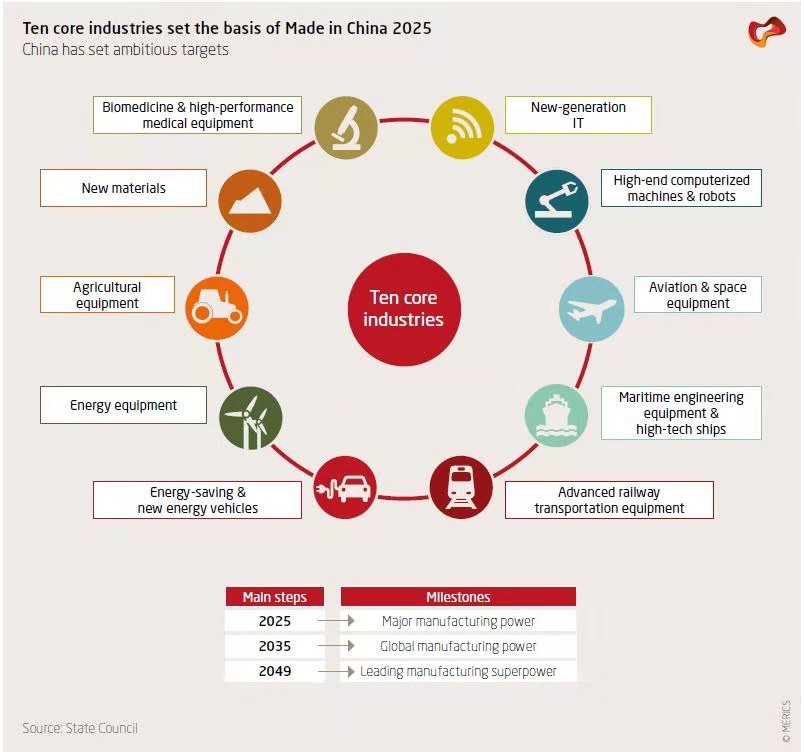
5 big strategic initiatives
The Chinese Government implemented 5 nationwide initiatives to implement a strategy where already major milestones are completed in 2020.
1. Research and Development Centers
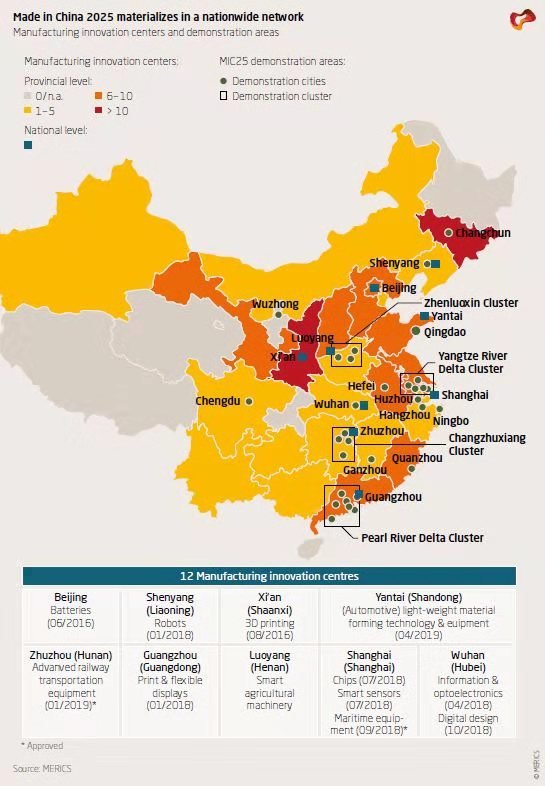
China implemented 15 R&D centers until 2020 and in total 40 of these Research&Development centers will be implemented by 2025. These centers are dedicated to the development of key technologies and cutting edge innovations for the 10 defined industry areas.
Here you see a map of the currently planned and implemented R&D centers, especially around manufacturing technologies.
2. Development of High-End Projects in key industries
With the basis of the R&D centers but also in cooperation with the industry, the government plans large scale innovation projects for high-end industries.
The overall goal is to ensure that China increases its market share for the important sectors and also produces Intellectual Property for these key industry areas.
3. Green Manufacturing / Sustainable Production
As we heard in the news quite often, the Chinese Government is pushing hard towards sustainability and green industry. One of the major objectives is to save the environment and make sustainable production possible. Until 2025 the energy efficiency of the Chinese manufacturing industry should be equal to or lower than the most advanced international standards.
4. Smart Manufacturing
It is key to have Chinese companies investing in smart manufacturing models, robotics but also digitalization. The goal was to decrease the production cost and time by 30% by 2020 and 50% by 2025.
5. New Materials
The last initiative focuses a lot on the basic commodities. In 2020 china wanted to be able to provide more than 40% of the core materials and components from the own market. The goal will be to increase this number for these important industrial materials for all the key industries to 70% by 2025.
What does it mean for the rest of the world?
This strong commitment by the Chinese government shows the will to really change the image of China. They want to focus on innovation, green technologies, and also take leadership for more industry areas of the future. The massive investments, Pilot Cities, The “One Belt, One Road”-Initiative, and many more investments level the field for the way to chinas industrial supremacy.
The USA already said that this will be a real existential threat to the technological leadership of the USA. But we also saw that Europe is struggling in the last years to create a common strategy and an innovation ecosystem. This will lead to more intense international competition in the innovation space.
Also looking into the start-up market we see a clear picture of where the innovation is happening currently. CB Insights published the Unicorn List (Start-Ups valued over 1 Bio USD) and while Europe only accounts for some dozens Unicorn-Start-Ups the US leads with 228 and China comes in second at 122.
This leads us to the question: Where should companies go and invest in their R&D when China wants to become a leading industrial and technological hub in the world?

Benjamin Talin, a serial entrepreneur since the age of 13, is the founder and CEO of MoreThanDigital, a global initiative providing access to topics of the future. As an influential keynote speaker, he shares insights on innovation, leadership, and entrepreneurship, and has advised governments, EU commissions, and ministries on education, innovation, economic development, and digitalization. With over 400 publications, 200 international keynotes, and numerous awards, Benjamin is dedicated to changing the status quo through technology and innovation. #bethechange Stay tuned for MoreThanDigital Insights - Coming soon!
The world lost the climate gamble. Now it faces a dangerous new reality
Ten years ago the world’s leaders placed a historic bet. The 2015 Paris agreement aimed to put humanity on a path to avert dangerous climate change. A decade on, with the latest climate conference ending in Belém, Brazil, without decisive action, we can definitively say humanity has lost this bet.
Warming is going to exceed 1.5°C. We are heading into “overshoot” within the next few years. The world is going to become more turbulent and more dangerous. So, what comes after failure?
Our attempt to answer that question gathered the Earth League – an international network of scientists we work with – for a meeting in Hamburg earlier this year. After months of intensive deliberation, its findings were published this week, with the conclusion that humanity is “living beyond limits”.
Exceed 1.5°C and not only do extreme climate events, like droughts, floods, fires and heatwaves grow in number and severity, impacting billions of people, we also approach tipping points for large Earth regulating systems like the Amazon rainforest and the Greenland and West Antarctic ice sheets. Tropical coral reef systems, livelihood for over 200 million people, are unlikely to cope with overshoot.
This translates to existential risks for billions of people. Not far in the future, but within the next few years for extreme events, and within decades for tipping points.
How global warming and social instability increase together:
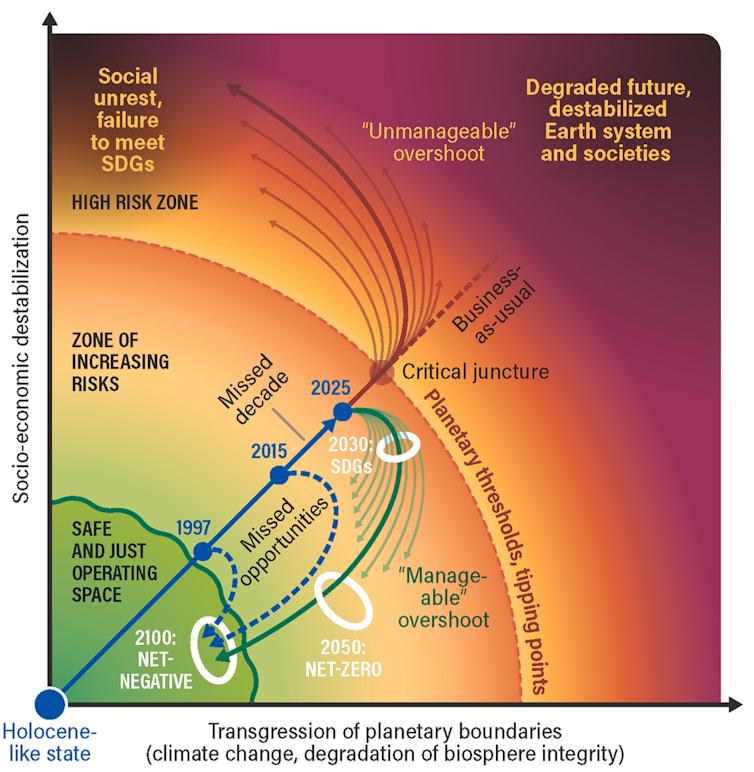
The missed opportunities between 1997 and 2015 are the failures of the Kyoto protocol to bend the global emissions curve. There then followed a missed decade since the Paris agreement.
The beauty of Paris – getting all countries to commit collectively to cut emissions – has been undermined by the voluntary mechanisms to achieve it. So while staying well below 2°C is legally binding, the actions within national plans are not.
We are now at a critical juncture. We are at or very close to human caused environmental change that will fundamentally unpick the life-sustaining systems on Earth. These risk triggering feedback loops, for example, the accelerating die back of rainforests which would release billions of tons of carbon dioxide which would raise temperatures even further.
Ultimately that could cause the planet to drift away along the pathway to “hothouse Earth”, a scenario where even if emissions were reduced, self amplifying feedback loops would drive global temperature increases up to or even beyond 5°C. The last time the climate warmed by such an amount was tens of millions of year ago.
Well before this nightmare scenario, significant impacts are now unavoidable. Increasingly destructive storms will produce more loss and damages, more loss of life. Efforts to accelerate – or even maintain – decarbonisation could be undermined by social and political destabilisation created by climate change.
If the consequences of climate change begin to interfere with our efforts to deal with its causes, moves towards a more sustainable world risk being delayed or even entirely derailed.
But the scale of suffering is still very much up to us. We still have the ability to minimise overshoot. The best science can offer today, is a future where peak warming reaches 1.7°C before returning to within 1.5°C in 75 years.
This requires immediate action at global scale, on multiple fronts:
First, we’ll have to accelerate the fossil fuel phase out to achieve at least 5% annual global emission reductions from now on. This requires increasing nations’ decarbonisation plans by at least a factor of ten.
Second, we must transform the global food system within the next decade so it is able to absorb 3 billion tons of carbon dioxide a year.
Third, we need new ways to remove an additional 5 billion tonnes of carbon dioxide from the atmosphere each year, and store it safely in the ground. Whether by restoring ecosystems such as forests and wetlands or with new approaches that would directly remove carbon dioxide from the atmosphere, this must be done in safe and socially just ways.
Finally, we must do all we can to ensure continued “health” and resilience in nature on land and in the ocean, in order to safeguard Earth’s capacity to store carbon. All this needs to happen, simultaneously, to have a chance of limiting overshoot and come back to at or below 1.5°C of global warming.
Science is crystal clear here. Our only chance to recover back to a stable and safe climate is to accelerate the phase-out of fossil-fuels, remove carbon and invest in nature (on land and in the ocean), and do that without trading off between them.
xxxxxxx
Planet at risk of heading towards “Hothouse Earth” state
Places on Earth will become uninhabitable
The authors of the study consider ten natural feedback processes, some of which are “tipping elements” that lead to abrupt change if a critical threshold is crossed. These feedbacks could turn from being a “friend” that stores carbon to a “foe” that emits it uncontrollably in a warmer world.
These feedbacks are: permafrost thaw, loss of methane hydrates from the ocean floor, weakening land and ocean carbon sinks, increasing bacterial respiration in the oceans, Amazon rainforest dieback, boreal forest dieback, reduction of northern hemisphere snow cover, loss of Arctic summer sea ice, and reduction of Antarctic sea ice and polar ice sheets.
"These tipping elements can potentially act like a row of dominoes. Once one is pushed over, it pushes Earth towards another. It may be very difficult or impossible to stop the whole row of dominoes from tumbling over. Places on Earth will become uninhabitable if “Hothouse Earth” becomes the reality," warns co-author Johan Rockström, former executive director of the Stockholm Resilience Centre and incoming co-director of the Potsdam Institute for Climate Impact Research.
Hans Joachim Schellnhuber, Director of the Potsdam Institute for Climate Impact Research, says, "We show how industrial-age greenhouse gas emissions force our climate, and ultimately the Earth system, out of balance. In particular, we address tipping elements in the planetary machinery that might, once a certain stress level has been passed, one by one change fundamentally, rapidly, and perhaps irreversibly. This cascade of events may tip the entire Earth system into a new mode of operation.”
“What we do not know yet is whether the climate system can be safely 'parked' near 2°C above preindustrial levels, as the Paris Agreement envisages. Or if it will, once pushed so far, slip down the slope towards a hothouse planet. Research must assess this risk as soon as possible."
xxxxxxxxxxxxxxxx
The following could not be copied into Blogger. Please click on the link
5). “PERSPECTIVE: Trajectories of the Earth System in the Anthropocene”, August 14, 2018, Will Steffen et. al., Proceedings of the National Academy of Science (PNAS), vol. 115, no. 33, pp. 8252–8259, at < https://www.pnas.org/doi/epdf/
xxxxx
Pardon, but I was unable to open the following - suspect it is a pdf that Blogger won't accept (will update if I can get a link).
6). The Global Tipping Points Report 2025, 2025, T. M. Lenten et. al. (eds), University of Exeter, Exeter, UK, Full Report (379 pgs), at < file:///C:/Users/Admin/

No comments:
Post a Comment