~~ recommended by collectivist action ~~
By KOLUMN Magazine
Growing Up Between Red Dirt and Black Wall Street
“I Still See Black Bodies Lying in the Street”
The trouble started with a rumor. On May 31, 1921, white-owned newspapers in Tulsa fanned outrage over an alleged incident between a Black teenager, Dick Rowland, and a white elevator operator. A lynch mob gathered outside the courthouse where Rowland was being held. Armed Black veterans from Greenwood went to the courthouse to prevent the lynching, and a confrontation escalated into gunfire.
What followed over the next 24 hours was not a “riot” but what the U.S. Department of Justice, in a 2025 report, would later describe as a coordinated, military-style attack. White civilians, many deputized and armed by local officials, surged into Greenwood — looting, burning, and killing. Planes flew overhead, with witnesses reporting explosives or incendiaries dropped on Black homes and businesses.
Inside her family’s house, seven-year-old Viola was asleep when the violence began. Her first memories of the massacre are sensory: the sound of gunshots, the smell of smoke, the terrifying glow of flames outside the window. Her mother shook the children awake and told them they had to run.
In her testimony before Congress in 2021, Fletcher described fleeing into a city transformed into a battlefield. She remembered the roar of airplanes, fires consuming homes, and Black men shot in the street as families tried to escape. Even a century later, she told lawmakers, the scenes still played “like a movie in my mind” when she tried to sleep.
By the time the smoke cleared on June 1, Greenwood lay in ruins. As many as 300 Black residents were dead; more than 1,000 homes and businesses were destroyed; some 10,000 people were left homeless. Fletcher’s family lost everything but the clothes they wore as they fled. She never again saw the comfortable house or the childhood street that had once symbolized possibility.
For decades, officials minimized or erased the massacre from public records, blaming Black residents for the violence and refusing to pay insurance claims for the destroyed properties. None of the white perpetrators were prosecuted.
For survivors like Fletcher, the aftermath was defined by dislocation and silence. Her family struggled to rebuild amid the wreckage. The trauma, she has said, followed her into every stage of life. For years she slept sitting up on her couch with the lights on, unable to rest in the dark.
Her schooling was one of the first casualties. Displaced and impoverished after the massacre, Fletcher left school after the fourth grade.
A Life of Quiet Labor
Breaking the Silence
The first steps toward a broader reckoning began in the late 20th century, as historians, local activists and survivors pressed Oklahoma to investigate the massacre. In 2014, Fletcher sat down with researchers from Oklahoma State University’s Oral History Research Program to record her memories. It was an early sign that the centennial of the massacre — then still years away — might finally push the story into national view.
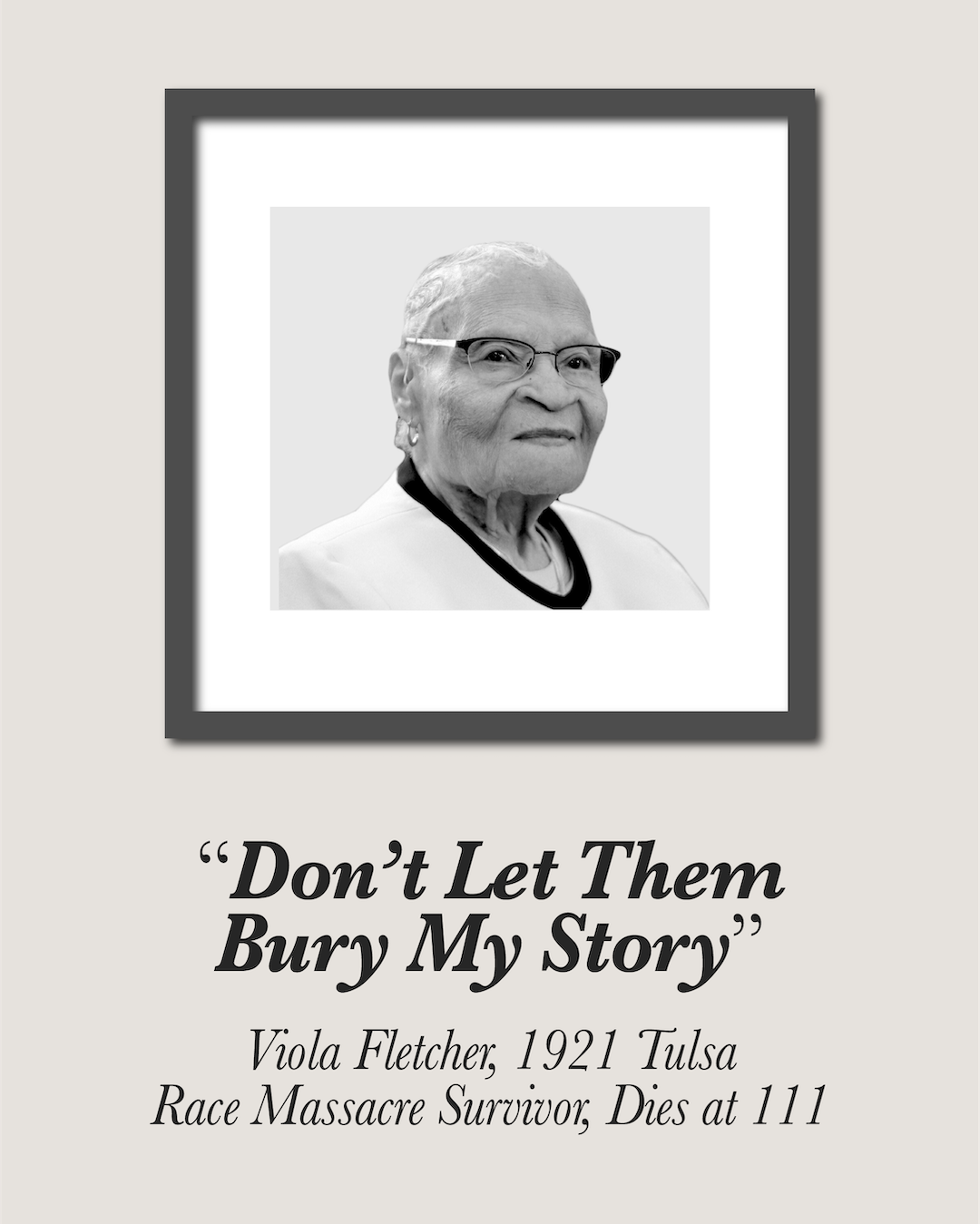
The turning point came in 2021. As the 100th anniversary approached, national news organizations — including The New York Times, The Washington Post, NPR and others — devoted extensive coverage to the massacre and to the few remaining survivors. Fletcher’s face, framed by white hair and wire-rimmed glasses, began appearing on front pages and television screens across the country.
On May 19, 2021, she traveled to Washington, D.C., for the first time in her life to testify before a House Judiciary subcommittee in a hearing on the Tulsa Race Massacre. She told lawmakers that she still saw the burning city when she closed her eyes, still smelled the smoke, still heard the planes. She explained how the attack had derailed her education and limited her economic prospects for decades.
“No one cared about us for almost 100 years,” she said, urging Congress to support reparations not just for her, but for the broader Black community harmed by the massacre. Her testimony drew a standing ovation from lawmakers and helped galvanize national attention on Tulsa at a moment when debates over racial justice and historical reckoning were intensifying across the country.
That same year, Fletcher and two other survivors — Randle and Fletcher’s younger brother, Hughes “Uncle Red” Van Ellis — became lead plaintiffs in a lawsuit against the City of Tulsa, Tulsa County, the state of Oklahoma and local institutions, arguing that the ongoing harms of the massacre constituted a modern-day public nuisance and unjust enrichment.
Their legal effort ran into the same structural barriers that had frustrated earlier attempts at accountability. In 2023, a Tulsa County judge dismissed the case. In June 2024, the Oklahoma Supreme Court upheld that dismissal, ruling that the survivors’ claims, while morally compelling, did not meet the legal definitions under the state’s public-nuisance statute.
In a statement after the ruling, the survivors’ legal team emphasized that the massacre had been carried out with the complicity of public officials and law enforcement, and that the city had profited for decades from the story and imagery of the tragedy even as survivors and descendants received nothing.
For Fletcher, the courtroom setbacks were another chapter in a long pattern: recognition without restitution.
A Memoir a Century in the Making
From Greenwood to Ghana: Becoming a Queen Mother
The Law Says “No Avenue” — But the Record Changes
Mother Fletcher in the Present Tense
A Story Too Big to Bury
The title of Fletcher’s memoir reads like a direct address to the country that failed her: Don’t Let Them Bury My Story. It is a demand for memory, but also for action.
To “bury” her story would be to consign the Tulsa Race Massacre to the footnotes of history courses, to treat Greenwood as a tragic anomaly rather than a case study in how racial violence and policy choices combined to strip Black communities of wealth, safety and political power. It would mean acknowledging the flames without tracing their smoke into contemporary housing disparities, business ownership gaps, educational inequities and the ongoing struggle for reparations.
As federal reports, academic studies and investigative journalism have made clear, what happened to Greenwood was not just an explosion of hatred; it was the deliberate destruction of a Black economic ecosystem — banks, businesses, homes, schools — with the complicity and sometimes direct involvement of local officials.
Fletcher’s life put a human face on those abstractions. It is one thing to say that thousands were displaced and their property rendered worthless on insurance ledgers. It is another to listen to an elderly woman describe leaving school after the fourth grade because the massacre shredded her family’s finances; to hear that she cleaned other people’s houses into her eighties; to learn that she reached 111 without ever owning a home of her own.
Her story also complicates any easy narrative of victimhood. She was, after all, a woman who lived long enough to see a Black president and a Black vice president, to travel to Africa as an honored guest, to publish a book that will outlive her, to watch as her once-buried memories shape federal investigations and municipal policy.
In interviews, she was at times asked about the secret to her longevity. Her answers leaned toward the practical: eat well, sleep, get some exercise, trust in God. Behind those simple prescriptions is something harder to quantify: the capacity to carry a century of grief and still insist on joy; to insist, above all, that the country she called home confront the violence it has too often tried to hide.
As Tulsa moves, haltingly, from commemoration toward repair, and as lawmakers across the country debate how — or whether — to compensate for historical wrongs, Viola Fletcher’s presence served as both inspiration and indictment. Inspiration, because she has turned personal pain into public testimony that has educated millions. Indictment, because it has taken more than 100 years for many Americans to hear what she has been saying all along.
Her story, once buried, is now in print, on tape, on video, in congressional records, in Ghanaian honorifics and college lecture halls and grassroots fundraising campaigns. Whether that story leads to the full measure of justice she sought for so long is a question the rest of us will answer, not her.
What is certain is that Mother Fletcher’s legacy is an inherent part of the history of The Greenwood District of Tulsa Okla., and that her call to “remember Greenwood, remember what was lost, and do not mistake acknowledgments and anniversaries for justice,” should guide the city and nation.
The future will now be shaped by the city that failed her, the country that forgot her, and the generations who now read her words and decide whether they will be buried — or finally heeded.

No comments:
Post a Comment