1). “History Warns us About the Dangers of Trump’s Brain Drain”, Jul 29, 2025, Chipo Dendere & Kellie Carter-Jackson, Time, at < https://time.com/7298847/
2). “The Brain Drain That Is Killing America’s Economy”, Jan 21, 2022, Parag Khanna, Time, at < https://time.com/6140707/
3). “France and EU to incentivise US-based scientists to come to Europe: Macron and von der Leyen expected to announce protections for researchers seeking to relocate amid Trump’s crackdown”, May 4, 2025, Angelique Chrisafis, The Guardian, at < https://www.theguardian.com/
4). “European universities offer ‘scientific asylum’ to US researchers fleeing Trump’s cuts: Academics from US hoping to escape funding freezes and ideological impositions are being actively recruited”, Mar 25, 2025, Ashifa Kassam, The Guardian, at < https://www.theguardian.com/
5). “Ireland hopes to entice academics as US becomes ‘a cold place for free thinkers’: Proposed scheme involves talent scouts offering attractive packages to tempt academics and lecturers from abroad”, May 13, 2025, Rory Carroll, The Guardian, at < https://www.theguardian.com/
~~ recommended by dmorista ~~
Introduction by dmorista: The U.S. for several generations had a standing in the world that prompted people to come here, either for higher education or to live permanently. That general reputation and image has now pretty much come to an end and Americans are starting to leave the country as discussed in Item 1)., “History Warns us ….”, that notes that: “Americans are looking to emigrate for the same reasons immigrants have historically chosen to come to the U.S.: political and economic anxiety and instability in their country of origin. The immigration script of the past century has been flipped, and for academics, in particular, the loss of government funding has led them to seek intellectual freedom and the ability to conduct research elsewhere.” (Emphasis added)
Promising young people now are as likely, or more likely, to choose to attend prestigious universities in Europe, Japan, or China as they are to enroll in top U.S. Universities. And farther down the pecking order of American Universities, at the less prestigious level, the flow of talented university students has slowed significantly.
This decline in interest comes at an inopportune time for the U.S., as noted in Item 2)., “The Brain Drain ….”, points out:
“Global teen talent choosing non-American higher education—and some of America’s best and brightest doing the same— couldn’t come at a worse time. The country’s demographics have been deteriorating since before the 2008 financial crisis, with economic insecurity leading to a sharp drop-off in fertility. The 'baby bust' that followed the financial crisis implied that America would have fewer 18-year olds entering college by 2026—and thus many colleges would have to shutter.
“But thanks to COVID-19, that reckoning has come much sooner. Not only have dozens of colleges closed since 2008 (particularly across the South), but poor finances and unpreparedness for the pandemic remote shift have led to double-digit declines in applicant numbers across the collegiate heartland from the Northeast to the Mid-Atlantic through the Midwest. College enrollment is plummeting as never before across all categories, from community colleges to private four-year universities.” (Emphasis added)
For many professors and researchers in the U.S. the situation is dire. Their areas of research are, in many cases, now forbidden. However, as Item 3)., “France and EU to incentivise ….”; Item 4)., “European universities offer ‘scientific asylum’ ….”; and Item 5)., “Ireland hopes to entice ….”: all point out that other countries are realizing this is a great opportunity for them. They are beginning to enact measures that incentivize U.S. Professors and Researchers to emigrate from the U.S. and become “Academic Refugees”. And it is a fact that on one level this is nothing new. Singapore has for decades offered U.S.-based biomedical and genetic researchers full support and well equipped labs; noting in their pitch that there are no religious fanatics interfering with research there.
xxxxxxxxxxxxxxxxxxxxxxxxxxxxx
History Warns us About the Dangers of Trump's Brain Drain
Since President Donald Trump has taken office, elite Americans and academics are leaving the country. A quarter of those who responded to a recent poll said they would like to move outside the country in the next five years. And European countries are welcoming them.
According to data released by the UK Home Office, between March 2024 and March 2025, a record-breaking 6,000 U.S. citizens applied to either become British citizens or to live and work in the country indefinitely. In April, over 300 scientists applied to France’s Safe Place for Science Program, which promises “a safe and stimulating environment for scientists wishing to pursue their research in complete freedom.”
Americans are looking to emigrate for the same reasons immigrants have historically chosen to come to the U.S.: political and economic anxiety and instability in their country of origin. The immigration script of the past century has been flipped, and for academics, in particular, the loss of government funding has led them to seek intellectual freedom and the ability to conduct research elsewhere.
While the rationale for emigration is clear, the potential consequences of their departure are not. What happens when a critical mass of middle-class, educated professionals leave the country? The exits of prominent people can have unexpected effects on a given country, embarrassing the regimes they've left, adding human capital to the places where they are welcomed. Additionally, when people emigrate, their absence consolidates power around the regimes they left behind. In other words, politics becomes more reflective of the ideologies and values of those who stay.
During South African apartheid, famous musicians such as singer Miriam Makeba were forced into exile as the only way to speak out safely against injustices. Makeba was very vocal in her criticism of the apartheid government at a time when most Black women were silenced by discriminatory laws, including pass laws that restricted movement, and denied the right to own land and even custody of their children.
In 1960, she left South Africa and continued to use her voice— both as a musician and activist—to speak on the atrocities in her home country. Her 1963 speech at the United Nations called out global silence on apartheid and encouraged world leaders to act by supporting freedom fighters. In response, the apartheid regime revoked her citizenship and passport.
Because Makeba was so beloved for her music and admired for courage, she was granted passports from nine different countries, including Belgium, Ghana, Tanzania, Cuba, Algeria, and Guinea. Among her American peers and friends were the likes of Nina Simone, Marlon Brando, Cicely Tyson, Ray Charles, and Louis Armstrong. Makeba was only able to return home in 1990, at the invitation of the recently-released Nelson Mandela, perhaps the most famous prisoner of the apartheid regime.
Like Makeba, trumpeter Hugh Masekela was also considered persona non grata by the apartheid regime, which viewed artistic expression by Black people as an act of violence. Masekela was forced to leave home after the 1960 Sharpeville massacres that resulted in the deaths of 69 people and deepened political unrest across the country. Makeba and Masekela, briefly married, also collaborated in anti-apartheid music. Their impact on the politics in their homeland, even from abroad, was powerful, despite the regime making it difficult for them to interact with family. Their highly anticipated 1980 joint anti-apartheid concert in Lesotho was cancelled after the apartheid regime in South Africa pressured neighboring Lesotho and Botswana.
While their music played an essential role in agitating for freedom, exiled artists faced numerous professional challenges and lost opportunities. Makeba’s success in exile came at great cost; two of her children died in exile and she was unable to return home to bury them.
South Africa also suffered from the loss of critical voices. Not everyone who went into exile returned home or was able to continue speaking up from abroad. Those who returned sometimes lacked the professional skills needed to build a life for themselves, having spent their prime years fighting for their survival. And in the U.S., they were often similarly restricted, as Jim Crow segregation mirrored many of the injustices that they experienced at home in South Africa.
As South Africans were pushed out, apartheid became stronger and more violent to dissenters. Even children who attempted to combat the racist laws were killed or beaten as in the Soweto Youth Uprising of 1976. In the aftermath, songs became inspiration to those in South Africa. In 1977, Makeba and Masekela's joint song “Soweto Blues” was a widely popular protest song about the massacre and a thorn in the side of the regime. Despite being banned in South Africa, collectively their music served as the soundtrack of the anti-apartheid movement.
While pushing out dissenters may allow an oppressive regime to consolidate power or suit a nation’s current political climate, it can have a huge cost—as America learned at the height of the Cold War. Consider the case of brilliant Chinese scientist Qian Xuesen in the 1950s. Qian had studied at MIT and CalTech and became a full professor at both universities. He went on to co-found NASA's Jet Propulsion Laboratory (JPL) in 1939, becoming one of the top rocket science experts working for the U.S. government. The U.S. government did not view his Chinese citizenship as a national security threat, because the U.S. and China were allies during World War II.
This relationship changed after the war. In 1945, revolutionary leader Mao Zedong declared China a communist country. Chinese nationals living in the U.S. were suddenly seen as state enemies. A new director at JPL, where Qian was now working, reported his concerns that some of the lab members were likely communists. There was fear and suspicion due to the growing Cold War and the rise of McCarthyism. Although there was no evidence of wrongdoing by Qian, he was put under house arrest for five years until his deportation to China in exchange for the repatriation of American pilots captured in the Korean War, in 1955 by President Dwight D. Eisenhower’s administration.
Qian’s politically-motivated exile did little to help America’s Cold War, and instead greatly benefitted Communist China. In 1958, he became a member of the Communist Party and revived his career. Prior to his arrival, China did not have a strong rocket science program. Qian became the "Father of Chinese Aerospace and Rocketry." He helped develop the Dongfeng ballistic missile and the Chinese space program. U.S. Secretary of the Navy, Dan A. Kimble called Qian's departure “the stupidest thing this country ever did. He was no more a communist than I was, and we forced him to go.”
xxxxxxxxxxxxxxxxxxxxxxxxxxxxx
The Brain Drain That Is Killing America's Economy

Each spring I get antsy WhatsApp messages from friends across the U.S., as well as London, Dubai, Hong Kong, and Singapore. Their high school senior kids have just been admitted to colleges in America, Canada, Britain, and elsewhere, and they want my opinion on the best option. Over the past decade I’ve been tracking these late teens’ decisions and the trend has been unmistakeable: Less America, more Canada. Canadian education is as good as America’s and more affordable. Universities such as Waterloo have blended apprenticeships into their curricula as a requirement for graduation, and McGill has established itself as a global innovation hub. The next beneficiary of America’s reputational fall from grace is Europe, especially universities in England, Scotland, and Ireland. The Netherlands is also very much in vogue as many countries switch to English instruction.
Global teen talent choosing non-American higher education—and some of America’s best and brightest doing the same— couldn’t come at a worse time. The country’s demographics have been deteriorating since before the 2008 financial crisis, with economic insecurity leading to a sharp drop-off in fertility. The “baby bust” that followed the financial crisis implied that America would have fewer 18-year olds entering college by 2026—and thus many colleges would have to shutter.
But thanks to COVID-19, that reckoning has come much sooner. Not only have dozens of colleges closed since 2008 (particularly across the South), but poor finances and unpreparedness for the pandemic remote shift have led to double-digit declines in applicant numbers across the collegiate heartland from the Northeast to the Mid-Atlantic through the Midwest. College enrollment is plummeting as never before across all categories, from community colleges to private four-year universities. The recession has forced many youth to choose between education and employment, with many choosing the latter, leaving educators uncertain as to whether they will ever go to college. Now, the COVID-19 “baby bust” is far more severe than even that of the 2008 financial crisis, meaning even under a roaring economic rebound scenario, many more colleges will go belly up by 2038.
Demographic forecasting is a generational exercise, and America’s shrinking youth base is the result not only of lower fertility and rising economic uncertainty, but also because the country has failed to maintain what used to be a huge edge in attracting young talent from around the world. America launched the “War on Terror” over twenty years ago, invading Afghanistan and soon after Iraq. Even as President Obama sought to rebuild America’s prestige, the annual inflow of Chinese and Indian students began to taper and decline during the latter years of his administration. Then came Donald Trump’s visa bans, border walls, and immigration restrictions. Taken together, as the startling data from the latest Census reveals, American immigration has plummeted to an all-time low of only 0.1% between mid-2020 and mid-2021, which amounts to barely 200,000 new migrants. At this rate, America’s population may well soon decline.
Even with sanity restored to the White House, America’s reputation remains at a nadir. More than half the world’s population is under the age of forty. From Colombia to Morocco to Afghanistan, they’ve grown up watching America flail militarily and disgrace itself politically. From 9/11 to the war on terror, the financial crisis and rising inequality, all have diminished America in the eyes of the younger generation.
Today’s most important battleground is people, not places. There is a global war for young talent to recruit young students, professionals, taxpayers, caregivers, entrepreneurs, investors, and others to ensure healthy demographics, tax base, industry, and innovation. But the young people America needs are a slippery target. Since the 2008 financial crisis, the number of American expats has doubled, many of them young professionals seeking opportunity across fast growing economies from Eastern Europe to the Far East.
Now comes the remote revolution. COVID-19 has been a “great reset” in our lifestyles, workplace habits, and other aspects of social and professional life. It will be for global talent migration as well. According to research firm IDC, more than forty percent of the global workforce—at least 1.5 billion people—is “location independent.” The capacity for remote work has graduated from latent to actual. Professionals are moving as never before, both within and across borders—and this is only the immediate mid-pandemic phase. Now imagine the pace of relocation once borders have actually reopened and corporate culture fully adapts to digital platforms. At the moment, asynchronous collaboration is Google Docs and Slack, but soon enough it will be more Github and Metaverse.
Many people are quitting their jobs due to burn-out but promising that their next job will be remote. According to the Y-combinator funded Hacker News, the number of job posts featuring remote work have quadrupled since 2017. American tech companies have been the most progressive in embracing remote work. That alone will drive many to seize the moment to relocate abroad. But they’ve also said they plan to hire the best people anywhere for each new position. Suddenly the Bay Area coder may be competing with talent in Kenya. As Simon Kuper wryly warned in the Financial Times, “If you can do your job from anywhere, then someone anywhere can do your job.” Even though the Biden administration is encouraging companies to “buy American” or “hire American,” their DNA guides them to constantly arbitrage the world for taxes, technology and talent. A friend from a major tech company recently flew to Portugal to recruit Europeans and Americans who have planted roots there and corral them into a new co-working space.
From Tulum, Mexico, to Athens, Greece, to Phuket, Thailand, entire colonies have sprung up catering to mobile youth in search of sunny, low-tax hubs. Digital nomads are geographically mercenary, using websites like Expatistan and nomad-themed message boards to calculate where to find the best balance between cost of living and quality of life. And those websites are steering them towards Berlin, Prague, Tbilisi, and Bali—not New York and Los Angeles. And according to VanHack, one of the largest platforms of digital nomads in the software industry, Canada, Britain, Germany, the Netherlands, Ireland, and Spain all rank ahead of the U.S. as top destinations for relocating among the more 600,000 developers surveyed. Americans are making Europe great again.
A generational shift has occurred that Boomers and even older Gen-X don’t quite grasp: Today’s young professionals don’t identify themselves by their nationality—they identify as talent. Millennial and Gen-Z are content with portfolio careers and working abnormal hours, even for less pay, in exchange for less work and more time for travel and passion projects.
Business degrees are a particularly powerful agent of mobility. For all intents and purposes, an MBA is a passport. The world’s eight hundred business schools spread across fifty countries are perhaps the leading agents in stirring the pot in the global war for talent. They recruit worldwide for students and compete fiercely to feed their graduates into multinationals, which then circulate them around the world.
Corporate executives may no longer control where employees want to be, but still determine who gets to rise to the top. Executives cluster near headquarters, and human resource departments are starting to emphasize longitude to avoid the inefficiencies of asynchronous coordination. For the same reason, venture capital funds will often have board members in two out of the three—America, Europe, or Asia—but rarely all three. The end-state for global companies might resemble the “Twenty hubs but no HQ” model business guru CK Prahalad prophesied nearly two decades ago.
Dozens of countries want to be those hubs. Smart governments are rolling out the red carpet for this new global nomadic class. Before Covid, almost no nation had special “nomad visas” save for Estonia. Now almost 70 countries do. Dubai’s Golden Visa program has attracted hundreds of young entrepreneurs who are given grants and other perks to innovate the country’s AI and drone programs. Sweden and Singapore have “tech pass” programs that actively give grants to start-ups. More broadly, many governments have adopted more clearly tiered migration systems, ladders that residents climb on the pathway from migrant and stakeholder to resident and citizen.
America is history’s greatest winner in the war for talent, but the competition is heating up. A decade ago, the U.S. still took in as many migrants as the rest of the rich world combined. But as of 2019, according to a recent CATO Institute study, that gap had narrowed to zero—and that was before COVID-19 travel restrictions. Continued suspicions over Chinese espionage have turned off many Chinese students and scholars. Universities are losing billions of dollars in tuition, property owners are losing tenants, and the cottage industry of language tutors and professional coaches have far fewer clients to assimilate into American life. As Stanford professor and Nobel laureate Steven Chu put it, “We’re shooting ourselves not in the foot but in something close to the head.” Until foreign students are guaranteed a green card with their degree, talented foreign youth may take their brains elsewhere.
Don’t be surprised if many of them move over the border and work remotely instead. After all, Canada appears to be the new home of the American Dream. Canada’s points-based immigration policy is luring young people from around the world with the promise of a pathway to citizenship. Even better, the vast majority of new jobs created are full-time rather than just temp work. Meanwhile, only ten percent of America’s immigration application forms are available online.
For the cash-rich Asians who represent the majority of global millennials and Gen-Z, Europe is even closer than North America. The U.K. capitalized on Trump’s odious image, admitting a record number of foreign students in 2020. Aging Europe has few children and needs to fill its classrooms with foreigners. Across Europe’s IT sector one finds Indian software engineers and data scientists with degrees from Manchester or Amsterdam, and they’re snapping up EU blue cards instead of American green cards.
The Biden Administration has its work cut out for it to attract the world’s best and brightest to America in anything like the numbers it used to. It has managed to let Trump’s H1-B visa restrictions expire, and plans to allow spouses of H1-B holders to work, a boost for would-be two-income households. But immigration reform remains an epic mess, held up by Congressional inaction on the Build Back Better Act whose provisions include a massive overhaul of green card processing that would immediately affect nearly one million current foreign workers. If those workers leave, there won’t be enough skilled Americans to take their place.
We need to forecast scenarios for the future distribution of talent from the perspective of Gen-Y and Gen-Z. Hundreds of millions of young people are becoming geography-free. But where they physically go matters. America’s national debt has exploded (100 percent of GDP and climbing), and young workers and taxpayers are needed to power a real recovery beyond today’s artificial stimulus. An aging country with a declining population and crumbling infrastructure isn’t fit to prevail over China, much less outlast its 1.4 billion people in the long run.
Despite record-low unemployment, there are still millions of job vacancies. Even after stimulus cheques are spent and wages rise, people aren’t going to rush back into menial labor unless they have to. Furthermore, as hundreds of billions of dollars are deployed on infrastructure across the country, far more workers will be needed to get it all done in any meaningful timeframe. America will need an army of migrants to truly build back better. Demographic renewal requires vigorously competing to attract the next generation. Collecting people is collecting power.
The war on terror lasted twenty years. The war for talent should be America’s main mission for the next twenty.
xxxxxxxxxxxxxxxxxxxxxxxxxxxxxxxxx
France and EU to incentivise US-based scientists to come to Europe

Macron and von der Leyen expected to announce protections for researchers seeking to relocate amid Trump’s crackdown
France and the EU are to step up their efforts to attract US-based scientists hit by Donald Trump’s crackdown on academia, as they prepare announcements on incentives for researchers to settle in Europe.
The French president, Emmanuel Macron, alongside the European commission president, Ursula von der Leyen, will make speeches on Monday morning at Sorbonne University in Paris, flanked by European university leaders and researchers, in which they are expected to announce potential incentives and protections for researchers seeking to relocate to Europe.
The event, bringing together European academics and European commissioners, is the latest push to open Europe’s doors to US-based academics and researchers who fear their work is threatened by federal spending cuts for universities and research bodies, as well as the targeting of US higher education institutions over diversity policies.
Macron’s office said the move comes “at a time when academic freedoms face a number … of threats” and when Europe “is an attractive continent”. An Élysée official said: “We are a space where there is freedom of research and no taboo topics.” The official said the event was about “affirming France and Europe as stable spaces that can guarantee freedoms and academic research”.
France is thought to be particularly keen to attract scientists working on health – particularly infectious diseases – as well as climate research and artificial intelligence.
Monday’s event, titled Choose Europe for science, comes after 13 European countries, including France, Germany and Spain, wrote to the European Commission urging it to move fast to attract academic talent.
France launched its own Choose France for science initiative in April with a dedicated platform for applications to host international researchers.
The French research ministry told Agence France-Presse: “Some foreign researchers have already arrived in France to familiarise themselves with the infrastructure, waiting for the funds and platform to be set up.”
In recent days, France’s flagship scientific research centre CNRS launched a new initiative to attract foreign workers whose research is threatened, as well as French researchers working abroad, some of whom “don’t want to live and raise their children in Trump’s United States”, its president, Antoine Petit, told AFP.
In France, Aix-Marseille University launched its “Safe place for science” programme in March. It will receive its first foreign researchers in June.
In a letter to French universities in March, Philippe Baptiste, France’s minister for higher education and research, wrote: “Many well-known researchers are already questioning their future in the United States. We would naturally wish to welcome a certain number of them.”
Challenges remain because research investment in the US – including private-public partnerships – has for many years been greater than in Europe. For decades, Europe has lagged behind the US on investment in universities and research centres.
French researchers have regularly raised the issue of the comparatively low salaries and precarious contracts for many researchers in France. On average, an academic researcher in the US is paid more than their French equivalent. Trade unions in France have called for better contracts, better salary provisions and better funding across the board at research institutions.
Some in France hoped the pay gap between scientists in France and the US would narrow, once the lower cost of education and health, and more generous social benefits in France were taken into account.
Germany’s incoming chancellor, Friedrich Merz, said last month: “The American government is currently using brute force against the universities in the US, so that researchers from America are now contacting Europe. This is a huge opportunity for us.”
xxxxxxxxxxxxxxxxxxxxxxxxxxxxxx
European universities offer ‘scientific asylum’ to US researchers fleeing Trump’s cuts

Academics from US hoping to escape funding freezes and ideological impositions are being actively recruited

Laced with terms such as “censorship” and “political interference”, the Belgium-based jobs advert was far from typical. The promise of academic freedom, however, hinted at who it was aimed at: researchers in the US looking to flee the funding freezes, cuts and ideological impositions ushered in by Donald Trump’s administration.
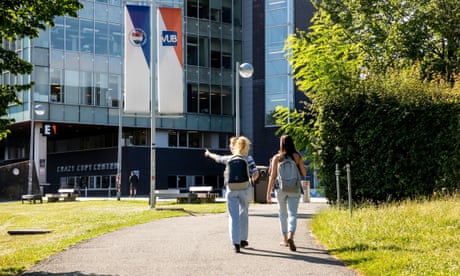
“We see it as our duty to come to the aid of our American colleagues,” said Jan Danckaert, the rector of Vrije Universiteit Brussel (VUB), in explaining why his university – founded in 1834 to safeguard academia from the interference of church or state – had decided to open 12 postdoctoral positions for international researchers, with a particular focus on Americans.
“American universities and their researchers are the biggest victims of this political and ideological interference,” Danckaert said in a statement. “They’re seeing millions in research funding disappear for ideological reasons.”
The university is among a handful of institutions across Europe that have begun actively recruiting US researchers, offering themselves as a haven for those keen to escape the Trump administration’s crackdown on research and academia.
Since Trump took power in late January, researchers in the US have faced a multipronged attack. Efforts to slash government spending have left thousands of employees bracing for layoffs, including at institutions such as Nasa, the Centers for Disease Control and Prevention, and at the National Oceanic and Atmospheric Administration, the US’s pre-eminent climate research agency. The government’s targeting of “wokeism” has meanwhile sought to root out funding for research deemed to involve diversity, certain kinds of vaccines and any mention of the climate crisis.
In France, the director of the prestigious Pasteur Institute in Paris, Yasmine Belkaid, said it was already working to recruit people from across the Atlantic for work in fields such as infectious diseases or the origins of disease.

“I receive daily requests from people who want to return: French, European or even Americans who no longer feel able to do their research or are afraid to do it freely,” Belkaid told the French newspaper La Tribune. “You might call it a sad opportunity, but it is an opportunity, all the same.”
The sentiment was echoed by France’s minister for higher education and research, Philippe Baptiste, in a recent letter that called on research institutions to send in proposals on how best to attract talent from the US. “Many well-known researchers are already questioning their future in the US,” he said. “Naturally, we wish to welcome a certain number of them.”
On Thursday, the Netherlands said it was aiming to swiftly launch a fund to attract researchers to the country.
While the fund would be open to people of all nationalities, the country’s education minister, Eppo Bruins, hinted at the tensions that have gripped US academia in announcing the plans.
“There is currently a great global demand for international top scientific talent. At the same time, the geopolitical climate is changing, which is increasing the international mobility of scientists,” Bruins said in a letter to parliament.
“Several European countries are responding to this with efforts to attract international talent,” he added. “I want the Netherlands to remain at the vanguard of these efforts.”
The Dutch effort comes after France’s Aix-Marseille University said it had set up a programme – titled Safe Place for Science – that would put aside funding for more than two dozen researchers from the US for three years.
xxxxxxxxxxxxxxxxxxxxxxxxxxxxxxxxxxxxxxxxx
Ireland hopes to entice academics as US becomes ‘a cold place for free thinkers’

Proposed scheme involves talent scouts offering attractive packages to tempt academics and lecturers from abroad
Ireland is to launch a scheme to poach academics and university lecturers from overseas on the basis that the Trump administration has made the US “a cold place for free thinkers and talented researchers”.
The higher education minister, James Lawless, will on Tuesday seek cabinet approval for a “global talent initiative” to entice top international academics, including those seeking to leave the US or deterred from working there.
The plan envisages deploying roving academic talent scouts who will offer potential recruits attractive packages, with the Irish government contributing up to half of the salaries offered by Ireland’s third-level institutions. The talent hunt will reportedly prioritise experts in renewable energy, food security, digital technology, artificial intelligence, semiconductors and healthcare.
Lawless told an Irish universities association seminar on Monday: “Today, as US research freedoms come under threat, Ireland has a unique opportunity to emulate their post-war success by offering a stable, open, EU-aligned environment where world-class researchers can thrive, contribute and shape the future of science. Ireland will be a welcoming host for the best and brightest fleeing the US university system.”
Perceptions of the US as a haven for research had changed in recent months, the minister said. “It has become a cold place for free thinkers and talented researchers. We all know how that will grind advanced research to a halt. And that is nothing in the face of the human suffering of targeted student arrests and deportations”. Reports of library culls “bring to mind book burnings of old”, he said.
As a precedent Lawless cited Ireland’s success in enticing Erwin Schrödinger to Dublin on the eve of the second world war. The Austrian physicist helped to set up the Dublin Institute of Advanced Studies (DIAS).
The Irish scheme follows efforts by Belgium’s Vrije Universiteit Brussel, France’s Pasteur Institute and other European institutions to recruit US researchers by offering themselves as a haven for those keen to escape a White House crackdown on research and academia. In March the Netherlands said it planned to launch a fund to attract researchers.
The Trump administration has frozen billions in federal funds for research under in the name of efficiency and punishing alleged anti-semitism and other transgressions in academia. It has been called an “RMS Titanic moment” for American higher education.
The migration of talent might initially benefit only individual, high-profile researchers but there would be an economic effect, Cas Mudde, the Stanley Wade Shelton UGAF professor of international affairs at the University of Georgia, recently wrote in the Guardian. “That might force even the Trump administration to change course.”

No comments:
Post a Comment