1). “Anti-Choice Group: 'We Are Drinking Other People's Abortions' ”, May 8. 2025, Jessica Valenti, Abortion, Every Day, at < https://jessica.substack.com/
p/anti-choice-group-we-are- drinking >. 2). “Now comes the ‘womanosphere’: the anti-feminist media telling women to be thin, fertile and Republican: A crop of conservative personalities such as Brett Cooper and Candace Owens, and outlets like Evie, are convincing young women of a gender-essentialist worldview”, Apr 24, 2025, Anna Silman, The Guardian, at < https://www.theguardian.com/
us-news/2025/apr/24/ womanosphere-conservative- women?utm_source=substack&utm_ medium=email >. 3). “Young Catholic influencers are bringing MAGA to the masses: A vocal and visible group of Catholic women are marrying faith with politics as they talk about their own brand of feminism — and Donald Trump”, May 6, 2025, Jennifer Gerson & Mariel Padilla, The 19th, at < https://19thnews.org/2025/05/
young-catholic-women- influencers-trump-maga/ >. 4). “The Rise of Abortion 'Abolitionists' ”, May 7. 2025, Jessica Valenti, Abortion, Every Day, at < https://jessica.substack.com/
p/the-rise-of-abortion- abolitionists >. 5). “ ‘Abolitionists’ Push Legislation to Criminalize All Abortions as Homicide: Measures introduced in 13 states this year would impose criminal penalties on people who obtain an abortion”, May 5, 2025, Colleen Scerpella, The American Prospect, vat < https://prospect.org/justice/
2025-05-05-abolitionists-push- legislation-criminalize-all- abortion/ >. 6). “State lawmakers are weighing bills that would treat abortion as homicide: None of the bills are likely to become law. But they illustrate a growing divide in the anti-abortion movement and could punish pregnant people”, Apr 7, 2025, Shefali Luthra, The 19th, at < https://19thnews.org/2025/04/
state-bills-abortion-homicide- pregnant-people/ > . 7). “Missouri’s Anti-Abortion AG Subpoenas Local Abortion Fund for Private Records:The state has a long, disturbing history of trying to surveil abortion seekers, abortion providers, and those who help them”, Apr 30, 2025, Kylie Cheung, Jezebel, at < https://www.jezebel.com/
missouris-anti-abortion-ag- subpoenas-local-abortion-fund- for-private-records >. 8). “Missouri’s New Fight to Roll Back Abortion Age Restrictions: An abortion-support text line is challenging two Missouri laws that limit young people’s access to abortion. Why have other reproductive rights groups been so reluctant to make similar challenges?”, Apr 30, 2025, Melissa Gira Grant, The New Republic, at < https://newrepublic.com/
article/194610/missouri-new- fight-roll-back-abortion-age- restrictions >
~~ recommended by dmorista ~~
Introduction by dmorista: The Struggle for Women's Reproductive Healthcare Rights and Access to Abortion rages on. Item 1). “Anti-Choice Group: ….”; Item 2)., “Now comes the ‘womanosphere’: ….”; Item 3). “Young Catholic influencers ….”; and Item 7)., “Missouri’s Anti-Abortion AG Subpoenas ….”, all contain discussions of the battle to influence young people, particularly young women, on their rights to abortion and family planning vs a distorted romantic vision in which women submit to males and give up working or educational advancement. Since they are basically promoting a lifestyle that a majority of women will never attain; their approach is full of lies and distortions. But we need to realize that, since they are trying to impose very unpopular harsh laws on people in many areas, including abortion access and other reproductive issues, the Forced-Pregnancy / Forced-Birth movement plans ahead for decades and uses a wide variety of tactics. The one discussed here are ways they are ginning up as much support among young women as possible.
The even more ominous struggle over women's bodily autonomy is discussed in Item 4).,“The Rise of Abortion 'Abolitionists' ”; Item 5)., “ ‘Abolitionists’ Push Legislation to Criminalize ….”; and Item 6)., “State lawmakers are weighing bills ….”, all discuss the rise of the movement that is eager to begin arresting women and executing them (after the appropriate show trials) for leaving one of the Dark Ages Red States to obtain an abortion in a Blue State where it is legal. Also they are very eager to execute some women for obtaining mifepristone and misoprostol for a home abortion. 15 State laws, in 13 States, were introduced this year to try to accomplish this.

The Abolition Abortionists are overwhelmingly vicious men who want to terrorize women and force them into accepting their perverted Christo-fascist views on Abortion.
Finally Item 7 “Missouri’s Anti-Abortion AG Subpoenas ….”; and Item 8)., “Missouri’s New Fight ….”, both look at the ongoing struggle to establish effective abortion and contraception services in Missouri after the historic win for Abortion and Contraception rights in the Nov 2024 election. The reactionaries who dominate the State Legislature and Statewide offices in Missouri are doing everything they can to resist the will of the people that was clearly demonstrated by the win for Amendment 3 in the state. The harsh repression and endless maneuvering of right-wing forces has turned much of the U.S. from a moderately progressive place for abortion access and reproductive healthcare rights into a nightmarish situation for 60 million women who live in the Dark Ages Red States. The map below shows the unfavorable developments in abortion access that has pushed the U.S. into the same category as a number of police states in the Third World.

xxxx
Anti-Choice Group: "We Are Drinking Other People's Abortions"
Click to skip ahead: I’m So Tired because what in the world did I just watch out of Texas?? Stats & Studies has new maternal mortality data from the CDC—and it shows exactly what you’d expect. Extremism Rising highlights some new important reporting on abortion ‘abolitionists’. In the States, news from South Carolina, Texas, Virginia, and more. In the Nation, some quick hits. Keep An Eye On right-wing content creators trying to indoctrinate young women. Finally, watch a panel conversation in You Love to See It.
I’m So Tired
Let’s be real: Most days I do this work, I’m writing about something batshit insane. But I don’t know that I’ll ever beat today’s news.
While giving testimony in support of an anti-abortion bill in Texas today, Kristi Hamrick of Students for Life told legislators, “Let me be clear, we are all drinking other people’s abortions in the wastewater.”
xxxxxxxxxxxxxxxxxxxx
Now comes the ‘womanosphere’: the anti-feminist media telling women to be thin, fertile and Republican

A crop of conservative personalities such as Brett Cooper and Candace Owens, and outlets like Evie, are convincing young women of a gender-essentialist worldview
On the most recent episode of her YouTube show, the rightwing commentator Brett Cooper joined the rest of the world in jeering Katy Perry, Gayle King and Lauren Sánchez’s brief flight to space.
“These women were completely dependent on men who built this spacecraft,” she said with a cheeky smirk. “Frankly, we all are, because men built civilization. They built the homes that we live in, they built the studio that I am recording in … the spaceships that all of these rich celebrities are flying around in.” The difference between Cooper and feminists, she says, “is I choose to acknowledge that and celebrate it and be grateful”.
The Blue Origin flight was prime fodder for Cooper, a bubbly, fast-talking 23-year-old with silky espresso brown curls and colorful Pinterest-friendly prints on the wall behind her. She posts biweekly videos commenting on hot-button social and cultural issues. Thumbnails on YouTube depict her – eyebrows raised quizzically, mouth agape in faux surprise – alongside titles like SNOW WHITE EPIC FAIL and CAPTAIN AMERICA HATES AMERICA? in yellow all caps. These cultural flashpoints serve as her evidence that young women are finally “waking up” to the lies feminism has apparently told them.

There is a sizable audience for Cooper’s brand of disarming anti-feminist content. She had the second-fastest growing political YouTube channel in the first quarter of 2025 with over 900,000 new subscribers, according to data analyzed by researcher Kyle Tharp. Her Spotify audience is about 60% female, a spokesperson told Semafor.
Analyses of the 2024 election widely heralded the “manosphere” – the coalition of bro podcasters and YouTubers popular with male audiences – as key to delivering Donald Trump’s victory. According to an AP poll, 56% of men under age 30 went for Trump compared with 41% four years prior. By meeting young men where they were at, Trump and his surrogates were able to reach voters who are typically among the least politically engaged segments of society.
Now, there are the beginnings of an organized effort to create a similar alternative rightwing media ecosystem targeting young female US audiences – one of the few demographics that has, until now, leaned substantially Democratic.
This new “womanosphere” includes Cooper’s channel as well as lifestyle magazines like the Conservateur and Evie, Candace Owens’s Club Candace, Alex Clark’s Maha (“Make America Healthy Again”) talkshow Culture Apothecary, conservative Christian influencer Allie Beth Stuckey’s Relatable, and swimmer turned anti-transgender activist Riley Gaines’s podcast Gaines For Girls. Draw the circle a bit wider and you get the “tradwives” posting homemaking content on Instagram, the edgelord It Girls of Red Scare, and “femcel” influencers positioning themselves as the female answer to Tate.
While the women behind these outlets all have different styles and tactics, they are mostly aligned in their desire to return to a gender-essentialist worldview: women as submissive homemakers, men as strong providers.
Like the manosphere influencers, these outlets are animated by a grievance against “wokeness” and the belief that conservatives are the real oppressed minority. They claim that the liberal media and Hollywood are promoting feminist propaganda, and so they must fight back.
Though they present themselves as independent thinkers, their ideology lines up neatly with the Trump administration’s quest to dismantle reproductive rights, roll back protections for LGBTQ+ people, and advance an anti-science agenda that puts the health of millions of Americans at risk.
It’s not only rightwingers who have gripes with contemporary feminism. Many on the left have been critical of shallow “girlboss feminism” (the bipartisan backlash to the embarrassing Blue Origin flight being a case in point), noting that impossible expectations are placed on women in a crassly capitalist society that offers little support for working mothers. According to a 2023 survey run by the non-profit Catalyst, four in 10 women said they felt they would need to change jobs in order to manage childcare demands, and the US is still the only rich country in the world without a national paid parental leave policy. Yet for this new womanosphere, the response is not advancing policies like paid family leave or affordable childcare, but to return to an idealized, illusory past where being a wife and mother was viewed as a woman’s sole purpose.
Young women are particularly vulnerable to these appeals. Like their peers in the manosphere, these commentators are capitalizing on a real crisis of loneliness and economic precarity facing gen Z. “Social media has truly given gen Z a warped sense of reality,” said Cooper, who has described dating apps as “treacherous” and a “barren” landscape.
The alternative vision these influencers are proposing is scarily retrograde and would strip women of their freedom and economic independence. “You want to go back and sit in a cubicle when you could have this, like, beautiful amazing child that you’ve created with the love of your life?” Cooper asked rhetorically on a recent podcast appearance.
Instead of trying to have it all, women, she said, need to change their priorities because “if you aren’t going to the gym, if you aren’t taking care of yourself, if you don’t like children, if you only care about your career, and you hate the patriarchy” then a desirable man is “not going to go for you”.
The type of woman these commentators valorize is thin, straight, fertile, traditionally feminine, conventionally attractive to men and white – though they try to avoid overt racism, instead opting for sentiments like, “as a minority woman, I’m here to say that you’ll be happier and more fulfilled if you aren’t consumed by thinking about your race.” Anyone who falls outside of this narrow mold is subject to relentless mocking and disparagement. Though they have different tactics and tones, like their cohorts in the manosphere, they play with the idea that calling women fat or ugly is fun and transgressive – framing it as part of a virtuous quest to rid society of woke, feminist ideals.

Young women have been hailed as the saving grace of the Democratic party, the force that will deliver us from all those angry young men spending all their time listening to podcasts, but that’s not a given. While young women still went blue in 2024, Joe Biden’s 35-point lead in 2020 dwindled to a 24-point lead for Kamala Harris. Other demographics, like Black and Latino men, broke with historical trends to shift to the right this election. Emily Amick, an influencer and political analyst who has been observing the trend on her Substack, said that people might underestimate the womanosphere’s impact at their peril. “What we saw in the 2024 presidential election was that the manosphere had a lot more impact than a lot of people expected,” Amick said. “I believe that the conservative movement is running the same play with women, and in 2028 we are going to see a massive impact of the messaging machines they have been building.”
A ‘conservative Cosmo’
Flipping through the homepage of Evie magazine – which launched online in 2019 and is now in print – you might mistake it for a regular glossy women’s magazine. There are pieces about the best nail color for fall and what to ask your stylist if you want Sabrina Carpenter’s hair.

But read deeper and you’ll notice that the Cosmo-esque sex tips about the art of oral sex and mastering cowgirl come with a disclaimer that they are “intended for married women” only. You’ll see headlines like Want Your Husband To Get You Pregnant? Cook Him These 10 Dishes and What Do JD Vance’s Blue Eyes And Sydney Sweeney’s Curves Have in Common? America Misses Classic Beauty And Wants It Back.
These pieces are written in a chatty, knowing tone designed to make it seem like everything they are saying is common sense, while dispatching their enemies with high school-bully cruelty. A recent piece called Why I Love Being A Hot Mom oscillated between glib declarations like “skinny sex is the best sex” and diatribes from the author about how she despises “mediocre motherhood” and the “lack of self-control, unattractiveness, and state of disease” that results from embracing body positivity. (Disagree with her? You’re probably a “sorry, sad, chronically online gutter goblin”.)
In the past two decades, mainstream women’s outlets have made attempts to emphasize overall wellbeing instead of outer beauty and valorizing thinness above all. Evie sees this as wokeness run amok. They want to bring back your mother’s – or your grandmother’s – women’s magazine, in which it was OK to celebrate a certain body type over others. “When we encounter a heavily tattooed, blue-haired, obese, gender-neutral individual with a bull-ring, that person is communicating to us that they actively disregard the standards for normality that the majority of people agree on,” read a 2021 piece titled Objective Feminine Beauty Is Not A Relic Of The Patriarchy.
Evie was started by married couple Brittany and Gabriel Hugoboom as a sort of “conservative Cosmo”. As Brittany Hugoboom told the New York Times in a March profile, their goal was to build a “one-stop shop for femininity” that runs counter to the “casual sex, careerism or ideological activism” she attributes to feminism.
Introducing TOXIC BREAKUP, the world's first 3-in-1 Birth Control Detox.
Developed by holistic doctors and leading hormone experts to detoxify, replenish, and restore balance to your hormones after getting off birth control.
Women everywhere are breaking up with their birth… pic.twitter.com/VGjSjTcpDr
In addition to Evie, the Hugobooms run a menstrual cycle wellness app backed by Peter Thiel that encourages fertility planning through cycle-tracking. Along with ads for the app in their print issue, their content frequently extolls the dangers of the pill and IUDs. “Our reproductive organs are made for just that – creating new life – not warding off sperm and altering our insides to make conception close to impossible,” read a recent Evie piece. Though some young women may recoil when conservative men like JD Vance and Elon Musk opine on birthrates and fertility, outlets like Evie are able to repackage a similar message in a more approachable way.
Maggie Bullock, a women’s magazine veteran who co-writes the Spread, a newsletter about the industry, said she saw outlets like Evie as trying to be something of a “gateway drug” into more extreme conservative ideologies. “Like, we’re nice and we’re pretty and we’re not that radical, don’t worry, we’re just telling you the truth,” she said. “It feels like a wolf in sheep’s clothing.”
Jessica Marie Baumgartner, a 41-year-old former Evie freelancer and self-identified “conservative pagan” mother of five based outside St Louis, Missouri, said that though she had written for other rightwing outlets before Evie, she was attracted to “being able to write specifically about women’s issues” like breastfeeding, home birth and home schooling. She was turned off by what she saw as an “obsession with sex” in mainstream women’s magazines. “They started writing articles about younger and younger sex, with younger and younger underage minors. And that was when I was just like, ew, what’s happening here?”
Baumgartner, like many of Evie’s writers, looks nostalgically to the past as a solution for society’s ills. “I think a lot of people are moving toward the conservative movement because we’re realizing that our grandparents had these very beautiful values that gave us a lot to look forward to,” she said. “We’re all working multiple jobs. We’re all so tired, we’re barely able to keep up with our kids. We barely know our neighbors. Everybody is so stretched thin because our values have shifted away from what really matters.”
Evie’s reach shouldn’t be overstated – it has 210,000 followers on Instagram, compared with Cosmopolitan’s 4m, and has only put out three print issues in four years – but they’re increasingly finding new ways to garner attention. The cover of Evie’s 2024 print issue featured Ballerina Farm influencer Hannah Neeleman – whose posts about homesteading and home schooling her eight kids on their Utah farm have garnered her 10 million Instagram followers – milking a cow in a bonnet and white peasant dress.
While quitting one’s corporate job to bake pies, milk cows and raise beautiful babies while wearing flowing nap-dresses may look like an appealing form of escapism, Bullock said this lifestyle propaganda was serving a much more sweeping and nefarious conservative agenda. As she put it: “If you’re going to tell a generation of young women that it’s bad to be a feminist, the Trump administration is pro-woman, that they should be having babies immediately and more of them and the pill is bad for them, that is a huge setback you’re proposing for American women.”
‘A real parasocial relationship’
From Phyllis Schlafly in the 1970s, who helped mobilize young Christian women against the Equal Rights Amendment, to Ann Coulter and Moms for Liberty, women have long played a role in spreading conservative propaganda. But what sets these new voices apart is that they don’t all market themselves as political commentators. In this sense, they are cribbing from the success of the manosphere, which won new Maga converts in part because most of its leading figures weren’t explicitly partisan. Multi-hours-long podcast episodes and Twitch streams from the likes of Rogan, the Nelk Boys or Theo Von are typically much more weighted to cover sports, gambling, drugs and dating than they are to talk about which bill is passing in the Senate.
The leading voices of the womanosphere are using a similar strategy. As Brittany Hugoboom put it in an op–ed for the rightwing outlet Quillette: “Conservatives will never win if they imagine themselves as combatants atop defensive battlements, hurling abuse on the mass media. We need to involve ourselves in the creation of pop culture.”
But while Maga has piggybacked on the manosphere’s existing popularity in fields like wrestling and comedy, many of the loudest voices in the womanosphere have already been political media operatives. Cooper, Candace Owens, Allie Beth Stuckey and Alex Clark all have longstanding ties to conservative media outlets like the Blaze and the Daily Wire as well as the conservative activist group Turning Point USA, which was instrumental in turning out the vote for Trump.
Over the past few years, Turning Point has poured millions into cultivating an alternative rightwing media space. After the election, the group told the New York Times that they had incubated about 350 rightwing influencers. “We made long-term investments in creators and in influential voices that we believe will be the opinion shapers of tomorrow,” executive director Charlie Kirk told the outlet.
“Influencers are not advertisements. They are in the bathroom with you, they are holding your hand when you break up with your boyfriend, they are helping you make dinner for your kids. You have a real parasocial relationship,” said Amick.

Take Candace Owens. Over the past five years, Owens has become a polarizing figure even on the right. In addition to vitriolic criticism of Black Lives Matter and #MeToo, Owens’s controversial claims that, for example, the Jewish mystical practice Kabbalah is a “pedophile-centric religion” have drawn condemnation from Jewish advocacy groups.
But her new site Club Candace, looks, at first glance, like a completely different venture. With a pleasing orchid purple color scheme, a cutesy cursive logo and slick interface, the Club Candace website marks Owens’s attempt to brand herself as a more mainstream women’s lifestyle influencer, offering a book club and fitness app specifically targeted at new mothers.
Like Cooper, Owens has figured out how to ride the coattails of the algorithm by choosing subjects that will shoot to the top of people’s social media feeds. She has become one of the leading commentators on the Blake Lively-Justin Baldoni scandal. On a recent YouTube video, which has garnered more than 2.5m views, she riffed: “Ryan Reynolds obviously has to be deported back to Canada,” saying this was the rare issue in which the left and right can “come together”. With a scrappy muckraking style that includes digging up documents and hunting down first-person sources – she recently shared a message she claims she received from Reynolds’s childhood teacher – Owens’s content is perfectly targeted to the era of the obsessive TikTok sleuth. Yet her defense of Baldoni is of a piece with her longtime quest to take down the #MeToo movement, which she has derided as “a witch-hunt on men”.

Viewers who initially tuned in for Owens’s dissection of Lively’s lawsuits will soon find themselves mired in conspiracy theories that the French president Emmanuel Macron’s wife is trans – “I would stake my entire professional career” on the fact Brigitte Macron “was born a man”, Owens has said – and claims that Chrissy Teigen’s pro-choice advocacy is an attempt to “glamorize child sacrifice”.
Likewise, people who come to Club Candace looking for another book club like Oprah’s or Reese Witherspoon’s will find themselves exposed to texts like The Assault on Truth, a controversial book attacking Sigmund Freud (which Owens has cited to claim: “Sigmund Freud was a homosexual man whose best friend was a pedophile”). Yet her rebrand seems to be working. As EJ Dickson wrote in the Cut, this segue into celebrity content has found her a much broader audience of listeners that cuts across the political spectrum, with her views quadrupling since this time last year. She’s hot on Cooper’s heels as the fourth-fastest-growing political YouTube channel.
Wellness influencers go Maha
Alex Clark is a 32-year-old influencer who used to host the podcast POPlitics, from which she garnered a loyal fanbase of “cuteservatives” who came to her for conservative takes on pop culture topics like: Who’s the Bigger Crybaby: Colin Kaepernick or Prince Harry?
But during the pandemic Clark became obsessed with wellness, and last year, she launched her new series, Culture Apothecary. Now, half a million subscribers tune in twice a week to see Clark – perched on a fuzzy pink armchair in a cozy olive green and gold-accented living room – interview guests on the harms of artificial food dyes and how to raise your kids to “love biblically” amid ads for brands like Cowboy Colostrum.
The coalition drawn to fringe wellness ideas is multifaceted: from the “crunchy” moms frightened of toxic chemicals they believe are in our food and pharmaceuticals, to the chronic illness sufferers frustrated with a medical system they feel has let them down. Yet the savvy voices of the womanosphere have responded by weaponizing genuine anxieties – which have complex roots and few easy answers – and serving up far-right propaganda on a platter. “It’s sneaky,” Clark told the Washington Post. “I want to be seen as: Alex Clark, cool girl, loves health and wellness, happens to be conservative. I’m not trying to beat people over the head with that. I don’t think that’s persuasive.”
✋(·•᷄ࡇ•᷅ )
Kristi, please—no.
Let’s back up. Hamrick was in Texas to support HB5510—the House version of SB2880, the GOP’s latest Trojan Horse bill. The legislation is part of Republicans’ plan to bring back a 1925 abortion ban that would let them prosecute patients and anyone who helps them—even if the abortion happens out of state. That’s right: if they succeed in reviving this zombie law, Texas could arrest women who leave the state for care.
But as you likely already know, that’s not the only wacky thing Texas Republicans are up to right now. Last month, Abortion, Every Day broke the news that Republicans had introduced legislation to test the state’s wastewater for birth control pills, abortion medication, and hormones associated with gender-affirming care. Sponsored by the lawmaker who crafted the state’s abortion ban, the bill lays the groundwork to restrict those medications by claiming they’re harming the environment and local wildlife.
And you’ll never guess where this legislative tactic came from: that’s right, Students for Life. The anti-abortion, anti-contraception organization has been pushing this bullshit for years—knowing that protecting the environment is a hell of a lot more popular than banning abortion. (Especially with young people.)
Most of the time, they try to keep somewhat sane-sounding. Like other anti-abortion activists and groups that spout bunk, Students for Life is eager to be seen as scientifically and medically credible. But this time around, they just couldn’t keep it together.
In their release about Hamrick’s testimony, for example, Students for Life complains that there were “witches” in the audience mocking and interrupting her. And after her warning that we’re all “drinking other people’s abortions,” Hamrick claimed that abortion medication in the water could be making women infertile.
I want to be clear: Students for Life is one of the most powerful and ‘mainstream’ anti-abortion groups in the country. And this is one of their primary campaigns. That should tell you everything you need to know about this movement.
If you can stomach it, watch Hamrick’s testimony below:
Stats & Studies
In some truly unsurprising news, provisional data released by the Centers for Disease Control and Prevention (CDC) shows that maternal mortality in the U.S. is on the rise.
The maternal mortality rate is up to 19 deaths per 100,000, up from 18.6 the year previous. We all know why: a combination of abortion bans and the ever-expanding maternal health desert—especially in rural areas. That, too, is happening because of abortion bans: OBGYNs are leaving states where they can’t practice without fear of arrest, which in turn makes it hard to staff hospital maternity wards.
This data comes on the heels of a study showing that women are twice as likely to die during pregnancy in states with abortion bans. In a state like Texas, for example—where the maternal mortality rate rose by 56% after they enacted an abortion ban—the death rate is 155% higher than California’s.
While the maternal death rises, Republicans are doing everything they can to hide that increase: Disbanding their maternal mortality committees (Idaho), firing everyone on said committees (Georgia), stacking the committees with anti-abortion extremists (Texas), or refusing to collect data for certain key years (also Texas).
Consider this just another reminder that some of the most insidious work the anti-abortion movement is doing is bureaucratic—seemingly ‘boring’ shit that they think no one will notice.
Extremism Rising
Just yesterday, I wrote about the rise of abortion ‘abolitionists’—a growing extremist sect of the anti-abortion movement that wants to see patients punished as murderers, even if that means giving women the death penalty. Today, NPR published a deep dive into the movement, laying out just how radical, organized, and misogynist they are. It’s a terrific article (and I promise I’m not just saying that because I’m quoted!).
What I appreciate most about this piece is that reporter Odette Yousef relays the very real danger these men pose. Too often, they’re treated like radical outliers no one takes seriously, even as their bills gain traction and co-sponsors. And as Yousef makes clear, it’s not just their legislation we should be afraid of—but the men themselves, who don’t bother hiding that they’re ready to break the law and get violent.
In fact, part of their strategy is to lobby local leaders—like mayors, sheriffs or council members—to break laws they consider “immoral.” Take Jason Storms, director of Operation Save America (OSA)—once known as the domestic terrorist organization, Operation Rescue. During a recent meeting in South Carolina, Storms told his followers to read The Doctrine of the Lesser Magistrates—which has been gaining popularity among the ‘abolitionist’ sect. From NPR:
“Its author, a militant anti-abortion rights activist and pastor in Wisconsin named Matthew Trewhella, is Storms' father-in-law. In 1993, he co-signed a statement endorsing the use of force to oppose abortion and calling the murder of a women's doctor outside a health clinic ‘justifiable.’ In his book, he claims that Americans have three ‘boxes’ with which to resist tyranny: the ballot box, the jury box and the cartridge box.” (Emphasis mine)
And despite their best attempts to pretend otherwise, ‘abolitionists’ are virulent misogynists. I know, this should go without saying: they want to give women the death penalty for abortions, of course they’re sexist. But it’s worth relaying the depth of that disdain: One young woman told Yousef about what happened when she shared a few thoughts during a convening of activists hosted by an ‘abolitionist’ pastor:
“Afterwards, before people had left, he started yelling at me for speaking in the presence of men. I was like, What? It was awful. It was humiliating.”
In a moment when these assholes are claiming their bills are simply about closing legal loopholes, it’s important to remind Americans what this is really about.
Read the whole piece, and check out the article I shared yesterday from The American Prospect. While the topic is chilling, it really is so heartening to see more and more media coverage of this ‘movement’.
Join the Abortion, Every Day community in comments, live chats, and video livestreams by signing up for a paid subscription:
In the States
Since we’re already talking about the rise of extremism, let’s get into what’s happening in South Carolina. Twenty-nine members of the ultra-conservative Family Caucus have resigned over a push to ban abortion in the state entirely.
This total abortion ban, sponsored by caucus leader Rep. John McCravy, has no exceptions for rape victims or those carrying nonviable pregnancies. But it’s not really the radical legislation that Republicans took issue with—it was the aggressive lobbying tactics of Students for Life:
“Chief among our concerns is your continued refusal to condemn the deeply troubling behavior of out-of-state, third-party groups that have descended upon South Carolina churches to provoke and disrupt worship services.”
Apparently, anti-abortion activists from the group went to a legislative session with plastic spines—the idea being lawmakers needed to “grow a spine”—and showed up at legislators’ churches to put fliers on their windshields.
Organization president Kristan Hawkins also tweeted that House Speaker Murrell Smith should be primaried in the same way three Republican female senators were after they publicly opposed an abortion ban.
And wow, did they hate that. “Your silence as the moderator of this caucus, along with your continued support and engagement with the groups that employ those tactics, is unacceptable,” the letter says.
It reveals a lot that Republicans don’t really have a problem with forcing women to carry doomed pregnancies to term—they just don’t want to be bothered about it outside of work hours.
Meanwhile, Texas Republicans are advancing legislation that would erect an anti-abortion statue at the state Capitol so that Texans could “celebrate the beauty of human life.”
The ‘beautiful’ piece Republicans want put up? An eight-foot bronze statue of a woman who appears as if she’s cradling a fetus in a dog dish. (I’m sorry, but am I wrong?)
If the Texas GOP is successful in getting this statue at the Capitol, I sure hope people show up with some art that actually reflects the state’s values around women. Maybe a few photographs of the women killed by the state’s abortion ban? I mean really—maternal mortality has skyrocketed, and Republicans want to pat themselves on the back about ‘life’?
While we’re talking about Texas, just a reminder that Republicans there are pushing forward legislation that would allow health care providers and pharmacists to deny patients birth control if it violates their personal beliefs.
Under SB 619, doctors, nurses, pharmacists and others could refuse to prescribe or dispense contraception if they had a ‘moral’ objection. What’s more, the legislation would allow them to deny a patient information about contraception—or even a referral to another healthcare provider who would give them birth control.
Then there’s SB 1985, which would allow pharmacists to refuse to dispense emergency contraception.
Between these bills, the ‘birth control in the water’ bills, and the ‘charge women with murder’ bills, Republicans aren’t even bothering to hide their extremism anymore.
Finally, just some brief news out of Virginia, where Lt. Gov. Winsome Earle-Sears recently noted her objection to an abortion rights amendment. Earle-Sears, a Republican, has to sign bills passed by the legislature—but in this case, wrote a handwritten note on top of her signature saying, “I am morally opposed to this bill; no protection for the child.”
The Virginia Mercury reports that the lieutenant governor did the same thing last year when she had to sign a bill that stopped public officials from denying marriage licenses to LGBTQ+ couples. (Charming!)
Earle-Sears isn’t alone, though: remember, Virginia Gov. Glenn Youngkin just vetoed a bill that would have codified the right to contraception in the state.
Quick hits:
The Burlington Free Press on why half of Vermont's Planned Parenthoods have closed in the last three years;
Rewire on the attacks on democracy in Missouri;
And a bill to ban all abortions in North Carolina didn’t make the legislative cut (thank goodness).
In the Nation
HuffPost reports on a new survey showing that abortion bans are disproportionately hurting LGBTQ+ people;
Reproductive Freedom for All announced their first slate of 2026 endorsements;
Andrea González-Ramírez at The Cut digs into why the Trump administration is asking a court to drop the mifepristone suit against the FDA (and no, it’s not because they’re “defending” abortion medication);
And finally, more on Republicans’ anti-abortion attacks on democracy from the Associated Press and NPR.
Keep An Eye On
One of the biggest takeaways after November’s loss was just how badly progressives need to invest in social media and content creators. Conservatives are indoctrinating the next generation of voters in video after video, spreading disinformation, and cultivating a stable of powerful anti-abortion voices. Us? Not so much.
I was reminded of this gap in two recent articles: This one, from The Guardian on the anti-feminist ‘womanosphere’; and this piece from The 19th about the rise of young Catholic female content creators.
What struck me about both was the focus on young women, in particular. It’s clear that conservatives—who have already successfully brought young American men into the fold—are now trying to kill the political gender gap and reach young women.
Banning abortion and consistently elevating rapists to the nation’s highest offices will make that difficult, but I’d be lying if I said I wasn’t worried. As I’ve written before, it’s clear to me that the anti-abortion movement is thinking twenty or thirty years ahead—fostering/indoctrinating young people now.
I don’t want us to take young women’s support for granted and then be surprised in a few years when they start voting Republican.
You Love to See It
Last month, I spoke on a panel at Woodstock Bookfest with some of my favorite feminists: Journalist Clara Bingham, author of The Movement: How Women’s Liberation Transformed America 1963-1973; Jamia Wilson, executive editor of Random House and author of Make Good Trouble; and Marianne Schnall, author of What Will It Take to Make a Woman President?
Marianne shared some highlights of our conversation over at Ms. magazine, or you can watch the whole chat below:
xxxxxxxxxxxxxxxxxxxxxxxxxxxxxxxxxxxxxx
Young Catholic influencers are bringing MAGA to the masses
Until recently, the young women at the forefront of conservative politics were largely evangelical Protestants. They looked like the kind of young women you might see showing their OOTDs on RushTok, marrying a certain Southern-bred feminine aesthetic with a defense of President Donald Trump. These young women aren’t fading into the background during the start of the second Trump administration, but they now have company.
Young Catholic women have emerged as instrumental messengers of the MAGA message. While much has been made of Vice President JD Vance’s Catholicism and the role it plays in his politics, less attention is given to the young women talking about their Catholic faith — Instagram influencers like Isabel Brown, staffers at the pro-Trump America First Policy Institute and Jayme Franklin, founder and CEO of the online conservative women’s magazine The Conservateur. A new class of influential young women have made the communication of Trumpian politics an extension of their Catholic faith.
About 1 in 5 adults in the United States are Catholic, a significant group that’s split evenly between Republicans and Democrats. Recent polling shows that the younger generation of Catholics is becoming increasingly conservative, particularly in the United States. For many of them, it has come as the parties have become increasingly divided on the issue of abortion and religion’s role in public life. The more conservative American Catholics have gravitated toward Trump — who has claimed credit for eliminating federal abortion rights before saying he would not support a nationwide abortion ban and also established a religious liberty commission.
The Catholic Church itself is at a crossroads after the April 21 death of Pope Francis. Pope Francis had a couple of months earlier issued a letter to the church’s American bishops condemning the Trump administration’s approach to immigration, seemingly criticizing Vance himself for using his Catholic faith to justify the administration’s deportation policies.
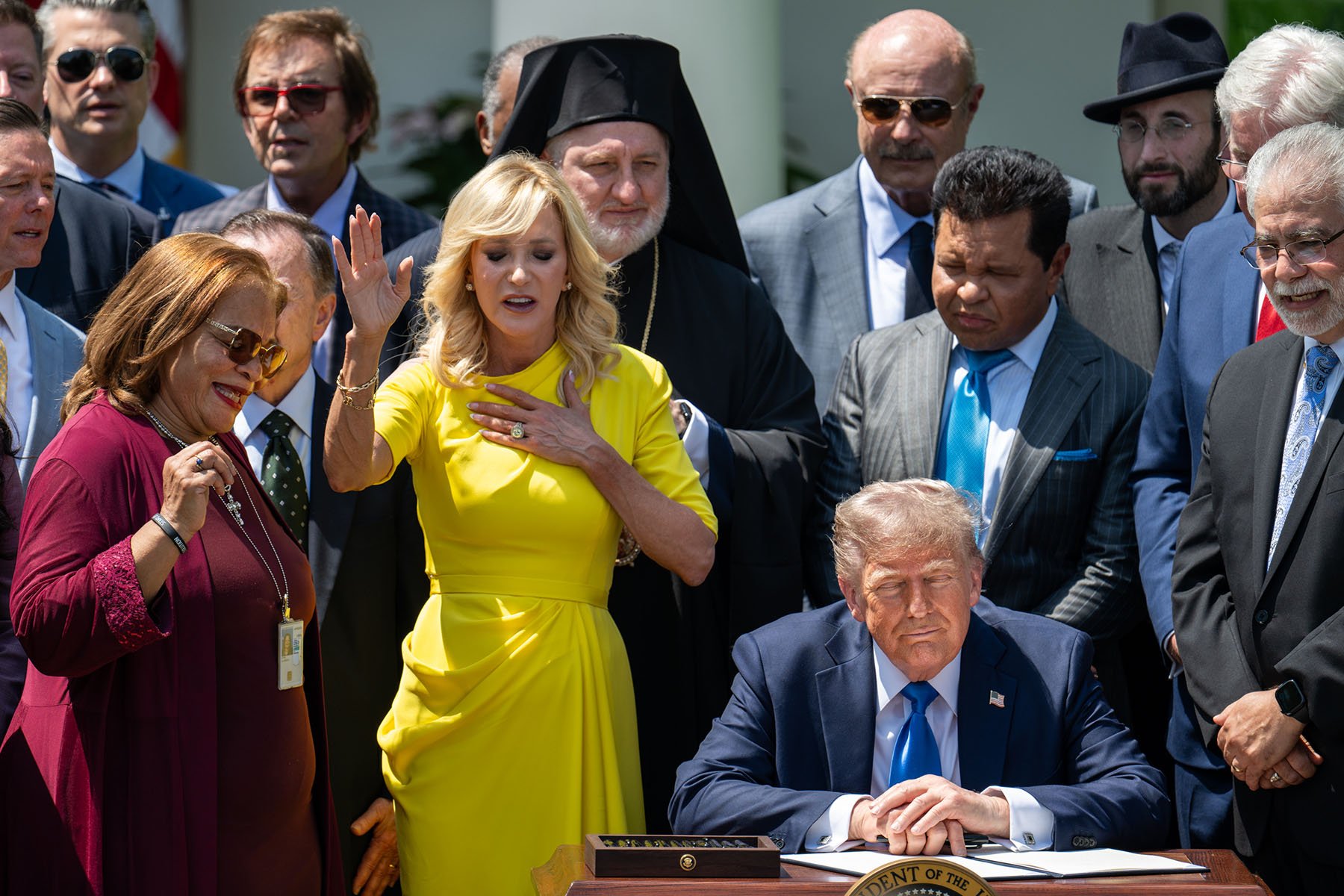
On Wednesday, the Catholic Church’s cardinals will gather for a conclave to select the next pope. They’ll also set the direction of the church — picking either someone more progressive, like Francis, or a more conservative choice, who might be more aligned with right-wing American Catholics, some of whom gathered in Rome over the weekend to fundraise and organize.
On Saturday, the White House posted on Instagram a captionless AI-generated image of Trump himself as the pope, upsetting and offending many — but seemingly leaving the young women who have become some of the president’s most vocal supporters online unaffected. (Trump, meanwhile, told reporters Monday, “I have no idea where [the post from the official White House account] came from — maybe it was A.I.” and “They can’t take a joke. You don’t mean the Catholics; you mean the fake news media. The Catholics loved it.”)
Catherine Pakaluk is an associate professor at the Busch School of Business at the Catholic University of America and is an expert on Catholic social thought and political economy. She said an increasingly active anti-abortion movement in the church coincided with the growth of social media, which provided more and more economic opportunities for young women. This eventually created a certain kind of influencer for whom Catholic faith and political ideology are now synonymous.
“They see their work as being meaningful and that their [online engagement] matters politically in the same way that people see social justice as something that is political activity, where you get up in the morning and you think, ‘OK how am I going to help people today?’” Pakaluk said.

One of the most prominent is Isabel Brown, a Gen Z livestreamer and content creator, who frequently discusses conservative politics and culture debates, advocating for traditional Catholic values to more than a million followers. She was featured on the cover of Newsweek, wearing a red MAGA hat, in 2019 and published two books in the last five years calling for Gen Z to embrace so-called traditional values. Brown was in attendance when Trump signed the executive order at the White House banning transgender women and girls from school sports that align with their gender identity and recently posted a critique of liberals’ supposed pearl-clutching about Trump’s proposed “baby bonus” to increase the national birth rate.
Leah Libresco, a freelance journalist and former policy researcher who has written extensively on feminism and Catholicism, stressed that while many of the of the most popular MAGA influencers happen to be Catholic, they do not represent the majority of Catholic women’s political opinions — but do reflect the reality that many Catholic women do not feel like there is a home for them in the Democratic Party today, largely because of the party’s pro-choice stance.
While many of the most high-profile practicing Catholics in politics lately have been Democrats, including former President Joe Biden and former House Speaker Nancy Pelosi, the Catholics now driving Republican politics are younger and more conservative. Not only is Vance a vocal Catholic convert, but Karoline Leavitt, the White House press secretary, has spoken about the impact of attending a Catholic high school and Benedictine College. Over Easter weekend, Catholics for Catholics — the heart of far-right wing Catholicism in the United States — hosted its annual gathering and gala at Trump’s Mar-a-Lago resort in Florida.

Conservative Gen Z Catholic influencers are being embraced by their party even as more progressive Catholic women feel shut out of liberal organizing spaces because of their belief that being anti-abortion is part of a larger, holistic approach to working to honor the sanctity and dignity of all life.
“I think a lot of the challenge for the faith right now is to try and talk about Catholicism as a whole unified faith and not just the little pieces that get snipped off as essentially controversial, so that you are making the case that pro-life activism for children who are disvalued in the womb is united to advocacy for the disabled is united to advocacy for the poor is united to advocacy for their caregivers,” Libresco said.
There’s another reason that social media is a natural fit for younger people looking to express their political, and religious, ideology — especially young women, Libresco added.
“I think when you have a platform that’s very photo- and video-oriented in the way that TikTok or Instagram is, you’re going to see that as creating different opportunities for very young women than those that are text-based and what they create for older women and that’s because people want to look at very young women,” she said.

Some of the most prominent Catholic voices on the right are converts, including Vance. One of the most controversial is Candace Owens, a far-right personality who rose to prominence as a Trump supporter and was fired from The Daily Wire in March 2024 for a series of antisemitic comments. The following month, she announced a conversion to Catholicism and was met with excitement from some Catholics online. She was immediately invited to Scottsdale, Arizona, for a welcome Mass that more than 200,000 people watched online. Then a month later when she posted pictures of her baptism in London, the Catholic Identity Conference — an annual event hosted by a traditionalist Catholic newspaper that often criticized the progressiveness of Pope Francis’ actions and teachings — announced she would be a headliner that fall.
Katherine Dugan, an associate professor at Springfield University and the author of “Millennial Missionaries: How a Group of Young Catholics is Trying to Make Catholicism Cool,” said that while the majority of Catholics are not enamored with “the moral life of Trump,” the influencers who have made their Catholicism synonymous with their politics are able to capitalize on a more widely felt sentiment that Trump represents “the lesser of two evils in a landscape where you have to choose between trans rights, abortion, and no religion in schools and the opposite of that.”
And though a minority voice within the world of mainstream Catholicism, Dugan said the women who have become key messengers of the Trump agenda are promoting not just a political message, but a version of Catholicism that they view as correct to other people’s wrong, more liberal Catholicism.

“My read is less that the politics are a necessary part of being Catholic in America, but they’re making a strategic choice to sort of pick a side of the spectrum that tastes a little better in their interpretation of the politics,” Dugan said.
Dugan explained that while this political ideology may not represent the majority of contemporary Catholics, a recent concerted movement to bring more young people into Catholicism has focused on young women — and offered them “a version of feminism that is different than second wave and even third wave feminism.”
This push stems from work done by Pope John Paul II in the early 1990s around what became known as “JPII feminism.” It was a kind of rebuke of the contemporary feminist movement, a disavowal of the idea that the way for women to assert greater power was to be thought of as like men.
“There’s this sense that culture has done women an injustice and in order to reclaim their power — like reclaiming the sanctity of life — they must reclaim a woman’s position in the world, which is that women need to not be like men,” Dugan said. “Women are to be women, and that’s how we celebrate God’s vision for all of human life.”
It has resulted in a unique cultural moment, Dugan said, where “Catholics understand their capacity to use Trump as a messenger, even if he is an accidental messenger, a great messenger for the dignity of human life” that is echoed through the way Trump talks about everything from abortion to increasing the birth rate to protecting women in sports.
And part of using Trump as a messenger means a cottage industry popping up of young women who both understand the power of Trump to act on their values, the power of social media to reach new audiences, and the power of the influencer economy to make new opportunities for themselves.
Part of this is also a natural side effect of a generation for whom social media is a native language. While evangelicals had a heavy radio presence throughout the 80s and into the beginning of the 21st century, “what has happened in the last 10 years is that Catholics woke up and figured out they’re not doing radio, but they’ve leaned pretty heavily into social media generally, especially in podcasting,” Pakaluk said.
“It’s still fringy, it’s not majority — but they are influential,” Pakaluk said of the emergence of the young women Catholic right-wing influencers. “I know a lot of young Catholic women who, like evangelical women before them, say it’s their number one interest after finishing college and before they get married to go down to Washington and be a staffer on Capitol Hill or work for think tanks. They want to change the world.”
xxxxxxxxxxxxxxxxxxxxxxxxxx
The Rise of Abortion 'Abolitionists'
Click to skip ahead: Attacks on Abortion Pills reveals that yes, of course, everything happening right now is coordinated. Local Travel Bans looks at the eighth Texas county to outlaw helping women get out of state abortions. All Eyes on Extremism has a deep dive into the growing abortion ‘abolition’ movement. In the States, news from Indiana, Louisiana, and Missouri. Attacks on Democracy has the latest in efforts to quash ballot measures and voters’ voices.
Attacks on Abortion Pills
It was only a week ago that I warned the anti-abortion movement was in cahoots with the FDA on a plan to restrict abortion medication: Just days after FDA chief Marty Makary said he would consider taking action on the pills if new data showed they were unsafe, a conservative think tank dropped a new study purporting to prove just that. Soon after, Republicans started calling for the federal agency to roll back access to mifepristone.
Today, POLITICO published an article making clear that this is all part of a coordinated plan of attack led by anti-abortion organizations, legislators and leaders. They’re calling it “Rolling Thunder,” which would be hilarious if these people weren’t so dangerous.
If you’ve been reading Abortion, Every Day’s coverage on the attacks against mifepristone, you won’t find anything super surprising in the piece—mostly just confirmation of what the newsletter has been warning about. (Yes, I’m still grumpy with POLITICO over their atrocious headlines yesterday claiming that the Trump administration is “defending” abortion pills.)
That said, there are a few interesting tidbits: To start, even the most radical anti-abortion activists admit this supposedly ‘groundbreaking’ research on mifepristone isn’t a real study! Dr. Christina Francis, president of the American Association of Pro-Life OBGYNs (AAPLOG), said the paper is “not a study in the traditional sense” and “not conclusive proof of anything.”
You know that shit is really fake when even the lady who doesn’t believe in life-saving abortions doesn’t want to get fully behind it!
The biggest takeaway for me, though, is just how orchestrated these attacks are. As Angela Vasquez-Giroux, vice president of communications of Planned Parenthood Action Fund, said, “It’s awfully convenient that a few days after Marty Makary says that he had no plans to restrict mifepristone, but that he’d be open to considering new science, some new trash science just happens to land in his lab.”
One gripe: This POLITICO piece is the first major national coverage of the nonsense anti-abortion study, and instead of pointing out that it’s utter bunk, reporters defaulted to ‘both sides’ mode. Here’s what I mean:
“The paper, published last week, purports to show significantly more patients have experienced serious side effects after taking mifepristone than previously known. Medical experts and abortion-right supporters say it exaggerates the danger of a medication that more than 100 scientific studies have found are safe and effective.”
It’s not until paragraph fifteen that readers are told the research isn’t peer reviewed. And not until paragraph twenty-eight do we learn that the “serious adverse events” it counted weren’t actually serious—or even necessarily related to mifepristone.
I get journalistic objectivity, and I know mainstream reporters don’t have the freedom I do. But there has to be a better way.
Local Travel Bans
It’s been a minute since we’ve talked about the push to ban abortion-related travel at the local level. Longtime readers know all about “Sanctuary Cities for the Unborn”—local ordinances designed to terrorize abortion patients and anyone who helps them.
Led by anti-abortion extremist Mark Lee Dickson, these laws don’t just declare abortion illegal within a town or county—they go further, banning so-called “aiding and abetting.” That means driving someone on county roads or even lending them gas money to leave the state for care could result in a civil suit.
Basically, these are de facto travel bans. The goal is to chill community support—scaring people out of helping one another—and making women too terrified to leave their state for care.
Sometimes Dickson and his ilk pass ordinances in pro-choice states—deliberately setting up a legal conflict they’re hoping will make it through the courts. (They want to get the Comstock Act in front of the Supreme Court.) But most of these ordinances are passing in places where abortion is already banned.
For example, Camp County, Texas just became the eighth county in the state to pass one of these local laws. The ordinance states that abortions are illegal, as is ‘aiding and abetting’ an abortion “regardless of the location of the abortion [and] regardless of the law in the jurisdiction where the abortion occurred.”
Just to take a step back a moment: we are talking about laws that make it illegal to help someone leave the state—ordinances that trap women in places where they’re not treated as full human beings.
Can you imagine the national outrage if towns across the country were passing laws to limit men’s right to travel?
But don’t give up hope—communities are fighting back and winning. If you haven’t read about what happened in Amarillo, Texas, check out this guest post from the Amarillo Reproductive Freedom Alliance:
All Eyes On Extremism
I hate giving these guys oxygen, truly—but we need to talk about abortion ‘abolitionists’. These mostly male extremists want to prosecute abortion patients as murderers—and they’re gaining political ground. What used to be fringe legislation is now getting co-sponsors, committee hearings, and Republican support. And while the GOP once claimed they’d never punish patients, now they say ‘equal protection’ bills “will inspire healthy dialogue.”
For fuck’s sake—some of these extremists are even getting elected to state legislatures.
That’s why I was so glad to see this sharp deep-dive from The American Prospect on the growing ‘abolition’ movement. It’s well worth a full read.
Reporter Colleen Scerpella includes a handy document listing all the ‘equal protection’ bills introduced this year—noting that the legislation often shares identical language. That means these bills are likely all coming from one group providing model legislation.
That tracks with what Abortion, Every Day reported back in January: This new stream of bills is all coming from the Foundation to Abolish Abortion and its leader, Bradley Pierce. (Pierce was also the driving force behind Texas Republicans changing their platform to call for ‘equal protection’ laws—which could mean the death penalty for abortion patients.)
Not that the idea of killing women gives these guys pause. One abolitionist leader, Jeff Durbin, was caught on leaked audio saying: “If you take the life of a human being…you forfeit your right to live.”
There are two things I’m especially worried about here. First, these people are a lot closer to mainstream political power than most folks think. One of FAA’s top legislative liaisons is John Rice-Cameron—the son of Susan Rice, who served as President Barack Obama’s national security advisor and U.N. ambassador.
Second, they’re incredibly organized. Scerpella reports that FAA is using a “precinct strategy” to burrow into local Republican parties:
“This ‘ground-up’ approach enables abolition activists to infiltrate state and county Republican parties, effectively making their extremist position more acceptable within the broader party by suppressing more moderate voices.”
In a 2024 speech, Rice-Cameron encouraged supporters to give local candidates time and money in the early stages of their careers—before they take office—in order to get their hooks in early.
And while the mainstream anti-abortion movement loves to insist they don’t want to punish patients, let’s not pretend there’s much real distance between them and ‘abolitionists’. Just a few weeks ago, Kristan Hawkins—president of Students for Life—flat out admitted that “the vast majority” of anti-abortion leaders do want to punish patients. They’re just waiting until it’s politically safe to say so.
All of which is to say: These aren’t political outliers anymore, and we can’t afford to treat them as such.
In the States
Indiana Attorney General Todd Rokita is downright obsessed with getting women’s abortion records. I’ve been tracking this story for a while—so if you need a refresher, click here, here, and here. The short version is that the Republican attorney general wants individual abortion reports to be public records in the same way birth and death certificates are. He’s been in a legal battle with the state department of health, which (correctly) argues releasing those records would violate patient privacy.
Why does Rokita want people’s abortion reports to be publicly-available? The idea is to allow anti-abortion activists to scour through the records, looking for evidence of ‘wrongdoing’ that they can then send to the AG so he can bring charges.
Thanks to a suit filed by OBGYNs Dr. Caitlin Bernard and Dr. Caroline Rouse, a judge blocked the health department from publishing individual abortion reports a little over a month ago. But Rokita is still at it—he’s appealing the ruling and wants the judge to release the records while the issue is battled out in the courts.
This isn’t just something happening in Indiana, by the way: What Rokita is doing is part of a broader national strategy by anti-abortion activists and lawmakers who want to weaponize abortion reports and data. In Ohio, for example, Republicans are pushing to expand the kind of information collected on abortion patients and then make that information public. In fact, they want to publish a publicly-available “electronic dashboard” that people could search through.
In addition to making it easier to criminalize providers and patients, the goal is to shame patients and create a chilling effect: you might be less likely to seek out an abortion if you know the state is collecting and publishing your data.
Abortion, Every Day has been connecting the dots for three years. Help the newsletter keep going strong by signing up for a paid subscription:
Meanwhile, Louisiana Republicans are advancing legislation that they say would require schools to offer support and resources to pregnant students. Sounds great, right? Until you read the fine print. Abortion rights activists in the state point out that HB 478 opens the door to sending students off to anti-abortion crisis pregnancy centers—groups that don’t offer real medical services, just religious ideology.
Here’s what Michelle Erenberg, executive director of Lift Louisiana, said at a committee hearing for the bill a few days ago:
“Public educational institutions have a constitutional obligation to remain neutral in matters of deeply personal and political significance. Requiring schools to promote the viewpoints of nonmedical, religiously motivated organizations threatens this neutrality and exposes institutions to potential legal challenges.”
Finally, The New Republic has a really good piece about the new lawsuit seeking to end forced parental involvement in Missouri abortions. I told you about this suit last week: youth-focused abortion access organization Right By You (RBY) is using Missouri’s Amendment 3 to ask the courts to end parental notification and consent laws in the state.
As executive director Stephanie Kraft Sheley said in a statement at the time, “These laws don’t protect youth—they are designed to punish those already in vulnerable situations.”
TNR goes into detail about what getting an abortion might look like for a young person, especially if they live in a state where they’re forced to get a judicial bypass to forgo parental involvement. Kraft Sheley calls it a “humiliation ritual.” Which sounds about right: remember the judge who chastised a Florida teen, denying her an abortion because she had poor grades? Nightmare shit.
Quick hits:
Arkansas just upped their funding for anti-abortion crisis pregnancy centers;
A Pennsylvania bill would remove waiting period and counseling mandates for abortions;
A new poll reminds us that Florida voters don’t want abortion banned;
And Arizona Gov. Katie Hobbs vetoed legislation that would have required abortion providers to include links to adoption services on their websites.
“To build a future where abortion is truly accessible, we must prioritize economic justice, invest in the infrastructure that supports patients on the move, and center the people most impacted by bans and barriers. That means investing in in-clinic care and virtual care. It means Medicaid and mutual aid. Anything less risks reinforcing the very inequities we’re trying to dismantle.”
- Amy Hagstrom Miller, founder & CEO of Whole Woman’s Health, TIME magazine
Attacks on Democracy
Okay, let’s talk about what Republicans are up to on ballot measures—namely, how they’re trying to make sure that voters can’t use citizen-led initiatives to restore abortion access of any kind.
You all know that anti-abortion legislators and activists have been chipping away at democracy ever since Roe was overturned: we’ve seen it in every single state where abortion was on the ballot, or where voters tried to get the issue on the ballot.
In Ohio, Republican leaders colluded with anti-abortion activists to write a biased ballot summary. Missouri Republicans stalled signature gathering for a pro-choice amendment and even sued to keep abortion off the ballot. In Florida, Gov. Ron DeSantis threatened television stations that ran ads for a pro-choice ballot measure and launched a bogus voter fraud investigation and disinformation campaign (funded with taxpayer dollars). In Nebraska, conservatives tricked voters out of supporting abortion rights by starting their own ballot measure to ban abortion using a near-identical name as the pro-choice campaign. South Dakota antis pretended to be from the Secretary of State’s office in order to pressure voters into removing their names from a pro-choice petition. And in Arkansas, they stopped the issue from getting on the ballot at all.
I could go on, but I think you get the point.
Even though November is over and done with, Republicans aren’t done yet. They’re trying to make sure that voters will never have a chance again to make their voices heard on abortion rights. Why? Because they know that Americans are overwhelmingly pro-choice, even in red states. And legislators obsessed with controlling our bodies and freedom don’t want to take the risk.
In Florida, for example, Republicans are pushing through new restrictions on citizen-led initiatives. They want signature-gatherers to collect all sorts of personal information from those signing petitions (like a driver’s license), limit how many signatures canvassers can collect, and force petitioners to submit signatures within just a few days.
I suppose this is better than what DeSantis originally proposed: He wanted to eliminate canvassers entirely, instead forcing voters to go sign a petition in person at their local Supervisor of Elections (SOE) office.
The Republican governor is pretending that this is about voter fraud, but we know what’s really going on here: With nearly 60% of the vote, Florida’s pro-choice amendment got too close for comfort.
The New York Times reports that Arkansas Republicans are trying something similar: adding onerous requirements to the ballot measure process in an effort to quash citizen-led initiatives. They want signature gatherers to collect photo ID from signers, for example, and mandate that canvassers are permanent residents of the state.
Then, of course, there’s Missouri. In one of the most clear-cut attack on the will of voters, Republicans in the state have been doing anything they can to stop Amendment 3 from being fully enacted. The state GOP now insists that voters didn’t really understand what they were signing up for, and they want to put abortion back on the ballot—this time, to get people to agree to an abortion ban.
Unsurprisingly, the same folks trying to bring back the state’s abortion ban also plan on weaponizing anti-trans bigotry. Check out this quote from Brian Westbrook, the executive director of Coalition Life:
“Voters should have another chance. From my conversations with lawmakers, I think primarily it’s going to be related to the abortion discussion, but the transgender discussion is certainly in this dialogue.”
Charming. I won’t even get into what’s happening with the Missouri Attorney General—you can catch up on that one yourself.
Some of the local activists I’ve spoken to in Missouri aren’t just furious at Republicans, though. Quite a few have said they feel like mainstream reproductive rights groups didn’t have a plan for the inevitable fight conservative lawmakers would put up after Amendment 3 was passed. As a result, much of the state’s abortion rights resources are being directed to the legal battle around getting the amendment enforced—rather than towards patients themselves.
Still, there’s no doubt that Republicans are showing exactly who they are in every state: they know that voters want abortion to be legal and they simply don’t care.
xxxxxxxxxxxxxxxxxxxxxxxxxxxxx
‘Abolitionists’ Push Legislation to Criminalize All Abortions as Homicide
Measures introduced in 13 states this year would impose criminal penalties on people who obtain an abortion.

Published in partnership with the Center for Media and Democracy
Inside a dingy conference room in the North Dakota state house, Texas attorney Bradley Pierce coolly made the case that the 14th Amendment and biblical scripture require the state to charge anyone who obtains an abortion with murder.
When asked by North Dakota Representative Jayme Davis (D–9) about whether the overtly Christian basis of his reasoning disregarded other people’s freedom of religion, Pierce responded with a wry smile and a comment to match. “Well, you know, I think the Aztecs believed it was okay to rip the hearts out of children and offer them as a burnt sacrifice to their gods, and I think that should be illegal.”
Pierce’s testimony in support of HB 1373, a bill that would criminalize all abortions in North Dakota, was one of more than a dozen heard by the state’s House Human Services Committee on February 5. Other supporters taking the podium that morning inside the crowded Pioneer Room included the son of Democratic career diplomat Susan Rice, the co-executive director of a Wisconsin-based network of crisis pregnancy centers, and a “post-abortive” activist from North Dakota.
HB 1373 is not a “typical” anti-abortion bill in post-Roe America. Introduced in January, it would expand the definition of “human being” in the state’s Century Code to include zygotes at “the beginning of biological development at the moment of fertilization” for the explicit purpose of banning all abortions and subjecting anyone who performs or obtains one to criminal punishment. Under this law, anyone who harms a zygote or embryo in North Dakota could be prosecuted for murder or assault, or sued for wrongful death.
Despite the impassioned in-person and written testimony from supporters of HB 1373, the bill was so extreme that even the co-director and general counsel of the North Dakota Catholic Conference testified against it, prompting the committee to issue a “Do Not Pass” recommendation. The bill went on to fail decisively in a full House vote a week later, earning a mere 16 “yeas” out of 93 votes cast.
“Abortion Abolition” Bills Introduced in 13 States This Year
The introduction of this extreme bill in North Dakota was not an isolated incident. This year alone, at least 14 other so-called “abortion abolition” bills have already been introduced in a dozen other states.
Since 2017, state lawmakers have considered abortion abolition bills in at least 21 states. Often called “prenatal equal protection” acts, most were introduced after the Supreme Court overturned Roe v. Wade in 2022 and opened the door to this type of legislation, which had previously run counter to SCOTUS precedent on abortion.
Even in states with severe restrictions on abortion access and criminal penalties for abortion providers, those who actually obtain an abortion are not subject to prosecution themselves. However, under abortion abolition laws, they would be.
The explicit criminal liability for the person who obtains an abortion is the most crucial difference between abortion abolition bills and other more common anti-abortion legislation. These types of bills amend state criminal codes to charge those who obtain an abortion with homicide for the “death” of their “unborn child,” including anyone who self-induces an abortion using medication legally prescribed and mailed from another state.
No exceptions are made for rape and incest. The bills do include vague, ill-defined allowances for attempting to save the life of a pregnant person, but only insofar that this attempt is “accompanied by reasonable steps, if available, to save the life of her preborn child.”
Though none of these bills has ever survived a simple majority vote in state legislatures, the rapid reemergence of abortion abolition legislation across the country indicates the growing influence of a radical, militant faction of anti-abortion fanatics whose ultimate goal is nothing short of the complete and total eradication of abortion access in the U.S.
Extreme Christian Patriarchy
The abortion abolitionist movement is a relatively nascent one, tracing its origins to a new generation of mostly white, male, conservative Baptists, Presbyterians, and Christian Reconstructionists emboldened by the anti-abortion stance of the Trump administration.
While anti-abortion activists have likened abortion to slavery since the passage of Roe v. Wade more than a half a century ago, the abortion abolition movement takes this comparison to extremes. Abolitionists appropriate rhetoric from the anti-slavery abolitionists of the 19th century, employing an “equal protection” argument from the 14th Amendment to compare embryos and fetuses to enslaved people.
Another distinguishing feature of abortion abolitionism is its “maleness.” For instance, T. Russell Hunter heads Abolitionists Rising, a group that organized the first abortion abolition national conference in 2020. End Abortion Now, an “outreach ministry” of Apologia Church, has an all-male staff of four, three of whom are pastors. Red State Reform, a 501(c)4 on the IRS auto-revocation list, features former pro-baseball player Dennis Sarfate as president. This is in contrast to the female figureheads of the biggest so-called “pro-life” organizations, such as Marjorie Dannenfelser of Susan B. Anthony Pro-Life America, Carol Tobias of National Right to Life, Lila Rose of Live Action, and Kristan Hawkins of Students for Life of America.
Abortion abolitionism differs from the pro-life movement in other key ways. Abolitionists find the pro-life movement to be insufficiently opposed to abortion, claiming that the pro-life position is too secular, too incrementalist, and too complacent in the aftermath of the Supreme Court’s reversal of Roe. Most pro-life organizations have long maintained that because women are the “second victims” of abortions and that the majority of abortions occur under some form of duress, individuals who get an abortion should be automatically exempt from criminal prosecution. Abolitionists fundamentally reject this premise, arguing that unless coercion is proven on a case by case basis, anyone who has an abortion is an active and willing participant in the “murder” of her “preborn child.”
Abolitionist leaders are rather explicit about this. According to NPR, Hunter told a crowd of several hundred supporters at an April 2024 Abolitionists Rising event, “We know the mother is the abortionist or the father is the abortionist. Whoever it is, the abortionist needs to be punished and we’re not going to lie about it in order to be friends with the world, because that is precisely what the pro-life movement has done and is doing.”
Jeff Durbin, leader of End Abortion Now, takes this position to its most extreme conclusion. In an audio recording, the Christian pastor calls for women who have abortions to be executed by the state.
“If you take the life of a human being, unjustly, then what the state owes you—if it’s proven and it’s true—is capital punishment. You forfeit your right to live.”
Origins of the Model Bill
Despite advancing a broadly unpopular position, legislators have introduced 15 abolition bills in 13 states so far this year. These bills don’t just share an underlying ideology. An analysis by the Center for Media and Democracy (CMD) found the same language—word-for-word or nearly word-for-word—in all but one bill. This suggests that these abortion abolition bills all emanate from a single source that provides lawmakers with a template to quickly and easily draft legislation.
One person stands out as the most likely author of this template: Bradley Pierce, the Texas attorney who used such forceful language when testifying before the North Dakota House Human Services Committee in February.
Pierce is the co-founder and president of Abolish Abortion Texas, a state-based abolition organization, and the vice president and general counsel of Heritage Defense. His public LinkedIn page also identifies him as an “allied attorney” with Alliance Defending Freedom (ADF).
Most significantly, Pierce leads a national abolitionist nonprofit called Foundation to Abolish Abortion (FAA), which he founded in 2019. According to the organization’s IRS form 990 from 2023, its mission is “to exalt and vindicate the image of God” through “promoting sound public policy that provides all preborn human beings the equal protection of the laws.”
FAA’s revenue for 2023 reached over $350,000, with at least $85,000 coming from the National Christian Charitable Foundation, a favorite donor conduit of the Christian Right that funneled more than $2 billion in donations that year to its preferred causes. Other than this one grant, the sources of FAA’s funding are unclear.
As the sole staff member listed on FAA’s website, Pierce is described as a “constitutional lawyer” who claims that he has drafted “dozens of equal protection bills filed to abolish abortion.” The 990 form also discloses that FAA “draft[s] and analyze[s] legislation.”
In 2022, Pierce filed an amicus brief in support of the petitioners in Dobbs v. Jackson Women’s Health Organization, the case that overturned the constitutional right to abortion established by Roe v. Wade in 1973, on behalf of 21 organizations and 20 state lawmakers. In it, he laid out the same argument of “equal protection” under the 14th Amendment and Christian scripture that is the basis for past and present abolition bills.
The lawmakers who signed this brief included four state Freedom Caucus members and six state legislators affiliated with the American Legislative Exchange Council (ALEC). Only nine of the 20 state lawmakers who signed the brief are still in office just three years later, but six of those nine have sponsored abortion abolition bills introduced during this legislative session.
Pierce has continued to connect with state lawmakers across the country, establishing relationships that likely provide him with the kind of access necessary for advancing his legislative agenda. In January, he appeared on a Crosspolitic podcast episode with Idaho State Senator Brandon Shippy (R–9) and first-term Texas State Representative Brent Money (R–2), the sponsors of Idaho SB 1059 and Texas HB 2197, respectively.
Neither Shippy nor Money are particularly coy about how closely they work with Pierce. Shippy disclosed that, “With the help of Bradley Pierce, we drafted some legislation that would essentially provide equal protection for the baby in the womb, the preborn child,” referring to Idaho’s “Prenatal Equal Protection Act.”
Shippy has previously said that under SB 1059, law enforcement officers could be authorized to investigate miscarriages as suspected abortions, according to the Idaho Statesman.
Pierce describes his national reach even more bluntly, stating, “We’re working, getting bills drafted and ready for legislators around the country… We’re expecting around 20 to be filed this year.”
Emails obtained by CMD through an open records request show that Missouri is another state where FAA has been deeply involved in pushing abortion abolition legislation.
“At Foundation to Abolish Abortion, we offer to write the press releases for our legislators to save them time,” wrote John Rice-Cameron in a January email to Missouri State Representative Justin Sparks (R–110) and State Senator Mike Moon (R–29), sponsors of HB 1072 and SB 619, respectively. Sparks is the vice chair of Missouri’s Freedom Caucus, while Moon is one of the signatories of the Dobbs amicus brief.
Rice-Cameron, the son of Susan Rice, testified in favor of North Dakota’s HB 1373 and is not listed as a staff member on FAA’s website, nor did he disclose this affiliation during his testimony. However, the registration page for an Equal Protection Advocacy Workshop event held in February describes him as a “Legislative Liaison” for FAA.
Also included on this email exchange was Wesley Scroggins, the executive director of Abolish Abortion Missouri and a professor of management at Missouri State University. In one email, Scroggins asks whether FAA would be willing to bring a legal challenge against Amendment 3 if the abolition bills sponsored by Sparks and Moon passed.
Despite attempts by Missouri Attorney General Andrew Bailey (R) to keep the initiative off the ballot last November, a majority of voters approved Amendment 3, which overturned the state’s total ban on abortion and instead enshrined the right to abortion in the state’s constitution. Since then, Bailey has affirmed that he will interpret Amendment 3 as narrowly as possible, while Republican lawmakers are currently working on a constitutional amendment to circumvent the referendum and restore the state ban abortion.
“If the bill were to pass, the AG should defend it,” responded Pierce. “That said, if the AG would not, yes we would [be] more than happy to do so.”
Abolition Advances
North Dakota’s abortion abolition bill is the only one to receive a floor vote so far this year, and its resounding failure in the Republican-dominated legislature suggests that no abolition bills stand a strong chance of becoming law this year. Three out of four Americans oppose criminal prosecution of doctors and parents for abortion, and other anti-abortion legislation presents a far less politically risky alternative.
Nevertheless, abortion abolitionists continue to make incremental headway. Although the “Georgia Prenatal Equal Protection Act” (HB 441) failed to make it out of committee before “Crossover Day” (the deadline for a bill to pass out of one chamber so that it can be considered in the other), it was still granted a public hearing on March 26.
Pierce sat side by side with the bill’s sponsor, Georgia State Representative Emory Dunahoo (R–30), who explicitly introduced him as the author of HB 441. Pierce also answered questions asked by members of the committee.
Abolitionists showed up in full force, with representatives from prominent abolitionist groups like Operation Save America, Operation Gospel, GA Right to Life, and End Abortion Alabama. Durbin, the head of End Abortion Now who voiced support for executing abortion patients, was one of nearly a dozen abolitionists who testified. During an exchange with Representative Esther Panitch (D–51), the only Jewish member of the Georgia Assembly, Durbin told her that her understanding of the teachings of her own faith regarding abortion was incorrect, and equated her pro-choice viewpoint with the Nazis’ dehumanization of Jews during the Holocaust.
The committee also heard from Coleman Boyd, an anti-abortion activist who is currently serving five years on probation after being convicted in 2024 of felony conspiracy and violation of the Freedom of Access to Clinic Entrances (FACE) Act. These charges stemmed from a 2021 incident in which Boyd and others affiliated with Operation Save America blockaded a reproductive health center in Nashville for almost three hours.
While HB 441 will not be put to a vote this year, Georgia’s two-year legislative system means that this same bill will be automatically reconsidered next year, giving it another chance to pass. As in many other states where abolition bills have been introduced, Georgia permits the death penalty for acts of homicide.
Abortion abolitionists are also becoming more organized. The Colorado Times Reporter noted in 2023 that Pierce promotes a “precinct strategy” for influencing local Republican parties at the state level. This “ground-up” approach enables abolition activists to infiltrate state and county Republican parties, effectively making their extremist position more acceptable within the broader party by suppressing more moderate voices.
Pierce’s precinct strategy may in fact be working. A coalition letter published in support of Georgia’s HB 441 included the expected names of those affiliated with abolitionist organizations and ministries. However, it was also signed by the chairs of several Georgia county Republican parties as well. A similar joint statement in favor of Texas HB 2197 was signed by 52 “conservative leaders,” including the chair and vice chair of the Republican Party of Texas, members of the State Republican Executive Committee, county chairs, and state representatives.
Support for this position in Pierce’s home state has grown so much that in May 2024 the Republican Party of Texas adopted abortion abolitionism as part of its official platform, becoming the first in the country to do so.
At an abolitionist event in August 2024, guest speaker Rice-Cameron presented an implicitly transactional approach to lobbying state lawmakers: abolitionists offer their time and money to support the campaigns of conservative lawmakers who demonstrate an openness to abortion abolitionism. He alluded to the successful use of this strategy in the case of Texas “abolitionist champion” Money, who unseated the moderate Republican incumbent, boasting that abolitionists helped him win by canvassing for him in the lead-up to the election.
“To the extent that you can, build relationships with sympathetic legislators early on in their political career, preferably before they even get into office, while they’re still campaigning,” Rice-Cameron said. “It’s important to realize that prior to actually winning an election a politician is a lot more open-minded than after being in office for some time.”
Activists like Pierce are under no delusion that their bills will pass in any state legislatures this year. However, the work they do now through abolition organizations and ministries builds crucial relationships with state lawmakers and local Republican leaders that increase their prospects of success in future years.
The growing number of abolition bills, co-sponsored by increasingly more lawmakers, indicates that this position is gradually becoming more mainstream among the conservative base. It’s a position that, if fully realized, would make getting an abortion a capital offense in many states.
xxxxxxxxxxxxxxxxxxxxxxxxxxxxxxx
State lawmakers are weighing bills that would treat abortion as homicide
Lawmakers in at least eight states are weighing bills that would treat abortion as a homicide, imposing criminal penalties on both providers and patients, once a Rubicon for the movement.
The bills, filed in Georgia, Idaho, Iowa, Kansas, Kentucky, Missouri, South Carolina and Texas, stem from the Prenatal Equal Protection Act, model legislation crafted by the Texas-based advocacy group the Foundation to Abolish Abortion. Three similar bills were introduced in Indiana, North Dakota and Oklahoma but failed to pass in committee or on the floor of the legislature.
In addition to banning abortion, the bills, which argue that life begins at fertilization, could outlaw fertility treatments such as in vitro fertilization.
No state abortion ban explicitly criminalizes pregnant people, and efforts to enact such a policy have consistently failed. Polling shows that most Americans support the right to abortion, and that they specifically oppose penalizing people who seek them.
Still, the number of these homicide bills — last year, only three were introduced across the country, according to the Center for Reproductive Rights — suggests that abortion opponents are growing more receptive to directly punishing people who terminate their pregnancies.
“It’s not surprising, though it’s incredibly chilling and alarming,” said Lizzie Hinkley, the center’s senior state legislative counsel. “Anti-abortion activists are motivated to push the envelope as far as they can.”
In Georgia, where abortion is currently outlawed after six weeks of pregnancy, lawmakers heard hours of testimony on one such bill, which drew opposition even from anti-abortion activists in the state.
“This is a bad bill. It’s bad for women,” testified Elizabeth Edmonds, who has worked as an anti-abortion lobbyist in the state and still supports abortion restrictions.
That bill is not slated for a committee vote, which it needs to advance. Similar legislation in other states has also not moved forward.
Still, abortion opponents are still finding support on other types of bills. In Texas, for instance, lawmakers have rallied around a bill that would stop cities and municipalities from supporting people traveling out of state for abortions and another that seeks to prevent people from ordering abortion medications online. In South Carolina, where abortion is currently banned after six weeks of pregnancy, 38 lawmakers backed a bill that would outlaw virtually all abortions.
Proponents of bills that would treat abortion as homicide — which they call “abolitionist” abortion policy — acknowledge they are still outside of the anti-abortion movement’s mainstream.
“Most major Pro-Life lobby organizations and leaders still oppose equal protection,” Bradley Pierce, who heads the Foundation to Abolish Abortion, wrote in an email to The 19th. “They oppose abolitionist legislation, which provides that everyone should be equally subject to the law and everyone’s life should be equally protected by the law. Instead, they support a policy that singles out women to grant them legal immunity to commit prenatal homicide.”
But more state lawmakers are expressing interest in reclassifying abortion as homicide and criminalizing pregnant people, Pierce said. The Georgia bill has attracted 21 sponsors, the most support one of his five year-old organization’s bills has ever had, he said. South Carolina’s bill has 10 sponsors. Despite failing to pass, a similar bill in North Dakota received 16 votes.
A dozen states have banned abortion almost entirely and four more have banned it after six weeks. Two ban it after the end of the first trimester, and still more have imposed other restrictions on the procedure. But workarounds such as travel and telehealth mean that the number of abortions in the United States has actually increased since the fall of Roe v. Wade — a development that has left abortion opponents scrambling for new approaches.
Three years ago, similar abortion bills — also the work of Pierce’s foundation — were introduced in 13 states, only making it out of committee in Louisiana. But even in that state, where lawmakers largely oppose abortion, the prospect of criminal penalties for pregnant people appeared to be a step too far.
“The most prominent national organizations don’t support anything that would criminalize the mother,” Sarah Zargoski, a spokesperson for Louisiana Right to Life, said at the time.
Still, repeated efforts to introduce these bills could chip away at that perspective, Hinkley said.
“Whether they’re enacted or not this year, they’re going to be normalized in certain circles,” she said.
xxxxxxxxxxxxxxxxxxxxxx
Missouri’s Anti-Abortion AG Subpoenas Local Abortion Fund for Private Records
The state has a long, disturbing history of trying to surveil abortion seekers, abortion providers, and those who help them.
Despite Missouri decisively voting to protect a right to abortion in November, there’s no low to which anti-abortion officials in the state won’t go. Since February 2024, Missouri Attorney General Andrew Bailey (R) has been leading a legal war on Planned Parenthood Great Plains, baselessly accusing them of trafficking minors out of state to access abortion while the state’s total ban was still in effect. Bailey’s evidence is a highly edited video from the anti-abortion extremist group Project Veritas, where an undercover anti-abortion activist poses as an uncle trying to help his underage niece get an abortion out of state. In the video, a Planned Parenthood employee tells him this is possible. Bailey’s case remains ongoing, even though, as of February, abortion is legal in Missouri again.
Most recently, Bailey subpoenaed the Missouri Abortion Fund to get them to submit years’ worth of private records. His office claims to be seeking communications between MAF and PPGP for evidence of PPGP illegally transporting minors to seek out-of-state abortion care, even though MAF isn’t even a party in the case—no one in the Project Veritas video even mentions them.
Thankfully, on Monday, Boone County Judge J. Hasbrouck Jacobs temporarily blocked Bailey from accessing MAF’s records, with a permanent ruling on the matter tabled for a later date, according to the Missouri Independent. However, Jacobs also denied Planned Parenthood’s requests for Bailey’s witch hunt to be thrown out altogether, even as an attorney for PPGP pointed out that, now that abortion is legal in the state, Missouri’s case against them should no longer be applicable.
Earlier this year, Missouri Republicans introduced a bill to establish a state-run registry to track pregnancies and identify and monitor pregnant people “at risk for seeking an abortion.” The bill remains under consideration in the legislature. In 2019, the state’s health director had to resign after he was caught keeping a spreadsheet of Planned Parenthood patients’ menstrual cycles. So it seems clear that Bailey’s efforts to access records of everyone the MAF has ever helped are part of the state’s broader, long-running effort to surveil and terrorize abortion seekers.
At a hearing on Monday, MAF accused Missouri of an “abuse of power” that’s “caused substantial and unnecessary expenses,” all while “Missourians still rely on us to make abortion accessible.” MAF’s executive director, Jess Lambrecht, told Jessica Valenti’s Abortion, Every Day newsletter that she expects legal fees “will eat at least at this point a full month of patient coverage,” or around $50,000 that could help fund abortion.
The organization further estimates that it would take almost 3,000 hours to sift through 35,000 records requests—hours in which they wouldn’t be able to help abortion seekers or fundraise and organize for abortion access. MAF is run by just two full-time and one part-time staff members, as well as volunteers. The goal—as is the goal with all obviously baseless and legally dubious lawsuits against abortion funds—is obstruction of their vital work.
Bailey is pursuing all of this under the guise of protecting children, taking a page from the broader anti-abortion movement’s playbook. In the Project Veritas video published in 2024, when abortion was still banned in Missouri, the fake uncle asks for help accessing abortion care for his made-up, underage niece. Clinic staff tell him he can go to their affiliate clinics in Kansas, where he can “bypass” parental consent requirements. The man asks the clinic workers if minors traveling out-of-state for abortion is common, and one of the employees tells him this happens “every day.” A spokesperson for PPGP told the Missouri Independent the video is “heavily doctored and edited.” But even still, no aspect of this—telling someone they can travel out-of-state for abortion care—is illegal. (Ever heard of a little thing called the First Amendment???) Missouri law at the time stated that “no one shall intentionally cause aid or assist a minor to obtain an abortion.” But PPGP points out they don’t provide any form of transportation directly to any of their patients, regardless of age. Plus, the Planned Parenthood employees didn’t even discuss transportation with the “uncle.”
Nonetheless, anti-abortion officials have increasingly zeroed in on accusing abortion providers and advocates of “trafficking” minors. Tennessee and Idaho have both enacted “abortion trafficking” laws that criminalize adults who help minors travel for abortion care without parental consent. Both laws are currently being challenged in court and parts of Idaho’s law were scaled back by a federal judge in November.
Earlier this year, Montana Republicans also introduced a bill to criminalize abortion-related travel, not just for minors; the bill wielded fetal personhood to charge abortion travelers and those who help them with “trafficking” their unborn fetus or embryo. Montana’s bill was eventually revoked in the wake of mass outrage, but not before exposing that it’s not just minors—Republicans are coming after the right to travel for abortion, for everyone.
Like what you just read? You’ve got great taste. Subscribe to Jezebel, and for $5 a month or $50 a year, you’ll get access to a bunch of subscriber benefits, including getting to read the next article (and all the ones after that) ad-free. Plus, you’ll be supporting independent journalism—which, can you even imagine not supporting independent journalism in times like these? Yikes.
xxxxxxxxxxxxxxxxxxxxxxxxxx
Missouri’s New Fight to Roll Back Abortion Age Restrictions
An abortion-support text line is challenging two Missouri laws that limit young people’s access to abortion. Why have other reproductive rights groups been so reluctant to make similar challenges?

In November, Missouri voters approved a ballot measure meant to end the state’s total abortion ban (which made only very narrow exceptions for life-threatening emergencies), adding an amendment to the state’s constitution that protected reproductive freedom, including the right to an abortion. The measure did not, however, automatically repeal the state’s dozens of anti-abortion laws—including those that have long made it impossible for young people in Missouri to obtain an abortion in the state. The new reproductive freedom amendment places no age limit on whose abortion rights it is meant to protect. But even as the measure’s backers brought challenges to numerous other abortion restrictions soon after Election Day, they did not challenge the two restrictions that effectively punish young people for seeking an abortion.
A lawsuit filed today seeks to overturn two state anti-abortion restrictions for people under 18, based on the rights protected by the reproductive freedom amendment. Among states that have advanced abortion rights ballot measures, Missouri is not alone in leaving such laws unchallenged; in fact, it may be the first of those states where advocates have tried to overturn them. While many reproductive rights’ groups have been eager to put abortion on the ballot, it seems there are still some abortion rights they are slow to defend.
The group bringing the legal challenge, Right By You, is a free abortion-support text line that aims to be, for young people, “basically in their pocket as a resource,” executive director Stephanie Kraft Sheley told me by phone this week. “A young person is free to text us throughout their entire experience.” Sometimes, the text line might be that young person’s only support. But Right By You is barred from providing funding for abortion and related costs. The group is prohibited from paying for or coordinating the travel, lodging, or childcare that abortion seekers might need in order to access care.
Under Missouri’s ban on helping minors obtain an abortion, a group like Right By You risks onerous fines, or being legally compelled to shut down by the state attorney general. Under the state’s mandated parental involvement law, it could also be subject to criminal liability, according to the group’s lawsuit, if it helps a minor obtain an abortion without parental consent. That law requires young people seeking an abortion to obtain consent from one parent or legal guardian, as well as notification from another, requirements that in practice prevent “some young people from even seeking an abortion,” the legal challenge states.
As volunteers at the text line regularly confront when explaining the laws to young people, the parental involvement law might result in delaying an abortion, which would in turn, because of the state’s gestational ban, limit the abortion seeker’s options for where they can get care and add “medical risks, added expenses, and stress,” according to the complaint. And because the parental involvement law requires either parental consent or an exception granted by a judge, “it coerces some young people to divulge intimate information to strangers because they are seeking abortion.” Together, these laws can put young people in even more precarious situations. What if a young person doesn’t have a trusted parent or guardian and needs to go to a state with less restrictive laws for an abortion? Anyone who helps them do so could run afoul of the abortion support ban too.
All that could be changing, owing to the new amendment protecting reproductive freedom in Missouri’s state constitution. But making the promise of that amendment a reality also requires people to bring challenges such as this one. “It takes bravery to bring these sorts of challenges,” said Rupali Sharma, co-director of litigation at the Lawyering Project and one of the attorneys representing Right By You. Right By You is seeking emergency relief in this case—meaning that the state could be immediately barred from enforcing these restrictions while the challenge proceeds in court. Young people in Missouri are experiencing “irreparable harm,” Sharma said, and every day this law remains in effect, Right By You “can’t fulfill its mission, and its clients are suffering.”
For young people, Right By You’s legal challenge argues, the ban on abortion support and the parental involvement mandate “deny, interfere with, delay, or otherwise restrict” their right to abortion, which is a violation of Missouri’s new amendment. Though the ballot measure in Missouri bars the state from restricting abortion access up to the point of fetal viability—a legal limit drawn at the point a fetus is thought to be able to survive outside the womb, typically between 22 and 24 weeks—it has no age limit on those whose rights to abortion are protected. “The text of the amendment is clear,” Sharma said. “It doesn’t leave young people out.”
Critically, the amendment also protects people from being punished for obtaining an abortion and for helping someone obtain an abortion. That protection paves the way for these two challenges to abortion restrictions, the ban on abortion support and the parental involvement mandate, to proceed together. “They obviously work together to humiliate young people, to burden young people,” Sharma said. “They need to be understood together.”
Parental involvement mandates are still quite common; more than half of states have a law on the books mandating parental notification and/or consent in minors’ abortions. In recent years, some of these laws have been struck down, as Montana did in 2024, or repealed, as Illinois did in 2021, after a report by Human Rights Watch and the ACLU of Illinois found that the state’s Parental Notice of Abortion Act “undermines the safety, health, and dignity of young people.” Major medical organizations have also defended young patients’ rights to independently choose to have an abortion, despite these laws. The American Academy of Pediatrics has taken the position that “it is the adolescent’s right to decide the outcome of their pregnancy and the people who should be involved.” The American College of Obstetricians and Gynecologists has called for the repeal of mandatory parental involvement laws; the American Public Health Association has stated that minors should not be forced to involve their parents when deciding whether to have an abortion; and the American Medical Association has called on physicians to be mindful of legal obligations but also asserted that physicians should “not feel or be compelled to require” minors to obtain consent of their parents” for abortion care.
Even the laws’ attempts to safeguard young people can function as another kind of barrier, if not a punishment. For young people who can’t obtain consent from a parent or guardian, they can request a judicial bypass—to go before a judge and make the case for an exception. But to do so, a young person has to disclose information about their family, and about their pregnancy. It can be traumatizing, Sharma said. Young people are “just so worried that if they said the wrong thing or wore the wrong thing or misunderstood what the judge was asking, the penalty of that would be having to remain pregnant.”
Kraft Sheley likened what she has seen in judicial bypass hearings to a “humiliation ritual.” On the text line, when a Right By You volunteer explains the judicial bypass process to an abortion seeker, she said, “after hearing what it involves, going to court and explaining in a group full of adult strangers how they got pregnant, intimate details about their life, what their fears are based on their prior experiences of abuse, that’s enough alone for some young people to say, I’m not doing that. And I’d rather stay pregnant even though I don’t want to.”
Though their state constitution now protects Missourians from being punished and burdened in this way, young people will only be protected if these laws are challenged. “It’s up to advocates to now bring challenges, in order to take advantage of what is possible under the amendment,” Kraft Sheley explained.
So far, although Planned Parenthood and ACLU affiliates in Missouri swiftly challenged a number of anti-abortion laws since voters approved the reproductive freedom amendment, they have not challenged these two restrictions on young people’s right to abortion.
In other states where voters approved measures meant to protect abortion rights in state constitutions, as far as Kraft Sheley and Sharma know, there have not been subsequent challenges to parental involvement mandates or assistance bans. In Ohio, for example, where voters approved the Right to Make Reproductive Decisions Including Abortion Initiative in 2023, no one has yet challenged the state’s restrictions for minors. “This is not something we can change without more community support,” said the executive director of one Ohio Planned Parenthood affiliate in 2024.
But in Missouri, Kraft Sheley is not willing to wait. Though she’s glad that Right By You can bring this challenge and “take that on,” she said, she is disappointed that more “well-resourced organizations” chose not to: “Young people were not prioritized. And it left us in the position of having to take it on ourselves.”


No comments:
Post a Comment