1). “Texas Cops Are Tracking Abortion Patients With License Plate Data”, May 29, 2025, Jessica Valenti, Abortion, Every Day, at < https://jessica.substack.com/
2). “A Texas Cop Searched License Plate Cameras Nationwide for a Woman Who Got an Abortion”, May 29, 2025, Joseph Cox & Jason Koebler, 404, at < https://www.404media.co/a-
3). “Missouri's Supreme Court Just Overturned the Will of the People”, May 27, 2025, Jessica Valenti, Abortion, Every Day, at < https://jessica.substack.com/
4). “Direct democracy alone won’t create change in Missouri”, May 21, 2025, Bonyen Lee-Gilmore, Missouri Independent, at < https://missouriindependent.
5). “2 Of Trump’s Court Picks Argued Abortion Pill ‘Starves The Baby To Death’ In Womb: Joshua Divine and Maria Lanahan represent the state of Missouri in the most recent challenge to the abortion pill”, May 28, 2025, Alanna Vagianos, Huff Post, at < https://www.huffpost.com/
6). “What Would It Mean to Defend All Abortions? Democrats love to avoid it, and Republicans love to lie about it. But later-abortion care has never been more important”, May 13, 2025, Amy Littlefield, The Nation, at < https://www.thenation.com/
Introduction by dmorista: The issue of freedom to travel for women has now been infringed by a new method by police in the leading fascist state, that bastion of oppression and social control via vigilantes, the State of Texas. As a prominent part of her article in Item 1)., “Texas Cops Are Tracking ….”, Jessica Valenti notes that cops in Texas have started tracking women's movements using a link to privately owned license plate cameras that are located in both Dark Ages Red States and in the more liberal Blue States as well. This is explained in greater detail in Item 2)., “A Texas Cop Searched License ….”. Valenti suggests that the Blue States should take action immediately to not provide this data to Fascist leaning social control operatives (police, prosecutors, vigilantes, and forced-pregnancy / forced-birth operatives) in places like Texas that are ruled by notorious retrograde figures.
Valenti also noted in Item 3)., “Missouri's Supreme Court Just Overturned ….” that blatant attacks on democracy are taking place in another well-known Dark Ages Red State, namely Missouri. We should not be surprised that the right attacks any sort of democratic extension, or in this case restoration, of the rights of the populace. In Item 4)., “Direct democracy alone ….”, the author points out that we should not be surprised at this and her solution is to heavily campaign against the far-right figures who direct these sorts of repressive governmental operations and policies, and defeat them and remove them from office. That would be good, but anybody who thinks this will be done simply by elections, in jurisdictions that are controlled by extreme gerrymandering, voter suppression and purges, and election fraud, underestimates the resolve and power of the far-right. In Item 5 “2 Of Trump’s Court Picks ….”, the author, Alanna Vagianos, notes the nomination by the evil Trump of two forced-pregnancy / forced-birth operatives to be placed on the Federal bench as 2 more lifetime appointment knee jerk votes for repression and Dark Ages policies in Missouri.
Finally Item 6)., “What Would It Mean to Defend All Abortions? ….”, is an article that looks at the human cost and experience of two pregnant women who chose to undergo “late term” abortions. The article points out that the Abortion Rights Movement must embrace all abortions and quit hiding behind the viability fig-leaf that Roe endorsed. We must quit ceding that ground to the fanatics and religious cranks in the forced-pregnancy / forced-birth movement. The American populace is ready for, and waiting for us to make that advance. People of all political leanings do not want the government to intrude into these highly personal decisions.
xxxxxxxxxxxxxxxxxxxxxxxxxxxx
Texas Cops Are Tracking Abortion Patients With License Plate Data
Click to skip ahead: Criminalizing Care reports that Texas cops are using automated license plate readers to search for abortion patients. Democracy Denied has the latest from Missouri, where the state Supreme Court overturned the will of the people. In the States, news from Maine, Connecticut, Kentucky, Iowa, and more. Conservative Cruelty reports that Georgia Dems are demanding answers on Adriana Smith, and that Kansas women have brought a lawsuit over advance directives for pregnant people. In the Nation on Trump’s new judicial nominees and their wacky anti-abortion beliefs. Stats & Studies has new research showing mothers’ mental health is declining. And AED in the News shares an interview I did with Jane Coaston at What a Day.
Criminalizing Care
Well, we knew it was only a matter of time: Texas cops tried to find an abortion patient by using data from an automatic license plate reader (ALPR), which gave them access to over 83,000 cameras across the country.
404 Media reports that Johnson County Sheriff’s Office spent over a month looking for a woman they believed self-managed an abortion—under the guise of ‘protecting’ her, of course. Sheriff Adam King told reporters that the search “was about her safety,” and that they weren’t trying “to block her from leaving the state or whatever.”
Abortion, Every Day first flagged the danger of ALPRs back in 2023, when I shared a report from the STOP (Surveillance Technology Oversight Project). Their warning was clear: ALPRs, traffic cams, even the data inside your own car could all be used to track and surveil abortion patients. The kicker is that police don’t even need a warrant to get access.
Take this latest case. Texas law enforcement used a company called Flok, which doesn’t require a court order—just a reason for the search. What did these cops put on the dotted line? “Had an abortion.”
And it’s not just local; this kind of surveillance pulls in data from across the country! Civil liberties groups like the Electronic Frontier Foundation (EFF) have spent years urging pro-choice states to stop sharing ALPR data with law enforcement in anti-abortion states—warning that they could inadvertently aid the investigation of abortion patients and providers.
Now, here we are.
I really urge you all to read this whole piece, because the dystopian future feminists spent years warning about is here now.
Before you go, I had to share this final thought from Kate Bertash of the Digital Defense Fund. She points out that while technology is new, the tactic isn’t:
“We saw the groundwork for this laid pretty early. You had anti-abortion activists doing surveillance of abortion clinics, license plates, the people driving in and out, but they would stand in the parking lot with pen and paper writing down license plates.”
The only difference is that now a huge tech company is doing that surveillance for them, handing over automated tools “on a silver platter.”
Read past AED coverage to learn more:

Democracy Denied
Anyone who still believes that Republicans “gave abortion back to the states” needs to take a look at what’s happening in Missouri right now. How many different ways can they prove they don’t care what voters want? How many different times do we need to explain to people that attacks on abortion rights are attacks on democracy?
Missouri voters passed a pro-choice amendment in November, but Republicans have been working overtime to undermine the will of the people ever since. Not only have they put the issue back on the ballot with an amendment that would ban abortion, but now the Missouri Supreme Court has repealed a lower court ruling that allowed for abortion care—effectively reinstating the state’s ban.
Planned Parenthood stopped providing care immediately after the ruling, calling patients to cancel their appointments. For a breakdown of how this went down legally, listen to this short segment from NPR, starting around minute 4:30:
Emily Wales, president and CEO of Planned Parenthood Great Plains, called the decision “shocking,” and said they plan to be back in court immediately.
In the meantime, Kansas abortion providers are opening up more appointments to handle the new influx of Missouri patients. President of Trust Women Kathryn Boyd says, “We have been providing essential care to people in the face of oppressive policies and threats of violence for a long time.”
Naturally, Republicans are pretending this is about protecting women’s health and safety. (Notice a trend?) Missouri Attorney General Andrew Bailey called the ruling “a win for common sense, for basic medical safety, and for the sanctity of human life.”
I’ll have more from the state in the coming days, but consider this yet another reminder that conservatives have zero interest in what Americans actually want on abortion.
In the States
Let’s get into some good news. First up, from Maine: A crucial protection for abortion providers has passed the legislature and is heading to Gov. Janet Mills for her signature.
LD 538 allows providers to keep their names off of abortion medication prescription labels, replacing them with their practice name instead. From Maine Rep. Sally Cluchey:
“They're doing hard work helping women on the worst day of their lives, and they're doing it because they believe it's right. And I think what we're showing them with this bill is that we got you. We are going to make it harder for people to come after doctors.”
I can’t stress enough how important this protection is—and how badly we need similar protections in other states, like California. Remember, the reason Louisiana and Texas were able to go after Dr. Maggie Carpenter with criminal and civil charges was because her name was on prescription labels. Laws like this make it that much harder for them to pull the same shit again.
More good news, this time in Connecticut: Minors will soon be able to access birth control without their parents’ permission. Lawmakers passed House Bill 7213, legislation that guarantees teens’ right to birth control, prenatal care, and pain management medication during labor.
While Connecticut minors already have access to reproductive health care—like STI testing and abortion—access to contraception is not guaranteed in state law. This legislation fixes that.
It also comes at a time when conservatives are weaponizing “parental rights” to block teens from accessing abortion, gender-affirming care, and birth control. And unfortunately, that messaging has worked—there are plenty of Democrats who won’t fight for teens’ rights because they’re scared of the political blowback.
That’s why it matters when groups push back. I told you last month about Right By You (RBY), a youth-focused organization that brought a suit challenging Missouri’s parental consent and notification laws. More like that, please!
Meanwhile, if you want to know how few women have been able to get vital healthcare in Kentucky, consider that there was just one abortion in the state in the first quarter of this year.
Kentucky has one of the strictest bans in the country, where only life-saving abortions or abortions to prevent “substantial” risk to health are permitted. While the state usually puts out an abortion report, it seems they’ve declined to because it would reveal information about the patient (given that there was only one).
Iowa abortion rights groups are expecting even more patients to leave the state for necessary care, now that Planned Parenthood is closing four clinics in the state. Iowa already has a six-week abortion ban—and these closures will leave only two Planned Parenthood clinics in the state. To help, consider donating to the Iowa Abortion Access Fund.
I also want to flag something important from Lyz Lenz, board chair of the Iowa Abortion Access Fund. Lyz pointed out that this doesn’t just hurt Iowans’ health and lives—but the state’s ability to retain young people:
“We’ll see fewer young people wanting to come here to go to college or people wanting to stay here after because if you’re living in a state virtually impossible to get affordable health care, why stay.”
That’s exactly right—and studies are backing it up. In January, the National Bureau of Economic Research found that states with bans lost 128,700 residents in the year following Roe’s demise, and that those in single-person households were most likely to move. (That indicates it’s probably young people fleeing these states.)
Quick hits:
A rape survivor writes in The Salt Lake Tribune that closing Utah Planned Parenthood clinics will hurt abuse victims across the state;
The Milwaukee Journal-Sentinel has a rundown of the abortion fight so folks can catch up before the Wisconsin Supreme Court comes back with a ruling;
And considering the news in Missouri, it’s worth reading this op-ed about why direct democracy alone is not enough.
Conservative Cruelty
Georgia Democrats held a press conference this morning demanding answers about the state’s abortion ban—and about what happened to Adriana Smith.
Smith was nine weeks pregnant when she was declared brain dead. Emory Hospital has kept her body alive for over three months, citing Georgia’s abortion ban as the reason they can’t remove life support.
Now, lawmakers are calling on Gov. Brian Kemp to request a legally binding opinion from the attorney general—one that clarifies how the ban defines medical emergencies and nonviable pregnancies, and what it means for cases like Smith’s. Most of all, they want to know: Why hasn’t any of this been made clear?
“Hospitals, doctors, and families across Georgia need answers,” said State Sen. Nabilah Islam Parkes.
But this isn’t just about rare cases like Smith’s. The press conference also featured Kaycee Maruscsak, a young woman denied miscarriage care because of the state’s ban—despite the risks of hemorrhage, infertility, and death.
“I was forced to walk around for more than a week carrying Sawyer, who was no longer alive. Our healthcare system had no place for my situation because of these restrictive abortion laws. The decision was out of my hands.”
As you all know, Smith’s story has sparked outrage across the country. In one state, it also appears to have inspired a lawsuit. The Washington Post reports that three women and two doctors in Kansas are suing over the state law that nullifies a pregnant person’s advance medical directive.
I reported on this a bit last week: Over 30 states have laws that override your advance directive if you’re pregnant, and nine states—Kansas, included—automatically invalidate that directive.
The doctors in the suit say the law makes them unclear about what kind of legal care they can provide; the women (one of whom is pregnant) say the law violates their constitutional rights and “unjustly, discriminatorily, and categorically disregards their clearly expressed end-of-life decisions.”
Plaintiff Emma Vernon says, “I am no less capable of planning my medical care simply because I am pregnant.”
In the Nation
Remember the FDA lawsuit that claimed abortion medication “starves the baby to death”? I sure do! Well, Alanna Vagianos at HuffPost reports the authors of that suit have just been tapped by Donald Trump for lifetime federal judgeships.
Joshua Divine and Maria Lanahan didn’t just claim that mifepristone “starves” fetuses, but that women who take the drug would get PTSD and be “triggered” by their bathrooms, and that states are victimized by abortion because of a reduction in the population. Seriously.
And that’s to say nothing of the ridiculous junk science they use: like a ‘study’ that’s really just 98 blog posts on an anti-abortion website, and images of embryos and fetuses pulled Live Action’s ‘Baby Olivia’ video.
Abortion, Every Day broke the news about this suit back in October: The short version is that Kansas, Missouri, and Idaho filed an amended complaint against the FDA, seeking to stop the shipping of mifepristone and seriously rolling back access to the medication across the board. Divine and Lanahan were co-authors on behalf of Missouri.
HuffPost points out that the two haven’t withdrawn from that case despite their nominations, and that it’s unclear if they’ll have to.
Quick hits:
NPR reports that more crucial reproductive health research is being jeopardized by funding cuts at Trump’s CDC;
Renee Bracey Sherman writes at Prism that abortion rights groups are afraid that speaking out about Gaza will impact their funding;
Finally, Mayday Health flew a banner with information about abortion medication over the Indy 500 this week. We love to see it.
Stats & Studies
No shock here: A new study shows a dramatic decline in American mothers’ mental health. Published this week in JAMA Internal Medicine, the study looked at data from over 200,000 women between 2016 to 2023.
In 2016, one in 20 mothers reported that her mental health was “poor or fair.” Just seven years later, the number of mothers reporting poor mental health jumped to one in 12.
While the study didn’t delve into why moms are struggling, I think we all have a pretty good idea. In addition to having no structural support—the U.S. doesn’t have paid maternity leave or subsidized child care—women are still doing the vast majority of work at home, even when they have full-time jobs.
And oh yeah: The country now has forced pregnancy, and being pregnant has become more dangerous than ever. (The study doesn’t do a year-by-year analysis, but I’d be very curious to see the difference in moms’ mental health after the Dobbs decision.)
We should be shouting this study from the rooftops right now—especially given that the White House is trying to ‘encourage’ women to have more children and force them back into the home.
xxxxxxxxxxxxxxxxxxxxxxxxxxxxxxxx
A Texas Cop Searched License Plate Cameras Nationwide for a Woman Who Got an Abortion


· May 29, 2025 at 1:35 PM
The sheriff said the woman self-administered the abortion and her family were concerned for her safety, so authorities searched through Flock cameras. Experts are still concerned that a cop in a state where abortion is illegal can search cameras in others where it's a human right.

Earlier this month authorities in Texas performed a nationwide search of more than 83,000 automatic license plate reader (ALPR) cameras while looking for a woman who they said had a self-administered abortion, including cameras in states where abortion is legal such as Washington and Illinois, according to multiple datasets obtained by 404 Media.
The news shows in stark terms how police in one state are able to take the ALPR technology, made by a company called Flock and usually marketed to individual communities to stop carjackings or find missing people, and turn it into a tool for finding people who have had abortions. In this case, the sheriff told 404 Media the family was worried for the woman’s safety and so authorities used Flock in an attempt to locate her. But health surveillance experts said they still had issues with the nationwide search.
“You have this extraterritorial reach into other states, and Flock has decided to create a technology that breaks through the barriers, where police in one state can investigate what is a human right in another state because it is a crime in another,” Kate Bertash of the Digital Defense Fund, who researches both ALPR systems and abortion surveillance, told 404 Media.
On May 9, an officer from the Johnson County Sheriff’s Office in Texas searched Flock cameras and gave the reason as “had an abortion, search for female,” according to the multiple sets of data. Whenever officers search Flock cameras they are required to provide a reason for doing so, but generally do not require a warrant or any sort of court order. Flock cameras continually scan the plates, color, and model of any vehicle driving by, building a detailed database of vehicles and by extension peoples' movements.
Cops are able to search cameras acquired in their own district, those in their state, or those in a nationwide network of Flock cameras. That single search for the woman spread across 6,809 different Flock networks, with a total of 83,345 cameras, according to the data. The officer looked for hits over a month long period, it shows.
💡
Do you know anything else about Flock? We would love to hear from you. Using a non-work device, you can message Joseph securely on Signal at joseph.404 or Jason on jason.404
Flock users are able to run a “Network Audit” to see what other agencies have searched their cameras. The data reviewed by 404 Media shows this was a nationwide search because evidence of the search appeared in logs held by different police departments on the other side of the country from Texas. Muckrock user Rose Terse obtained two of the sets of data from Yakima and Prosser police departments in Washington via public records requests. The same search also appears on the audit report for the Mount Prospect, Illinois Police Department.
Sheriff Adam King of the Johnson County Sheriff’s Office told 404 Media in a phone call that the woman self-administered the abortion “and her family was worried that she was going to bleed to death, and we were trying to find her to get her to a hospital.”
“We weren’t trying to block her from leaving the state or whatever to get an abortion,” he said. “It was about her safety.”
He said the search “got a couple hits on her on Flocks in Dallas,” but Flock was not responsible for ultimately finding her. Two days later the Sheriff’s Office was able to establish contact with the woman and verify she was okay, he added.
On the fact that the Sheriff’s Office performed a nationwide search and not just one in Texas, King said “that way we’re hitting everything, every possibility.”
A screenshot of the data.

Eva Galperin, director of cybersecurity at digital rights organization the Electronic Frontier Foundation (EFF), told 404 Media “The idea that the police are actively tracking the location of women they believe have had self administered abortions under the guise of ‘safety’ does not make me feel any better about this kind of surveillance.”
Elizabeth Ling, senior counsel for If/When/How, a reproductive rights group that runs a reproductive legal rights hotline, told 404 Media that many criminal cases they’ve seen originate after someone close to the person getting an abortion reports it to police. A research report published by the group found “about a quarter of adult cases (26%) were reported to law enforcement by acquaintances entrusted with information, such as friends, parents, or intimate partners.”
“Self-managed abortion is extremely safe. What we have found in our work and our research is that the greatest risk posed to people self-managing their abortion is state violence and criminalization. I understand wanting to keep your loved ones safe,” Ling told 404 Media. “When people have died from pregnancy or from being denied an abortion, it makes sense that people are scared that they could lose a loved one. But, when police and prosecutors have wrongly investigated and punished people for their abortion or pregnancy loss it is equally fair to fear criminalization if police are aware of your abortion. All of this shows why it is essential for people to have access to accurate information about their options and legal risk. Because no one should face criminalization for their abortion.”
Almost all abortions are illegal in Texas, where the officer who performed the search was based. But in Washington and Illinois, where at least some searched Flock cameras were located, abortion is legal before viability of the fetus and is seen as a fundamental right. Courts have repeatedly protected people’s right to travel to get an abortion, but the specter of this type of surveillance has led to widespread fear among people who have sought legal advice from abortion helplines like If/When/How.
“We hear this every day on the helpline, there is an overwhelming fear that they’re being watched and tracked by the state, whether that’s through their internet history or through traveling,” Ling told 404 Media. “There have been multiple court decisions within the abortion context reaffirming the right to travel, but you have law enforcement agencies utilizing tools to extend their reach outside of their jurisdiction to surveil and try to find people. Even if that doesn’t ultimately result in an actual criminal prosecution, that is still a complete invasion of someone’s privacy and it increases people’s fear.”
The surveillance of women seeking abortions has long been a problem, and with the 2022 Dobbs Supreme Court decision allowing states to criminalize abortion, experts have warned that patients, the people who help them, and their doctors are at a much higher risk of surveillance and criminal prosecution.
“One of the biggest issues that has emerged in the post-Dobbs era is there’s all these things that are possible in terms of how people might use the tools available to go after abortion seekers or surveil abortion seekers but then you’re not sure which ones are actually going to be used,” Bertash said. “Knowing this helps us hone in what tools in the field law enforcement is actually using.”
“We saw the groundwork for this laid pretty early. You had anti-abortion activists doing surveillance of abortion clinics, license plates, the people driving in and out, but they would stand in the parking lot with pen and paper writing down license plates,” she added. “When you have this legacy of manual surveillance and then a large tech company offers this type of surveillance as a service, those same tactics, techniques, and customers coming from an antiabortion legacy are handed these automated tools handed on a silver platter, it’s shocking to see it but also it felt inevitable.”
Ashley Emery, senior policy analyst in reproductive health and rights at the National Partnership for Women & Families, told 404 Media “The risks of this intrusive government monitoring cannot be overstated: law enforcement could deploy this surveillance technology to target and try to build cases against pregnant people who travel for abortion care and those who help them. This incident is undeniably a harbinger of more AI-enabled reproductive surveillance and investigations to come. Especially for women of color who are already over-surveilled and over-policed, the stakes couldn’t be higher.”
“Police in one state can investigate what is a human right in another state because it is a crime in another.”
Neither the Yakima or Prosser police departments responded to a request for comment asking if they were aware an officer in Texas had searched their cameras for an abortion-related reason.
Flock told 404 Media in a statement: “Flock is committed to ensuring every customer, including law enforcement, can leverage technology in a way that reflects their values, and we support democratically-authorized governing bodies to determine what that means for their community. Flock does not decide which criminal codes to enforce in Texas or Washington. We rely on the democratic process. And in this case, it appears Flock was used to try to locate a vulnerable person who may have been a danger to herself.”
Earlier this week, 404 Media reported about the use of Flock cameras and its lookup tools to help the Department of Homeland Security and Immigrations and Customs Enforcement. Ling of If/When/How said the use of Flock in that context cannot be separated from the use of it in an abortion context.
“This use of license plate recognition in an immigration context is not separate and apart from the criminalization of abortion. In both cases we’re talking about the state wanting to control what people do with their bodies,” Ling said. “There is a firmly established constitutional right to travel, but unfortunately that does not mean that the state will not do everything in its power to infringe on people’s bodily autonomy. It’s really important to understand that this is happening at the county level, because regardless of what is happening at a national level, there are decision makers at the state and county levels who feel emboldened to use these tools of punishment and surveillance.”
In October, 404 Media reported on a tool bought by the U.S. government which tracked cellphones and could be used to monitor visits to abortion clinics.
Update: this piece has been updated with additional comment from Ashley Emery.
xxxxxxxxxxxxxxxxxxxxxxxx
Missouri's Supreme Court Just Overturned the Will of the People
Click to skip ahead: In Attacks on Democracy, Missouri’s Supreme Court has overturned the will of the people. In the States, news from Texas, South Carolina, Wisconsin, Minnesota, Iowa, and Louisiana. Policing Pregnancy looks at the case against a New York abortion provider and The Daily’s latest episode. In the Nation, a coalition of Democratic AGs speaks out on dangerous testing requirements for OBGYNs. In Care Crisis news, the latest on Adriana Smith and state laws on advance medical directives. You Love to See It looks at proactive legislation to protect abortion pills in Illinois. Finally, Extra Credit offers some reading on ‘viability.’
Attacks on Democracy
This is fucking ridiculous—but not surprising: The Missouri Supreme Court just effectively revived the state’s abortion ban, ignoring the fact that voters passed a pro-choice amendment in November.
This is what Republicans mean when they say they want to “give abortion back to the states”—they mean handing it over to GOP lawmakers.
Here’s the short version:
Missouri voters passed Amendment 3 in November, protecting abortion rights until ‘viability’. Since then, Republicans have waged an all-out war on the will of the people, desperately trying to keep the state’s total ban in place. Most recently, they put the issue back on the ballot with a new measure that sounds pro-choice but would actually ban abortion.
Even with Amendment 3 in effect, abortion access has remained spotty. That’s because when a judge repealed Missouri’s total ban, she left in place several TRAP laws—regulations designed to shut down clinics. These policies included requirements that doctors have hospital admitting privileges and gave the state clinic licensing power to anti-abortion state officials.
It wasn’t until Judge Jerri Zhang blocked those laws in February that clinics could legally provide care. (And even then, access was still hard to come by.)
But today, the Missouri Supreme Court ruled that Zhang must lift and “reevaluate” her rulings. They sided with the state’s virulently anti-abortion Attorney General Andrew Bailey, who claimed that without those burdensome regulations, women “have no guarantee of health and safety because abortion facilities are functionally unregulated under state law.”
Unsurprisingly, anti-abortion groups are thrilled by the ruling. Sam Lee, director of Campaign Life Missouri, said, “This means that our pro-life laws, which include many health and safety protections for women, will remain in place.”
Listening to Bailey and anti-abortion activists pretend to care about women’s health makes me furious. They are watching women die, go septic, and be used as incubators—they do not give a single shit about us. And they certainly don’t care about what voters want.
More on this story coming tomorrow.
In the States
I think we could use a bit of positive news, so I’m really glad to share this: one of Texas’ most dangerous pieces of anti-abortion legislation is dead in the water.
You all know I’ve been tracking SB2880 closely: On the surface, the bill was a major attack on abortion pills that expanded citizens’ ability to sue over the medication. That would have been bad enough, but the legislation was also Republicans’ second attempt to revive a hundred year-old ban—a law that would let the state prosecute abortion patients and criminalize abortion travel. Read below for a refresher:
The bill also would have given the Attorney General the power to sue on behalf of fetuses, and allow lawsuits against lawyers and judges who might intervene. So yeah, just massively dangerous.
The legislation had been advancing, but in a nice turn of events Republicans failed to get it onto the state House calendar before the deadline. That means as of midnight tonight, SB2880 is done for this legislative session.
A representative from Texas Right to Life called it “very disappointing.” 🎻🎻🎻
Some other positive news: I was glad to see the Post & Courier profile the activists at Palmetto State Abortion Fund. This South Carolina abortion fund has no paid staff, no office, and is run entirely by volunteers. Despite that, and despite the state’s ban, they’ve helped thousands of women get abortions.
Co-founder Ashlyn Preaux had me cheering in my seat:
"We're not going away, and abortion funds will never go away because abortions never stop. We will just continue to navigate and adjust."
I can’t stress enough how vital groups like this are, and how they’re operating in spite of serious legal risk: Republican attorneys general across the country are desperate to prosecute funds for ‘aiding and abetting’ abortion. But they’re not backing down, and they refuse to operate in the shadows.
Preaux says, “If we're quiet, then people who need us won't be able to find us—you can't have a movement no one knows anything about.”
Let’s move on to Wisconsin, where the Republican party voted on a resolution last week supporting an 1849 law they say bans all abortion. Kristin Brey at the Milwaukee Journal-Sentinel asks the right question in response: “Do we all live in different realities?”
“The Wisconsin resolution might be nonbinding, but it is still revealing. It lays bare a movement that appears more interested in punishing abortion than in grappling with its consequences. It exposes a political stance where symbolism takes precedence over safety—where women are expected to serve as ideological props instead of autonomous human beings.”
Meanwhile, I have some sad news out of the Midwest: Planned Parenthood is shutting down four clinics in Minnesota, and four clinics in Iowa. The group pointed to the Trump administration’s Title X funding freeze, Republicans’ budget, and state restrictions.
The closures will mean laying off 66 employees. It’s just awful.
Planned Parenthood North Central States president Ruth Richardson said in a statement, “We have been fighting to hold together an unsustainable infrastructure as the landscape shifts around us and an onslaught of attacks continues.”
Finally, I wrote in detail last week about a Louisiana bill that would dramatically expand civil liability around abortion—putting patients in serious danger in the process. New Orleans Public Radio has more on HB 575, which would allow people to sue not just abortion providers—but pharmacists, funds, and drug manufacturers.
The primary goal here is to create a chilling effect that makes people too afraid to help each other get care. But Louisiana Republicans don’t want to admit they’re trying to isolate pregnant people from any kind of support, so they’re making bogeymen out of blue state providers instead: Attorney General Liz Murrill said, “The problem that we have is that there are activists who are intent on sending these pills to people through the mail.”
Policing Pregnancy
Speaking of Louisiana and criminalization: Today’s episode of The Daily covers the growing interstate battle over prosecuting abortion providers who send pills from shield states—spotlighting Louisiana’s case against New York provider Dr. Maggie Carpenter.
If you need a refresher: Louisiana prosecutors indicted Carpenter for sending abortion pills to a teenage patient. They also arrested the teen’s mom, claiming that she coerced her daughter into ending the pregnancy. (Tellingly, they only charged the mom with abortion, not ‘coercion’.)
Carpenter is protected by New York’s shield laws, and Gov. Kathy Hochul said “there’s no way in hell” the state will extradite the abortion provider. That means the states are situated for a major court battle—one that will almost certainly end up at the Supreme Court.
A couple of things: First, I’m grateful to NYT reporter Pam Belluck for noting today that “the description of what happened is coming directly from authorities in the states themselves…and we don’t independently know if what they’re saying is accurate.”
I’ll be more blunt: Louisiana prosecutors and Republican leaders are lying—just like Texas Attorney General Ken Paxton did when he brought a civil suit against Carpenter. These people know that what they’re doing is incredibly unpopular, and they need to distract voters from the fact that they’re targeting doctors and mothers.
As I wrote in January, this isn’t just about one state and one doctor: Anti-abortion activists and big-money donors are eager to get this issue in front of SCOTUS and open the door to extraditing providers. Chances are, the billionaire-backed Republican Attorneys General Association (RAGA) have had their activist AGs on the lookout for the perfect case to bring through the courts.
Listen to The Daily below:
In the Nation
Last week, I reminded folks that hundreds of OBGYNs would be forced to travel to Texas this summer to take their board certification exams. That’s because the American Board of Obstetrics & Gynecology (ABOG) requires doctors to take an in-person test at their Dallas headquarters, despite the serious threat the state poses to abortion providers’ safety and freedom.
So I was thrilled to see that a coalition of 20 Democratic attorneys general are pushing the American Medical Association (AMA) to better protect abortion providers from these kinds of dangerous certification and licensing mandates.
In fact, New York Attorney General Letitia James’ office cited ABOG’s requirements specifically, pointing out that mandating in-person testing in a state like Texas—which has some of the most punitive anti-abortion laws in the country—could have “far-reaching and harmful consequences.”
James’ office said that they’ve reached out to ABOG to discuss “safer testing alternatives,” but that the group has “refused to grant exemptions for candidates who are pregnant or who provide reproductive health care to patients from hostile states.”
Why won’t they budge on this? It probably has something to do with the $34 million new building and testing center they opened just last year.
Quick hits:
The FBI is revisiting the investigation into the leaked Dobbs decision;
The Atlantic lays into the junk science mifepristone study;
The push to get emergency contraception in more convenience stores;
And States Newsroom and Reuters have more on a federal judge’s ruling that allows employers to discriminate against abortion patients.
Abortion, Every Day relies on readers like you. Become a paying supporter to help the newsletter keep going and growing:
Care Crisis
I know we’re all still thinking about Adriana Smith, the Georgia woman whose body is being kept alive against her family’s wishes because she’s pregnant. In The New York Times this weekend, Rutgers law professor Kimberly Mutcherson writes that “this kind of catastrophic event was inevitable,” given abortion bans.
“Reproductive justice advocates have long been clear that abortion law is never only about abortion. It is about the exercise of control over all pregnant women, regardless of whether they plan to carry their pregnancies to term. That’s why the anti-abortion movement has pursued a broad agenda of legal personhood for embryos and fetuses.”
Here’s what’s wild to me: It’s been two weeks since Smith’s story went public and sparked national outrage, and we still haven’t heard from the nation’s most powerful anti-abortion group, Susan B. Anthony Pro-Life America. In fact, the most important players in the anti-abortion movement have either stayed silent or tried to distance themselves from the horror. If you’re interested, Media Matters has published a roundup of the activists and organizations trying to downplay or distance themselves.
In related news, I told you last week that more than 30 states have laws that override a person’s advance directive if they’re pregnant. Nine states invalidate a pregnant person’s advance directive automatically.
For those who want to learn more, Pregnancy Justice has published some really helpful maps on advance directive restrictions and fetal personhood laws. I included a screenshot below, but definitely click through for the interactive version.
You Love to See It
Over in Illinois, Democrats are pushing legislation that would allow the state to continue providing abortion medication even if the FDA restricts it. HB3637—which also offers broad protections for abortion providers—would allow doctors to continue to prescribe abortion pills so long as they’re approved by the World Health Organization.
Conservatives and Republican legislators are losing their collective minds, accusing Democrats of putting the WHO’s authority above the FDA’s. But let’s be real, we’re in a moment when federal agency is set to restrict a safe medication because a conservative think tank colluded with anti-abortion groups to publish a junk science ‘study’. So yeah, maybe their authority isn’t all that credible.
As bill sponsor Rep. Dagmara Avelar said last month, “We know that Project 2025 has called for the revoking of the FDA approval for medication abortion drugs, and we cannot wait to react after the fact.”
Thank you. Please, we need more Democrats who aren’t waiting to react, but are pushing forward with proactive measures. Even if they don’t all work—give it a shot! I mean, really, if the anti-abortion movement can propose bills that claim we’re drinking abortions, surely we can get a little creative, too. (Unlike them, we’ll actually be telling the truth.)
Extra Credit
If you’re a regular reader, you know I write often about how harmful ‘viability’ language and limits are. If you want to learn more, Pregnancy Justice and Patient Forward have published The Viability Line—a report on the history and implications of ‘viability’ standards. There’s also a terrific article in The Conversation, “How abortion laws focusing on fetal viability miss the mark on women’s experiences.”
xxxxxxxxxxxxxxxxxxxxxxxxxxxxxxxxx
Direct democracy alone won’t create change in Missouri • Missouri Independent
Bonyen Lee-Gilmore
May 21, 2025 5:55 am

Protestors hold up signs criticizing Missouri lawmakers’ recent votes to overturn ballot measures passed in 2024 during a rally on the Missouri Capitol steps on May 15 (Annelise Hanshaw/Missouri Independent).
In the words of a dear mentor and friend: the Missouri Legislature is as predictable as a Kardashian divorce.
It’s the shock and awe of Democrats and progressives that confuses me.
Did anyone expect the Republican-controlled legislature would do anything other than undermine voters, criminalize reproductive health care and oppress workers? After all, these actions reflect their strong brand.
What have progressives done to prevent the carnage unfolding yet again? Protesting in the statehouse, signing petitions and rallying in the streets only work if there is a strategy fueling those actions.
As a long time left-flank campaign strategist, I’m here to tell you: strategy requires analysis. Analysis demands facts. And facts are hard to confront. But if there’s one thing I know about Missourians (I’m a born and bred one myself), it’s that we can do hard things.
So, what happened this year just months after abortion and workers’ rights sailed to voter-approved victories?
Missouri ballot measures embody a tactics hungry progressive movement devoid of strategy. If the working class reality in our state is a wound, ballot measures are mere band-aids. What we need are antibiotics — strategies that target the systems that infect poor, working class and rural communities, and disproportionately the people of color among them.
Now with the first legislative session after Amendment 3 and Prop A under our belts, this landscape has gone septic. An abortion and trans health care ban will be back on the ballot. At the stroke of the governor’s pen, paid sick leave that voters approved will be repealed and minimum wage could remain inadequately stagnant.
The facts of how we got here so quickly after these November wins are hard to ignore and even harder to dispute.
The campaign behind Amendment 3 in Missouri decided early on that the only path to success at the ballot was to prioritize GOP voters over their young, people of color base, as reported in The Nation just last week. Democrats across Missouri and nationwide took to the campaign trail selling a delusional promise — you can have your abortion and MAGA, too.
This single issue approach to bait MAGA voters into securing “reproductive freedom” also ushered in a new era of fascism.
Veteran polling firm Perry Undem released a post-election analysis that shows voters make decisions based on “who they believe sees them, understands them and represents their values — whether or not those values are expressed through specific policies.”
A political strategy to win back progressive power in Missouri requires values that reflect progress — and trust that most Missourians, like all people, can move towards what is right and just if they have the information.
This means taking principled stances that help people navigate the complicated life challenges they face, and doing it radically, loudly and unapologetically.
We have to educate people about how an abortion — sometimes later in pregnancy — can help a poor working class woman dig herself out of poverty and put food on the table for her existing kids.
We need to defend the rights of transgender people and explain that if their marginalized identities can be targeted so, too, can yours.
You want affordable food? Then protect the immigrants who farm it.
Worried your child won’t come home from school alive? Unseat the lawmaker who refuses to reform gun laws.
And yes, that means primary the Democrats, too.
Nationwide, nearly 90 million voters stayed home last year. Voter apathy is a real threat to democracy. If we want people to feel the ballot box is worth their time, they need to believe their votes matter.
This requires electoral change.
Direct democracy is a powerful tool, but as evidenced in Missouri, a useless one if we cannot elect lawmakers who will protect the change voters approve. Missourians deserve leaders who will implement radical strategies at the temperature needed to burn fascism to the ground.
From one engaged Missouri voter to another: demand nothing less if you truly want your vote to stick.
xxxxxxxxxxxxxxxxxxxxxxxxxxxxxxxxx
2 Of Trump’s Court Picks Argued Abortion Pill ‘Starves The Baby To Death’ In Womb

Two of President Donald Trump’s nominees for lifetime federal judgeships co-authored a major challenge to the abortion pill on behalf of Missouri.
Joshua Divine and Maria Lanahan represented the state in challenging the Food and Drug Administration’s regulations around mifepristone. The nearly 200-page complaint filed in October includes outlandish statements rife with anti-abortion misinformation, including that the abortion pill “starves the baby to death in the womb” and the population loss caused by mifepristone access creates “diminishment of political representation” and “loss of federal funds” for some red states.
Divine is currently the solicitor general of Missouri and director of special litigation in the state attorney general’s office. Lanahan is the state’s principal deputy solicitor general.
Trump nominated Divine and Lanahan earlier this month. Divine is Trump’s pick for the U.S. District Court for the Eastern and Western Districts of Missouri. He nominated Lanahan to a federal judgeship in the Eastern District of Missouri. The White House did not immediately return HuffPost’s request for comment.
“Donald Trump is picking up right where he left off using the courts to impose an agenda that takes away our rights and control of our lives,” Caroline Ciccone, Accountable.US president, told HuffPost. Ciccone said Divine and Lanahan have a “record of eliminating Americans’ freedoms” which “is out of step with the vast majority of the public and calls into question their ability to rule impartially.”
“Senators should know that a vote for these judicial nominees is a rubber stamp for Trump’s out-of-touch ideological judicial agenda,” she added.
Divine and Lanahan authored the brief in State of Missouri v. U.S. Food and Drug Administration alongside several other lawyers representing the attorney general offices of Kansas and Idaho. The suit is an amended complaint to FDA v. Alliance for Hippocratic Medicine, which anti-abortion advocates took all the way to the Supreme Court last summer. State attorneys general in Missouri, Idaho and Kansas essentially revived the suit, despite the Supreme Court rejecting the previous plaintiffs on a lack of legal standing.
Neither Divine or Lanahan have withdrawn from the State of Missouri v. FDA case. It’s unclear whether they will need to do so before judicial nomination hearings begin.
The amended complaint cited discredited anti-abortion junk science and made many of the same claims as Alliance for Hippocratic Medicine. Divine and Lanahan argue that mifepristone is dangerous and more regulations around the drug are needed, including that telehealth medicine for abortion care should be banned.
The suit makes other bizarre claims including that abortion pills by mail should be banned because one study they cited shows that access to mifepristone via telehealth has lowered the birth rates for teen mothers. Another outlandish claim in the complaint is that medication abortion is so terrifying that the sight of blood in a toilet will give women post-traumatic stress disorder.
“Women who choose chemical abortion are more likely to continue associating their homes, or the bathroom, with abortion. The home may become a trigger for uncomfortable emotions rather than a refuge,” the suit claims.
The amended complaint is a plain attempt at “judge shopping,” a strategy used by conservatives to get their cases before judges who agree with them. Missouri, Idaho and Kansas filed this amended complaint in the Northern District of Texas which has become the epicenter of this controversial practice. Judge Matthew Kacsmaryk, a far-right Trump appointee infamous for his anti-abortion views, is the lone judge in the district who last year ruled that the FDA unlawfully approved mifepristone when it first went to market over two decades ago.
The Trump administration this month asked Kacsmaryk to toss the lawsuit because Missouri, Idaho and Kansas have no standing to sue. While Trump’s Department of Justice likely took this stance to kick the can down the road, not to protect abortion access, the argument still reveals the blatant attempt at judge shopping.
xxxxxxxxxxxxxxxxxxxxxxxxxxxxxxx
What Would It Mean to Defend All Abortions?
Democrats love to avoid it, and Republicans love to lie about it. But later-abortion care has never been more important.
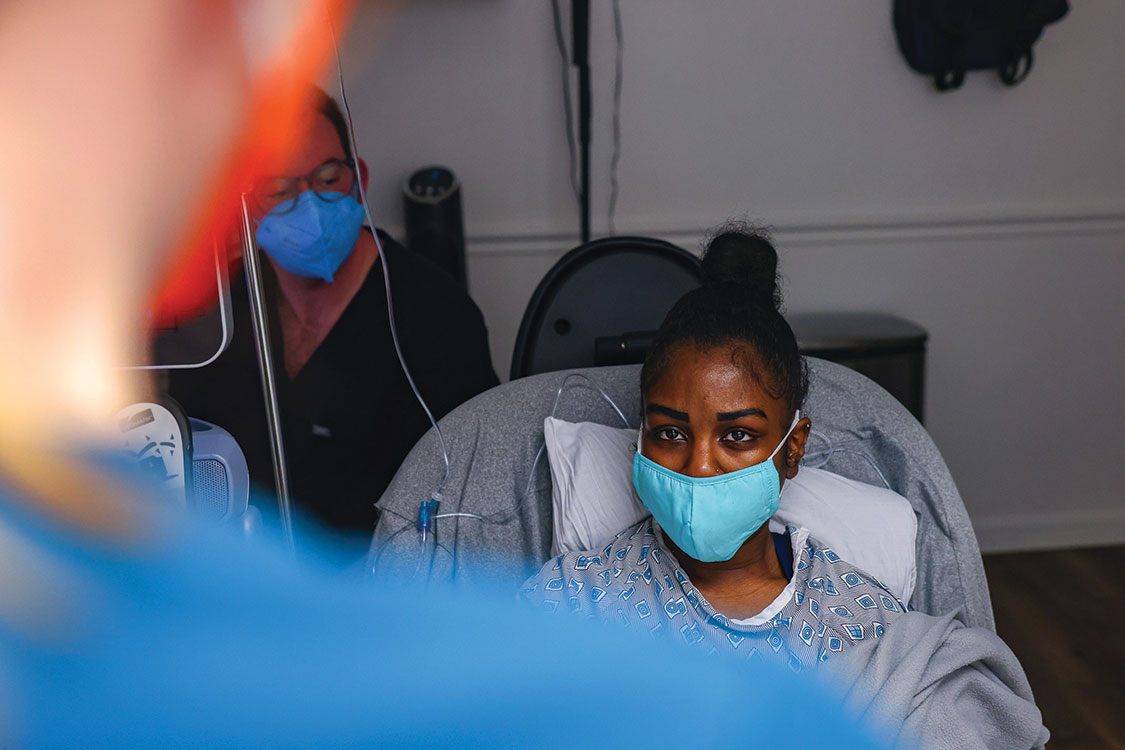
Ayana, 28 years old and 28 weeks pregnant, eases herself onto the procedure table at Partners in Abortion Care in College Park, Maryland. She is a Black woman with the tiny bearing and erect posture of a bird. Above her head, a flock of pink and blue butterflies decorates the ceiling. In a few minutes, a doctor will perform an injection to the fetal heart to end her pregnancy.
Ayana had spent months in turmoil over this abortion. As she chased after her two older kids while lugging her 1-year-old on family outings to the arcade and the movies, she tried to imagine hauling two car seats instead of one. While she changed her baby’s diapers, she thought about what a newborn would subtract from him. The family was already stretched thin. Her boyfriend worked for a moving company. Ayana cared for her baby in the mornings, then handed him off to her sister to go to work. She juggled two jobs, teaching kids with autism during the week and answering the phones at a pizza place on weekends. Her oldest son was oblivious to her pregnancy as he raced around playing basketball and video games. But her daughter seemed to sense that her mother was struggling. At 5, she was already trying to cook and change her baby brother’s diapers. When she noticed her mother’s belly growing, she chided her, “We don’t need any more babies.”
Ayana, who had grown up as the oldest of three, knew the pressure another baby would put on her kids. She waited months for a sign; in the end, the sign was her three kids. And now that she’s made her choice, she radiates a sense of unflappable calm. “I just had to realize that I wasn’t ready,” she told me.
The care she is about to receive has been maligned and lied about from the national political stage. Later abortion is banned in all but nine states and Washington, DC, and performed in only a handful of clinics nationwide. It has divided the pro-choice movement, leading to bitter struggles and the resignations of high-profile leaders. Most of the widely celebrated abortion-rights ballot initiatives floated in a record number of states since 2022, when the Supreme Court overturned the national right to abortion in Dobbs v. Jackson Women’s Health Organization, have allowed states to ban it.
Democrats love to avoid it, and Republicans love to lie about it. Even among pro-choice voters, abortions that take place when the fetus looks less like a blob of tissue and more like a baby stir the kind of complex feelings that our political discourse seldom accommodates. As a result, later abortion has never had the widespread support that earlier abortion receives. And under the Trump administration, this care could get harder to provide and receive. Health and Human Services Secretary Robert F. Kennedy Jr. noted during his confirmation hearing in January that the administration wanted to end later abortions, signaling the possibility that Trump might pressure Congress to pass a ban on them or even attempt to do so himself through an executive order. More likely, the administration could restrict medication abortion, disrupting access to earlier abortions and driving up the need for later procedures.
Since Dobbs, abortion bans have already pushed some patients further into pregnancy. And even as clinics in many states have closed, there has been a rise in the number of places advertising later care. After third-trimester-abortion provider George Tiller’s assassination in a Kansas church in 2009, just four providers continued the work he once did, according to the 2013 documentary After Tiller. Today, a new generation of abortion providers has stepped into the breach. In the fall of 2022, the doctor-midwife duo Diane Horvath and Morgan Nuzzo opened Partners in Abortion Care. It’s one of the few clinics in the country that offers abortions to anyone up to 34 weeks; other clinics offer care that late at the discretion of the physician. Horvath estimates there are now at least 15 doctors at a handful of clinics in the United States offering third-trimester abortions, and more who are doing so in hospitals.
For Horvath and like-minded advocates, defending this procedure is a bright line for a movement that has lost Roe and must now build a new, more ambitious framework. Their clarity in fighting for the procedure stems from research showing that later-abortion patients are among the most vulnerable people in the country—disproportionately young, low-income, and people of color.
“These are often children; these are people in poverty; these are people with very few resources; these are people who use drugs,” Horvath told me. “If we’re willing to throw the most vulnerable people under the bus as a movement, then what the hell is our movement doing?”
In early March, I spent three days with Horvath and her team at Partners, setting out to demystify this much-maligned procedure. I emerged with a greater sympathy for the argument Horvath and activists like her have been shouting for years: that we are destined to repeat the mistakes that led to Roe’s fall if we cannot find a way to defend these most demonized of abortions.
After Trump’s Supreme Court appointments allowed the high court to overturn Roe in June 2022, Republicans facing an outraged public were left with just one viable talking point: attacking later abortion. By claiming that Democrats supported “abortion in the ninth month” and wanted to “execute” babies after birth, as Trump did on the debate stage in September 2024, Republicans sought to distract from the fact they had just overturned 50 years of precedent. Their goal was to make Democrats look like the extreme ones.
The Nation Weekly
No state allows doctors to “execute” a baby after birth. But a small number of people do seek abortions in the seventh or eighth month of pregnancy. While abortions at or after 21 weeks represent less than 1 percent of all abortions, Democrats responding to the GOP talking point seemed more comfortable denying that they happened at all.
“Nowhere in America is a woman carrying a pregnancy to term and asking for an abortion,” Kamala Harris shot back at Trump during the debate.
The Democratic-allied strategists who shaped the slew of abortion ballot initiatives after Dobbs followed a similar playbook, guided by polling that has long shown that support for abortion declines as pregnancy advances. From Ohio to Arizona to Florida, advocates and consultants crafted language that reinstituted Roe—which allowed states to ban abortion after viability, the point in pregnancy when a fetus can theoretically survive outside the womb, around 24 weeks.
The stakes were high in Missouri in June 2022, when it became the first state in the country to ban abortion after Dobbs. The greatest hope of restoring access was a ballot initiative to enshrine abortion in the state Constitution. Internal polling obtained by The Nation showed that strategists considered a version allowing the state to ban abortion after viability and a version that allowed no gestational limit. The more restrictive version did “marginally” better, by two to four percentage points, thanks to “older and GOP voters,” the pollsters noted, while those most likely to need an abortion—younger people and people of color—were more likely to support the measure with no gestational limit. In the end, as had happened elsewhere in the country, the strategists proceeded with the version that allowed a ban after viability, with an exception to save the patient’s life or to protect their physical or mental health. The policy “met Missourians where they are” and had the “legal teeth” to be effective in the state’s hostile judicial environment, said Mallory Schwarz, the executive director of Abortion Action Missouri, which supported the measure. She told me that some of her base voters had expressed concern about “abortion up until the moment of birth,” showing that even pro-choice voters had internalized this anti-abortion myth.
But Colleen McNicholas, the chief medical officer at Planned Parenthood’s St. Louis affiliate, disagreed with this approach. She thought public outrage over Dobbs presented a golden opportunity to reach beyond Roe and protect access for all Missourians. “It just felt like a really unique opportunity to live our values and the things we put on T-shirts and billboards,” she told me.
When McNicholas refused to sign on to her affiliate’s endorsement of the ballot initiative, her critics sent reporters lengthy anonymous e-mails accusing McNicholas of undermining the campaign. This backlash contributed to her decision to leave Planned Parenthood in January.
“It told me that having courageous conversations about the impact of policies…was dangerous,” McNicholas said. “I have risked far too much, and care way too deeply about the work, to have to worry if those that I should be working with and protected by [are] wishing me harm.”
On Election Day in November 2024, the initiative passed by three percentage points. After months of legal fighting, a few clinics resumed limited services, but many Missourians are still traveling out of state because of various issues, including a lack of providers.
A 29-year-old with light skin and dark hair walks down the hall at Partners, sobbing. She flew here from California, one of the 22 states in the country that ban abortion at or around “viability.” In 2022, 67 percent of California voters backed a referendum that blocks the state from interfering in a patient’s pregnancy decisions, but a state law banning most abortions after viability still stands.
So the patient in the hallway faced a grueling journey from one of the nation’s bluest states. First she had to raise close to $20,000 to pay for the abortion itself. At least 90 percent of Partners’ uninsured patients cobble this funding together from abortion funds and clinic discounts. Yet by the time she made her decision, raised the money, and flew to Maryland, an ultrasound had put her well past Partners’ limit. (Another clinic in Maryland, CARE in Bethesda, will see some patients up to 35 weeks and six days, but it seemed highly unlikely that this patient, at 35 weeks and five days, could be seen there in time.)
It was too late. She was going to have a baby.
Though this happens about once a week, it hits the staff like a brick every time. A hush sets over the nurses’ station.
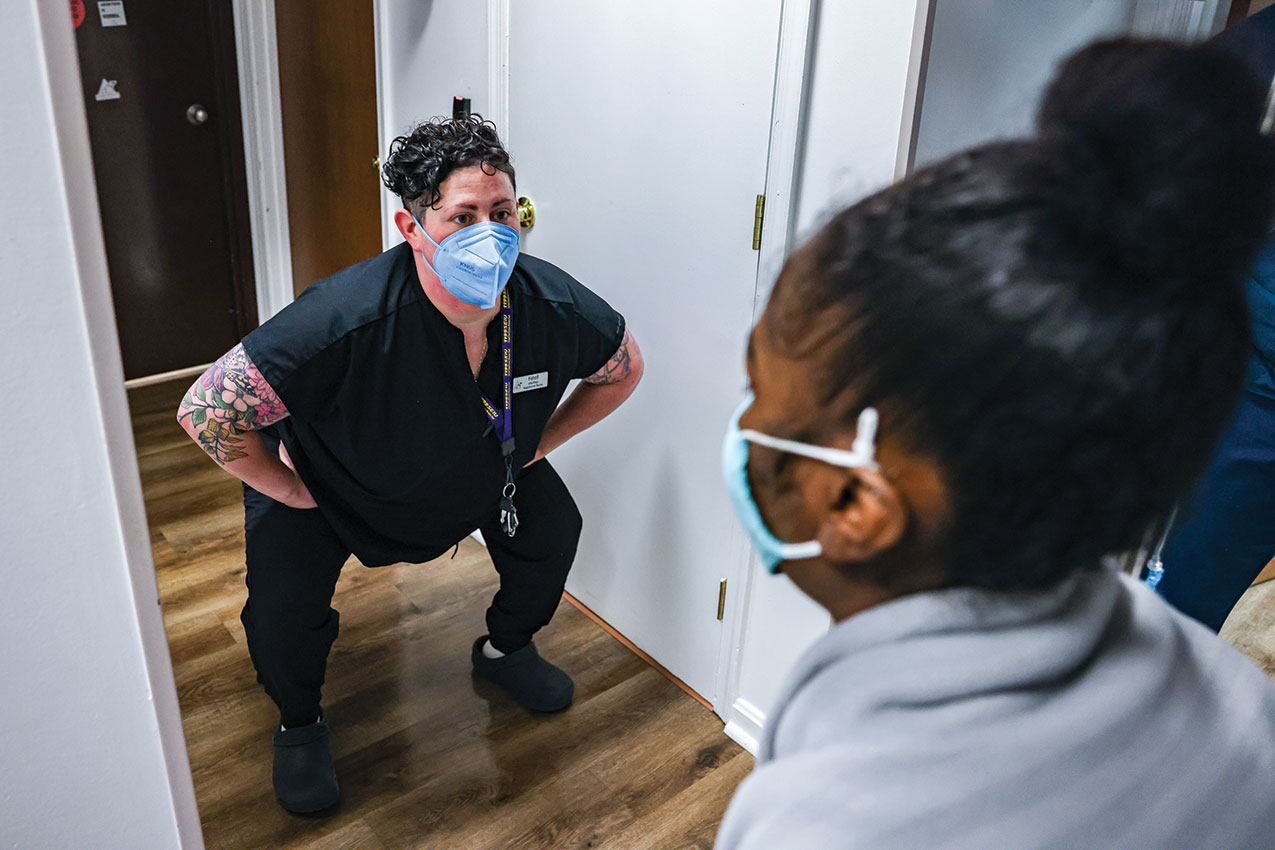
“It definitely is challenging to have to tell someone no, especially when you know you’re the end of the line,” said Jenni Villavicencio, the doctor on duty that week. Clinic co-owner Diane Horvath stands nearby, recalling how terrified she felt when her daughter was born. Sara Fatell, a nurse with short curly hair and a knack for lightening the mood, chimes in with a memory from the trenches of newbornhood: One day, her sleep-deprived wife noticed that their baby had a rash and wailed, “We have to be in charge of its skin, too?”
No one here takes forced pregnancy lightly. The Turnaway Study, a major analysis of women who were denied abortions for being too far along, found that such patients were more likely to wind up trapped in poverty and abusive relationships. The staff will give the women references for sympathetic adoption agencies. But just 9 percent of the study’s subjects who had been turned away wound up placing their babies for adoption. Those who surrendered infants for adoption faced higher levels of regret and negative feelings about their pregnancy than those who parented or had abortions. “In fact, of the three groups, the relinquishing mothers…were far more likely than those who parented to wish that they still could have had their abortion,” adoption researcher Gretchen Sisson wrote in her book Relinquished.
Ayana, the 28-weeks-pregnant patient, enrolled in a military academy when she was 15, eager to take the fastest route out of high school in Washington, DC. She trained for the Air Force and learned to fly. The first time she steered a plane into the air, it was terrifying to watch the water stretch out below her. But once she got the hang of it, it was fun. During her training, she met a man she thought of as her best friend—until he confessed his feelings for her, and they began dating. When he told her he didn’t want her to leave for the Air Force, she stopped flying. Now the couple have three children and work three jobs combined to support them.
Research from the University of California, San Francisco, shows that people seek abortions after 24 weeks for one of two reasons: They receive new information—such as finding out late that they’re pregnant or learning that their health is at risk or the fetus has a serious anomaly—or they face barriers, like the out-of-pocket costs of abortion. One person in the study didn’t know she was pregnant until 26 weeks because a chronic medical condition masked her pregnancy symptoms. Another found out at 29 weeks that her fetus’s brain was not developing—a diagnosis that was not possible earlier.
In Ayana’s case, the barrier she faced was her own ambivalence, as she agonized over what a fourth child would mean for her future and family. Her case is not especially common; while 37 percent of women in the Turnaway Study reported that taking the time to decide whether to have an abortion slowed them down, the time needed was often days, not months. The study found no significant difference in the amount of time that patients in early or later pregnancy took to make up their minds.
If she had lived almost anywhere else in the country, it might have been too late. But Ayana lives in an area that’s home to three third-trimester clinics, in a state where Medicaid covers abortion. Partners accepts Medicaid because it wants to serve low-income patients, but it has chalked up a huge loss and struggled to keep its doors open as a result. The state reimbursement rate for an abortion like Ayana’s is $1,600; the cost to the clinic for her care exceeds $10,000.
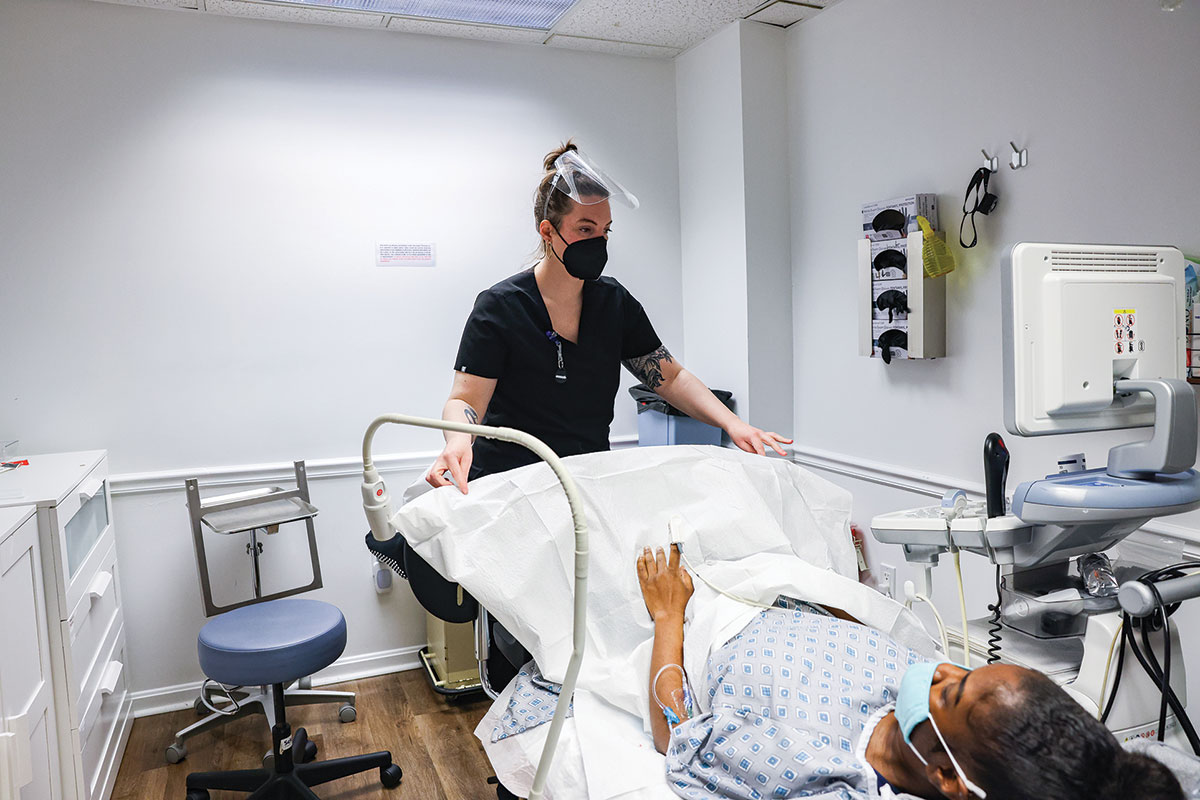
In the procedure room, Dr. Villavicencio sits at Ayana’s feet and looks her in the eye. Almost six feet tall with tattoos on both arms, a brown ponytail, and a gold ring in her nose, Villavicencio tries not to loom over her patients. She arrived here after her own unexpected journey: A first-generation Latina who was raised Catholic, she was a staunch anti-abortion activist until her early 20s, when the complex life experiences of her patients made her realize that abortion was necessary.
“We’re going to clean your belly off, and then I’m going to do the procedure,” Villavicencio says. “Do you want to know details about it?”
“Yes,” Ayana replies. She’s been channeling her anxiety into research, watching videos about later abortion on YouTube. She declines the sheet they usually suspend from the ceiling to prevent patients from seeing the injection.
Despite Republicans’ claims that later abortion involves ripping live babies apart, an injection is the standard first step at this stage to end the pregnancy. After the shot, the fetus no longer has a heartbeat. Opening the cervix to prepare for removal of the pregnancy takes another day or two.
“We place the needle where we need to go in the pregnancy, and we inject a medication that will stop the heartbeat of the fetus,” Villavicencio explains. They’ll numb her skin first, which might burn a little.
“I’m ready,” Ayana says.
At Ayana’s request, Partners co-owner Morgan Nuzzo puts on music. Mellow R&B plays through a speaker on the wall, and Ayana pulls her leggings down to expose her round belly. She closes her eyes and squeezes a purple ball that Nuzzo hands her, as Villavicencio sticks a long needle into her abdomen.
“You’re doing fantastic,” Villavicencio says. “Everything’s going exactly as we expected it to.”
A single tear wells in Ayana’s eye. Even as she guides the needle, Villavicencio notices; she tries not to leave her patients alone in these moments.
“Is that just like a random tear, or are you having some emotions?” she asks.
“A little emotion,” Ayana says quietly.
“Whatever you need to feel, you feel.”
The music is soothing. The room is quiet.
“It is relaxing, though,” Ayana says as they finish pushing lidocaine through the syringe. Moments later, Villavicencio confirms on the ultrasound that the heart has stopped.
“Do you want to talk about any of the emotions that you were having?” she asks, when they’re sitting at eye level again.
“I just got a little emotional once it started moving,” Ayana says softly.
“Understandable,” Villavicencio replies, reassuring her that the procedure doesn’t cause the fetus any pain or discomfort.
That is an abortion at 28 weeks.
For Republicans, it’s a coveted talking point. For Democrats, it’s a liability. For Ayana, it’s a chance to be the mom she wants to be.
If hearing the details of a later abortion makes you uncomfortable, you’re not alone. But a new crop of polling shows that while support for abortion has historically dropped when the procedure is done later in pregnancy, that may be changing in the wake of Dobbs, as people become more hostile to government intrusion at any stage of pregnancy. In a recent poll, 66 percent of respondents said the decision to have an abortion in the last three months should be between a person and their doctor.
Later-abortion advocate Erika Christensen had an abortion at 32 weeks, when she learned that her fetus would not be able to breathe outside the womb; she traveled from New York to Colorado for care. Since then, she’s had innumerable conversations with people who feel uncomfortable about abortions like hers—but who still don’t think they should be banned. For her, that level of acceptance is enough.
“I had an abortion in the third trimester; I don’t expect every American to have the same understanding that I do,” Christensen, a cofounder of Patient Forward, said. “However, I do believe that I am in line with most Americans when we agree that we do not want the state to punish people for having them.”
People are routinely punished for pregnancy outcomes in this country already. In the year after Dobbs, Pregnancy Justice reported a record 210 prosecutions for conduct associated with pregnancy, loss, or birth. Most of these cases happened in Alabama, Oklahoma, or South Carolina, where courts “have expansively interpreted the personhood of viable fetuses,” according to a new report from Pregnancy Justice on how viability leads to criminalization. In Ohio, a Black woman named Brittany Watts was arrested for miscarrying in her bathroom. While she had been told her fetus was not viable, Ohio law defines viability based on gestational age.
“It didn’t matter if she was having a miscarriage; it only mattered that this fetus was a size and age where it could, in some universe, survive,” said Karen Thompson, the legal director of Pregnancy Justice.
The month after Watts’s arrest, Ohioans passed a ballot initiative that enshrines the legal right to abortion in the state Constitution but allows the state to continue banning it after viability except to save the patient’s life or health.
“Viability,” though, is a slippery target, one that changes depending on each pregnancy. As Shelley Sella, a retired third-trimester-abortion doctor, writes in her new book Beyond Limits, a pregnancy can become nonviable because a patient doesn’t have the resources to support it. Sella trained under Dr. George Tiller and was the first woman doctor in the country to openly provide third-trimester abortions.
“Whether a pregnancy is viable—as defined by the mother—is the issue for every abortion,” Sella writes. In a sense, this definition harks back to the 1800s, when abortion was legal until “quickening,” the point when a pregnant person could feel the fetus move—a doctrine that relied on the judgment of women, not doctors. Male doctors who were seeking to assert their professional superiority over lay midwives succeeded in advancing laws that banned abortion in every state by 1910. Those laws were all nullified in 1973 by Roe, which protected abortion until “viability,” a threshold determined by doctors.
Sella’s definition would put the ability to determine viability back in the patient’s hands, demanding a level of trust in pregnant people that has never been part of our modern healthcare system—much less our abortion politics.
For Sella, defending later abortions requires a new paradigm of trust that—if the movement and the public can embrace it—will make us better able to defend all abortion. “If we can open our hearts to the most desperate among us, we can understand all who seek to have an abortion,” she writes.
This radical trust in pregnant people may not exist yet in our politics—but it does exist in clinics like Partners. Sella’s framework helped me navigate a personal tension I felt as I walked the hallways there. I happened to be nine weeks pregnant at the time. My embryo, the size of a grape, already had a nickname; my husband and I called it “the little cocoa bean.” While I dutifully took my vitamins and surreptitiously rubbed a belly bump that only I could see, I watched women end pregnancies much farther along than mine.
Thanks to Sella’s framework, I felt better equipped to embrace this contrast. I had become pregnant on purpose at the right time for my family; my pregnancy was viable.
Scarlet’s pregnancy, while far more advanced, was not.
Scarlet (a pseudonym) is a young black mother in a gray sweatsuit, with straight hair that frames her face. “I don’t want to see,” she tells Dr. Villavicencio, opting for the sheet between her face and belly that shields her from watching the injection.
Scarlet traveled from a state that does not have any clinics that offer care as late as she needed it.
She found out she was pregnant at 16 weeks. It took her time to get out of denial, reach a decision, and raise the $12,000 she needed for this abortion.
Learning that the fetus was a girl terrified her because of her own history of abuse. Already she was hypervigilant about leaving her baby alone with relatives.
Her baby was the reason she decided her pregnancy wasn’t viable.
In the exam room at Partners, Scarlet is talking about her baby and how they like to do puzzles together when Villavicencio performs the injection to end her pregnancy. Scarlet is not as far along as Ayana, so her procedure takes just two days. After the injection, Villavicencio inserts dilators that will expand in her cervix overnight. As Villavicencio prepares for the procedure, Scarlet talks about her guilt over the fact that this is her second abortion. She’s been reading her Bible, she adds.
“Is it OK if I tell you what I think?” Villavicencio asks. When Scarlet says yes, Villavicencio channels the language of her Catholic upbringing. “Any God I believe in knows your heart and knows you’re a good mom,” she says. A right decision can be a hard decision, she adds.
Lee McKeever, a nurse practitioner, helps Scarlet take deep breaths as Villavicencio inserts rods that look like dark matchsticks into her cervix.
“We can all tell,” Villavicencio says soothingly, “what a good mom you are.”
It was Villavicencio’s patients who changed her anti-abortion views. Watching people navigate the medical and emotional complexities of pregnancy, she realized that their choices did not fit into the black-and-white logic she’d been raised with. She came to see her patients as the experts in their own lives.
Over time, her relationship to her Catholic faith evolved; on her shoulder she has a tattoo of her interpretation of the Garden of Eden, with the forbidden fruit depicted as a papaya—the fruit used to train people in abortion techniques.
“Eve had all the knowledge,” she tells me.
In 2020, Villavicencio became a leading spokesperson for the American College of Obstetricians and Gynecologists (ACOG), the main professional organization for ob-gyns. She was charged with representing in the press the policies that set the gold standard for the profession. These included a 2022 policy she helped craft that omitted ACOG’s previous opposition to most post-viability abortions and that strongly opposed “any effort that impedes access to abortion care and interferes in the relationship between a person and their healthcare professional.”
Then a ban on abortion after six weeks took effect in Ohio, and doctors in the state rallied behind a ballot initiative to repeal it. Like most initiatives, this one would allow the state to continue banning abortion after fetal viability. The Ohio section of ACOG endorsed the initiative, calling the viability limit “reasonable.” Local sections are supposed to comply with ACOG’s national positions, but officials voted to allow the endorsement in a closed-door meeting. Incensed, Villavicencio denounced the decision, only to be told she was hurting the movement by speaking out.
“Which is really upsetting,” she told me in the break room when she was between patients, “given that I’m one of the few people who actually does this care and takes care of the patients that are left behind.”
The vitriol she faced from her peers was the final straw in her decision to resign from her position as a spokesperson for ACOG and found her own advocacy group, Raven Lab, with Colleen McNicholas.
“What’s become clear to me is that our own movement is very uncomfortable with later abortion, and that we have a lot of work to do before we can claim that we are truly justice-based,” Villavicencio told me.
The next morning, Scarlet arrives for her procedure and confesses that she had carrot cake for breakfast. “At least it has vegetables in it,” jokes Lee McKeever, the nurse practitioner. A diffuser on a desk emits the scent of lavender. McKeever gives Scarlet medication to block pain and put her in a semi-sedated state. Then Villavicencio uses a series of metal dilators to open her cervix. McKeever leans over Scarlet’s shoulder and, with the quiet voice of a yoga instructor, tells her that the procedure is underway and that she’s safe.
“Breathe in slowly with the waves,” Allison, a patient care technician, tells Scarlet, playing the sound of ocean waves over the speaker. “Breathe those waves out.”
Twenty-five minutes later, the procedure is finished, and Villavicencio massages Scarlet’s uterus to stop the bleeding—a common practice in postpartum care. A few hours later, Scarlet looks alert as she listens to her discharge instructions. She tells me she can’t wait to get home to her baby.
“I’m OK now,” she says. “I’m still going to think about it, of course, but I’m OK.”
Ayana arrives for the third and final day of her procedure.
“You can do this, OK? You’re superstrong,” Villavicencio says as she removes the dilators that were inserted the day before. She uses an instrument to break Ayana’s water and then injects pain medicine into her cervix.
“I’m fine,” Ayana tells the staff as she sits up on the procedure table afterward. “This is way better than the hospital.”
She spent the previous afternoon at the mall buying shoes for her kids: sparkly light-up ones for her daughter and Nikes for her son. Now she sips cranberry juice and chews ice in a darkened recovery room, waiting for the contractions to intensify. As her labor progresses, she paces the hallway. Nurse Sara Fatell leads her through a series of hip thrusts and squats, and Villavicencio and the clinic manager, Alliah, join in. The clinic starts to look like an aerobics class, but it does the trick.
They bring Ayana to the exam room and give her sedating medication. All she will remember later is lying down and falling asleep. But the staff talk to her like she is awake, as Villavicencio uses instruments to remove the fetus and placenta. A technician makes footprints of the fetus for Ayana to take home, as she requested.
“I just feel like I took a great nap,” Ayana says when she wakes up. A nurse hands her a pink envelope with the footprints and tells her she can go back to work tomorrow.
Ayana looks and sounds like she has just been relieved of a heavy weight. Sella says in her book that she often saw patients experience this exact transformation after they ended unwanted pregnancies. “There is an openness to their faces I hadn’t seen before,” Sella writes. “Their personalities shine through, and they are glowing. It makes sense. They have been relieved of a huge physical and emotional burden, and it shows.”
“Thank you so much for all your help,” Ayana tells the staff before she leaves. Her boyfriend is on his way to pick her up, with all three kids in the car. With a new lightness, she walks out into the lobby, and back to her life.
Editor’s Note: This piece has been updated to reflect that after publication, The Nation learned of an additional clinic that has begun publicly offering care up to 34 weeks to anyone who is medically suitable for outpatient care. For current information on clinics, see the Later Abortion Initiative at Ibis, AbortionFinder.org, and INeedAnA.com.

No comments:
Post a Comment