Attack of the Sadistic Zombies
and
~~ recommended by newestbeginning ~~
Attack of the Sadistic Zombies
Republicans in Congress, taking their marching orders from Donald Trump, are on track to enact a hugely regressive budget — big tax giveaways to the wealthy combined with cruel cuts in programs that serve lower-income Americans. True, the legislation suffered a setback last week, initially failing to make it out of committee. But that was largely because some right-wing Republicans didn’t think the benefit cuts were vicious enough.
OK, news at 11. Isn’t this what Republicans always do? But this reconciliation bill — that is, legislation structured in such a way that it can’t be filibustered and may well pass with no Democratic votes — is different in both degree and kind from what we’ve seen before: Its cruelty is exceptional even by recent right-wing standards. Furthermore, the way that cruelty will be implemented is notable for its reliance on claims we know aren’t true and policies we know won’t work — what some of us call zombie ideas.
And it’s hard to avoid the sense that the counterproductive viciousness is actually the point. Think of what we’re seeing as the attack of the sadistic zombies.
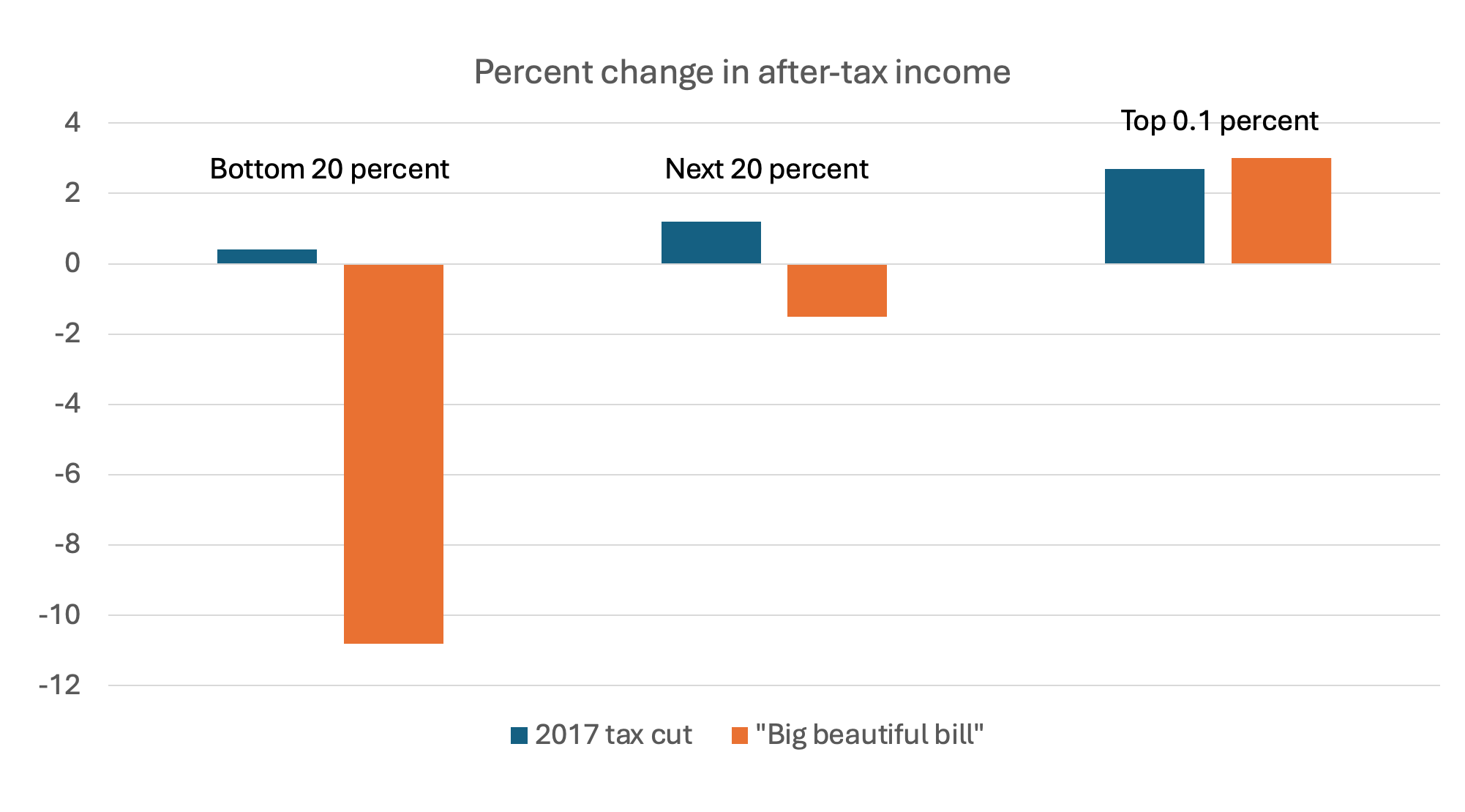
To get a sense of how extreme this legislation is, do a side-by-side comparison of the impact on different groups of Americans between this bill and Trump’s one major legislative achievement during his first term, the 2017 Tax Cuts and Jobs Act. It looks like this:
Source: Tax Policy Center and Penn-Wharton Budget Model
Source: Tax Policy Center and Penn-Wharton Budget Model
The TCJA, like the current legislation, gave big tax breaks to the wealthiest Americans. But it also threw a few crumbs to people further down the scale. By contrast, the House Reconciliation Bill, by slashing benefits — especially Medicaid — will cause immense, almost inconceivable hardship to the bottom 40 percent of Americans, especially the poorest fifth.
Medicaid, in case anyone needs reminding, is the national health insurance program for low-income Americans who probably don’t have any other way to pay for medical care. In 2023 Medicaid covered 69 million Americans, far more than Medicare (which covers seniors), including 39 percent of children.
Providing health care to children, by the way, isn’t just about social justice and basic decency. It’s also good economics: Children who receive adequate care grow up to be more productive adults. Among other things they end up paying more taxes, so Medicaid for children almost surely pays for itself.
And although Republican legislation apparently won’t explicitly target childrens’ care, it will impose paperwork requirements that will cause both children and their parents to lose coverage.
Back to the comparison with the TCJA. It's true that 2017 would have looked considerably worse in this comparison if Trump had also succeeded in his attempt to destroy the Affordable Care Act, depriving millions of Americans of health insurance coverage. But he didn’t. This time the assault on health care and the tax cuts for the 0.1 percent are part of the same legislation — a “big, beautiful bill,” as Trump calls it. And after some adjustments to make the bill even nastier, it’s likely to pass.
Wait, it gets worse. One of the ways Republicans will try to slash Medicaid is by requiring that adult Medicaid recipients be gainfully employed — or, more accurately, that they demonstrate to the satisfaction of government bureaucrats that they are gainfully employed, which is not at all the same thing.
The belief that many Americans receiving government support are malingering, that they could and should be working but are choosing to be lazy, is a classic zombie idea. That is, like the claim that cutting taxes on the rich will unleash an economic miracle, it’s a doctrine that should be long dead. It has, after all, been proved wrong by experience again and again.
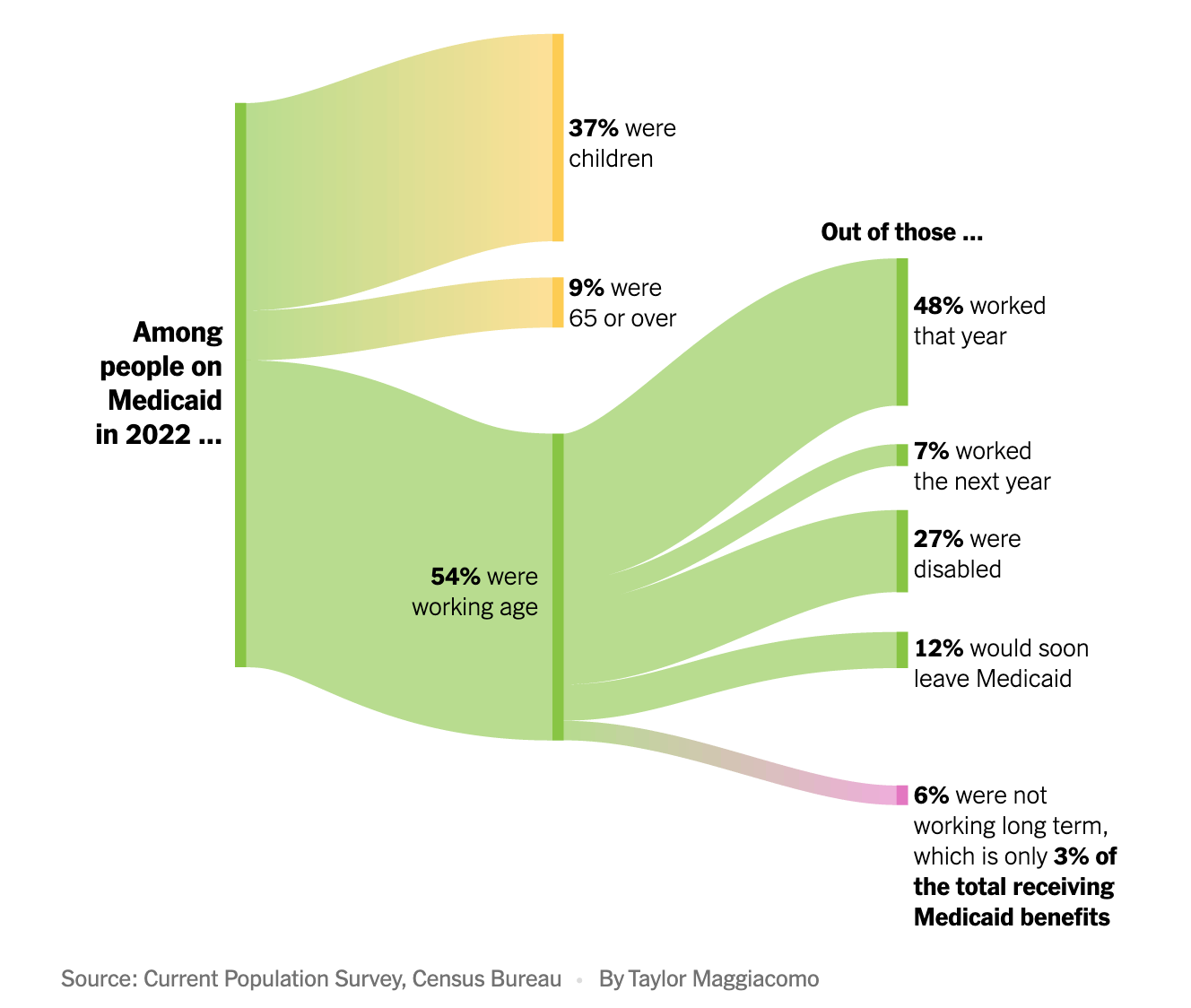
But right-wingers simply refuse to accept the reality that almost everyone on Medicaid is either a child, a senior, disabled or between jobs. A recent article in the Times by Matt Bruenig had a very illuminating chart:
Only 3 percent of Medicaid recipients were non-disabled working-age adults
Only 3 percent of Medicaid recipients were non-disabled working-age adults persistently not working — the kind of people right-wingers imagine infest the program. And it’s a good bet that a fair number of these people had extenuating circumstances of some kind.
So what do work requirements actually accomplish? They don’t get lazy people to work. What they do, instead, is take away benefits from people who are legally entitled to aid, because they can’t overcome the paperwork and administrative barriers. Think about it: Low-income adults, even when working, are often employed as day laborers or in other informal ways that don’t generate the right forms. They may lack the formal education to deal with complex reporting requirements. So the people who need help most are unjustly cut off.
Why, then, are Republicans doing this? Part of the answer is to save money: By making the poor even poorer they reduce the extent to which tax cuts for the rich explode the budget deficit.
But I’m actually skeptical that this is the whole story, or even most of it. If you pay attention to what right-wing Republicans do, as opposed to what they say, it becomes obvious that they don’t really care about budget deficits. Oh, they do a lot of posturing, issuing dire warnings about debt and pretending to be deficit hawks. But can you think of a single example in which the U.S. right has been willing to give up something it wants, such as tax cuts for the rich, in order to reduce the deficit?
As I see it, right-wingers’ rhetoric about the budget deficit is a lot like their rhetoric about antisemitism. It’s not something they actually care about. It’s just a club they can use to bash their opponents.
But in that case, why the cruelty toward less-fortunate Americans? Well, as I see it the cruelty, as opposed to the dollars saved, is actually the point. Inflicting harm on the vulnerable isn’t something they do with regret, it’s something they do with a sense of satisfaction.
OK, I’ll probably get a lot of grief for saying that — but maybe not as much grief as I would have gotten a few months ago. For does anyone doubt that the people now running America are bullies completely lacking in any kind of compassion?
And why do bullies beat up people who can’t defend themselves? Because they can.
MUSICAL CODA Grim stuff, so here’s a palate cleanser
xxxxxxxxxxxxxxxxxxxxxxxxxxxxxxxxxxxxxx
How Trump Will Make the Tariff Shock Worse
Beware the three Ds: denial, dirigisme and deception
|

| |||||||||||||||


In the fall of 1979, as I was just beginning my teaching career at MIT, I went to an economics conference in Vermont. I made the trip in a state of high anxiety — not because I was worried about my presentation, but because I was driving. And it wasn’t at all clear whether I’d be able to find gas for the return trip.
For those were the days of fuel shortages and gas lines, with drivers sometimes waiting hours for the opportunity to refill their tanks.
What happened in 1979 was that the United States faced an inflationary shock: soaring oil prices in the aftermath of the Iranian revolution. That was a bad thing for American consumers. But the experience was made much worse by botched policy. Rather than simply accept higher prices at the pump, the U.S. government imposed a gasoline price ceiling. And as often happens when the government tries to control prices, the result was shortages and a lot of disruption.
Obligatory disclaimer: Price controls, or more generally government pressure on companies to keep prices down, aren’t always a bad thing. Back in 1962, when John F. Kennedy pressured the steel industry to roll back a coordinated price increase, his actions made sense: Steel companies weren’t responding to higher costs, they were collaborating to take advantage of monopoly power.
But trying to simply order businesses not to pass on a genuine cost shock is asking for trouble. Which brings us, as most things seem to these days, to Donald Trump.
Right now U.S. business is facing a large cost shock created by Trump himself. Even after the partial climbdown last weekend, the average U.S. tariff rate stands at 17.8 percent, up 15 points from its pre-Trump level. Since imports of goods are more than 11 percent of GDP, that’s a big shock to consumer prices. And no, foreigners won’t pay the tariffs.
Now, an inflationary hit this size is a bad thing. Still, it could be a one-time event, something the economy absorbs before moving on. But for that to happen we’d need an intelligent, responsible policy response.
Hehehe.
What we’re actually going to get are the three Ds: denial, dirigisme and deception.
Denial: Trump has, of course, repeatedly insisted that there is no inflation in America, pronouncing reports of rising prices “fake news.” What’s new is that Scott Bessent, the Treasury secretary — who was, you may remember, supposed to be the adult in the room — has gotten into the act. On Meet the Press Sunday Bessent dismissed inflation concerns by asserting that
Gasoline prices have collapsed under President Trump … that is a direct tax cut for consumers.
Now, in general presidents deserve neither credit nor blame for fluctuations in gasoline prices, which mainly reflect the global price of crude oil. But that aside, what the heck is Bessent talking about? Here’s what has been happening to gas prices:
 |
Source: Gasbuddy.com
I do not think that word “collapsed” means what he thinks it means.
So is Bessent just lying? Or has he joined Trump in his epistemic bubble, where reality is what he wants it to be? I’m not sure which is worse.
Dirigisme: Originally a term from postwar France, it refers to an economy that remains mostly in private hands but in which the government sometimes tries to tell companies what to do. It remains unclear to this day how well dirigisme actually worked or even how much it was real as opposed to officials getting in front of an economic parade that was happening anyway and pretending that they were leading it. What’s true is that dirigisme may not do too much harm when practiced by sophisticated, well-informed technocrats.
What won’t be harmless is when dirigisme is practiced by a president who takes time off from declaring that Taylor Swift is “no longer hot” to issue demands like this:
 |
Now, Walmart, while profitable, can’t actually afford to EAT THE TARIFFS. (Weren’t the Chinese supposed to do that?) So what will Walmart and other companies do if Trump’s tariffs are way up but they’re afraid to risk Trump’s ire by increasing prices?
Hello, empty shelves.
Finally, deception: What will happen when the tariffs start showing up in official measures of inflation, which will happen soon? Erica Groshen, former head of the Bureau of Labor Statistics, is worried. In a recent briefing paper she warned that changes in personnel policy
could lead to the politicization of the federal statistical workforce … for example, Bureau of Labor Statistics’ leaders could be fired for releasing or planning to release jobs or inflation statistics unfavorable to the President’s policy agenda.
So when inflation rises, the Trump administration could simply bully the statistical agencies into claiming that it never happened. You may say that they couldn’t or wouldn’t do such a thing. But so far people downplaying what Trump and co might do have been wrong every time, while the often-mocked alarmists have been consistently right.
The bottom line is that the direct economic consequences of Trump’s tariffs will surely be bad, but his unwillingness to accept the reality of those consequences will probably make them considerably worse.
MUSICAL CODA
This should have gone with yesterday’s post


No comments:
Post a Comment