1). “Trump is UNITING the World Against the US | Prof. Jeffrey Sachs”, Apr 7, 2025, Nima Rostami Alkhorshid, interviews Jeffrey Sachs, Dialogue Works, duration of video 35:45, at < https://www.youtube.com/watch?
2). “BRICS expands with new partner countries. Now it’s half of world population, 41% of global economy: BRICS keeps expanding, adding partner countries in January 2025, after admitting new members in 2024. It now makes up roughly half of the global population and more than 41% of world GDP (PPP). It’s an economic powerhouse, with top producers of key commodities like oil, gas, grains, meat, and minerals”, Dec 25, 2024, Ben Norton, Geopolitical Economy, text and video, duration of video 22:35, at < https://geopoliticaleconomy.
3). “Trump's tariffs are part of a class war on his own base”, Apr 6, 2025, Rhadika Desai & Michael Hudson, Geopolitical Economy Hour, duration of video 55:18, at < https://www.youtube.com/watch?
4). “All The Damage Trump’s Tariffs Are Doing”, Apr 8, 2025, David Cay Johnston, DCReport, at < https://www.dcreport.org/2025/
5). “RAY DALIO: AMERICA'S HIDDEN CIVIL WAR & THE GLOBAL RACE TO DEFEAT CHINA IN TECH, ECONOMICS, ACADEMIA”, Apr 6, 2025, Speech by Ray Dalio, Ray Dalio, duration of audio 29:36 but the last 7:50 will not play, at < https://www.youtube.com/watch?
Introduction by dmorista: The U.S. ruling class, as personified in Donald Trump, has not really begun to understand just how serious the various issues afflicting the U.S. are; and are only dimly aware of the fact that Global Economic, Technological, Scientific, Political, and Military power have shifted away from the U.S. and its G-7 allies to China and its BRICS allies. In Item 1)., “Trump is UNITING ….”, Jeff Sachs points out that while Trump's pronouncements and actions might play well with his base of support in the U.S. those statements and actions don't appeal to most of the world. The changing structure of the world's economic power and its derivatives is discussed by Ben Norton in Item 2)., “BRICS expands with new ….”. He points out that now BRICS countries include over 50% of the World's population and 41% of Global Economic Activity. The U.S. Led G-7 Alliance has about 28% of Global Economic Activity and just under 10% of the global population. The inhabitants of the G-7 countries enjoy higher levels of prosperity and have longer life-spans and other social well being indicators. But many of the BRICS countries are rapidly improving the conditions for their inhabitants.

In Item 3)., “Trump's tariffs are ….”, Desai and Hudson discuss how the highly regressive Trump Tariffs will increase taxes on the bottom 90% of the population and will decrease taxes on the top 10%, particularly for the top 0.01% of the income distribution. In conjunction with the cuts at the IRS and the attempts by Elon Musk's fanatical right-wing operatives to disrupt the IRS; Trump wants to stop collecting income tax and rely entirely on Tariffs for money to operate the Federal Government. In fact Trump and many of his right-wing allies think of the period before 1913 as a golden age when they could operate without paying any taxes.

In an article from DCReport, from David Cay Johnston, in Item 4)., “All The Damage ….”, the author provides some useful background and discussion of the Trump Tariff Regime. Johnston notes that:
“Tariffs are not inherently bad. Used selectively these taxes can be useful economic tools. But Trump has this bizarre and fact-free idea that the country hit with tariffs pays them. It’s a demented, looney concept with zero basis in fact but once Donald gets an idea in his head, I can tell you from knowing him for 37 years, he doesn’t change his opinion. Facts matter, except to Trump. In fact, consumers pay these taxes, which fall most heavily on people down the income ladder.” (Emphasis added)
In Item 5)., “RAY DALIO: AMERICA'S ….”, Dalio discusses, in a speech, the problems the U.S. faces: with its increasing strife, partisanship, censorship and political interference with scientific endeavors. He notes that China has a much longer planning horizon and is making major strides in science and technological advancements.
xxxxxxxxxxxxxxxxxxxxxxxxxxxxxxxxxxxxxxxxxxx
xxxxxxxxxxxxxxxxxxxxxxxxxxxxxxxx
BRICS expands with new partner countries. Now it’s half of world population, 41% of global economy
BRICS keeps expanding, adding partner countries in January 2025, after admitting new members in 2024. It now makes up roughly half of the global population and more than 41% of world GDP (PPP). It’s an economic powerhouse, with top producers of key commodities like oil, gas, grains, meat, and minerals.

By
Update (January 7, 2024):
Indonesia was admitted as a full member of BRICS on January 6, 2025. This was announced just two weeks after Russia had revealed that Indonesia was one of nine countries that were added as BRICS “partners”.
This means that BRICS now has 10 full members, consisting of the following:
- Brazil
- Russia
- India
- China
- South Africa
- Egypt
- Ethiopia
- Indonesia
- Iran
- United Arab Emirates
Joining the 10 BRICS members are eight partner countries that are on the path to full membership. These are:
- Belarus
- Bolivia
- Cuba
- Kazakhstan
- Malaysia
- Thailand
- Uganda
- Uzbekistan
The following is an updated map showing the members and partners of BRICS, as of January 7, 2025:

Original article (December 25, 2024):
BRICS, the Global South-led forum for economic cooperation, continues to grow in influence, as its seeks to de-dollarize and transform the international monetary and financial system.
After admitting four new members in 2024, BRICS officially welcomes nine new nations as partner countries on January 1, 2025. They are:
- Belarus
- Bolivia
- Cuba
- Indonesia
- Kazakhstan
- Malaysia
- Thailand
- Uganda
- Uzbekistan
With its nine members and nine partners, BRICS now makes up roughly half of the global population and more than 41% of world GDP (PPP).
The group is an economic powerhouse, including top producers of key commodities like oil, gas, grains, meat, and minerals.
At the BRICS summit in Kazan, Russia in October 2024, 13 countries were invited to become BRICS partners, meaning they are on the path to full membership in the near future.
Nine of these 13 nations accepted the invitation. The remaining four did not give a formal response as of the end of 2024. These were Algeria, Nigeria, Turkey/Türkiye, Vietnam.
The Russian government, which in December announced the admission of the nine new partners, emphasized that “we expect that in the near future responses will come from” the other four.
BRICS: 9 members and 9 partners
Initially founded in 2009 as BRIC – by Brazil, Russia, India, and China – the organization grew in 2010 with the addition of South Africa.
At the 2023 summit in Johannesburg, South Africa, BRICS expanded again, inviting six more countries: Argentina, Egypt, Ethiopia, Iran, Saudi Arabia, and the United Arab Emirates.
Egypt, Ethiopia, Iran, and the UAE accepted the invitation and officially became BRICS members in January 2024.
Saudi Arabia still had not made a formal decision as of the end of 2024.
Argentina initially agreed to join, when it had a center-left government led by President Alberto Fernández and Vice President Cristina Fernández de Kirchner. However, far-right pro-US leader Javier Milei came to power in December 2023, and he overturned the decision, blocking Argentina from joining BRICS in January 2024.

Representatives of the 9 BRICS members at the 2024 summit in Kazan, Russia
BRICS comprises roughly half of world population
With the addition of the partner states, nine of the 20 most populous countries on Earth are now part of BRICS.
Their combined population is approximately 4 billion, or roughly half of the world population.
India is the most populous country on Earth, followed by China in second. Each country has more than 1.4 billion inhabitants.
With nearly 290,000 citizens, Indonesia is the fourth-most populous nation.
Brazil is the seventh-most populous country, followed by Russia in ninth and Ethiopia in tenth.
Egypt is the 14th-most populous nation; Iran is the 17th; and Thailand is the 20th.
The sixth-most populous nation, Nigeria, was invited to join BRICS as a partner, but did not give a formal answer in 2024.

BRICS makes up 41% of global GDP (PPP)
Together, the nine BRICS members and additional nine BRICS partners represent more than 41% of global GDP (when measured at purchasing power parity).
The original five BRICS members made up 33.76% of world GDP (PPP) in October 2024, according to IMF data.

This means that the five founding BRICS members comprise a larger share of the global economy than the G7, which only represented 29.08% of world GDP (PPP) in 2024.
This is a massive decline from 1990, when the G7 economies made up nearly 52% of world GDP (PPP).

The main reason for this historic shift is the enormous economic growth in China, which has become the world’s only industrial superpower, responsible for 35% of global gross manufacturing production (nearly three times that of the United States).
China overtook the US to become the largest economy on Earth in 2016, according to IMF data.
As of October 2024, China made up 19% of global GDP (PPP), compared to just 15% for the US.

When the four new BRICS members that were admitted in 2024 are added, the share of global GDP comprised by BRICS’ nine members rises to 36.44%.

The addition of nine new partner states increases BRICS’ share of world GDP further, to 41.41% (and this does not include Cuba, as the IMF does not have data on the country’s economy).

US GDP overstates its economic power
While GDP can give a rough approximate of the influence of a country in the global economy, the measurement presents its own series of problems. GDP does not necessarily reflect the productive capacities of a nation; it is important to look at the sectoral composition of GDP.
In the United States for instance, a staggering 21% of GDP comes from the FIRE sector: finance, insurance, and real estate. Another 13% of US GDP consists of professional and business services, from white-collar workers like lawyers and managers. Manufacturing makes up only around 10% of US GDP.

Another 8% of US GDP, as reported by the Bureau of Economic Analysis (BEA), is the imputed rental value of owner-occupied housing, or how much an owner of a house would hypothetically pay to rent a house they own and live in. This is to say, 8% of US GDP does not really exist; it is merely accounting.
Furthermore, approximately 18% of US GDP comes from the health sector. The United States spends roughly twice as much on healthcare as the average advanced economy in the OECD, yet has some of the worst public health results.
Just because a country has more expensive services in a given sector, and thus has a higher GDP, doesn’t mean that its people benefit. The case of the US health system is a clear example of how residents can in fact suffer greatly, despite having impressive GDP statistics.

BRICS: a commodities powerhouse, producing grains, meat, oil, gas, minerals
The people of a country can’t eat their GDP. A more useful assessment of BRICS’ growing economic power can be seen in the productive capacities of the economies that make up the organization.
BRICS members and partners are the world’s leaders in the production of crucial commodities, such as cereals, meat, crude oil, natural gas, and strategic minerals like iron ore, copper, and nickel.
The main primary crops in the world, which represent more than half of global agricultural production, are, respectively, sugar cane, maize (corn), rice, wheat, oil palm fruit, and potatoes, according to the UN Food and Agriculture Organization (FAO).
BRICS countries dominate global production of these primary crops.
Brazil, India, and China make up roughly two-thirds of global production of sugar cane.
China and Brazil represent nearly 30% of global maize (corn) production.
China and India produce over half of the world’s rice.
China, India, and Russia produce more than 40% of the world’s wheat.
Indonesia, Malaysia, and Thailand (all new BRICS partners) comprise almost 90% of global oil palm fruit production.
China and India produce nearly 40% of the world’s potatoes.

BRICS countries likewise produce much of the world’s meat.
China and Brazil make up more than 20% of global chicken production.
China produces more than 40% of the world’s pork.
Brazil and China make up more than 20% of global beef production.

China dominates aquaculture production of seafood, making up nearly 60% of global output. Combined with India and Indonesia, they account for more than 70%.

BRICS countries likewise make up more than half of the world’s production of hen eggs. China alone produces 34%.

BRICS is now an energy powerhouse as well.
China is leading the world’s transition to renewable energy. China is building twice as much solar and wind power capacity as the rest of the world combined.

BRICS countries also play a major role in global production of crude oil.
Five of the world’s top 10 producers of crude oil are in BRICS, including Russia (3rd), China (4th), Iran (7th), the UAE (8th), and Brazil (9th).

BRICS nations are important in the global natural gas industry.
Top natural gas producers in BRICS include Russia (2nd), Iran (3rd), China (8th), the UAE (10th), Indonesia (11th), and Malaysia (15th).
(Venezuela, a major producer of oil and gas, was initially offered BRICS membership, but Brazil vetoed the invitation at the 2024 summit in Russia, which caused an international scandal.)

When it comes to strategic minerals, BRICS is, again, highly influential.
BRICS countries are among the world’s leading producers of iron ore, including Brazil (2nd), China (3rd), India (4th), Russia (5th), South Africa (8th), Kazakhstan (9th), and Iran (10th).
When it comes to global copper production, BRICS members are also very important, including China (3rd), Russia (7th), Indonesia (9th), and Kazakhstan (12th).

The admission of Indonesia as a partner likewise means that the world’s only nickel superpower is now part of BRICS, along with other important nickel producers like Russia (3rd), China (7th), Brazil (8th), and Cuba (9th).

What these statistics demonstrate is that BRICS has become one of the most important organizations on Earth, bringing together nations with massive populations, enormous economies, and incredible productive capacities.
If BRICS countries can successfully coordinate and take collective action, they will change the world.
xxxxxxxxxxxxxxxxxxxxxxxxxxxxxxx
All The Damage Trump’s Tariffs Are Doing

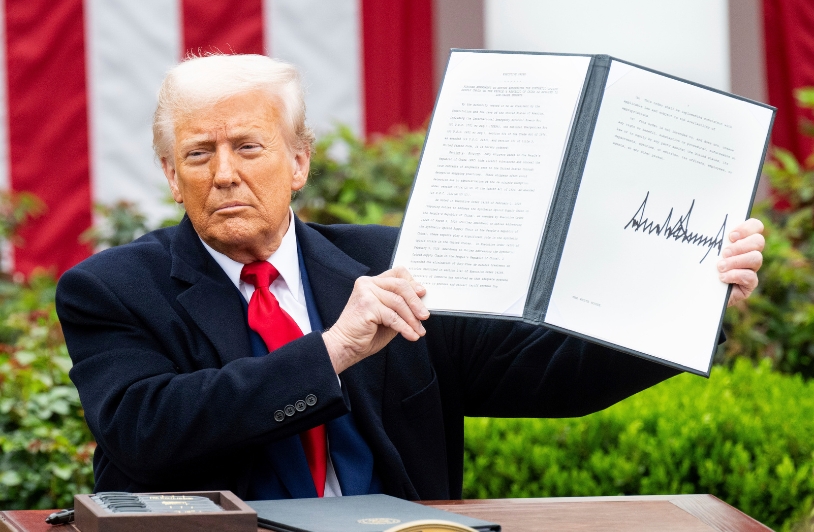
A Decade Ago Trump Went to Great Lengths to Evade U.S. Tariffs
Just how could Donald trump’s so-called Liberation Day tariffs mess up the American and world economies and make us all worse off not just now, but for the long term?
What Donald really wants is submission to his imagined greatness, everything else be damned.
Let me count the ways, or at least a few of them.
- Consumer prices will rise not only for imported goods, but domestic manufacturing products as well. That’s because one of the basic points of tariffs is to give domestic manufacturers the ability to raise prices to just below the competing tariffed good, as I explained here last September.
- The other major global economies could form a free trade zone that excludes the United States. Imagine a trading alliance among the European Union, United Kingdom, Canada, Mexico, Japan, South Korea, Australia, New Zealand, and perhaps China and India. That would spell D-I-S-A-S-T-E-R for most Americans, especially the millions of factory workers whose ranks shrank during Trump’s first term, but grew significantly under Biden.
- Even worse, these countries could also stop using the greenback as the world reserve currency, ending a massive and subtle subsidy to Americans. About 60% of global financial reserves are in dollars.
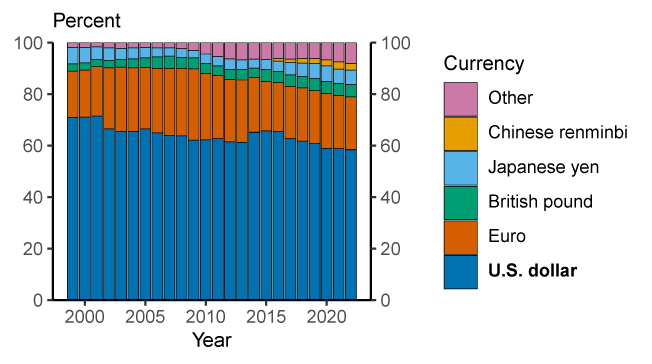
World Reserve Currencies
Credit: International Monetary Fund
- China’s patient but persistent drive to lead trade and economic policy, as well as exert military power, in Asia and Oceana is likely to grow, especially since Trump in his first term withdrew the U.S. from the proposed Trans-Pacific Partnership trading zone (parts of which I criticized here, here, and here as damaging personal liberty, discouraging competitive market capitalism, and expanding corporate power).
- Inflation must worsen. Joe Biden got America’s inflation rate down to 2.9% in December, well below the post-World War II average of 3.65%. When the data comes in for March and April expect inflation to be up.
- The risk of a recession is 45%. Goldman Sachs estimates. On this, Goldman is one of the more optimistic Wall Street firms.
- Countries that allow American military bases — more than 800 are known publicly — could pare back or even expel our military, refuse to dock our Navy ships for refueling or repairs, and even end our positioning of Air Force bomber, fighter, and surveillance aircraft on their soil.
- Countries could stop honoring monopoly patents owned by American companies, a policy shift that could devastate America’s extraordinarily profitable pharmaceutical and digital enterprises.
- Over time other countries could develop their own fiber optic cables crisscrossing the oceans, hampering the gathering of signals intelligence, or SIGINT, which is now easier because most global digital traffic flows through the U.S., and is easily accessed by our allies, especially our Five Eyes partners: Canada, the U.K., Australia, and New Zealand.
- The rest of the world could join China in reducing purchases of American farm products from beef and corn to poultry and soybeans. Trump’s first term caused a massive shift in soybean sales to China. Midwest farmers lost out to Brazil and that business hasn’t come back. Trump covered that over with billions (note that B) in subsidies. During Trump’s first term these subsidies nearly tripled from $11.5 billion to $32 billion.
If you doubt that friends could turn cold or even become hostile consider what Mark Carney, the new Canadian prime minister, said on March 28: “The old relationship we had with the United States based on deepening integration of our economies and tight security and military cooperation is over.”
“FREEDOM OF THE PRESS IS NOT JUST IMPORTANT TO DEMOCRACY, IT IS DEMOCRACY.” – Walter Cronkite. CLICK HERE to donate in support of our free and independent voice.
Tariffs are not inherently bad. Used selectively these taxes can be useful economic tools. But Trump has this bizarre and fact-free idea that the country hit with tariffs pays them. It’s a demented, looney concept with zero basis in fact but once Donald gets an idea in his head, I can tell you from knowing him for 37 years, he doesn’t change his opinion. Facts matter, except to Trump. In fact, consumers pay these taxes, which fall most heavily on people down the income ladder.
Tariffs can be useful tools for developing countries and when hostile foreign governments use stealth subsidies to help their industries sell at below market prices, often called dumping. But as a general tool for a mature economy like ours all tariffs do is create havoc, harm consumers by raising prices, and damage economic growth.
There’s also hypocrisy in Trump’s love of tariffs. A decade ago Trump went to great lengths to evade U.S. tariffs on steel and aluminum he bought from China, my friend Kurt Eichenwald revealed in 2016.
The one thing trump’s tariffs will not do is prompt hundreds of billions of dollars of investment in new factories here in America. That’s because from the idea of a new factory to churning out the first product takes years while Donald flip flops on tariffs and other issues almost by the day. Only a fool would make huge investment decisions based on Trumpian whims.
Now there is one big benefit, for Donald, in his tariff scheme. It’s the ego boost Trump gets from his swinging his tariff cudgel so widely that he hit islands occupied only by penguins or by American and British soldiers. At least 70 countries have indicated they will bend the knee to Donald if that’s what it takes to lowers their tariff rate.
What Donald really wants is submission to his imagined greatness, everything else be damned.
David Cay Johnston co-founded DCReport. He is a best-selling author and investigative journalist who for 13 years reported for The New York Times. Johnston is a specialist in economics and tax issues. He won a 2001 Pulitzer Prize. He is a professor of practice teaching law, public policy, and journalism at Rochester Institute of Technology.
xxxxxxxxxxxxxxxxxxxxxxxxxxxxxxxxxxxxxxxxx

No comments:
Post a Comment