1). “Bro-Natalists Are Ruining America: Elon Musk & JD Vance want you to have more babies”, Apr 22, 2025, Jessica Valenti, Abortion, Every Day, at < https://jessica.substack.com/
2). “Women Are Twice As Likely to Die in Pregnancy in States with Abortion Bans”, Apr 23, 2025, Jessica Valenti, Abortion, Every Day, at < https://jessica.substack.com/
3). “The Mystery of the Declining U.S. Birth Rate”, Feb 15, 2022, Melissa Kearney, Phillip Levine & Luke Pardue, Econofact, at < https://econofact.org/the-
4). “The Trump Team Wants to Boost Birth Rates While Poisoning Children: Sure, they’re contemplating a 'baby bonus.' But they’re also cutting funding for children’s health, reversing PFAS and lead pipe rules, eliminating food safety measures, and attacking vaccines. Call it two sides of the eugenicist coin”, Apr 27, 2025, Liza Featherstone, The New Republic, at < https://newrepublic.com/
5). “Trump Wants A 'Baby Boom' Yet Plans to Cut Essential Childcare Program Head Start”, Apr 25, 2025, Erin Ryan & Alyssa Mastromonaco discuss the Trump Baby Boom proposals & interview Reshma Saujani, founder of Moms First, HYSTERIA, duration of video 49:21, at < https://www.youtube.com/watch?
6). “US birth rates near record low as Trump, Musk talk baby boom”, Apr 23, 2025, Alejandra O’Connell-Domenech, The Hill, at < https://thehill.com/policy/
~~ recommended by dmorista ~~
Introduction by dmorista: The Trump Regime has had numerous meetings and various billionaires and right-wing “Influencers” have met with Trump to discuss ideas to incentivize American Women to have more children. Of course their suggestions were mostly either band-aids that won't begin actually encourage American women to have more babies or were insulting sops to women by the Billionaire & Right-wing Influencers; who actually want to see American women barefoot and pregnant submissively drying the dishes.
A number of suggestions were submitted and some have been publicized and in Item 1)., “Bro-Natalists Are ….”, Valenti lists some of them and discusses their significance:
“Here are just a few of the ideas the Times reports are being tossed around at the White House:
“A 'National Medal of Motherhood' to women with six or more children;
“Reserving 30% of government fellowships for those who are married with children;
“State-funded education programs teaching women and girls about their menstrual cycle, 'so they can better understand when they are ovulating and able to conceive';
“$5,000 cash as a ‘baby bonus’.
“First of all, it’s telling that this administration will do anything other than what families really need. If the Trump administration was actually interested in supporting parents, they’d be pushing for paid parental leave, subsidized childcare, and an end to laws that make it deadly for people to give birth. (Emphasis in original)
“But Republicans don’t care about making the world better, safer, or healthier for American families and children—they just want women to have more babies. What happens after that? They couldn’t care less.” (Emphasis added) In addition the Secretary of Transportation has said he will base infrastructural and repair funding on the birth rate and percentage of married people in the regions that need investment. He has said the funds will be spent in high birthrate / high marriage areas.
Of course none of these largely older white male politicians and business Oligarchs even bothers to acknowledge that, in the wake of the Trump Abortion Bans, pregnancy has become even more dangerous to women than it was before the overturning of the important protections in Roe v Wade, by the Dobbs decision. In Item 2)., “Women Are Twice As Likely to Die ….”, Valenti discusses the grim facts of the fate of pregnant American women in the Dark Ages Red States and even some terrible cases in the Blue States. In fact Valenti quotes a recent study from the Gender Equity Policy Institute (GEPI) that notes that:
“Mothers living in states that banned abortion nearly 2x as likely to die during pregnancy, childbirth, or soon after giving birth, compared to mothers living in supportive states where abortion was legal and accessible 1
“Maternal mortality fell 21% in supportive states post-Dobbs 2
“Maternal mortality rose 56% in Texas in the first full year of the state’s abortion ban; up 95% among White women
“Black mothers living in banned states were 3.3x as likely to die as White mothers in those states.
“Women’s risk of maternal death in Texas was 155% higher than in California
“Latina mothers in Texas faced nearly triple the risk of maternal mortality as those in California.”
(emphases in original)
(See, “Maternal Mortality in the United States After Abortion Bans: Mothers Living in Abortion Ban States at Significantly Higher Risk of Death During Pregnancy and Childbirth”, Apr 2025, Anon, Gender Equity Policy Institute, at < https://thegepi.org/maternal-
American women wanting to have children face such grim statistics, the U.S. with its cash register for-profit healthcare system was already at the bottom of the ratings, for maternal and infant mortality levels, among the developed countries and is falling lower than many developing countries. The sleight of hand and faux concerns of the U.S. ruling oligarchs and billionaires will not fool too many American women into risking their lives to produce offspring for creeps like Elon Musk, Peter Theil, J.D. Vance and Donald Trump to exploit.
The various Right-wingers from the Bro-Natalist to other Authoritarian / Libertarian Billionaires, who think they should dictate public policy and coerce the rest of us into acquiescing to their agenda, seem to be unaware of a world-wide long-term trend. Female fertility has been declining in the U.S. for at least 220 years.

This decline was gradual and constant except for the famous “Baby Boom” period from 1945 – 1970, when American women's fertility rose, in the flush after WW 2 and during the greatest period of prosperity the U.S. has ever known.
What is more, the current level of Female Fertility recorded for the U.S., now 1.6 children / woman / lifetime, is actually an overstatement. When the actual generation of immigrants, who on average have larger families, are factored out the fertility rate for native-born women (of all ethnicities and races) falls to about 1.4 children / woman / lifetime.
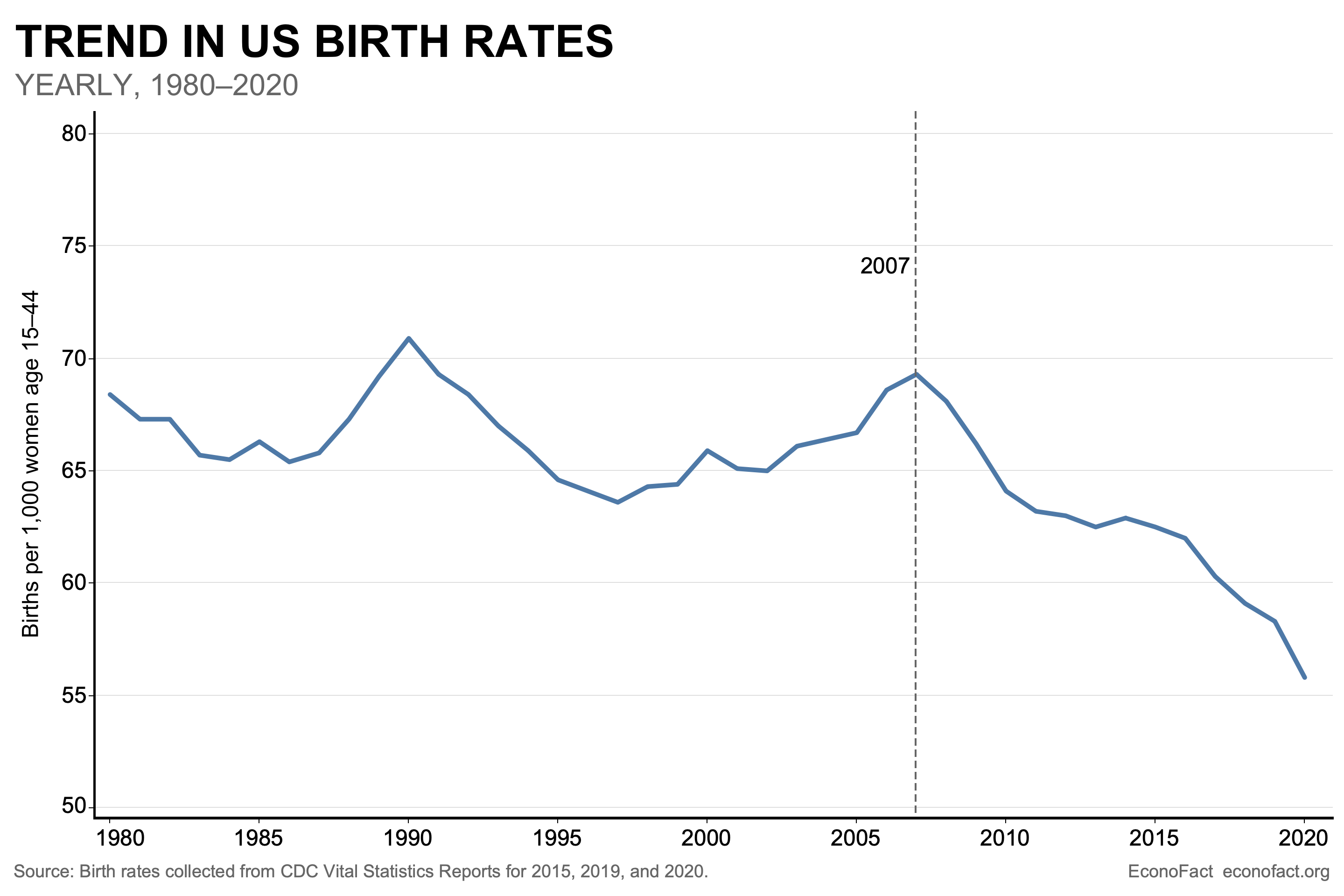
In Item 3)., “The Mystery of the ….”, the authors note that the general gradual decline in Female Fertility that had proceeded for over 200 years beginning in 1800 was accelerated after 2007 / 2008 Financial/Economic crisis. The Birthrate for American Women, aged 15 – 44 fell from a relatively stable rate that oscillated from between 65 and 70 Births per thousand women. The U.S. Birthrate had fallen to 55.8 in 2020 from 69.3 in 2007 a fall of 20%. They stated the facts about what has happened this way:
“The Great Recession disrupted a stable period in birth rates. For the almost three decades between 1980 and 2007, the U.S. birth rate hovered between 65 and 70 births per 1,000 women between the ages of 15 and 44. The birth rate followed a predictable pro-cyclical pattern, falling during economic downturns and recovering when the economy improves. But something changed around the time of the Great Recession; the birth rate fell precipitously, and it did not recover when the economy improved. Rather, the U.S. birth rate has continued a steady descent. As of 2020, the U.S. birth rate was 55.8 births per 1,000 women between the ages of 15 and 44, a decline of almost 20 percent from the rate of 69.3 in 2007. (Emphasis added)
“The decline in births cannot readily be explained by changing population composition. The sustained decline in U.S. births since 2007 has been driven by declining births among many demographic groups, rather than by changes in population composition. Births have fallen among women in their early 20s, late 20s, and teens (in fact, the teen birth rate in the U.S. has been falling steadily since the mid-1990s). Births have fallen among white women, Black women, and Hispanic women, with the largest declines among Hispanic women. Births have also fallen among women with and without college degrees and among both married and unmarried women. The population of U.S. women of childbearing age has actually shifted toward groups that tend to have higher birth rates, not lower birth rates, with the exception of a rising share of women of childbearing age being unmarried.
“No obvious policy or economic factor can explain much of the decline. The onset of the Great Recession clearly played a role in the early stages of the decline. Beyond that, it is difficult to identify any policy or economic factor that can statistically account for the continued decline. ….
“Successive generations of women are having fewer children at every age. While the largest decreases in birth rates have occurred amongst women under 30, it is possible that this reflects more than a general tendency among women to delay childbirth and that there are generational changes taking place. Cohorts of U.S. women born after the mid-1980s are having fewer births at all ages.”

As I stated earlier this is a global phenomenon. Women, and in many cases their partners, have learned that they can care for one or two children far better than they can for several children, and as the world becomes more urban and less rural the need for peasant and subsistence farm families to use child labor in the fields has gone down significantly. The fertility rate of the women of the world has now fallen to 2.3 children / woman / lifetime. Clearly this figure of average global fertility hides extremely low and high rates. The highest levels of Human Female Fertility are found in Sub-Saharan Africa with levels of near or over 6 children / woman / lifetime in several countries there, though the actual figures vary somewhat from source to source (the main primary sources used by most websites are The United Nations, The World Bank, and the International Monetary Fund). Chad, Niger, Benin, Somalia, Democratic Republic of Congo, Angola, Mali, Uganda and the Central African Republic are the countries with the highest Female Fertility rates on Earth, the highest rate outside of Sub-Saharan Africa is in Afghanistan. S. Korea and Taiwan have the lowest Human Female Fertility rates on Earth; S. Korea is the lowerst at 0.7338 children / woman / lifetime and Taiwan is second at 0.8626 children / woman / lifetime, and many other developed countries have rates near 1 child / woman / lifetime. These include Singapore, Puerto Rico, China, Italy, Spain, and Poland among others. The situation in S. Korea has elicited organized resistance by some S. Korean women, they have formed some “4-Bs” organizations that oppose having sex with men, marrying men, dating men or having children with men. They appear to have had some effect in lowering the fertility-rate in S. Korea. The most hopeful development in recent years is the lower rates of Human Female Fertility in developing and middle income countries. Previously it was thought that societies had to become relatively prosperous before the “demographic transition” would occur lowering fertility rates, but it turns out that even poor people love their children and were ready to reduce family sizes when possible. Readers who want to go to the two population / fertility websites I looked at can pass the cursor over the maps there for readouts on the fertility rates for each country. (See, “Total Fertility Rate by Country in 2024”, n.d., anon, Database Earth, at < https://database.earth/


In fact, the U.S. has become an exception and an outlier in areas like family planning and abortion access. Only 4 countries have moved towards making Abortion Access more difficult and restricting other Reproductive Health Care Rights and the U.S. is far and away the most eggregious. Clearly we are now approaching a crisis level of increased numbers of deaths and an abominable maternal mortality rate in the Dark Ages Red States, as Jessica Valenti reported in Item 2)., the maternal death rate in the Dark Ages Trump Abortion Ban Red States is double that in the Blue States. There are also large numbers of low-income pregnant women who are killed by their intimate partners, stuck in abusive relationships by the Trump Abortion Bans and the easy availability of Guns in the Dark Ages Red States. We hear about individual cases but actually we are talking about thousands of dead women, many tortured and murdered by the Force-Pregnancy / Forced-Birth policies imposed on them by right-wing, predominantly white male politicians and Force-Pregnancy / Forced-Birth operatives. Even more others killed by intimate partners they cannot escape who are armed and sooner or later kill their girlfriends or wives.
The current trend is for U.S. State Governments to work on a variety of ways to prohibit any effective access to abortion or any Reproductive Healthcare Rights. 12 States had serious attempts to pass legislation allowing women who obtain abortions to be prosecuted for murder, and 10 of those states have the death penalty. And the extremist factions of the Forced-Pregnancy / Forced-Birth movement are eager to begin executing women who obtain abortions; they call themselves Abortion Abolitionists in an attempt to assume the mantle of nobililty and freedom the struggle against slavery still has.


The next 3 Items, Item 4)., “The Trump Team Wants ….”; Item 5). “Trump Wants A 'Baby Boom' ”; and Item 6)., “US birth rates near record low ….”; all discuss the absurdity and ludicrous nature of the Trump / Vance / Musk proposal to try to convince American Women to give up all the rights and jobs won over the past few decades and to become Trad Wives. One of the first things that most women comment on is the total inadequacy of the offer of $5 thousand. Raising a child now costs at least $300,000 and more likely more than $400,000 just to get the child out of high school. College and Graduate School easily add another $200,000 to $300,000. But as the two articles and the podcast note Trump and his minions are busy gutting and ending any subsidy that the federal government provides for people of modest means. But of course these children are mostly people to be exploited for sexual use, as cannon fodder for the endless wars, and as drones for the ruling class' business operations. One discussion I listened to recently discussed the Romanian attempts to force women to bear more children back during the Ceacescu Regime. Birth Control was illegal for women of reproductive ages. The coercion worked for about 1 year, after which middle class and higher status women figured out how to evade these laws. What then happened was the part of the population incapable of raising children who would become productive citizens were the ones who produced the great majority of the children. The regime built a large number of grim orphanages to raise these children that were rife with abuses and neglect. Ceacescu and his wife were overthrown and executed by the rebels.
xxxxxxxxxxxxxxxxxxxxxxxxxxxxxxxxxxxxx
Bro-Natalists Are Ruining America
We have to talk about this absolutely batshit New York Times piece—the headline alone turned my stomach: “White House Assesses Ways to Persuade Women to Have More Children.”
“Persuade” is a polite way to put it, given that forced birth is the law of the land in half the country! But this isn’t just about abortion bans: Since Trump took office, the country has been handed over to a newly emboldened bro-natalist cabal—men like Elon Musk and JD Vance, desperate to increase the birthrate, whether women like it or not.
Here are just a few of the ideas the Times reports are being tossed around at the White House:
A “National Medal of Motherhood” to women with six or more children;
Reserving 30% of government fellowships for those who are married with children;
State-funded education programs teaching women and girls about their menstrual cycle, “so they can better understand when they are ovulating and able to conceive”;
$5,000 cash as a ‘baby bonus’.
First of all, it’s telling that this administration will do anything other than what families really need. If the Trump administration was actually interested in supporting parents, they’d be pushing for paid parental leave, subsidized childcare, and an end to laws that make it deadly for people to give birth.
But Republicans don’t care about making the world better, safer, or healthier for American families and children—they just want women to have more babies. What happens after that? They couldn’t care less.
Actually, scratch that—because the administration’s “baby boom” push isn’t just about boosting the birthrate. It’s about reasserting a rigid, traditional vision of American family life: one where parents are straight, women are submissive, and the bro-natalists in charge get to pretend it’s all for the good of the nation.
As Times reporter Caroline Kitchener points out, the White House has an ideologically-specific definition of ‘family’: Straight married couples with children. Consider what that means for some of the administration’s proposals: If 30% of fellowships (like the Fulbright) are reserved for married parents—and the administration only recognizes straight marriages—they’d be creating a deliberately discriminatory quota, excluding LGBTQ people from prestigious awards and funding.
Imagine how many other government marriage promotion programs they could use to leave certain families behind.
And then there’s the ‘menstrual cycle’ classes. Emma Waters, the Heritage Foundation policy analyst behind this White House proposal, says that the government-funded program wouldn’t just be for adults—but part of sex education lessons taught in school.
Just so we’re clear: Instead of teaching kids about birth control and sexual health, the government would fund programs that teach little girls how to get pregnant.
If you think that’s hyperbole, please remember that the Heritage Foundation doesn’t have a problem with young girls giving birth: In 2023, I reported that the group had shifted away from decrying teen pregnancies—instead decrying the “non-marital teen birth rate.”
But here’s the thing I can’t stop thinking about: What policy proposals is the administration working on that they haven’t told the Times about?
A couple of final thoughts:
If we’re looking for a point of weakness for this movement, it’s IVF. There’s a clear divide between bro-natalists pushing for more fertility treatments and religious conservatives who oppose IVF altogether. It’s a point of tension, and Democrats should take advantage of that.
This administration’s birthrate policies basically come down to benevolent coercion. They can’t force all American women and girls to give birth, so they’re slickly pretending that these moves are in women’s best interest. (It reminds me of the insidious cultural campaign against birth control—making young women think hormonal contraception is bad for them so they won’t be too pissed when Republicans start restricting it.) The hypocrisy is clear to us, but Democrats would do well to have a proactive vision of family and family support that they’re sharing with voters.
Bro-natalists are bad fathers—personally and politically. There’s a reason all these policies focus on convincing women to give birth, and say little about men. That’s because conservatives only see fathers as bread-winners, decision-makers, and disciplinarians. Once again, that’s a place we can push back with our own positive vision. One where men are more than just punishing sperm donors.
xxxxxxxxxxxxxxxxxxxxxxxxxx
The Mystery of the Declining U.S. Birth Rate | Econofact
The Issue:
Up until the Great Recession, the number of babies born per woman in the United States had been quite stable for the previous three decades. The birth rate fluctuated within a relatively narrow range, often along with economic conditions, with fewer babies born during lean times and with births recovering when economic growth was stronger. However, the U.S. birth rate has fallen precipitously since the 2007 Great Recession, with no signs of reversing. This decline cannot be explained by demographic, economic, or policy changes. It is reflective of lower childbearing rates across successive cohorts.
The U.S. birth rate has fallen by 20% since 2007. This decline cannot be explained by demographic, economic, or policy changes.
The Facts:
- The Great Recession disrupted a stable period in birth rates. For the almost three decades between 1980 and 2007, the U.S. birth rate hovered between 65 and 70 births per 1,000 women between the ages of 15 and 44. The birth rate followed a predictable pro-cyclical pattern, falling during economic downturns and recovering when the economy improves. But something changed around the time of the Great Recession; the birth rate fell precipitously, and it did not recover when the economy improved. Rather, the U.S. birth rate has continued a steady descent. As of 2020, the U.S. birth rate was 55.8 births per 1,000 women between the ages of 15 and 44, a decline of almost 20 percent from the rate of 69.3 in 2007.
- The decline in births cannot readily be explained by changing population composition. The sustained decline in U.S. births since 2007 has been driven by declining births among many demographic groups, rather than by changes in population composition. Births have fallen among women in their early 20s, late 20s, and teens (in fact, the teen birth rate in the U.S. has been falling steadily since the mid-1990s). Births have fallen among white women, Black women, and Hispanic women, with the largest declines among Hispanic women. Births have also fallen among women with and without college degrees and among both married and unmarried women. The population of U.S. women of childbearing age has actually shifted toward groups that tend to have higher birth rates, not lower birth rates, with the exception of a rising share of women of childbearing age being unmarried.
- No obvious policy or economic factor can explain much of the decline. The onset of the Great Recession clearly played a role in the early stages of the decline. Beyond that, it is difficult to identify any policy or economic factor that can statistically account for the continued decline. Casual observers have suggested that a variety of potential factors are responsible for the decline, including greater take-up of highly effective contraception, the high cost of raising children, improved occupational opportunities for women, and the high level of student debt carried by young adults. Our research finds little empirical support for these possible explanations. Moreover, none of the measures that have been shown in previous research to have a causal effect on annual birth rates – such as labor market conditions (beyond the Great Recession), certain social policy indicators (such as child support enforcement) or reproductive health policy measures (such as abortion clinic closures) – have changed in ways that can account for the drop in the national birth rate since 2007.
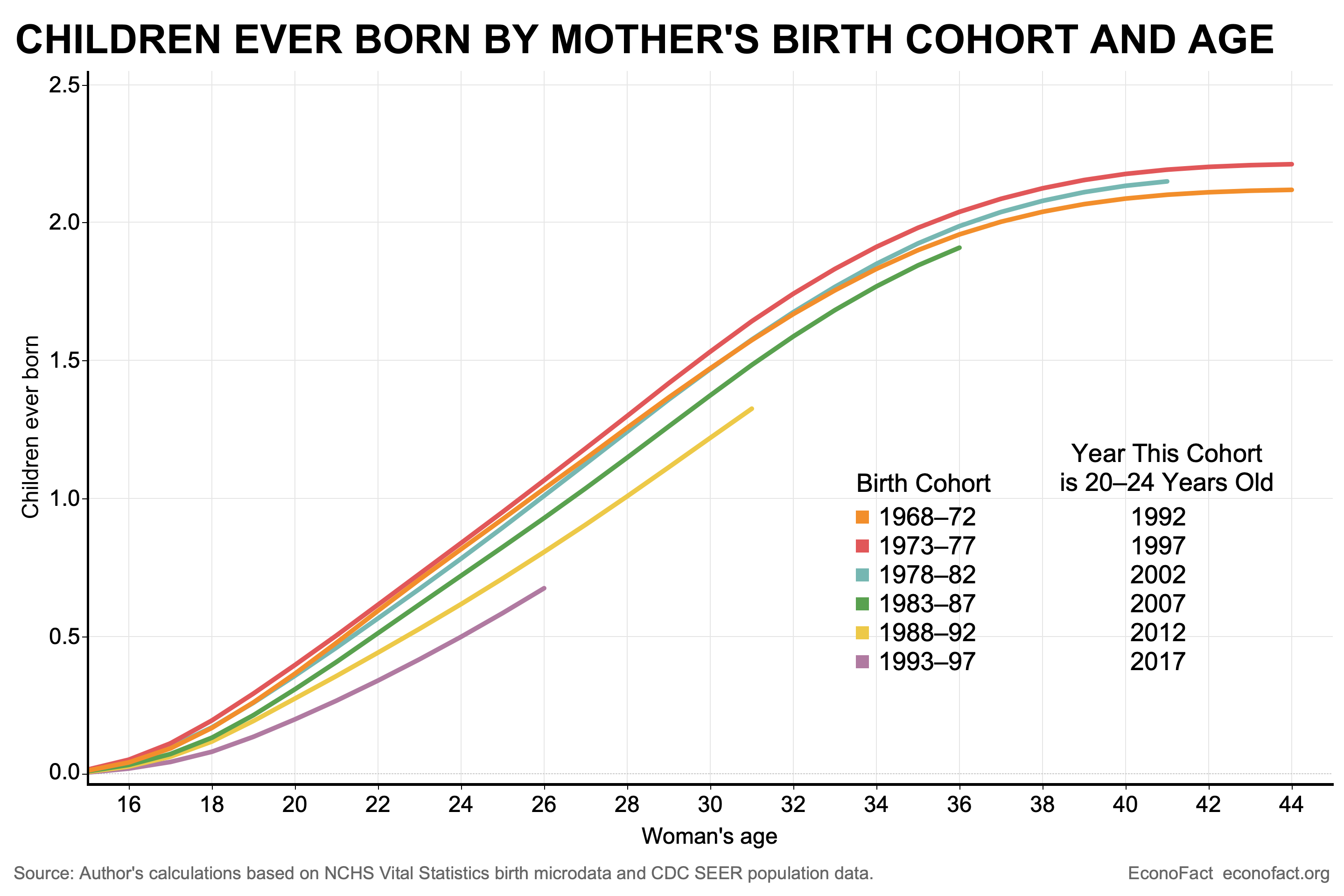
- Successive generations of women are having fewer children at every age. While the largest decreases in birth rates have occurred amongst women under 30, it is possible that this reflects more than a general tendency among women to delay childbirth and that there are generational changes taking place. Cohorts of U.S. women born after the mid-1980s are having fewer births at all ages. The above figure shows that subsequent cohorts of women who were born in the windows 1968 to 1972, 1973 to 1977, and 1978 to1982 all had similar childbearing age profiles throughout their lives. Then, the cohort of women born between 1983 and 1987 had fewer children throughout their 20s and their 30s. The next two five-year birth cohorts of women (born between 1988 and 1997) have fewer children than earlier cohorts. In other words, later cohorts of mothers have fewer children at every age than women in earlier cohorts. The likelihood of births “catching up” at older ages across these cohorts seems limited.
- Shifting priorities could be the primary driver for the decline in the birth rate since 2007. There is survey and anecdotal data suggesting that perhaps more recent cohorts of young adults have different preferences for having children, aspirations for life, and views about parenting norms that are driving the decline in the U.S. birth rates. These shifts could reflect preferences and norms that changed primarily in earlier decades, long before 2007 – such as more intensive parenting practices and expanded economic opportunities for women – in ways that profoundly shaped the world views of today’s younger adults.
- A sustained decline in the birth rate would have important social and economic consequences. A temporary decline in annual birth rates does not necessarily portend social and economic challenges. However, the decline in annual birth rates in the U.S. has been ongoing for many years and as shown above, corresponds to a decline in the number of children a woman has over her lifetime, on average. This trend predicts a persistently lower fertility rate in the U.S., which, absent increased immigration, would lead to a smaller workforce and an older population. In general, a smaller workforce and an aging population would have negative implications for economic productivity and per capita income growth. In addition, the combination of a smaller workforce and an aging population puts fiscal pressure on social insurance programs, like Social Security, that rely on tax payments from current workers to pay the benefits of current retirees. Some observers point to the idea that, all else equal, a shrinking population will reduce humans’ carbon footprint, and hence have positive environmental effects. We are not aware of any evidence, though, that population declines corresponding to the size of the drop in U.S. fertility would have a meaningful effect on climate outcomes.
- The onset of the COVID pandemic added another layer of uncertainty to childbearing trends in the United States. Births conceived between the onset of the pandemic in March 2020 and the end of that year fell by around 60,000. This is a smaller drop than many had expected, given the dramatic rise in unemployment and in economic and public health uncertainty at the outset of the pandemic. It is possible that government assistance blunted the economic impact of the pandemic on many families.
What this Means:
Although the 2007 recession seems to have played a role in decreasing the number of children born per woman in the United States, the lack of any rebound in births and, in fact, their continued decline following the end of the recession suggests a role for factors beyond the Great Recession. A decline in annual birth rates does not necessarily imply a long-term reduction in childbearing. If the recent decline in annual birth rates simply reflects women pushing off having children from their 20s to their 30s, then annual birth rates will eventually rebound and the total number of children the average U.S. woman has over her lifetime will not change. But the decline in annual birth rates since 2007 is consistent with more recent cohorts of women having fewer births. Those cohorts have not completed their childbearing years yet, but the number of births they would have to have at older ages to catch up to the lifetime childbearing rates of earlier cohorts is so large that it seems unlikely they will do so. If the decline in births reflects a (semi)permanent shift in priorities, as opposed to transitory economic or policy factors, the U.S. is likely to see a sustained decline in birth rates and a general decline in fertility for the foreseeable future. This has consequences for projected U.S. economic growth and productivity, as well as the fiscal sustainability of current social insurance programs.
- Editor's Note: The analysis in this memo is based on Kearney, Melissa S., Phillip B. Levine, and Luke Pardue. 2022. "The Puzzle of Falling US Birth Rates since the Great Recession." Journal of Economic Perspectives, 36 (1): 151-76.
- xxxxxxxxxxxxxxxxxxxxxxxxxxxxxxxxxx
The Trump Team Wants to Boost Birth Rates While Poisoning Children
Sure, they’re contemplating a “baby bonus.” But they’re also cutting funding for children’s health, reversing PFAS and lead pipe rules, eliminating food safety measures, and attacking vaccines. Call it two sides of the eugenicist coin.
 Kayla Bartkowski/Getty ImagesU.S. President Donald Trump and Vice President JD Vance during a ceremony on April 14
“I want a baby boom,” Trump has said. His administration is indeed exploring a range of approaches to boost the birth rate, including baby bonuses and classes on natural fertility. Yet his focus is entirely on the production of babies. When it comes to keeping these babies alive, this administration is leaving parents on their own, facing some horrifying and unprecedented challenges.
It’s common for right-wing American governments, whether at the state or federal level, to be only half-heartedly natalist: restricting abortion, birth control, and sex education, while also failing to embrace any policy that makes it easier to raise a family, like universal childcare, robust public education, school lunch, cash supports for parents, or paid family leave. But the Trump-Vance government has taken this paradox to a new level, with natalist rhetoric far surpassing that of other recent administrations, while real live children are treated with more depraved, life-threatening indifference than in any American government in at least a century.
Due to brutal cuts at the Food and Drug Administration, where 20,000 employees have been fired, the administration has suspended one of its quality-control programs for milk, Reuters reported this week. Milk is iconically associated with child health, and this is not a mere storybook whimsy: Most pediatricians regard it as critical for young children’s developing brains and bones. The American Academy of Pediatrics recommends two cups a day for babies between 1 and 2 years old. While some experts—and of course the administration—are downplaying the change, emphasizing that milk will still be regulated, a bird flu epidemic hardly seems like the right time to be cutting corners. A government so focused on making more babies shouldn’t be so indifferent to risks to our nation’s toddlers.
This reckless approach to child safety is not limited to food. Also this week, The New York Times reported that the Environmental Protection Agency was canceling tens of millions of dollars in grants for research on environmental hazards to children in rural America. These hazards include pesticides, wildfire smoke, and forever chemicals, and the grants supported research toward solutions to such problems. Many focused on improving child health in red states like Oklahoma.
Children are much more vulnerable than adults to the health problems that can stem from exposure to toxins. That makes Trump’s policies, for all his baby-friendly chatter, seem pathologically misopedic; he is reversing bans on so-called “forever chemicals” and repealing limits set by the Biden administration on lead exposure, all of which will have devastating effects on children’s mental and physical development.
And of course there’s RFK Jr.’s crazy campaign against vaccines. This week, the health secretary said he was considering removing the Covid-19 vaccine from the list of vaccines the government recommends for children, even though to win Senate confirmation, he had agreed not to alter the childhood vaccine schedule. Even worse, RFK Jr. has used his office to promote disinformation about extensively debunked links between vaccines and autism, while praising unproven “treatments” for measles as an outbreak that has afflicted more than 600 people and killed at least three continues to spread. Trump’s public health cuts are meanwhile imperiling a program that gives free vaccines to children.
So far, I haven’t even mentioned children outside the United States. Trump has not only continued Biden’s policy of mass infanticide in Gaza—at least 100 children there have been killed or injured every week by Israeli forces since the dissolution of the ceasefire in March—he has vastly surpassed that shameful record by dismantling USAID. (The Supreme Court demanded that the government restore some of the funding to the already-contracted programs, but it’s unclear what the results of that ruling will be.) Children across the globe will starve to death due to this policy. The cuts to nutrition funding alone, researchers estimate, will kill some 369,000 children who could otherwise have lived. That’s not even counting all the other children’s lives imperiled by USAID funding cuts to vaccines, health services, and maternal care, or the children who will go unprotected now that Trump has cut 69 programs dedicated to tracking child labor, forced labor, and human trafficking.
Natalist or exterminationist? Pro-child or rabidly infanticidal? It’s tempting to dismiss such extreme contradictions within the Trump administration as merely chaotic and incoherent. But the situation is worse than that.
Trying to boost births while actively making the world less safe for children is creepy—but not in a new way. The contradiction is baked into the eugenicist tradition that Vance and Trump openly embrace. Vance said at an anti-abortion rally in January that he wanted “more babies in the United States of America.” Vance also said he wanted “more beautiful young men and women” to have children. Notice he doesn’t just say “more babies”: the qualifiers are significant. Vance was implying that he wanted the right people to have babies: American, white, able-bodied, “beautiful” people with robust genetics. Children dying because of USAID cuts aren’t part of this vision, presumably, because those children are not American or white. As for infected milk, environmental toxins, or measles—here too, it’s hard not to hear social Darwinist overtones: In a far-right eugenicist worldview, children killed by those things likely aren’t fit for survival. In a more chaotic and dangerous environment, this extremely outdated logic goes, natural selection will ensure that the strongest survive.
It’s also worth noting that this way of thinking originates in—and many of these Trump administration policies aim to return us to—an earlier era, when people of all ages, but especially children, were simply poisoned by industrial pollution, unvaccinated for diseases, and unprotected from industrial accidents. In such an unsafe world for children, people had many more of them; the world was such a dangerous place to raise kids that families expected to lose a few.
That all-too-recent period is the unspoken context for natalist and eugenicist visions. That’s the world Trump and Vance seem to be nostalgic for, one in which women were constantly pregnant and in labor, and children were constantly dying horrible deaths. Doesn’t that sound pleasant for everyone?
xxxxxxxxxxxxxxxxxxxxxxxxxxxxxxxxxxx
Trump Wants A 'Baby Boom' Yet Plans to Cut Essential Childcare Program Head Start
xxxxxxxxxxxxxxxxxxxxxxxxxxx
US birth rates near record low as Trump, Musk talk baby boom

Adobe Stock A newborn baby holds a mother’s finger. That marks a 1 percent increase from the record low number of births in 2023.
The U.S. birth rate has steadily declined since the Great Recession in 2007, with a slight bump in births occurring in 2021, according to CDC data.
The data also show that older women are continuing to have more children, with the report showing the birth rate of women 30-34 increased by 1 percent between 2023 and 2024.
The birth rate of women 35-39 also went up 1 percent during that time, and the birth rate of women 40-44 increased by 2 percent.
The drop in the U.S. birth rate has caused some within the Trump administration to sound the alarm about the perceived dangers of falling global birth rates.
Elon Musk, CEO of Tesla and key adviser to President Trump, shared his concerns over the country’s falling birth rate and declining birth rates abroad during an interview on Fox News earlier this week.
“The birth rate is very low in almost every country, and unless that changes, civilization will disappear,” he said.
The Trump administration has considered implementing new policies to incentivize American women to have more children, including giving out $5,000 in cash to women after giving birth and reserving 30 percent of Fulbright program scholarships for applicants who are married with children.
Trump suggested to reporters Tuesday that he supports the idea of giving mothers money after delivering a child.
“Sounds like a good idea to me,” he said.


No comments:
Post a Comment