1). “Christopher Tackett Followed The Money And It Led Him To Uncover Two Texas Billionaires Controlling Texas’ Far-Right Political Agenda”, September 26, 2022, Claire & Nichole interview Christopher Tackett, Behind the Ballot, duration of video 57:30, or of the podcast 51:68, at < https://gobehindtheballot.com/
2). “How two Texas megadonors have turbocharged the state’s far-right shift”, July 24, 2022, Casey Tolan et. al., CNN, at < https://www.cnn.com/2022/07/
3). “Deep in the Pockets”, Jul 30, 2022, Documentary Video by Christopher Tackett, CNN, duration of video 43:35, at < https://www.youtube.com/watch?
4). “The Campaign to Sabotage Texas’s Public Schools”, March 2023, Mimi Schwartz, Texas Monthly, at < https://www.texasmonthly.com/
5). “Inside the Secret Plan to Bring Private School Vouchers to Texas”, October 18, 2022, Forest Wilder, Texas Monthly, at < https://www.texasmonthly.com/
6). “How a Brazen School-Voucher Scheme in Texas Got Derailed”, February 14, 2023, Forest Wilder, Texas Monthly, at < https://www.texasmonthly.com/
Introduction: IMHO Texas has become the leading state in the country for producing extremist reactionary / fascist political and socioeconomic initiatives (of course we could clearly argue that Florida is the number one in this regard and that Texas is a close runner-up). Where Texas is far different from Florida is that, in its relative vastness, and in the isolated resource extraction peripheries that exist in parts of West West-Central, South, and North East Texas, extremely virulent Christo-Fascist movements, so-called churches, and leaders have time to develop and become ever more dangerous.
The core of Texas Urban areas and where most of the state's people live is in an area called “The Texas Triangle”, roughly demarcated by I-35 on the west, I-45 on the east, and I-10 on the south, though the urbanized areas spill out tens of miles outside of the 3 interstate triangle. The urban areas of Dallas-Fort Worth, Houston, San Antonio, and Austin are all located in the Texas Triangle. If you live and work in Texas and your company or governmental agency sends you to: West Texas; the Texas Panhandle; The South Texas Border area; to The huge region between West Texas deserts and the Panhandle, and the Texas Triangle; or to the Piney Woods of Northeast Texas you have been sent a clear message and that is: “Your career here is over, you are now banished to whatever horrific outpost we have sent you to, don't call us we'll call you (and don't hold your breath)”.
These two money men for Texas style Christo-Fascism, who are discussed in these articles, both come from one part of this huge weird backward area. Timothy Marvin Dunn grew up in Big Spring, Texas but has resided for years in Midland, Texas. There he is a major figure and funder for a right-wing school and some crazed reactionary church where he occasionally preaches. Big Spring is about 30 – 35 miles from Midland (described by commentators as the most reactionary community in the entire U.S., it is where George W. Bush grew up after his father and mother moved there from Connecticut, to pursue making a fortune in the Oil Industry and furthering Bush senior's ongoing surreptitious CIA asset career).
Dunn obtained a degree in chemical engineering from Texas Tech University in Lubbock, Texas. Texas Tech is the largest university in any of the banishment zones. Farris Wilks (and his brother Dan, who is less overtly political) both still live in Cisco, Texas; a small city east of Abilene, Texas and deep in the “ region between West Texas deserts and the Panhandle and the Texas Triangle”. They are members of a truly zany reactionary Church with bizarre beliefs, including that homosexuality and abortion are crimes that should be vigorously punished. Concerning the Church where Farris Wilks is the Pastor: “the Assembly of Yahweh (7th day) is a conservative Jews for Jesus type congregation (though sans Jews, d.m.). It teaches that 'the true religion is Jewish (not a Gentile religion)' and its members celebrate the Old Testament holidays rather than those related to the New Testament. The congregation considers the Old Testament historically and scientifically accurate. The congregation considers homosexuality and abortion to be crimes.” (See, “Dan and Farris Wilks”, Wikipedia, at < https://en.wikipedia.org/wiki/
The Wilks brothers grew up poor and did not obtain the same level of formal education as Dunn. The Wilks Brothers and Dunn are all billionaires that made their money in the Oil Industry. They are now using that wealth to attack public education and any progressive beliefs and practices. They fall into the faction of the Christian Right known as “Dominionists” (look that term up, but I will post some materials that address “Dominionism” in particular in the near future). That is they want to take political power and force their backward and hideous beliefs using state power, including murder and other practices. They want to be in the position of controlling the entire state apparatus and to use it to persecute those they think are evil, sad to say they have made significant progress towards that goal.
Wilks and Dunn are motivated by the plan to take control of the "7 mountains" of influence in American Society (the mountains are Arts and Entertainment, Business, Education, Family, Government, Media, and Religion). Their belief system is inspired by the work of Rousas John Rushdoony, only they are more bloodthirsty and have made far more progress towards taking actual political power. The vicious views of Wilks and Dunn are shown in their own words in short clips in the video in item 3). “Deep in the Pockets”.
The three articles from Texas Monthly, items 4 - 6, look at a political struggle over the public schools of Wimberly, Texas and the surrounding area. Wilks and Dunn funded much of the partially successful attempt to take over Wimblerly ISD and to use it to promote the use of public monies to fund private schools (mostly of the reactionary Christian flavor). Wimberly is a bucolic upper middle class and upper class suburban community near Austin, Texas. Sort of like parts of Marin County near San Francisco. This is sobering reading, but it does stand out that even though the state and many local governments in Texas are overtly Christo-Fascist the state still has a lively journalistic effort. This is, of course, bolstered by massive urban populations that live in and around Dallas-Fort Worth, Houston, San Antonio, and Austin as well as other smaller urban areas. The state government is controlled by authoritarians, who constantly take measures to limit the ability of the state's urban populations to vote, to control socioeconomic or political policies that affect them, or any of a number of other ways that the state government interferes in the operations of local governments. But they cannot control the political or social opinions of the large urban population, at least not yet.
Christopher Tackett Followed The Money And It Led Him To Uncover Two Texas Billionaires Controlling Texas’ Far-Right Political Agenda - Go Behind The Ballot

Attention Mentions:
Chris: The Flag and the Cross: White Christian Nationalism and the Threat to American Democracy by Philip S. Gorski and Samuel L. Perry
Claire: Dopesick on Hulu
Nichole: The Bachelorette on ABC and Hulu
There’s big money behind the Texas Far Right, and it was Chris Tackett who exposed it. In this conversation with Claire and Nichole, Chris shares how he got his start in public life by serving on the school board for Granbury ISD and how what was meant to be a nonpartisan race became partisan despite the wishes of him or his opponent. That experience led him to follow the money trail in Texas politics and what he found was enlightening and frightening. Chris discusses the influence of money in politics and how it can make a few voices sound like many. He talks about the need for free and fair elections and how being consistent in his message lights the way for how he moves forward. This episode is a can’t-miss for anyone who wants a greater understanding of the relationship between money and politics in Texas elections today.
—
Nicole, thank you so much for joining us for this episode of Go Behind the Ballot. We are going to be jumping into our elections series. We’re going to talk about why elections matter, why you need to vote and things that happen behind the scenes that you might not realize. That leads us to our guest for this episode, who is Chris Tackett. He served on the Granbury ISD School Board and he has this mission to help people understand money and politics.
Money is so huge when it comes to elections. Money equals communication and communication equals votes. He tells us about how these two billionaires in West Texas, Tim Dunn and Farris Wilks, have funneled millions of dollars into local races and so few people know that this is happening. Nicole, what did you think of this talk?
You know how excited I was that we got the opportunity to talk to Chris Tackett. I can’t even tell you how much I’ve looked forward to this interview. He shines a light. He makes things clear that seem muddy and unclear and helps everyone to understand them. Also, he is an excellent follow on social media on Twitter. He takes the fight to the issues.
He also has a great YouTube Channel where he makes these videos that allow people to speak for themselves so that you, as the viewer, can make your own choices and decisions about what you’re hearing people say. I think that highlights who Chris Tackett is. A guy who is making the things that we wonder about and have unclear information about making those things clear and obvious. Enjoy, it’s a great one.
I’ll lastly add, Chris Tackett is one of those people who ran because he wanted to level up his public service. He cares a lot about having a healthy democracy. This is so important when we talk about elections that we have good competitive races. He shows how having these super-rich billionaires very much goes against that and why we need to be aware of it. As Nicole said, this is a great read and we hope you will all enjoy it.
—
Chris, to get us started, we would love to know a little bit about you. Did you grow up in Texas? How did you start getting a little bit more politically involved?
I’ll say I can’t claim being a Native Texan because I was not born here. That’s one of the rules, but my parents moved us here to Texas when I was in the 4th grade. I have been here for the better part of my life. I went all the way through school here. I lived in other parts of the country. I lived in Canada for a couple of years but came back in 2008 with my wife and two kids to raise said kids and try and be close to family because we’ve been gone for a number of years. When we moved back to Grandbury, Texas, in 2014, I made the decision to run for school board with the support of my wife.
I was fortunate enough to get to serve. I won the election. I served on the school board from 2014 to 2017, but while I was there, I got a different sense of what was happening in the state and politically, had a newly elected House Representative, Mike Lang, in House District 60, which is where Grandbury is a part of. Had told us on the school board and the superintendent that he was a big supporter of public education.
We said, “When you go to Austin, here are the things that we think you should look at and support. They will help not only our district but other districts around the state.” He said, “Yes, no problem,” and then he got down to Austin and voted the opposite on every single one of those issues. It got me digging in, trying to understand why. To me, the obvious answer was money. I went into the Texas Ethics Commission website, started pulling campaign finance reports and saw massive amounts of money going to this guy from a handful of people.
Mostly, a gentleman from West Texas named Farris Wilkes, who is featured very prominently in the CNN documentary, Deep in the Pockets of Texas. As I figured that out, I started making pie charts to help make it easier for me to understand how much of this is coming from a handful of people but also to help others. I posted it on Facebook. People saw and started asking questions about, “What about my rep because they’re not supporting public education or all these other things either?” I started doing the research for candidates all over the state. It eventually led me to create a website ChrisHackettNow.com.
I have continued since that 2016, 2017 window ripping the entire Texas Ethics Commission database, repurposing it, putting it into a format where it’s easier for me and apparently, lots of other people around the state to leverage. It’s bar charts, pie charts, graphs so that you can go in and search for what you want and see who’s funding the politicians. The other thing it does is it helps you see very quickly what the web of money is. There’s a handful of people pulling a lot of strings in this state. That’s the abbreviated version of how I got here.
Thank you for sharing that. We want to talk about your website and the CNN documentary, Deep in the Pockets of Texas, but to rewind a little bit. I’m curious about your family growing up. Did you folks talk about politics? Would you consider your parents political because you went on to become a school board member, which is an elected office?
We weren’t political. It was one of those, you hear the things like you don’t talk about religion or politics at the table. I wouldn’t say we were hard and fast in that space, but politics wasn’t something we dove into. I grew up with my dad coaching my baseball team and being involved. With my kids, I took that space. When we moved back to Grandbury in 2008, I was the coach of my son’s team and my daughter’s teams.
I ran the local sports association for baseball and softball. I was the president there for about five years. To me, that serves not only to my kids but helping other kids in the community. The transition to school board felt like a reasonable push and between my professional space in the business world and again, my love of helping kids. It felt like, “This is a great place, a nonpartisan space that’s about community.” Going through that election changed some perspectives about the nonpartisan nature of elections, at least in modern times.
Were you prepared for that or was that surprising?
It was surprising because we hadn’t paid that much attention to politics. We had lived away for a number of years, so some of the local elements of things don’t happen. We had seen the rise of the tea party locally in Texas and across the country. Seeing that had been a little confused about some of the things that were going on, but it was one of those. It was like, “That was all big politics.” It wasn’t local stuff.
When I said I was going to run for school board, I very naively tried to schedule time to speak to all the various community groups n Grandbury. It was the optimist club and the Kawanas and all of these groups. Including the local democratic club, the local Republican club and the things you start to learn that are happening in the local politics as you go through that process. It was eye-opening.
Was your run competitive? What was that experience like when you decided, “I’m going to throw my hat in the ring and run for this position?”
It was myself and one other person. After the fact, as you go through the election, the other person who was running against me was a good guy who was trying to do it for some of the same reasons I was, wanted to contribute to the community. It’s one, the wife of the state Senator who lives in Grandbury, had somebody pull my previous voting record. I had voted in a Democratic primary in 2012 and because of that, I was a bad guy.
This state senator’s wife completely funded my opponent’s race, gave all the contributions to him and tried to do everything they could through the party and others to say some very not nice things about me. Including started running in what had been again, nonpartisan races locally, school board, city council and things, started running ads in the paper, as we were getting ready that was not authorized by the candidate.
That said, “Republican for school board and his name and everything.” I countered with, “Let’s not play politics with kids.” My opponent, at that point, as soon as they started running ads in his name that were making it very partisan, basically put his hands up and said, “I’m not participating in this.” Big kudos to him because this wasn’t what he wanted. It was the local political machine trying to take over and run this.
It was a 55-45 race in the end. He and I talked at length after the fact about, “We were trying to, again, serve the community.” The people we see at the grocery store, the people we run into at our kids’ schools, the softball games, or the baseball games. We were both trying to do it for the right reasons, but the politics on one side overwhelmed things. Luckily, I got the opportunity to serve the community in that space.
Now I understand why you say it was surprising because it sounds like that came out of nowhere. Talk about a political awakening that you may not have asked for, but here you are. I also respect your opponent that you both remained true to your original reasons for even running. I love these conversations we’re having because so much of my skepticism and cynicism is getting challenged for the best. It’s moments like that that give me so much hope. I keep saying this. This happens every time, but people who want to serve the public exists. They are out here and they’re running for offices. It gives me a lot of hope and optimism. It’s going to be okay, but we also have to expose and shine a light.
Yes, it’s making me think. When you started following the money, was that with your race or was it later on that you started digging into the Texas Ethics Commission reports?
It was after. Honestly, I did not know who was funding my opponent because I didn’t even think to ask for campaign finance reports because it was like, “What the heck?” It was only years later that I was like, “I’m going to go ahead and request those to see what happened.” Again, it was years later that I started digging into the Texas Ethics Commission. Again, I knew I had to turn my stuff in when I ran for the school board to the local district office. That’s where I was turning in my campaign finance reports. At the time, I had no clue that those reports don’t go to Austin and get loaded into a database. I figured that’s how it worked. You’re running for a public office no matter what level and everything goes to a central spot.
When I started polling from Austin and you realize, “This is only state-level races. Anything that’s local is maintained in these local spaces.” That’s what triggered me to say, “I want to find my race and understand this.” I think that one of the things people don’t understand is if you want to follow money, there are different places you have to go to be able to draw a complete picture. If you’re talking about city council races, county commissioner races, basically, anything that’s county level or below. It’s all maintained at those local spaces.
It’s generally if you’re in a small community, it’s not electronic. It’s one that you’ve got a request via a public information request. You can’t hop on the website and pull it. When you do get those, even from some of the larger places, it’s not like an excel type file where it’s easy to manipulate. You’re getting a scanned version of what was filed. Being able to connect dots and seeing who’s giving what, it’s hard. It’s easier at the state level because you can get an excel sheet and start to run these things together but following the money in this state, which also has no campaign finance contribution with it? It’s crazy.
We got to highlight this. I’m going to repeat what you said because I want to make sure I’m comprehending. Statewide races, that information is shared with must be reported to the Texas Ethics Commission. All of that is held in Austin and it is available electronically. Is that also true?
Correct. Anybody can go search for it, whether it’s the file or ID or the name and you can find those reports.
Now they may not be shiny and pretty, you’re also saying. The information is there, but it’s raw data, let’s say. For more local races, like you’re saying for trustees, for city council, that information is still kept at the local level and by who? Which office?
It’s all about what the race was. If you’re talking about a school board race, the school district offices maintain it. If you’re talking about a city council race, it’s the city offices. If it’s a county commissioner’s race, it’s the county offices. Somebody could be giving in all three of those spaces, but you would never know it because you’re only requesting this candidate’s reports, which aren’t indexed. They aren’t electronic in a database-type format. People can weigh in with money in lots of different places.
This might be jumping ahead, but is there any legislation to change this system or any movement to make it easier for folks to understand where money is coming from?
There has been some legislation filed. It hasn’t gone anywhere in the last few sessions to try and put whether it’s campaign finance, contribution limits in place or centralizing all campaign finance records in one place. I think the reality is that the people in charge now control some of the levers of power in the state. They’re pretty okay with the way things work. The idea that it’s hard to follow the money and that people can write a million-dollar check if they want to make it easier for them to do some of the things they want to do.
It means you don’t have to necessarily connect with the people you represent because you can get checks from all over the place. That may not be the people who live in your district, who may not be the people who, again, if you run into them in the grocery store, you would have any connection with. Stuff has been filed, but it hasn’t gone anywhere.
Maybe that will change with the information that more people are hopefully getting about what’s happening behind the scenes. A phrase that you said that stuck out to me was the people in charge. I wondered who are these people in charge? Is it even our representatives? I feel like that leads into the CNN special, Deep in the Pockets of Texas. Can you tell us a little bit about that special and the two people who are at the top, maybe the actual people in charge?
Now, Deep in the Pockets of Texas is a documentary that CNN put together. It’s an hour-long documentary that dives into if you’ve been following me on Twitter or Facebook or anything over the last few years that myself and my wife have been trying to yell about for a number of years. There’s not to say that we’re the only ones.
There have been lots of other people trying to highlight this, but it dives into not only what’s been happening with money in Texas politics and that two billionaires out of west Texas, Tim Dunn and Farris Wilkes, have very aggressively been investing millions of dollars in each electoral cycle in challenging and trying to get their people elected to then advance their ideology broadly across the state.
They put millions of dollars in, win some elections, lose some elections, but the whole time, they’re moving the Overton window. That idea of the way we look at things, what’s relative, pulling it further to the right and the documentary does a good job showing with the perspective of people who’ve been inside the Republican political machine and seen it with how they’ve been either marginalized or pushed to the sides because they haven’t been doing what these two billionaires wanted them to do.
It gets to this idea of a handful of people who are pulling strings on a lot of the politicians we see across the state. It’s not just them pulling the strings directly with the people they have. It’s also impacting other legislators who will vote the way they want them to vote. Maybe they’re not told directly, but they know this is what the conservative space is looking for because they don’t want to get a well-financed challenger in a primary.
Even though you have somebody who may not be aligned with the Wilkes-Dunn group, they’ll start to vote that way to avoid challengers as they go forward. That moves our overall Overton window in the state into a much more conservative space. What I did love about the documentary is it talked about not only the what, which is the money and the connections and such. It dives into the why, which is some of the ideology that comes from these billionaires.
I think that’s an important piece. For the folks, as they watch the documentary because it’s such a well-done document. It’s the tip of the iceberg. In an hour-long documentary, you can only talk about so much. There’s so much more below the water line that they haven’t been able to dive into, but I hope as people see it, it makes them more open to listening to the rest of the story. I can’t recommend that documentary enough.
For anybody who follows us on social media, on TikTok, it went across all of our social media handles and talked about where you can find it because Chris has it available on his YouTube Channel. Perhaps you’re like Claire and you were able to find it on YouTubeTV, but it can be found and we can help you find it if it isn’t simple for you. There’s something that you said that I’m hoping you can dig into a little more about. You talked about the tip of the iceberg. I’d be curious what else I think is where are we going?
It’s not only the ideology because that’s the space that starts to get scary on the why they’re doing these things. It’s also that understanding that. Again, the documentary is focused at the state-level type races but the reality is they are pushing, whether it’s public education and school boards, city councils or county commissioner races. The ideology that’s fueling all of this is one that aims to control all levers of government.
It’s not at the state house. It’s not at a federal level. It’s also those races, that again, historically have been nonpartisan, but they want to control. To touch a little bit on that ideology that’s mentioned in the documentary, it’s seven mountains dominionism. You may have heard Christian Nationalism as a term that’s leveraged. It was what fueled January 6th at the US capital. Seven mountains is the engine behind it.
It’s this idea that there are seven mountains or seven pillars of society. If you can gain dominion and again, it’s a biblical term. Gain dominion over those seven mountains, you can take a nation. When you start to dive into those mountains, it’s the church, the government, the family, education, the media, arts and entertainment and business. Those are the seven. That philosophy is to drive control. It is to own all levers of power. Not at the top levels, but it’s in all aspects of society. That’s the push to get these people elected so that they can pass the laws via the government to impose their version of religion on everybody else.
You see it when you look at the public education space, the push to ban books, the ridiculous CRT dialogue, which you can’t talk about history in what happened. It’s this idea of, again, porn and libraries, bathroom bills, anti-transgender students being able to participate in athletic activities. It’s all of these things come back to this push to devalue what we see for public education in people’s minds to create fear so that they can start to deconstruct it.
It comes down to money that comes down to this push for vouchers. It comes down to this push, they want the ability to indoctrinate kids in the way they talk about our schools or indoctrinating kids now, which is not true. Their real goal is that’s what they’re shooting to do in that one space. That’s some of the play in one of those mountains.
There’s so much about this ideology that’s very upsetting, but the thing that makes me very frustrated is they want to prioritize these things that it takes us away from what matters. Nicole and I read an article that Texas Tribune put out about how rural Republicans are holding back the floodgate for school vouchers and school choice.
They keep saying what we need to talk about is school safety, but we can’t talk about it because, somehow, they’re taking all the attention away. It’s so frustrating because it’s like we have the grid that needs to be fixed. We have to fix our schools. We’re losing our teachers. Our road systems aren’t the best and yet, what do we talk about session after session?
Trivial things or harmful things at worst and yet, that’s what that’s happening. As the documentary reveals, these two billionaires have had such influence and it’s been very much in the dark. We appreciate that you and other people are finally, it feels like getting some light on this so folks can know what is happening. Do you want this to happen? I don’t think many of us do.
There are so many people who, “I don’t want to talk about politics. I don’t want to wade into this space or that space.” We’re honestly at the point where if people don’t start talking about some of these things, the things that you value in your life, the things that you want your kids to have, the opportunity, the diversity that many of us celebrate, some of those things will go away and a lot of the public spaces. I think that’s pretty tragic. People do need to plug in and start paying attention to what’s happening in our communities, in our state and broadly in our country.
Such an important point. I found myself as you were sharing with us about the seven mountains, dominionism and philosophy and I watched your video, which was amazing. Here’s another plug for a Chris Tackett video. Here’s what I appreciate about your channel, which is that you don’t put commentary over the information you present. You allow people to speak for themselves, which means me, as a viewer, get to make my own choices and decisions about what they’re saying.
That is something that I appreciate. That’s one thing I want to say. I’m trying to make sense of it in my mind still. It’s like I can understand it on an intellectual level but what I’m trying to understand is like, if I were a believer in the seven mountains philosophy. If that was a rule that I lived my life by, I struggle and I don’t think anybody can answer this for me, but I feel the need to pause and say this.
I struggle with why there is such a deep desire to impose that on others and I get that it’s built into the philosophy. That it’s part of the thinking that it is your biblical duty to have dominion that’s part of what God has called you to do. Anyway, before we got on, Chris, I will also say I was watching another one of your videos. Maybe I won’t even get into the actual content of the video as much as to say there’s this scarcity also like mentality underneath it all I think that I find disturbing, which is this idea that only a certain thing can exist.
There’s a very specific way of life that is endorsed by them or that is put forth by them. Anything that is outside of that specific way of life, there’s no room for it. There’s no actual tolerance for anything that falls outside of this very specific way of living and philosophy. For me, the part that’s the most upsetting and disturbing is how narrow and specific and limited it is. Underneath it all is this idea that nothing else can exist because anything else takes away from their pie. It’s a real killer for me.
The reality is that you’ve had groups that have been marginalized. People who have not had that equal seat at the table and no one’s advocating that someone has to lose their seat. It’s, “Let’s make room for somebody else and somebody else’s voice and somebody else’s experience.” I went in South Beto’s Peak in Fort Worth.
He said, “It’s the philosophy we see from a lot of folks is you or me and rather than you and me.” That truly resonated with me as I was thinking about the things that we’ve been trying to talk about and what you articulated in what you’ve seen. It’s it is very much a you or me. It is not someplace that they can make room for anything that is different.
It makes me think in the documentary, there’s a woman who’s speaking and she is a theologian. It’s interesting because it comes down to theology. Do you believe in Genesis 1:28 to be interpreted that we’re supposed to have dominion over the earth and their sense of it, this domination? She’s saying not necessarily. It’s so frustrating that their theology is leading our policies when not even theologians are on the same page with this issue. We are the ones that they’re mercy, it feels like.
Without realizing it too.
Sure, because it’s all happening behind the scenes where we don’t understand who’s funding the politicians, who’s funding the packs. One of the things that I always touch on when I do my follow the money presentations is until you understand that when you go through a primary cycle and you’re getting ten pieces of mail in your mailbox every single day from all of these different groups. Until you realize that it’s the same handful of billionaires who are not only funding the candidates who are sending you stuff but also funding the packs who are sending you stuff, who are also on the board of directors of the nonprofit organizations who are sending you stuff.
It’s the same handful of people influencing so much of what we see in our politics in this state. Again, it’s not just Texas. It’s carried further, but it’s one for a low information voter when they see all of these mailings come in from these groups that have these names that sound like something you would want. Responsible government, “Yes. We want this.” Physical responsibility, yes. We should be physically responsible. Those things, you can get lulled into this space of, “This is a candidate I should be supporting,” because look at how many others are supporting them when the reality is, it’s the billionaires who have an ideology that they’re trying to advance. People don’t know.
Incredibly smart. It is very skillful to split that up into so many different entities that it feels like this is much bigger than it is.
Its voices being converted into a chorus. It’s not real.
That was probably my biggest takeaway from this documentary because I had seen you speak and you shared a lot of this amazing information. I had no idea how coordinated it was with these two billionaires giving to things like Texas right to life, Texas public policy foundation, the scorecard thing, defend Texas Liberty. I was like, “This is unreal.” It seems like you’re saying on its surface to be another group. It’s a nonprofit. Like, “This person’s got support and money and I’m getting these flyers. I’m going to vote for them,” but it’s all smoke and mirrors.
They try and present themselves as being grassroots, but they’re anything but.
What do we do?
That is the operative question. It all comes down to elections. It truly is about trying to make sure we’ve got people who believe in free and fair elections. We’ve got people who believe that a diverse society is a stronger society, who believe in public education, who, again, believe in LGBTQ rights, rights for the disabled, who believe in all of these things for separation of church and state. This is where getting people to take the blinders off and understand what’s at stake because all of the things I rattled off may not impact everybody’s life on a daily basis, but there’s probably something there. I didn’t even mention voting rights. That’s something that’s at risk too.
In any of those spaces, we have to help people understand what’s at stake and they have to show up in November. They have to show up in every election after that, whether it’s local or not or it’s a statewide or federal to make sure that we’re trying to put people in office who may not believe everything that you believe. There are almost no perfect candidates but trying to vote for people and help them move forward. That will represent the community that they’re supposed to be, therefore.
Whether it’s at the school board, city council, county commissioner, state rep, house rep, State Senator or the Governor’s mansion, we have to have people that truly represent us if we’re going to continue and continue to grow as a democracy, representative democracy. Whatever you want to call it but we have to engage. We’re like, what? Less than 90 days, I think, from the election at this point when we’re recording this. It’s now. We have to engage.
I was going to share with you all. When I was watching the documentary, one of the saddest moments to me and there were a lot of them. , the screen would go to black and the text would come up and say, “So and so is running in this election. They’re heavily funded by Dunn and Wilkes.” They don’t have an opponent. They don’t have a challenger. If I was someone living in these rural areas, seeing this documentary and I was like, “I’ll vote for the other person.” There is no other person in some cases. Can you talk about how that is damaging to our democracy?
In places like that, in the more rural spaces is where you especially see it happen. The activity isn’t in the general election. It is only in the primary. As we think about the redistricting process that we went through.
Which was sooner than it had to be.
We didn’t have all the information, and there were questions, especially about Texas, the numbers, and where things should have been. They did go through and redistrict and it was a very partisan push because there were a lot of districts across Texas that were competitive districts. That were leaning toward purple to where in the next cycle you could see some chick seats flip.
Districts were all drawn to basically maintain a status quo. Red districts got redder. They did draw blue districts bluer and created less purple. Less swing type districts with the idea of being, “As we go forward, we want to maintain control of those levers for any of these house races, these state Senate races.”
As it translates to the US House races as well, the congressional districts. It is to maintain the hold on power we have. What that does is in your districts that are those safe red districts like the one they talked about in the documentary because it is so red, there’s not a chance for somebody who’s a Democrat to win in that space. When you can’t win, it’s hard to get people motivated to run. To get the right people running for those.
It does take your politics ever further in an extreme direction because that’s who’s going to show up to vote. That’s the game that Dunn and Wilkes have played in very effectively over the last few years is taking those Republican primaries and making them more conservative, as the term I’ll use, all the way through. It hurts your democracy because you don’t get a balanced set of ideas talked about by candidates.
You don’t give the community broadly the ability to participate and influence who’s going to be representing them because there’s bad and worse, become your only choices as you’re going through this. To me, creating competitive districts where we will not be able to until the next census is completed. We’re plus years away from that next census starting, but competitive districts create dialogue in your communities. You will have what probably is the majority in most communities being able to make a real difference in that. You hear young people talking about, “It doesn’t matter for my vote. There’s no reason for me to vote.”
In certain districts, it’s hard to argue if you’re talking about an individual race because you can’t make a difference. You either may not have somebody on the ballot who represents you from your party or otherwise that’s out there. I think that’s where coming back to the issues at stake and understanding that whether it’s a local election talking about a school board or a city council or the bigger races, the statewide, Lieutenant governor, land commissioner, AG commissioner, governor’s race. You can make a difference in those races. It’s only by electing some of the people at a statewide level that truly represents us broadly. Will it enable us to get better people and more representative people running in these other spaces as well?
Yes, it’s like, I want to highlight to anybody reading who would consider sitting out any election that isn’t the solution no matter how defeated you might feel that your vote does matter. It matters even when it doesn’t feel like it. We can’t give up. Democracy is counting on every single person and every single vote.
To somehow find a way to encourage people to run even if they don’t win, but you never know if we’re going to win.
You might be surprised.
Magic could happen.
I believe in miracles.
That’s where finding good candidates who connect to their community should be supported. No matter which rates they’re running in. When you find good people, you support them and help them and shout their names from the rooftops in every single platform you have whether it’s online or in person. If you run into somebody at the grocery store, “Did you hear about this person’s running? They’re good. You should support them.” We all have to leverage our networks and, no matter where they are, to help these people make a difference.
I think also reminding people that when you run it, the wind can be something outside from getting that position. It can be Dunn and Wilkes have figured out, moving the conversation in the direction they want it to go. They have effectively done that by putting their money behind candidates who don’t even win. Their win rates like 50/50, but they’re getting what they want anyway. They’re getting people to move further to the ultraright. If we remind candidates, “You’re going to have a microphone,” and that is so valuable. If you can run for that reason, it could be worth the effort you’re going to put into it. It will hopefully help your community for the better.
I was thinking about how you said it so well, Claire, which is how can we redefine winning? In this case, I don’t even think what we’re talking about is a conservative versus liberal winning. What we’re all touching on is a democratic winning with a lower-case D. It’s what does a win mean in a democracy? It means having a conversation that is about issues that affect people. It means electing representatives who have your interests at heart and who will be responsive to you. That’s what the winning we’re talking about, having the conversations that we want to have.
As you’re saying, it does not have to mean that you win the office. It can mean at least having an agenda that is representative of the things that you care about and having conversations that matter to your community. Let’s focus on that. Redefining what winning means could be helpful. I know it’s shifting my brain because of that sense of defeat. If we could redefine like, “No, it wasn’t a defeat if we got to talk about these things that haven’t been talked about in forever.” Maybe some of the smaller communities that are unopposed races or whatever that picture could look like.
I would speculate, too, that this is what folks like Dunn and Wilkes are relying on. Tired of trying and trying that you’re like, “I got to step out and take a break.” What if no one’s there to pick up the baton then it’s game over. If we can find other ways to have our voices heard, maybe that’s the approach we should take until we can find a way to change the system the way they have. For some of our wrap-up questions, can you let us know what has been successful for you with your advocacy work? How have you managed to get people to listen to you?
It is be very consistent with message over and over. As I said, my wife and I have been beating this drum for a while now, a number of years. There are times when it feels like you’re screaming into the void. You’re putting this message out there. You’re trying to help people understand. It will get frustrating when you’re doing the advocacy work, when you’re trying to help people see things in a different way.
Sometimes it takes time and it takes lived experience in many cases, somebody feels personally, “Now I’ve experienced this. Chris, let me have a conversation with you because I have heard you talking about this. Is this what this was?” When you feel in your gut that something is right or something is wrong and you want people to hear about it. You have to be consistent in the way you’re talking about it. You have to figure out different ways to try and present it. I will tell you, the very first time I laid out the campaign information, the campaign finance numbers. I’m an Excel guy.
I had my spreadsheets and my numbers and I showed my wife the numbers. She’s looking at this Excel sheet and it’s like, “You’re not helping me here. You’re telling me this is awful, but I’m not seeing it.” It was translating those numbers into a pie chart that gave a visual, which is not the way I intuitively processed things, but it’s the way she did. It’s figuring out how you can share your message with people and how you can repackage your ideas in a way that may connect with someone differently.
It is truly that consistency of what we’ve done. I hate to say build a brand, but that’s where we’ve been because it has been not only the what is happening. That’s the money but touching on to the why. I would love to say, “We talked about this and this thing went away and therefore, it was a win and we didn’t get any attention for these things.” These bad things from our perspective continue to happen, it has helped others see it. They’ve had that lived experience and it has the things we’ve been talking about and other experts whom we’ve learned from along the way.
All of the work being recognized is helping people put into context the things they’ve been seeing happening all around them the scary things going on. That’s where coming back to the documentary for a second, what it did is distilled a lot of the things that we’ve talked about over the last few years into a single narrative. That, again, it’s not the whole story, but it’s a big piece of the story that made it digestible to folks.
I think that was hugely important in helping that message get out there. When they reached out and said, “Chris, would you be interested in being involved in this?” I was like, “Oh my gosh.” This is because we had made enough noise for a long enough time, someone referred them to us and it helped to create a different platform and a different way to go about it. Be the little engine that could. Keep pushing, keep putting it out there because eventually, somebody may notice and help carry your message even further.
Do you have any final thoughts before we move into our last little ending segment?
I don’t think I do. This is one of those that is going to be playing on my mind. I’m going to have all these things that I.
That’s what we do, back and forth.
Before we let our guests go, what we like to do is our attention mentions where we mention something that has our attention, like a show or a movie or an article, something like that. I’ll go first because I’m dying to share it because it’s so connected to what the work you do. I found this show. I don’t know how I missed it in 20201, but Dope Sick on Hulu. Have you seen this, Chris?
I have not seen it, but I’ve heard good things about it.
You got to go watch it. It basically tells the whole story of how oxycontin rose in the United States and the family behind it, the Sackler family. It was Purdue Pharma that created oxycontin and marketed very aggressively, got many people hooked on it and addicted. I think ha half a million people have died from it since it rolled out in like 1996. It’s amazing because they put the pieces together and they show you how this family was so skillful in marketing this drug and making it seem like these other nonprofit entities were pushing the value of it, but it was them behind the scenes funding these organizations. It was incredible. Very much recommend Dope Sick on Netflix.
I was obsessed with it for a little bit. When Claire said she was watching it, I was pretty excited. Do you have one, Chris?
I’ll say the book that I’ve finished reading, which again, relates to all of this craziness that we’ve been dealing with. It’s called The Flag and the Cross. It’s by Samuel Perry and Philip Gorski. It connects Christian Nationalism broadly and the things that drive it using social surveys, real outcomes on what we’ve seen to again help drive context. If anybody who’s reading what we’ve talked about here is intrigued and wants to dig deeper into the science behind the realities of what we’re seeing around us.
That book is a fabulous introduction, which again, if what we’ve talked about peaks your interest. Go look up The Flag and The Cross because they draw connections between the things going on in the Trump presidency. The things that we have all as people who care deeply about our communities have mobilized to go push back on. It puts real research-type information behind it to show you the root of the route that we see happening in these places.
It’s this idea of Christian Nationalism and the fact that these things that we’re all fighting are the weeds that come out of this one route. Until you understand that all of these things are being driven by different fragments of the same ideology, it’s hard to go fight. It will help people understand the mountain we were up against. Until you understand it’s a mountain, it’s hard to go fight.
It sounds like you could get exhausted because you’ll be exhausted finding that little bit of thing when you’re not focused on the bigger.
I can’t recommend that book highly enough.
Very cool. I wrote it down, but it also will be in our episode description. I’m going to take it in a totally different direction. I’m going to bring the lightness and the mindlessness. I have been watching the Bachelorette. They have two this season, which is a little bit chaotic and crazy. There are more tears than I think I’ve seen in a while on that franchise. It is mindless and it is a relaxing time when you need to like step out of the craziness. You can watch it on ABC or you can watch it on Hulu when it streams.
I’ll say the Great British Bake Off is that show for me.
I hear good things about it. My family watches it. I haven’t seen it with them, though.
They’re so and happy even when horrible things are happening in their kitchen in front of them.
Our brains need the time to let it go and get back up to fight. Thank you so much, Chris, for your time. We appreciate you chatting with us and sharing more about your journey with your advocacy and the incredible documentary that you are part of Deep in the Pockets of Texas. If you haven’t seen it, go check it out. Let us know what you think and follow Chris on social media to learn more.
How two Texas megadonors have turbocharged the state's far-right shift | CNN Politics
Gun owners allowed to carry handguns without permits or training. Parents of transgender children facing investigation by state officials. Women forced to drive hours out-of-state to access abortion.
This is Texas now: While the Lone Star State has long been a bastion of Republican politics, new laws and policies have taken Texas further to the right in recent years than it has been in decades.
Elected officials and political observers in the state say a major factor in the transformation can be traced back to West Texas. Two billionaire oil and fracking magnates from the region, Tim Dunn and Farris Wilks, have quietly bankrolled some of Texas’ most far-right political candidates – helping reshape the state’s Republican Party in their worldview.
Over the last decade, Dunn and his wife, Terri, have contributed more than $18 million to state candidates and political action committees, while Wilks and his wife, Jo Ann, have given more than $11 million, putting them among the top donors in the state.

The beneficiaries of the energy tycoons’ combined spending include the farthest-right members of the legislature and authors of the most high-profile conservative bills passed in recent years, according to a CNN analysis of Texas Ethics Commission data. Dunn and Wilks also hold sway over the state’s legislative agenda through a network of non-profits and advocacy groups that push conservative policy issues.
Critics, and even some former associates, say that Dunn and Wilks demand loyalty from the candidates they back, punishing even deeply conservative legislators who cross them by bankrolling primary challengers. Kel Seliger, a longtime Republican state senator from Amarillo who has clashed with the billionaires, said their influence has made Austin feel a little like Moscow.
“It is a Russian-style oligarchy, pure and simple,” Seliger said. “Really, really wealthy people who are willing to spend a lot of money to get policy made the way they want it – and they get it.”

Dragged to the ‘hard right’
Dunn and Wilks did not respond to repeated requests for comment. In past interviews and opinion pieces, Dunn has argued that his political spending is focused on making Texas’ state government more accountable to its voters, while Wilks has described his donations as aimed at electing principled conservative leaders.
Former associates of Dunn and Wilks who spoke to CNN said the billionaires are both especially focused on education issues, and their ultimate goal is to replace public education with private, Christian schooling. Wilks is a pastor at the church his father founded, and Dunn preaches at the church his family attends. In their sermons, they paint a picture of a nation under siege from liberal ideas.
“The cornerstones of our government are crumbling and starting to come apart,” Wilks declared in a 2014 sermon at his insular church, the Assembly of Yahweh 7th Day. “And it’s because of the lack of morality, the lack of belief in our heavenly Father.”
Texas’ far-right shift has national implications: The candidates Dunn and Wilks have supported have turned the state legislature into a laboratory for far-right policy that’s starting to gain traction across the US.

Dunn and Wilks have been less successful in the 2022 primary elections than in past years: Almost all of the GOP legislative incumbents opposed by Defend Texas Liberty, a political action committee primarily funded by the duo, won their primaries this spring, and the group spent millions of dollars supporting a far-right opponent to Gov. Greg Abbott who lost by a wide margin.
But experts say the billionaires’ recent struggles are in part a symptom of their past success: Many of the candidates they’re challenging from the right, from Abbott down, have embraced more and more conservative positions, on issues from transgender rights to guns to voting.
“They dragged all the moderate candidates to the hard right in order to keep from losing,” said Bud Kennedy, a columnist for the Fort Worth Star-Telegram newspaper who’s covered 18 sessions of the Texas legislature.
“I don’t think regular Texans are as conservative as their elected officials,” Kennedy said. “The reason that Texas has moved to the right is because the money’s there.”
Political investments paying off
Over the last decade, many of the most conservative bills in the Texas legislature, on topics from LGBT rights to guns to private school vouchers, were killed by the moderate Republicans who held sway in the state House. That changed last year, thanks to people like Valoree Swanson.
Swanson was a Sunday school teacher and political activist when she challenged a 14-year incumbent Republican, Debbie Riddle, in 2016 in a district covering Houston’s Republican-dominated northern suburbs.
Swanson, who ran to Riddle’s right, shocked political observers by outraising the incumbent – an unusual feat for a first-time candidate. Her largest donor: Empower Texans, a political action committee created by Dunn and largely funded by him and Wilks. She defeated Riddle in the Republican primary by more than 10 percentage points and went on to easily win the general election.
Last year, Swanson won a major legislative victory: She authored the transgender sports bill, which blocks trans students from playing on K-12 school sports teams that aren’t aligned with their genders at birth. While other bills about transgender issues had failed in previous years, the sports bill was approved by a legislature now firmly controlled by the GOP’s right flank after the moderate former House speaker retired. Observers saw it as a validation of the billionaires’ early investments in Swanson’s first campaign, paying off years later.
“They’re effectively investing their money and they’re moving the needle on policy in Austin,” said Scott Braddock, the editor of Quorum Report, a publication that’s been covering the legislature for decades, referring to Dunn and Wilks. “These are extreme people investing a lot of money in our politics to reshape Texas, such that it matches up with their vision.”

Swanson is hardly an outlier: All 18 of the current Republican members of the Texas Senate, and almost half of the Republican members of the Texas House, have taken at least some money from Dunn, Wilks or organizations that they fund. Lt. Gov. Dan Patrick and Attorney General Ken Paxton have also been major beneficiaries of the billionaires’ spending.
Texas is one of just 10 states that allow individuals to make unlimited contributions to state political candidates, according to the National Conference of State Legislatures – letting Dunn and Wilks have more influence than they might elsewhere in the country.
While Dunn and Wilks focus on state politics, they’ve also gotten involved in national races. Wilks, his brother Dan and their wives were among the largest donors to super PACs supporting GOP presidential candidate Sen. Ted Cruz in 2016, contributing a total of $15 million. And Dunn has given millions of dollars to super PACs supporting former President Donald Trump and congressional Republicans in recent years.
In a statement to CNN, Cruz called the Wilks brothers “the epitome of the American dream” and “fearless champions of conservative causes, much to the consternation of the corrupt corporate media.”
So far in 2022, Dunn’s and Wilks’ political investments haven’t been as successful as in past years. Defend Texas Liberty, the group they fund, gave more than $3 million to Don Huffines, a former state senator who challenged Abbott in his Republican primary and won just 12% of the vote. Despite his loss, experts pointed out, over the course of the campaign Abbott embraced some of the positions Huffines had staked out, including strong opposition to transgender rights and support for deploying National Guard members to the US-Mexican border.
Defend Texas Liberty’s second-largest beneficiary this year has been Shelley Luther, an unsuccessful far-right legislative candidate who attracted national attention after she was arrested for refusing to shut down her Dallas hair salon to comply with coronavirus restrictions.
In an interview with CNN, Luther – who proposed banning Chinese students from Texas universities and declared she is “not comfortable with the transgenders” – said that Dunn and Wilks had been integral to her campaign.
“Without them, I couldn’t have even run,” Luther said. But she added that the spending wouldn’t have given the billionaires influence over her votes or decisions: “He wants me to do what I say that I represent,” she said of Dunn.
Enforcing the ‘law of the jungle’

Dunn and Wilks don’t just use campaign donations to play a role in state politics. They also fund a network of organizations that have been influential at boosting conservative causes.
Texans for Fiscal Responsibility, a non-profit chaired by Dunn, has released a “Fiscal Responsibility Index” each legislative session grading state lawmakers based on their stances on conservative bills. The scorecard, which is often cited in election ads that show up in voters’ mailboxes, is known in Texas political circles for its ability to make and break Republican primary campaigns.
“If you don’t show up well on the scorecard, you’re going to have a lot of money spent against you,” Seliger said.
Texas Republicans say that even a deeply conservative record doesn’t protect someone from a primary challenge funded by Dunn, Wilks and groups they bankroll.
State Sen. Bob Deuell had won elections for years in his northeast Texas district and racked up a conservative record – including co-authoring a 2013 abortion bill that was considered among the strictest in the country at the time, and was struck down by the US Supreme Court.
But in 2013, Deuell, a doctor, supported a bill that overhauled Texas’ end-of-life procedures. Texas Right to Life, a group whose largest donor over its history is Wilks, falsely claimed the bill would “strengthen Texas’ death panels.” The following year, Deuell was challenged by Bob Hall, a tea party activist.

Texas Right to Life spent more than $150,000 on mailers, voter guides and political consultants for Hall and other candidates in 2014, airing a barrage of ads claiming Deuell had “turned his back on life and on disabled patients.” Hall won the Republican primary in a runoff by 300 votes. Since that first campaign, Hall has received more than $900,000 from Dunn, Wilks, and groups that they are major funders of – about a third of his total donations.
“All this West Texas money is what made him into a viable candidate,” Deuell said of Hall, who did not respond to requests for comment from CNN.
Seliger, Deuell’s former colleague in the Senate, has also staked out conservative positions on many issues, and Dunn gave his campaign $1,000 during his first year in office in 2004.
But after Seliger decided he couldn’t support efforts to divert funding from public schools to private school vouchers, Dunn turned on him, he said. In the decade since, he’s found himself repeatedly running against a challenger backed by groups funded by Dunn and Wilks.
“That’s the law of the jungle now in Texas,” Seliger said. “The majority of Republican Senate members just dance to whatever tune Tim Dunn wants to play.”
Dunn has defended his spending and his group’s campaign tactics.
“Empower Texans remains outside the swamp, and the group informs voters who want their representatives to do in Austin what they promised during election season,” he wrote in a 2018 op-ed in The Dallas Morning News, responding to criticism of the group’s tactics. “If all of us outsiders stick together, we can drain the Austin Swamp.”
Zachary Maxwell has had an inside view of the billionaires’ influence. He worked for Empower Texans, Dunn’s PAC, and served as campaign manager and chief of staff for then-state Rep. Mike Lang, who received more than 60% of his campaign donations from Wilks and PACs he and Dunn were major funders of.

Maxwell told CNN in an interview that there was “no way” Lang could have gotten elected without Wilks’ money. At one campaign fundraiser, he said, Jo Ann Wilks handed Maxwell a check for more than $100,000.
“I was like, ‘Can you even write a check that big?’ ” Maxwell remembered. “I about had a heart attack.”
Huge sums like that helped buy Wilks influence once Lang took office, Maxwell said. “Whenever (Farris Wilks) called, he answered,” Maxwell said of Lang. “There was a lot of control.”
Lang did not respond to requests for comment from CNN.
West Texas upbringings
Texas has a long tradition of oil and gas magnates using their fortunes to shape politics. Hugh Roy Cullen, one of Houston’s wealthiest philanthropists, supported the pro-segregation Dixiecrat movement in the 1940s, and H.L. Hunt, who owned a vast swath of the East Texas Oil Field, funded a conservative radio program that aired across the US in the ’50s and ‘60s.
What sets Dunn and Wilks apart, political observers say, is how they’ve spent so much money pushing not just business-friendly policies that boost their bottom line but also socially conservative bills that seem designed to reshape Texas in the image of their far-right Christian values.
Both are products of humble West Texas upbringings who earned huge fortunes in Texas’ energy industry.
Dunn, 66, lives in Midland, the childhood home of George W. Bush and a center of the state’s oil industry. He grew up in nearby Big Spring, the son of a farm and factory worker, and studied chemical engineering at Texas Tech before working for Exxon and other oil and banking companies.
He started his own oil company, now named CrownQuest Operating, in 1996. The firm operates oil wells around West Texas’ Permian Oil Basin and beyond, and pumped 31 million barrels of oil in Texas in 2021, making it the state’s 12th largest oil producer, according to government records.
Dunn became more involved in Texas politics in 2006, when he opposed a tax measure that included a new tax on business partnerships – including some that fund oil wells, Texas Monthly reported. He started an organization to oppose the measure, Empower Texans, which continued to fund conservative causes even after the tax legislation passed. The group’s PAC shut down in 2020, and the billionaires more recently pivoted to funding Defend Texas Liberty.

Wilks, 70, grew up in a converted goat shed in Cisco, Texas, a town of 3,700 where sleepy streets are dotted with more than a dozen churches. He and his younger brother Dan were the sons of a bricklayer and started their careers as apprentice masons.
After several other business ventures, in 2002 they founded Frac Tech Services, a company that provided trucking services for fracking operators. It was perfect timing: Fracking was about to take off in Texas and elsewhere in the US amid a boom in shale gas.
Less than a decade later, in 2011, the Wilkses sold their majority share of the company for more than $3 billion to a group that included international investors. Since then, they’ve been buying up land in Texas and around the Western US, joining the ranks of America’s largest landowners – and getting involved in politics.
Farris Wilks is the pastor of the Assembly of Yahweh 7th Day Church, which operates a sprawling compound outside of Cisco and was founded by his father. In sermons, he has denounced homosexuality and abortion rights in vitriolic terms.
“A male on male or a female on female is against nature,” Wilks declared in a 2013 recording of one sermon posted on his church’s website, which is no longer publicly available. “This lifestyle is the predatorial lifestyle in that they need your children. … They want your children.”
Dunn also preaches at his church, the Midland Bible Church, where he serves as a member of the congregation’s “pulpit team.”
“No matter what rules you grew up with, none of them are enforceable in God’s kingdom,” he declared in one 2018 sermon.
In a 2004 interview with The Times of London, Dunn told a reporter he believed that, as the newspaper put it, “his oil has existed for only 4,000 years, the time decreed by Genesis, not 200 million years as his geologists know.”
That religious fervor has influenced Dunn’s and Wilks’ political moves. In a meeting with former Texas House Speaker Joe Straus, who is Jewish, Dunn declared that only Christians should hold leadership positions in the chamber, Texas Monthly reported. Straus declined an interview request with CNN.
And both Wilks brothers have donated millions of dollars through their personal foundations to conservative Christian groups, including crisis pregnancy centers, according to IRS records, which work to dissuade women from abortion and in some cases share misleading medical information.
‘The goal is to tear up, tear down’
People who’ve worked with Wilks and Dunn say they share an ultimate goal: replacing much of public education in Texas with private Christian schools. Now, educators and students are feeling the impact of that conservative ideology on the state’s school system.
Dorothy Burton, a former GOP activist and religious scholar, joined Farris Wilks on a 2015 Christian speaking tour organized by his brother-in-law and said she spoke at events he attended. She described the fracking magnate as “very quiet” but approachable: “You would look at him and you would never think that he was a billionaire,” she said.
But Burton said that after a year of hearing Wilks’ ideology on the speaking circuit, she became disillusioned by the single-mindedness of his conservatism.
“The goal is to tear up, tear down public education to nothing and rebuild it,” she said of Wilks. “And rebuild it the way God intended education to be.”
In sermons, Dunn and Wilks have advocated for religious influence in schooling. “When the Bible plainly teaches one thing and our culture teaches another, what do our children need to know what to do?” Wilks asks in one sermon from 2013.
Dunn, Wilks and the groups and politicians they both fund have been raising alarms about liberal ideas in the classroom, targeting teachers and school administrators they see as too progressive. The billionaires have especially focused on critical race theory, in what critics see as an attempt to use it as a scapegoat to break voters’ trust in public schooling.
In the summer of 2020, James Whitfield, the first Black principal of the mostly White Colleyville Heritage High School in the Dallas suburbs, penned a heartfelt, early-morning email in the wake of George Floyd’s murder, encouraging his school to “not grow weary in the battle against systemic racism.”

The backlash came months later. Stetson Clark, a former school board candidate whose campaign had been backed by a group that received its largest donations from Dunn and organizations he funded, accused Whitfield during a school board meeting last year of “encouraging all members of our community to become revolutionaries” and “encouraging the destruction and disruption of our district.” The board placed Whitfield on leave, and later voted not to renew his contract. He agreed to resign after coming to a settlement with the district. Clark did not respond to a request for comment.
Whitfield said he saw the rhetoric pushed by Dunn and Wilks as a major cause of his being pushed out.
“They want to disrupt and destroy public schools, because they would much rather have schools that are faith-based,” Whitfield said. “We know what has happened over the course of history in our country, and if we can’t teach that, then what do you want me to do?”
Meanwhile, the legislature has also been taking on the discussion of race in classrooms, passing a bill last year that bans schools from making teachers “discuss a widely debated and currently controversial issue of public policy or social affairs.” The legislation was designed to keep critical race theory out of the classroom, according to Abbott, who signed the bill into law.
Some of the co-authors and sponsors of the bill and previous versions of the legislation received significant funding from Dunn and Wilks.
The billionaires “want to destroy the public school system as we know it and, in its place, see more home-schooling and more private Christian schools,” said Deuell, the former senator.
The Texans feeling the impact include Libby Gonzales, an 11-year-old transgender girl living in the Dallas suburbs. She and her family say they feel like targets after the new law restricting trans students’ participation in school sports went into effect last year – passed by Swanson and other legislators bankrolled by Dunn and Wilks. Now, Libby won’t be able to play for the girls’ soccer team that she’d like to join.

“We don’t have issues in our neighborhood, among our friends,” said her mother, Rachel Gonzales. “It’s when our legislators meet and decide that they’re going to leverage their political power against some of the most marginalized kids in our state.”
Gonzales has started volunteering for political campaigns in an attempt to turn the tide on anti-trans policies. Libby said she’s been following the news about Texas’ conservative turn – and worrying what’s coming next.
Last month, the Texas Public Policy Foundation, a think tank that Dunn serves on the board of, called on the legislature to ban the prescription of puberty blockers and hormone treatments for minors.
“I’m under attack,” Libby said. “I have no idea why people don’t understand that I’m just a girl: an 11-year-old girl living in Texas – with amazing hair.”
The Campaign to Sabotage Texas’s Public Schools
What seems like an outbreak of local skirmishes is part of a decades-long push to privatize the education system.

Joanna Day has never been a fan of horror movies, which is why she didn’t yet realize she was starring in one in real life. If you had to pick a turning point in her story, the part when everyone in the audience feels their jaws and shoulders tighten because they know—unlike the oblivious, trusting protagonist—that really bad things are about to happen, it would be when a member of the Hays County Sheriff’s Office showed up at Day’s home, in Dripping Springs.
It was a hot evening in August 2020, with the sun just about ready to give up on the day. The family was collected around the dinner table, which, thanks to its second-floor location, felt like it was in a tree house nestled in the branches of some comforting old live oaks. Day loved this house, with its rooms laid out every which way on three floors, the abundant windows filling the place with light. It was filled too with family: husband Eric, three towheaded children, two dogs, and all the accompanying detritus—kid toys, dog toys, books, and clothes dropped willy-nilly but in a good way, a happy way. Day’s indomitable optimism showed in the print hung in the stairwell with the famous Methodist maxim (“Do all the good you can by all the means you can”) and in the words on a multicolored abstract sculpture in the front yard (“Kindness can change the world one heart at a time”).
Tonight, as on most nights, plates clattered, silverware clinked, and the high-pitched voices of the kids—two boys and a girl, all under twelve—rose and fell as each competed to describe the best part of their day. “We only talk about the peak, not the pit,” is the way Day, 47 years old, describes this ritual. Focusing on the good calms the kids and fosters a positive outlook.
On this evening, though, the doorbell rang while someone was just about to get to their good part. Everyone went silent. The house sits high atop a hill on several brambly acres, a ten- to fifteen-minute drive from the middle of town. No one ever just showed up at the door, except the occasional Amazon driver, and he just tossed the packages and raced off.
The kids looked at their mom expectantly. Day pushed back from the table and trotted down the twisting flight of wooden stairs to the front door. When she opened it, a uniformed officer was holding her Lab mix, Heath, by the collar. Heath was panting proudly. How kind that he found our dog and brought him home, began Day’s internal dialogue. I have no idea how he got out.
But when Day focused on the officer’s words, she realized he wasn’t talking about the dog at all. He was young and blond and, she thought, unaccountably anxious. “We got a call about a domestic disturbance,” he said.
Now Day was confused. She didn’t know of any disturbance, except that with three kids, every day brought at least one. But rowdy children weren’t what the officer was talking about. Whoever had made the report, he said, “heard people threatening to kill each other.”
Day is a small, pale, brown-haired woman with a delicate, underplayed prettiness and a melodious voice. These characteristics can make her seem harmless, like someone who is maybe too nice for her own good. But before she became a full-time mom in Texas, Day was a public defender and an adjunct law professor at Catholic University of America, in Washington, D.C. She’d also taught in one of the city’s underserved public schools and lived a block away from an open-air drug market. Day had lingering fears about a stray bullet piercing the walls of her house. After she gave birth to her first child, in 2009, those dangers figured into her and Eric’s decision to move to Austin. Later, in 2015, they moved twenty miles southwest, to Dripping Springs, where ostensibly the biggest threats were fire ants and rattlesnakes.
But in the past few months, Day’s sunny life had grown dark. There had been phone calls with no one on the other end and Facebook posts in which her name was attached to lie after lie. Once friendly faces shunned her in the grocery store. And just the other day, someone had told her about a local troll doxing her on a neighborhood website, posting her home address. Now this officer was suggesting the danger was coming from inside her house?
After witnessing the quizzical faces of three clearly safe kids, the officer retreated. That’s when Day started fuming. She had no proof that the dinnertime disruption was related to previous threats, but logic suggested it was. Someone was trying to rattle her, and the reason seemed clear. Day had unknowingly made one big mistake after moving to town. In 2019 she had run successfully for the Dripping Springs Independent School District’s board, a job that not long ago had been about as controversial as cafeteria lady.
But that was then.


The scenes have become weirdly familiar all across Texas. Just a few years ago, furious, placard-waving parents protested pandemic-induced school closings and mask mandates. Now that anger has been redirected toward school library books that deal with issues of race and gender and toward the supposed teaching of critical race theory, a college-level framework for examining systemic racism that is not actually taught in Texas public schools.
A school superintendent in Granbury, southwest of Fort Worth, told a group of librarians that if they aren’t conservatives, they’d “better hide it.” In the Cypress-Fairbanks ISD, northwest of Houston, three trusted incumbent school board members lost their elections, largely over their support for a resolution condemning racism. Other long-serving school board members throughout Texas have suddenly found themselves having to defend teachers who have been labeled, without a shred of evidence, as pedophiles or “groomers.” A Grapevine high school imposed new rules that led to a student walkout, with students calling the rules transphobic. Texas recently took the national lead in book banning (a frequent target is The Bluest Eye, by Nobel Prize winner Toni Morrison), and some school librarians who tried to hold the line against unwarranted censorship became targets of death threats.
Taken individually, any of these incidents may seem like a grassroots skirmish. But they are, more often than not, part of a well-organized and well-funded campaign executed by out-of-town political operatives and funded by billionaires in Texas and elsewhere. “In various parts of Texas right now, there are meetings taking place in small and large communities led by individuals who are literally providing tutorials—here’s what you say, here’s what you do,” said H. D. Chambers, the recently retired superintendent of Alief ISD, in southwest Harris County. “This divisiveness has been created that is basically telling parents they can’t trust public schools. It’s a systematic erosion of the confidence that people have in their schools.”
The motivations for these attacks are myriad and sometimes opaque, but many opponents of public education share a common goal: privatizing public schools, in the same way activists have pushed, with varying results, for privatization of public utilities and the prison system. Proponents of school privatization now speak of public schools as “dropout factories” and insist that “school choice” should be available to all. They profess a deep faith in vouchers, which would allow parents to send their children not just to the public schools of their choice but to religious and other private schools, at taxpayers’ expense.
But if privatizing public education is today cloaked in talk of expanded liberty, entrepreneurial competition, and improved schools for those who need them most, its history tells a different story. In 1956, two years after the U.S. Supreme Court handed down its landmark Brown v. Board of Education decision, a group of segregationist legislators in Texas, with support from retiring governor Allan Shivers, began concocting work-arounds for parents appalled by the prospect of racial integration of public schools. One idea: state-subsidized tuition at private schools. That never came to pass, but it was Texas’s first flirtation with vouchers.
Privatization proponents have since switched up their rhetoric, pitching vouchers as an opportunity for poor urban families to save their children from underperforming neighborhood schools. That hasn’t worked out either. In various experiments across the nation, funding for vouchers hasn’t come close to covering tuition costs at high-quality private schools, and many kids, deprived of the most basic tools, haven’t been able to meet the standards for admission.
School funding in Texas is based largely on attendance—as the saying goes, the money follows the child. Considerable evidence suggests that vouchers would siphon money from underfunded public schools and subsidize well-to-do parents who can already afford private tuition. Critics frequently cite a program in Milwaukee, where four out of ten private schools created for voucher students from 1991 to 2015 failed.
“I don’t think that vouchers serve any useful purpose at all,” said Scott McClelland, a retired president of H-E-B who now chairs Good Reason Houston, an education nonprofit. Ninety-one percent of Texas students attend public schools. “There isn’t enough capacity in the private school network to make a meaningful difference in their ability to serve economically disadvantaged students in any meaningful numbers, and it will divert funding away from public schools.”
In Texas, an unusual alliance of Democratic and rural Republican leaders has for decades held firm against voucher campaigns. The latter, of course, are all too aware that private schools aren’t available for most in their communities and that public schools employ many of their constituents. But the spread of far-right politics and the disruption of public schools during the pandemic created an opening for activists to sow discontent and, worse, chaos. “If they can make the public afraid of their public school, they will be more likely to support privatizing initiatives. Then that puts us back to where we used to be with segregation of public schools,” says former Granbury school board member Chris Tackett, who, with his wife Mendi, has become an outspoken advocate for public education and a relentless investigator of the attempts to undermine it.
They have their work cut out for them. In the past, just a few right-wing legislators pushed for privatization and were routinely ignored. After all, the state constitution spelled out “the duty of the Legislature of the State to establish and make suitable provision for the support and maintenance of an efficient system of public free schools.” But as times have changed, so has the interpretation of that guarantee.
Betsy DeVos, President Donald Trump’s former Education Secretary, set up shop in Dallas with her American Federation for Children to push against “government schools” in favor of “school choice.” Political PACs such as Patriot Mobile Action, an arm of a Christian wireless provider in North Texas, continue pouring millions into school board races and book bans to promote more religious education. Patriot has joined other recently formed PACs with inspirational names such as Defend Texas Liberty and Texans for Excellent Education, all of which supposedly support better public schools but are actually part of the privatization push. But by far the most powerful opponents of public schools in the state are West Texas oil billionaires Tim Dunn and the brothers Farris and Dan Wilks. Their vast political donations have made them the de facto owners of many Republican members of the Texas Legislature through organizations such as the now dissolved Empower Texans and the more recent Defend Texas Liberty, which the trio uses to promote restrictions on reproductive rights, voter access, and same-sex marriage. Almost as influential is the Texas Public Policy Foundation, where Dunn is vice board chair.
A November 2021 TPPF fund-raising letter, sent to supporters in advance of the Eighty-eighth Legislature convening, argued that “public education is GROUND ZERO” in the fight for freedom. “The policy team and board of the Texas Public Policy Foundation (TPPF) believe it is now or never,” it read, signaling that the long-standing and robust alliance against vouchers was unusually vulnerable. “The time is ripe to set Texas children free from enforced indoctrination and Big Government cronyism in our public schools.” The letter went on to herald a $1.2 million “Set the Captives Free” campaign to lobby legislators to save Texas schoolchildren from “Marxist and sexual indoctrination” funded by “far-Left elites for decades.”
Lieutenant Governor Dan Patrick, generously backed by Dunn, the Wilks brothers, and their organizations, has long been a proponent of privatizing public education (and of starving it through reductions in property taxes). He has made vouchers a primary legislative goal of the current session. Mayes Middleton, of Wallisville, a Republican state senator and former chair of the TPPF-aligned Texas House Freedom Caucus, filed a bill to create the “Texas Parental Empowerment Program,” proposing education savings accounts that are essentially a form of vouchers. Representative Matt Shaheen, of Plano, who is a member of the Texas Freedom Caucus, has introduced a measure that would guarantee state tax credits for those who donate to school-assistance programs—such as scholarships for kids wishing to go to private schools.
Governor Greg Abbott, knowing all too well the political headwinds that vouchers have faced, has long been wary of publicly supporting them, so he has undermined public schools in other ways. While campaigning early last year, he promised to amend the Texas constitution with a “parental bill of rights,” even though most, if not all, of those rights already existed. By then, “parental rights” had become a dog whistle to animate opponents of public education. (As the Texas Tribune put it: “Gov. Greg Abbott taps into parent anger to fuel reelection campaign.”)
During the recent intensifying crisis on the border, Abbott publicly floated a challenge to the state’s constitutional obligation to give all Texas children, including undocumented ones, a publicly funded education—a step his Republican predecessor, Rick Perry, had denounced years earlier as heartless. Then last spring, Abbott made headlines with his first full-throated public endorsement of a voucher program.
So here we are, with distrust in public schools advancing as fast as the latest COVID-19 variant. The forces behind the spread of this vitriol are no mystery. Those who would destroy public schools have learned to apply three simple stratagems: destabilize, divide, and, if that doesn’t work, open the floodgates of fear.
Just ask Joanna Day.
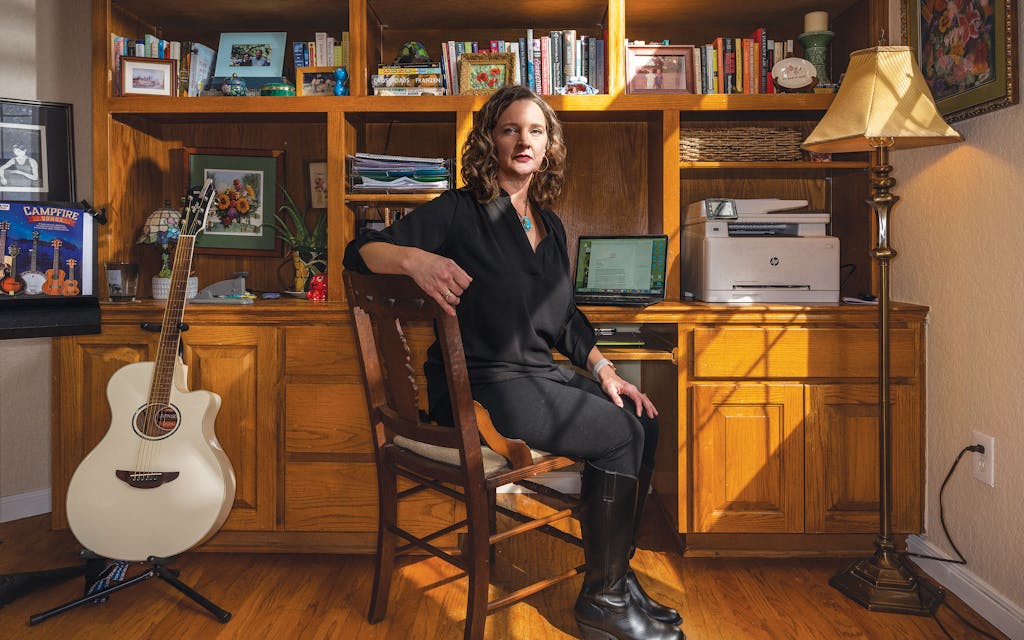
In retrospect, Day’s decision to run for the school board seems almost inevitable. She grew up in Houston, the daughter of a prominent Methodist minister, imbued with and rebelling against all the values that implies. She excelled at Lamar High, a well-regarded public school, and then at Rice University and in law school at American University, in Washington, D.C.
Before she became an adjunct professor at both American and across town at Catholic University, Day held a prestigious fellowship to teach in a law program at one of the lowest-performing high schools in the district. She went on to become a public defender as some of her former students had their initial encounters with the criminal justice system. “He was fifteen and illiterate,” she said, recalling the arrest of one. Day also saw firsthand how learning disabilities can be destroyers of equal opportunity when a member of her own family was affected, another reason she had a soft spot for those who are left behind.
By the time her family arrived in Dripping Springs, much of the town’s claim to rural simplicity was disappearing. Today there are few traces of what natives call Old Dripping, the sleepy spot with a handful of one-story limestone buildings lining a main street that gave way to dusty roads and cedar-dotted hills within just a few blocks. Even if it is the “wedding capital of Texas,” thanks to its Hill Country setting, Dripping Springs has become an extension of a bursting-at-the-seams Austin. It has more than doubled in size since 2014, to a population of around six thousand. A frenetic U.S. 290 slices through town. Some old ranches remain, set far back on caliche roads, but they’re outnumbered by Orangetheory and Starbucks and H-E-B chains that serve the inhabitants of sprawling housing developments with names like Belterra and Cortaro or the more nostalgically titled Double L Ranch.
In the old days—say, before the end of the twentieth century—Dripping Springs was a go-along, get-along kind of place: a one-stoplight town where differences between Democrats and Republicans, or ranchers and hippies, didn’t amount to much. Not so long ago, social media was focused on identifying stray cows and on teenage boys driving too fast (“If this is your son, we need to talk . . .”). Explained resident Kent Willis, “The politics have always been fairly conservative in the sense that we understand there’s a role for government. We want that role to be minimal, but we understand you need things like schools, police, and firefighters. We want our kids to get a good education.”
In the old days—say, before the end of the twentieth century—Dripping Springs was a go-along, get-along kind of place: a one-stoplight town where differences between Democrats and Republicans, or ranchers and hippies, didn’t amount to much.
The town’s school district, with its five elementary schools, two middle schools, and one high school, has consistently received A ratings from the Texas Education Agency. The district’s success can be at least partly attributed to wealth—median annual household income is around $111,000. Roughly 20 percent of the kids are listed by the TEA as being at risk of dropping out, with 9 percent economically disadvantaged. In Austin ISD, by contrast, about half the kids are considered economically disadvantaged and at risk, statistics that are not coincidental to the growth in Dripping Springs. A major reason, if not the major reason, for the town’s explosive growth has been its schools.
For a while, the Dripping Springs community united against the kinds of divisive culture wars that were raging in other Texas towns and cities. In the fall of 2016, Julie Pryor, the beloved principal of Walnut Springs Elementary, allowed a transgender third grader to use the girls’ restroom. (The child had previously been accommodated in the faculty restroom.) Because the school was small, many parents knew Lily (a pseudonym to protect her privacy) and her family and had no objection. “She was just a third grader,” said Andy Hutton, a soft-spoken Walnut Springs dad who is also a partner at a high-powered Austin law firm and was an assistant attorney general under Greg Abbott. “She was fun. She was well-liked and had a lot of friends. But she knew who she was in a way that I don’t know that a lot of third graders did.”


There was also enormous support for Pryor, Hutton said. “We felt if Julie was making a certain decision, she had the interest of these kids at heart. She knew every one of them. She knew what would make them thrive. The parents had a high level of trust.”
Still, word of the accommodation reached Jonathan Saenz—maybe from a local parent, maybe from a local pastor. Saenz, president of the far-right Austin-based group Texas Values, brought the equivalent of a traveling medicine show to an open field on the elementary school grounds to protest. Gray-suited and wearing a red tie, his dark hair slicked back against a harsh November wind, the 49-year-old Saenz stood at a podium and expressed his deep disappointment with Dripping Springs ISD’s supposed “efforts to hide the truth” about Lily’s use of the girls’ restroom. Eight more adults and two abashed-looking schoolchildren flanked him.
State representative Jason Isaac next tried to speak over the wind, stating that his concern extended beyond the schoolchildren of Dripping Springs to the “safety of women throughout the state.” Isaac has worked on various projects with and for the Texas Public Policy Foundation, the organization funded in part by billionaire Tim Dunn, who has long advocated allowing parents to use tax dollars to send their children to Christian schools—and who once told then–house speaker Joe Straus, who is Jewish, that only Christians should be in leadership positions.
Republican state senator Donna Campbell, whose district includes an area stretching from San Antonio to Austin, sent a statement to her supporters that day, asserting that allowing Lily access to the girls’ restroom represented “a breach of trust” between the parents and the school leadership. Campbell, too, has links to TPPF. She’s also accepted political contributions from the voucher-supporting Texans for Education Reform and is a vocal supporter of charter schools. (Last cycle, she took $5,000 in contributions from Texas Charter Schools Now.)
This performance happened to occur at the same time that Lieutenant Governor Dan Patrick and a band of far-right legislators were touting the infamous “bathroom bill,” which would have required transgender Texans to use public restrooms according to the sex they were assigned at birth. The feeling among many in Dripping Springs was that lawmakers “were casting around and looking for a story to launch into some public forum before the legislative session,” said Hutton. He didn’t have trouble persuading others to join him in support of Lily and the principal. “I think we all felt that we would not let them make Julie Pryor into some sort of pariah who was trying some sort of social experiment.”
Hutton added that it was also easy to win local support because so many residents viewed Saenz as “an outsider trying to shake up our town and score political points and, on top of that, use a third grader as a political football.”
One of the parents that Hutton enlisted was Day, who was just finding her footing in town. “I felt horrible for Lily and her family. We were concerned about her safety,” Day recalled. “We should be protecting all kids,” she added, expressing a sentiment she repeated often. Before long, Day and Hutton formed a group whose name was a play on the district’s mascot: “Many Stripes, One Tiger.” Within 48 hours they gathered five hundred signatures on a petition that supported Pryor.
Day drafted and issued public statements and organized members of the community to show up for board meetings, where the emotional heat was quickly rising from a simmer to a boil. “Our messaging was, ‘This is our child, our community, our administrators,’ ” she told me. “That really resonated across our community.” Soon there were overflow rooms for the growing number of local speakers, most of whom supported Lily and Pryor. “It got to the point that meetings went on till midnight,” recalled resident Elizabeth Bryant, who had children in the school.
Finding itself competing against a local group that was better organized and had a bigger megaphone, the outsiders from Texas Values and their supporters simply stopped showing up for board meetings. Soon after, they stopped showing up in town at all. “They expected they could pack the meetings with speakers saying how horrible this was that there would be sexual predators in the bathroom,” Day said. “They thought they could cow the board into thinking that this was what the community wanted. Instead, they got a huge backlash.”
In the end, the school board refused to overturn Pryor’s decision, and Lily was left in peace. “That was the Dripping Springs I came to and knew,” Day said.
As it turned out, Day was both too optimistic and too naive. By the end of 2016, school board dustups had erupted across the state. Even victories turned into defeats: Lily’s family, for instance, eventually moved out of state, as attacks from Texas’s political leaders on transgender children and their parents escalated.
After Trump took office, in early 2017, such divisiveness intensified, even in Dripping Springs. Those who once might have kept their most extreme views to themselves now felt no need to do so. They included Del Bigtree, a right-wing talk-show host and anti-vaccine activist, and Phil Waldron, who was later subpoenaed by the January 6th Committee for his role in distributing a 38-page PowerPoint to Trump’s then–chief of staff Mark Meadows and other supporters of the president, containing plans to overturn the 2020 election. Some of the newer nondenominational evangelical churches in town began participating in school events more frequently than their old-fashioned Baptist or Methodist counterparts had, a few of them bringing along a level of intolerance for kids who were different.
The biggest catalyst for division, though, might have been Dripping Springs’ explosive growth. It became clear to the school board that it would have to build additional elementary schools and expand the high school, which was nearing capacity. The estimated price tag was $132 million, and a bond election was scheduled for 2018.
In the past, bond elections did not often evoke, say, the Battle of the Alamo. But just as school board wars were escalating around the country, so did fissures appear—or widen—in Dripping Springs. A pair of newcomers named Valerie and Martin McConahay formed a group called CEEDS, Citizens for Excellent Education in Dripping Springs, and launched an online campaign largely driven by Facebook. Their website was a hot and heavy testament to their anti-bond passions: “This Bond is Full of Nonessential, Excessive and Wasteful Luxury Expenditures—DSISD Wants to Borrow Against Our Homes for Everything but the Kitchen Sink!” one post declared. “Taxes are Busting Our Household Budgets and Putting Our Homes at Risk!” read another. (Rare was the post without an exclamation point and random capitalization.)
According to Hutton and members of the school board at the time, none of these assertions were true. Yes, property tax bills in the district had skyrocketed, but that’s because the average home value had shot up to roughly $500,000. The property tax rate had stayed the same for years. “We were just building modern schools like everyone else, and it’s expensive,” said Hutton.
But now, as with the fear-driven controversy over Lily, a small brush fire became a conflagration. Again, the attacks were personal. In this case, the target became the president of the school board, Carrie Kroll, whose family had been in Dripping Springs for generations and who had attended the local public schools. Kroll is a dark-haired woman in her forties whose diplomatic
finesse was honed during her years as a lobbyist for Texas hospitals. Hers was the last high school graduating class of fewer than 100 students, in 1994;
28 years later, her daughter’s class numbered 512. The Dripping Springs of her day, Kroll told me, was “a little slower and quieter,” and the community came together and pitched in. “People worked hard and wanted to provide for their kids. My mom was in the schools constantly. I followed the example I was given.”
Kroll had served uneventfully since 2012. But now, because she wholeheartedly supported the bond, she was villainized by CEEDS—and its followers. Everything from her clothing to her acreage in the country were subject to attack on social media and at board meetings. The situation deteriorated to the point that Kroll began receiving death threats. “We went through a phase where we told our kids not to answer the phone or go to the door,” she said.
Meanwhile, the McConahays continued spreading propaganda, focused mainly on the supposed incompetence of the board and the assumption that property taxes would increase should the bond pass. “They managed to create a cultural movement that gets passed along from person to person,” said Hutton. “You start a conversation on Facebook that reaches out to one mom who didn’t like the idea of a $132 million bond, and she talks to her neighbor, and it grows.” (The McConahays did not respond to phone calls or emails.)
The couple weren’t tyros who got lucky, however. Both McConahays are experienced political consultants. And this wasn’t the first time they’d waged a fight against school bonds. “They were involved in a similar operation in Denton and ran a similar playbook,” said Willis.
Sandy-haired and bespectacled, Willis is himself a political consultant, his rueful sense of humor a probable occupational hazard. He learned his trade at the feet of Karl Rove, widely credited with the rise of George W. Bush. Willis knows an orchestrated political effort when he sees one. “They got involved with bond issues, stirred up trouble, submarined them. That’s their MO. Now they’re here doing it,” Willis said of the McConahays.
It turned out that CEEDS, which at first glance appeared to be a purely local affair, was something altogether different. The biggest benefactor was Monty Bennett, a wealthy hotelier who lives in Dallas. Bennett is a growing player in the school-privatization movement. A cofounder of the nonprofit Texans for Education Rights Institute, he was recently involved in a secretive plan to implement a backdoor voucher scheme in the nearby Hill Country town of Wimberley. (Those efforts failed once community leaders discovered them.) His far-right bona fides are unassailable: he was a major Trump donor and was present at the U.S. Capitol insurrection, though he was not accused of entering the building.
As it happened, the bond squeaked through by 50.47 to 49.53 percent, a margin of just 31 votes. Subsequently, CEEDS demanded and lost a recount, then sued. The vote was upheld, but the legal fight and construction delay ended up costing the district (and the taxpayers of Dripping Springs) roughly $500,000.
It was clear that the district was coming under ever-larger attacks, and the more traditional, service-oriented board members such as Kroll saw the need for backup. A seat came open in 2019, and that’s when a group of locals began urging Day to run. She agreed to think it over despite the strife she had seen. “I really felt like I had the experience and skill set to do this,” she told me, apologizing for sounding so earnest.
In a field of four candidates running for two open slots, she won a seat handily, with relatively mild opposition from CEEDS and a pinch of negative press from the Texas Scorecard, the powerful right-wing publication funded in part by Dunn.
Like any newly elected official, Day was excited about her role. Never one to walk into a situation unprepared, she educated herself in all the different forms of accountability. She studied land acquisition. She investigated ways the district could improve its special ed programs. Her house filled up with binders and more binders. But there were some things she couldn’t anticipate. “I had no idea what I was getting myself into,” she said.

By the time Day took office, activists had been chipping away at public education in much the same manner as those opposed to abortion and to measures that made it easier to vote. They moved deliberately, stealthily, and creatively.
In the nineties, the state’s most powerful school-privatization advocate was a San Antonio physician who became one of the richest men in Texas by manufacturing a better hospital bed. By the early aughts, James Leininger had become better known as the top political campaign contributor in the state.
He created the Texas Public Policy Foundation, in 1989, as a nonprofit “research and outreach” arm devoted, its website claims, to “liberty, responsibility, and free enterprise.” A progressive lobbying organization described Leininger’s interests as “vehement opposition to tort laws, abortion, and gay marriage.” He also advocated for “the teaching of such conservative Christian ideas as creationism in private and public schools.”
From the earliest days of TPPF, Leininger was a proponent of school vouchers. He spent millions on a program in the early nineties that was supposedly designed to help poor Latino kids in San Antonio but was quietly abandoned. Still, Leininger found an ally in Governor George W. Bush, who ran in 1994 on an education-reform platform that included, along with greater school accountability through standardized testing, support for charter schools and vouchers. Bush got nowhere with vouchers, though in 1995 Texas’s first bill creating charter schools passed, promising “schools of choice” for kids ostensibly stuck in failing public schools.
Leininger spent millions on a program in the early nineties that was supposedly designed to help poor Latino kids in San Antonio but was quietly abandoned.
Charters, which are public schools run by nonprofit organizations (some of which contract out their operations to for-profit companies), are exempt from some of the regulations imposed on traditional public schools. They have more freedom to hire and fire teachers and do not have to abide by state-mandated curriculum standards. Once the Legislature signed off on the charter experiment, the number of such schools soared over the next five years, to 146, with minority students representing about 78 percent of their enrollment.
Some well-managed and well-funded charters lived up to their promises, but many became mired in scandal. This may have been because, as one school historian noted, “the State Board of Education granted charters to just about everyone who applied.” The objections to charter schools are akin to those regarding vouchers: when students leave public schools, the money goes with them, often to institutions of debatable quality. As critics of both vouchers and charters have asserted, this setup often proves more lucrative for the companies that run them than beneficial to the students who enroll.
The setbacks to privatization did not deter Leininger and his allies, however. During the 2005 legislative session, a voucher bill was pushed by House Speaker Tom Craddick and Governor Rick Perry, both of whom had ties to TPPF. (Perry was simpatico with Leininger, once commenting that “this separation of church and state is just false on its face.”) Even with that backing, rural legislators, the bulk of them Republican, quashed the effort. Leininger then spent $5 million on an effort to unseat those who had opposed his voucher dreams.
In 2006 Leininger found powerful new allies when Dunn, with a major financial assist from the Wilks brothers, formed Empower Texans. Public education became one of its primary targets, in part because the property taxes that funded schools ran counter to their interests as billionaires and in part because they wanted more Texas children exposed to their version of Christian values.
Coincidence or not, the Legislature in 2011 famously slashed $5.4 billion from the public-school budget, citing a projected revenue shortfall. Some of those funds were restored in 2013—the shortfall turned out to be smaller than lawmakers had insisted—but the battles over school finance became as routine at the Capitol as bourbon and branch water.
What voucher proponents needed most was a powerful champion who was also a gifted salesman. Former sportscaster and right-wing talk-radio host Dan Patrick happily stepped into the role. Elected to the state Senate from Houston’s prosperous, white, northwestern suburbs in 2006, the perpetually youthful but often choleric Patrick was lieutenant governor by 2015. Patrick found school choice and its kissing cousin, property tax reduction, to be winning issues among his right-wing base and his growing cadre of big-money donors, who, along with the backers of TPPF and Empower Texans, also included the billionaire deans of dark money, the Kansas-based brothers Charles and David Koch.
The American Legislative Exchange Council, commonly known as ALEC, is a powerful Koch-supported organization that has devoted much time and money to privatizing public schools nationally. According to a study by the watchdog group Common Cause, Texas has one of the highest concentrations of state lawmakers connected to the organization, at around 32 percent. One of the first bills Patrick introduced in the 2011 legislative session called for eliminating the ceiling on the number of charter schools allowed in the state. It failed, but the relentless Patrick rammed it through two years later. Echoing Republican U.S. senator Ted Cruz, Patrick would also proclaim vouchers to be “the civil rights issue of our time.”
Despite his rising influence, Patrick tried but again failed, in 2013, to goad the Legislature into setting up what he called the Texas Equal Opportunity Scholarship Program (a.k.a. vouchers). Even so, ALEC-backed members supported the bill, setting the stage for future fights.
Over the next few years, as the Legislature swung further right, it also became more beholden to TPPF, Empower Texans, and, evidently, ALEC. One reason was Empower Texans’ creation, in 2015, of the Texas Scorecard, an online publication that keeps a watchful eye on how closely elected officials hew to its priorities. (No one is safe. A recent headline on the site asked, “Should John Cornyn Resign?”)
“Every member was held in sway by the Texas Scorecard,” said Republican former state senator Kel Seliger. “They were afraid of retribution from TPPF and the lieutenant governor. They buy the seats, and now they have them in hand.” Seliger, who retired in January, was muscled out as chair of the Senate Higher Education Committee in large part because of his opposition to vouchers.
The state’s leadership has found other ways to undermine public schools. Texas, according to the latest data, ranks fortieth when it comes to school spending—$10,300 per pupil annually, compared with the national average of $13,500. According to a survey conducted by the Annie E. Casey Foundation, a charitable organization devoted to child welfare, Texas gets what it pays for, ranking thirty-third in the U.S. in the quality of its K–12 education.
Then there is the state’s ongoing loyalty to the STAAR test, the results of which are used to evaluate teacher and school quality. Its efficacy has been widely challenged by educators, parents’ groups, and academic researchers, who have found that the test’s demands are often well above grade level. And because the test is used as a yardstick to grade (and potentially close) schools, test prep has taken over actual teaching in many classrooms.
Abbott, Patrick, and other critics of Texas’s public schools blame their poor STAAR performance on many things: teachers unions, the lack of competition, and poor leadership at the district and board level. To be sure, many schools have been dysfunctional for decades. Houston ISD, which the state is currently trying to take over, has suffered from chronic corruption and mismanagement. But even critics of that district say they fail to see how the situation would be improved if the state got involved.
Of course, for those who have long sought to undermine public schools, the biggest gift arrived in March 2020.
From the vantage point of three years, it can be hard to conjure those disorienting early days of the pandemic, the terrifying period when schools and businesses shut down seemingly overnight—when there were no vaccines, when the death tolls were skyrocketing, when no one, including the best doctors in the world, knew what to do.
Even so, parents, teachers, and administrators initially banded together for what was seen as a higher purpose: to do right by schoolchildren while keeping them safe from the virus. During that period, educators were briefly hailed as heroes doing their best in a nearly impossible situation. But as the months of Zoom classes wore on, something changed. Children fell behind in their studies. Many parents grew frustrated, while others, observing their children’s lessons more closely than before, became concerned about what was being taught. For some politicians on the right, the time was ripe to exploit those concerns.
One of the first and most prominent was Glenn Youngkin, who won election as governor of Virginia in 2021 largely by championing “parental rights” over what and how children are taught. His success inspired imitators, including Florida governor Ron DeSantis and, in turn, Abbott. Suddenly public schools were being characterized as repositories for all sorts of predators, groomers, pornographers, inappropriate-restroom users, critical race theory proponents, and other generally unsavory types—including LGBTQ children. That this moral panic was ginned up in large part by frequent-flier far-right activists such as Christopher Rufo was not widely understood.
At around this time, handbooks proliferated that spelled out how-tos for disrupting school districts and taking over school boards. At least two pamphlets were produced by an organization called Tea Party Patriots Action, which has links to the January 6 insurrection. (An early funder of the group was San Antonio’s picante-sauce king Christopher “Kit” Goldsbury.)
One version of the booklet has clearly been modified for Texans, given its references to the battle for the soul of the Southlake school district, northeast of Fort Worth, and the document’s attack on the Texas Association of School Boards, which has long been opposed to vouchers and other attempts at privatization. “Whether you want to influence policy on masks, in-person school, Critical Race Theory or anything else, this mostly requires talking to other parents/community members who agree with you, and then go from there—build a team and decide what your goals are before you launch your plan,” the pamphlet urges. “Be brave! You can do this!”
It also suggests turning to help from organizations such as Parents Defending Education, a Koch-connected group that claims to be a grassroots nonprofit. Yes, it would be beneficial to tackle issues on the national and state level, the pamphlet continues, “but it will likely be easier to take them on and dismantle them if we address it at the local level first. You’ll see that the first set of associations highlighted are those for local school boards.”
Maybe, being experienced political operatives, the McConahays didn’t need such advice. But those tactics were reflected in their Dripping Springs campaign. After their efforts to tank the 2018 bond failed, CEEDS became even more strident on social media in its war against the school board. Facebook posts were often accompanied by memes of burning cash, rotten apples, or a woman looking appalled. A series of posts crowed about the growing number of likes the page received. (“What’s the significance of 890 Likes? It means we now have over FOUR (4) TIMES as many Likes as the current Dripping Springs ISD School Board Members’ Average Number of Likes, which is only 222.43!”)
After their efforts to tank the 2018 bond failed, CEEDS became even more strident on social media in its war against the school board.
As the pandemic wore on and schools remained closed under orders from the state government, board meetings, held virtually, became increasingly combative across Texas. Dripping Springs was not immune. The fury boiled over once in-person meetings resumed in early 2021. As was happening elsewhere across the state and the country, the debate over masking became a stand-in for all the pent-up fear, anger, and frustration caused not just by the pandemic but by the divisive politics that preceded it and exacerbated it.
Once the schools reopened, opposing groups squared off against one another, placards brandished, in front of the auditorium, where the board meetings were moved to accommodate the teeming crowds. Inside, the gatherings, which had previously been mundane affairs, dragged on for hours, with person after person tongue-lashing the board with epithets that included but were not limited to “useless,” “power hungry,” and “corrupt.” Those at a loss for words could find talking points on the CEEDS Facebook page.
The attacks were dizzying. “We are told we are abusing children if we require masks, and we are murdering them if we do not,” Day realized at one point. There was no middle ground, no room for compromise. Nor at that point was there much reliable information from epidemiologists or much guidance from the state. “Eric and I began to get more nervous when we saw how angry and irrational people were, on all sides,” she told me. “That’s when we decided to put up cameras [at our home], and I started carrying Mace.”
It seemed impossible that the situation could deteriorate further, but in fact it got worse as the year went on. There was another school board election in May, with three seats open. Locals on the far right heeded the call of former Trump administration provocateur Steve Bannon and, with CEEDS’s fervid support, ran multiple candidates for the seats. “The ratio of extreme social conservatives outnumbered more traditional board candidates six to three,” said Kent Willis. “Typically, the normal to right-wing-nut ratio has been even or better, going back to 2016. For every kook, there was a sane candidate.” The glut of candidates ended up splitting the vote. Among those on the far right, the only winner was Stefani Reinold, a local psychiatrist who had been a vocal anti-masker.
After that election, Del Bigtree covered school board meetings on his talk show, The HighWire, calling on Reinold to provide color commentary and raising the temperature even higher. While the meetings degenerated, local law enforcement was loath to interfere, although constables, when pressed, did escort board members to their cars after the assemblies. There were near-fistfights and lots of name calling; one of Day’s supporters was called a whore in front of the school. “I remember being shocked because some of these were people I knew,” said Day supporter Bryant. “I saw sides of them I didn’t know existed.” Attendees once stormed the desks where board members sat, grabbing their papers and tearing them up.
Meetings weren’t limited to parents who had kids in local schools or even to residents of Dripping Springs. People from all over the county started showing up. That included members of the Hays County Freedom Network, mostly from nearby Buda and Kyle, whose logo includes a burning cross over an American flag in the shape of Texas. They created a sort of umbrella group for anti-maskers in the area, who showed up at the meetings without face coverings and ripped up the yellow tape designed to keep attendees six feet apart.
Things were so bad by August that a parent named James Akers made an appeal for consensus on mask wearing by stripping down to a tiny bathing suit while providing a semicomedic monologue about what happens when rules created for the greater good aren’t followed. “On the way over here, I ran three stop signs and four red lights,” he said. “I almost killed somebody out there but by God, it’s my road too, so I have every right to drive as fast as I want to and make the turns that I want to.” The bit went viral but didn’t change anything. “It was all about ‘my child’ and stopped being about our children,” said Suzy Robbins, who worked on Day’s campaign.
Disheartened, Day was in a quandary as 2021 came to an end. Her term was up in May 2022, and there was still so much she wanted to do. She had willingly worked for free—Texas school board members are unpaid—and had sacrificed countless hours with her own kids. Still, she said, “I like public service, being part of a team that’s moving things forward in a productive way.”
She felt as though she had done that, getting the board to focus on improving student achievement and to evaluate the state’s standardized STAAR test results in the most accurate way possible and helping the board more clearly understand internal audits. She knew that to be an effective school board member she had to keep an eye on finances, but she also knew that wasn’t the most important part of the job. “Ultimately, you are entrusted with the assets of the community for the benefit of the students. If you want to be good at what you are doing, you have to keep your eye on that. Your decisions can’t be grounded on how people vote.”
Weighing her decision, Day worried about the stress, pressure, and increasing toxicity. Close relatives and closer friends told her she’d done enough for the schoolkids and her community. Her own children, who had witnessed her struggles, begged her to let go. But she couldn’t.
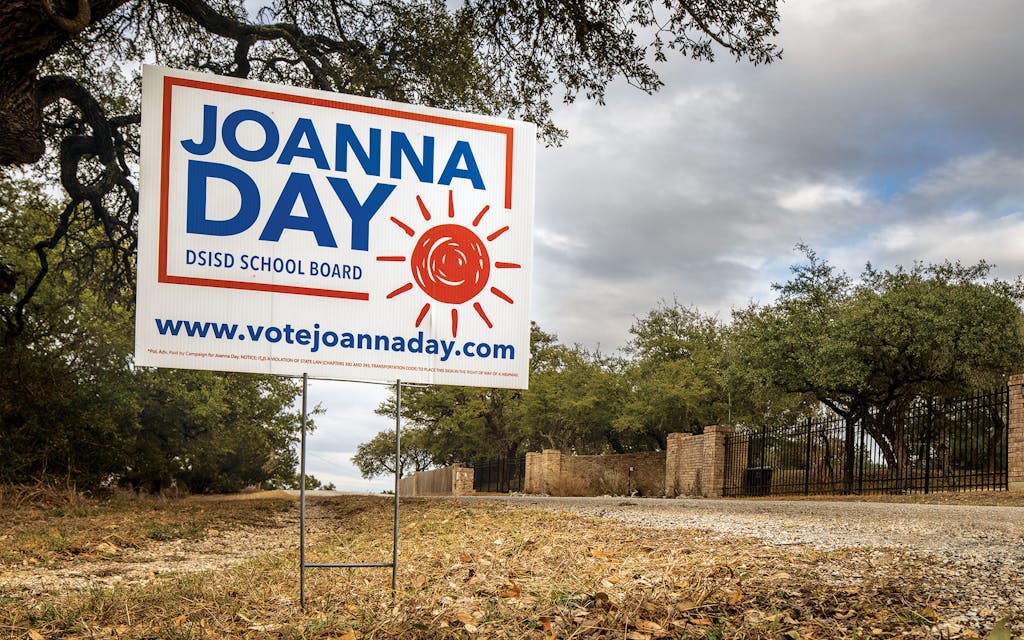
Day sensed early on that this race would be different. She regrouped in January with many who had worked on her first campaign, drawing up strategy and putting together a list of donors. In 2019 she’d spent around $5,000, average for a school board race in Texas. This time, team Day knew they would need more. She recycled her campaign slogan, which was, like Day herself, straightforward and unpretentious: “I believe in the power and the promise of public education.”
Two board positions were open, and another moderate—a wry engineer by the name of Thaddeus Fortenberry—had signed on to run. Others had considered it but were unwilling to subject themselves and their families to the kind of abuse that had characterized the previous year. Meanwhile, those on the right had learned from their mistakes. Instead of running the six candidates who split the vote in the 2019 election, they ran only two: a project manager for T-Mobile and mother of five, Tricia Quintero, and a local realtor and single mom, Olivia Barnard. If they both won, they would join far-right member Reinold, who had recently commented on social media that “liberalism is a mental illness.”
Before moving to Dripping Springs, Quintero had been a disruptive force down the road in the Hays Consolidated ISD, where she’d battled unsuccessfully against the passage of a school bond. She had a well-meaning mien, describing herself as a “God Fearing woman” in campaign literature, and her straight brown hair fell below her shoulders. She favored casual tunics, tees, and jeans, the uniform of the harried mom. Her campaign slogan was “Put the Trust Back in TRUSTee.” Her husband happened to be James Quintero, policy director for the Texas Public Policy Foundation. The concern, as Kent Willis put it, was that “Tricia was just a stalking horse for her husband.”
Barnard could have been mistaken for Quintero’s opposite. The former looked like the successful real estate agent she is. If she wore jeans, they were stylishly ripped and accessorized with a tasteful hacking jacket. Her sable-hued hair shimmered. Her teeth and nails gleamed. But Barnard was Quintero’s equal in her support of the Republican party’s far-right flank. On social media, Barnard posted photos of herself with Donald Trump Jr. at Mar-a-Lago, as well as candid shots with Supreme Court justice Brett Kavanaugh, Florida congressman Matt Gaetz, and failed Arizona gubernatorial candidate Kari Lake. Barnard had captured a video of an altercation at a Dripping Springs school board meeting that then appeared on the website of Charlie Kirk’s Turning Point USA, a controversial nonprofit that has propagated disinformation about electoral fraud and vaccines.
With masking controversies receding in the rearview mirror, political operatives needed new material with which to fester discontent. Next up were library books. Quintero came out early with a stand on what she asserted were “school libraries all across the state” filled with “inappropriate reading material, including books with pornographic images,” though she never cited any specifics. She called for the Dripping Springs school board to do its own investigation of such books and promised, if elected, to “fight every day to protect our kids from the filth that seems to be infecting so many other school districts.” (After a review of library materials, the district opted not to remove anything.) This all came in the months after TPPF launched its “Set the Captives Free” fund-raising initiative, raising the straw man of critical race theory.
Day had sailed through her first campaign; now personal attacks appeared almost daily, some on CEEDS’s various Facebook pages and some on her own. Some commenters were volunteers for Barnard and Quintero, but others were just angry Dripping Springs residents, including some Day had seen at her kids’ schools, at the grocery store, or while filling up her minivan with gas. “I didn’t have to get offline in 2019,” Day told me. “I didn’t have to have someone manage my social media.”
That changed in 2022. Stefani Reinold’s husband, Travis, who self-
produced a podcast on “Christianity and Mental Health,” suggested obliquely on his show that pro-mask school board members should have “a heavy millstone around their neck and be thrown into the depth of the sea.” The opposition also attacked Day for covering her face long after Abbott rescinded the mask mandate. (Because her father was dying in a nursing home, Day continued to mask.) One critic, a parent of one of her kid’s classmates, inexplicably attacked her for helping out at an elementary school book fair. The vitriol left her shaken, and she was not the only one. Friends who had supported Day in the past were frightened too, suddenly reluctant to put campaign signs in their yards. Meanwhile, signs and billboards trumpeting Barnard and Quintero started sprouting all over town, like bluebonnets after an April rain. “At that point I saw that they had more community support than I had hoped,” Day said.
Most threatening to Day’s success, though, was her loyalty to the tradition of nonpartisanship in school board races. “It was like blood in the water for the crazies,” said political adviser Willis. Those who supported Quintero and Barnard tagged Day early as a liberal, after their opposition research turned up her old Democratic-primary voting record. There was no undoing that tag, even as she stressed her refusal, since becoming a trustee and campaigning for reelection, to attend forums sponsored by any political party. Day did not fill out the CEEDS candidate questionnaire for the same reason, which opened her up to still more criticism.
She stayed resolute, and even today her voice hardens when she explains herself. “I don’t think, when you are talking about education, partisanship really has any role,” Day said. “To me, I represented the kids. All the kids, whether their parents agreed with my viewpoints or not. Our schools have to serve everyone in the community. They have to serve the kids whose parents voted for Biden. The kids whose parents didn’t vote. And the kids whose parents voted for Trump.”
Barnard, in contrast, seemed to have no interest in avoiding party politics. Many of her largest campaign contributions came from wealthy Republicans who did not live in Texas. Of the $14,000 she raised, $2,500 came from Jim Lamon, who recently ran unsuccessfully in the Republican primary for U.S. senator in Arizona and has been implicated in a “false elector” scheme to overthrow the 2020 presidential election. (Lamon, along with ten other members of the Arizona GOP, filed paperwork after the election asserting that he was a duly elected “qualified elector” when he wasn’t. Lamon later told the Arizona Republic, “This is a heck of a lot to-do, from the left, about moving off of the real issues of this country.”) Barnard also collected $1,500 from Priscilla O’Shaughnessy, a board member of the Kansas Policy Institute, which is active in ALEC and has taken contributions directly from the Koch brothers.
“What should have been a sleepy school board race essentially turned into a Texas House campaign,” noted Bryant, who had become Day’s campaign manager. “We were not thinking about text banking and phone banking. We didn’t think we needed that. Then it became, could we get enough money for a third mailer?”
The team believed that Day’s sincerity and expertise would win the day. To combat the false claims of reckless spending by the district, she made videos with her kids, pouring water into various buckets to explain school finance. They may have been charming, but the point wasn’t taken. “People didn’t want to watch four and a half minutes of videos to understand school finance,” Day told me.
She didn’t seek any political endorsements and declined those that were offered, even as the district’s congressman, Chip Roy, publicly supported Day’s opponents. In a press release, Roy began by identifying himself as “a parent of school-age children,” without revealing that his own kids attended private school. “I recognize how important it is for our school board to fully reflect the values of our community, promote financial and curriculum transparency, and—most importantly—empower parents and protect students instead of radical special interests, corrupt unions, and rogue bureaucrats.” (He had earlier tweeted his preference for private school by claiming that he kept getting his “values blown to heck . . . in schools where bathrooms become social engineering experiments.”)
Undaunted, Day pushed harder. She and her team identified two thousand voters who had never participated in school board elections and sent them handwritten notes asking for support. She knocked on 1,500 doors, sometimes in neighborhoods that had never seen or heard from anyone running for office, where dogs constantly nipped at her heels. “My dad died while I was campaigning,” Day said. “I told my mom we couldn’t have the memorial service until the campaign was over. I was really all in it.”
She remained optimistic despite some dark portents, including on a warm spring evening in April, just a few weeks before the election. The Founders Day parade is a Dripping Springs tradition, a return to and reminder of its small-town roots. The parade travels the few blocks that make up the main street; grown-ups and kids ride with their friends on homemade floats touting local businesses and schools. Pep-squad members toss plastic “tiger beads” to the crowd. Local bands march and local musicians play. Townspeople line the streets and cheer on just about everyone. In 2022 the theme was Dripping Springs Through the Decades. Quintero and Barnard shared a campaign float, dressed in fifties-style poodle skirts.
Before the event, Day considered dropping out. “People were telling me they didn’t think it was safe for me to do it,” she said. By then it didn’t matter whether threats were real or imagined; fear thrived regardless. Day decorated her float with bright yellow suns and her campaign slogan, the one about believing in the power and promise of public schools. Riding along on her float, smiling gamely and waving to the crowd, Day was either too anxious or too hopeful to notice that some of the spectators who saw her turned their backs, one by one.
The election arrived on May 7. Day and her team gathered with friends and donors for an evening watch party at the home of one of Day’s volunteers. Kent Willis kept hitting the refresh button on his laptop to get the latest numbers. The more time passed, the more somber he became. “She’s going to lose this,” he said at one point under his breath.
In the end, for the two seats available, Barnard clocked in with 2,994 votes and Quintero at 2,993. Day received 2,931. “Conservatives Who Promise to Stop Leftist Racism Win Texas School Board Seats,” declared a missive from the Texas Public Policy Foundation.
That night, Day took down her Facebook page and website because, even in defeat, she was still being trolled. Something else was being trolled with her: the community that had once put aside all its differences to protect an eight-year-old child. As Bryant put it, “The idea that public schools are supposed to be for all students and not just some students, and that schools should be a safe place for all kids—it seems our community no longer cared about that.”
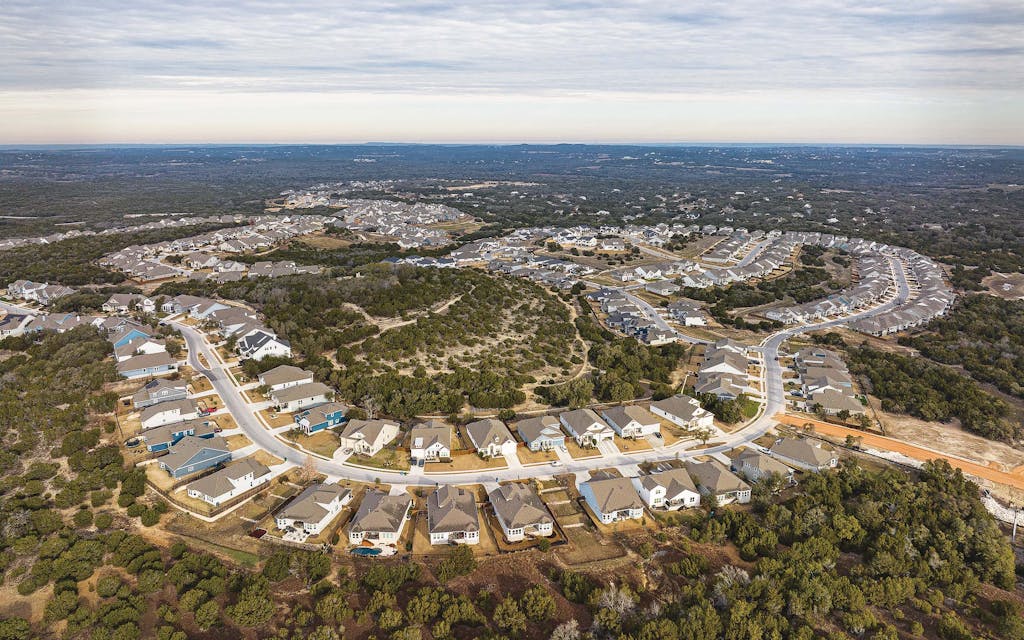
In November, Dripping Springs voted down three proposed bonds for the school district. Those who had supported the bonds were, naturally, crestfallen. They worried that there would not be enough classroom seats—literally—to accommodate new students. Enrollment in the previous ten years had nearly doubled, from 4,500 to 8,500 students. That attendance has grown much larger than Dripping Springs’ relatively small population might suggest is due to the many developments that have sprouted just outside city limits, and all projections showed the enrollment would double again in the next ten years, to 16,000.
In victory, there was much meme joy on the CEEDS Facebook page. The authors thanked, among others, Congressman Roy, the newly elected state representative Carrie Isaac, and Rick Green of the Dripping Springs–based Patriot Academy, a national political network whose mission is “to equip and educate a generation of citizen leaders to champion the cause of freedom and truth in every sector of society, as we help restore our Constitutional Republic and the Biblical principles that cause a Nation to thrive.” That group is “partnered” with Patriot Mobile, the right-wing phone company based in North Texas.
Not to be outshone was the Texas Scorecard, which tipped its hat to “local activists”—CEEDS—for convincing the majority of voters that “the school board could not be trusted with responsible management of taxpayers’ money.” Tricia Quintero’s husband James chimed in on Twitter: “Last night, voters soundly rejected the idea that we should keep kids trapped in failing public schools.”
One likely reason for the bond’s failure was a small addition to the ballot that privatization advocates had won during the legislative session back in 2019. By law, all school district bond-referendum ballots now had to contain the words “This is a property tax increase.”
That’s narrowly true but highly misleading. Had the bond passed, the interest and principal on it would have been repaid over time by the school district, through increased tax revenue. But that revenue need not necessarily come from a tax increase. It could also come, especially in a fast-growing town such as Dripping Springs, from higher property values and from new residents paying taxes.
Early this year, as the current legislative session got underway, legislators backed by Dunn and the Wilks brothers were primed for the long-anticipated now-or-never shot at vouchers. The governor has clearly joined them. Abbott used his inauguration speech in January to continue attacking public schools, declaring that parents “deserve the freedom to choose the education that’s best for their child.” He added that “our schools are for education, not indoctrination,” a buzz phrase also used by Florida governor DeSantis in a campaign to reject high school classes in African American studies.
At his swearing-in ceremony that same morning, Dan Patrick was resolute, saying that “the governor and I are all in on school choice.” He nodded to the widespread resistance in rural communities. “To the naysayers that say school choice hurts rural Texas, the governor and I will have a plan to protect those schools financially and to make sure those parents have choice also where they are in a failing school.” Thus far, they’ve offered no details, and Michael Lee, executive director of the nonpartisan Texas Association of Rural Schools, told me that he had not been apprised of any plans. “We would hope that rural legislators would vote against any scheme that would divert public funds away from public education,” he added.
Abbott used his inauguration speech in January to continue attacking public schools, declaring that parents “deserve the freedom to choose the education that’s best for their child.”
Even if voucher efforts don’t prevail in this legislative session, significant damage has already been done to the state’s education system, especially as more teachers, weary of being scapegoated, leave the profession. The fake crisis manufactured by activists has turned into an actual crisis for those on the front lines.
Texas employed about 376,000 teachers during the 2021–2022 school year, during which 12 percent, about 45,000 teachers, left the job. About 8,500 teachers retired that same year, about 1,000 more than the number who left the previous year. Once the shortage started making news, the governor directed the Texas Education Agency to create a Teacher Vacancy Task Force to investigate the problem—which he had helped create. That move did little to reassure demoralized educators: a survey conducted by the Texas State Teachers Association revealed that 70 percent of respondents were on the verge of quitting because of the pandemic and political attacks. Eighty-five percent of those surveyed said they “didn’t believe state leaders and legislators had a positive opinion of teachers,” a number that grew during the pandemic.
Ovidia Molina, the TSTA president, was near tears as she described the ways opponents of public education have driven a wedge between schools and families. “We have the support of people who know us,” Molina said, sounding as if she were trying to buck herself up.
In Dripping Springs, many of the teachers are cowed. “I second-guess myself,” one told me, confessing that she dropped from her reading list a story about a Black brother and sister who were split up in the foster-care system and ended up in vastly different living situations. “I was too afraid of all the backlash.”
Almost a year after the school board election, Day was still processing her loss. She worries about the future of the district. Who from the more moderate side of the political spectrum would step in to run for school board in the upcoming 2023 election, given the behavior on display the last few years? If a far-right majority came to dominate the board—now they are just two seats short—one of their duties will be to choose the next superintendent, a job that has become increasingly fraught. “As culture wars envelop schools, North Texas sees a superintendent exodus” was a recent headline from the Texas Tribune. Kroll, the former school board president, told me, “The more zany our district becomes, the harder it will be to attract candidates.”
That raises another concern: with ongoing attacks and the impending possibility of overcrowded schools, will the district be able to maintain its A rating? And should that fall, what would happen to the community’s allure?
Driving down a rutted road in a forgotten part of town, Day pointed out ramshackle homes where she had knocked on doors, looking for votes. Sometimes she would say “we” when talking about the school board and then catch and correct herself. She does not spend time on social media. She avoids restaurants where those who opposed her might lurk. She remains unsure about next steps, like anyone working through a painful experience.
Day’s is the grief not of a sore loser but of someone who understands the larger consequences of what can appear to be, in the greater scheme of things, an almost insignificant defeat. One loss of a school board seat in a small town doesn’t seem like much—until that scene is repeated over and over, in towns and cities all across Texas.
This story has been updated to clarify the nature of the relationship between the Koch brothers and the American Legislative Exchange Council.
Inside the Secret Plan to Bring Private School Vouchers to Texas
Political operatives descended on the Hill Country town of Wimberley with a scheme to send taxpayer dollars to private schools. Now they’re shopping the same blueprint elsewhere.

The proposal landed on Greg Bonewald’s desk like a pipe bomb. Bonewald, a soft-spoken career educator, had served as a teacher, coach, and principal in the fast-growing Hill Country town of Wimberley for fifteen years. In 2014, he took a bigger job as an assistant superintendent in Victoria, about two hours to the southeast. But he maintained an affection for Wimberley, and when its school board sought to bring him back as superintendent this year, he was thrilled. His honeymoon would be short.
In a document obtained by Texas Monthly, stamped “Confidential” and dated May 3—the day after Bonewald was named the sole finalist for the job—a Republican political operative and a politically connected charter-school executive laid out an explosive proposal for “Wimberly [sic] ISD.” (Out-of-towners frequently misspell “Wimberley,” much to the annoyance of locals.) Apparently, the plan had been in the works for months and had been vetted by the outgoing superintendent. But Bonewald said no one had bothered to mention it to him.
One of the authors of the plan was Aaron Harris, a Fort Worth–based GOP consultant who has made a name for himself by stoking—with scant evidence—fears of widespread voter fraud. In June, he cofounded a nonprofit called Texans for Education Rights Institute, along with Monty Bennett, a wealthy Dallas hotelier who dabbles in what he regards as education reform. The other author was Kalese Whitehurst, an executive with the charter school chain Responsive Education Solutions, based in Lewisville, a half hour north of Dallas.
Their confidential proposal went like this: Wimberley would partner with Harris and Bennett’s Texans for Education Rights Institute to create a charter school tentatively dubbed the Texas Achievement Campus. But “campus” was a misnomer, because there would be none. The school would exist only on paper. Texans for Education Rights would then work with ResponsiveEd, Whitehurst’s group, to place K–12 students from around the state into private schools of their choice at “no cost to their families.”
The scheme was complex but it pursued a simple goal: turning taxpayer dollars intended for public education into funds for private schools. The kids would be counted as Wimberley ISD students enrolled at the Achievement Campus, thus drawing significant money to the district. (In Texas, public schools receive funding based in large part on how many students attend school each day.) But the tax dollars their “attendance” brought to the district would be redirected to private institutions across the state.
The plan was backed not only by an out-of-town Republican operative and a charter-school chain with links to Governor Greg Abbott, but by a Wimberley-based right-wing provocateur who bills himself as a “systemic disruption consultant.” Texas education commissioner Mike Morath—an Abbott appointee—also seemed to support the deal.
Its proponents have called the scheme pioneering and innovative. Though the effort ultimately failed in Wimberley, one of its backers says he is shopping the plan around to other districts. Critics have raised all manner of alarms.
“I’m not accusing anyone of laundering money, by the legal definition, but there sure are a lot of hands touching a lot of money in this,” said H.D. Chambers, the superintendent of Alief ISD, a district in the Houston area that serves 47,000 students. He also pointed to another, more sweeping, concern: “It’s a Trojan horse for vouchers.”
The most transformative of a set of policies often described by proponents as “school choice,” vouchers allow students to attend private schools using taxpayer dollars. For more than sixty years, school-choice enthusiasts have tried, and failed, to create a voucher program in Texas. Texas’s first dalliance with vouchers came in the wake of the 1954 Brown v. Board of Education case, in which the U.S. Supreme Court ordered desegregation of public schools. Following that ruling, segregationist legislators studied ways to keep Hispanic and Black kids from attending schools with non-Hispanic white students. (One unsuccessful idea was for the state to subsidize tuition at private schools for parents who didn’t want their child to attend an integrated school.)
In recent years, voucher proponents have flipped their rhetoric. School choice, they now argue, is a way to empower poor and minority families to get their kids out of underperforming public schools and into charters and private schools that are presumed to deliver better education. But their arguments and lobbying efforts have encountered deep resistance from voters. Teachers and administrators generally view vouchers as a thinly veiled privatization scheme and a threat to public education. They cite considerable evidence showing that vouchers, far from empowering poor families, drain money from struggling public schools while subsidizing wealthy parents who can already afford to pay private school tuition. Poor parents, meanwhile, still cannot send their kids to private schools because tuition often far exceeds the voucher subsidy.
As a result, vouchers have remained deeply controversial in Texas, and for decades an anti-voucher coalition of Democrats and rural Republicans—in whose districts the public schools are often the only game in town—has proved durable.
But the politics of public schools shifted sharply during the pandemic. The backlash against compulsory masking, the moral panic over textbooks and classroom teaching about issues of race and gender, and the palpable anger in some quarters toward teachers—all of that has animated the skeptics and enemies of public education. In January, Abbott announced a parental “bill of rights” at a charter school run by ResponsiveEd. The proposal was light on details and mostly seemed to be a repackaging of existing law—more of a nod to conservatives than a big policy shift. But then in May, the governor made waves by giving full-throated support for a voucher program.
Many school-choice activists now see the 2023 legislative session as their best chance yet to pass a voucher program. (The corporate-funded Texas Public Policy Foundation called it “do or die” in a fund-raising letter that also pledged to “free 5.5 million Texas public school students from being a captive audience to both Marxist and sexual indoctrination.”) But these activists still face strong headwinds. “Even though the governor and the lieutenant governor want vouchers badly, there’s a serious concern that a deal is not going to pass the Legislature,” Chambers told me. He pointed to the proposal that landed on Bonewald’s desk in Wimberley. “There are people doing things like this to try to circumvent the will of the Legislature by creating their own voucher system.”
Brian Woods, the superintendent of Northside ISD in San Antonio, agrees. “Everybody’s geared up for a voucher fight starting in January,” said Woods, who is also the president of the Texas School Alliance, an association of 45 school districts educating 41 percent of the state’s students. The plan quietly attempted in Wimberley, he said, offers “a way to create a voucher [program] without having to even get it through the legislative process.” If such a plan were implemented, he said, “People would go crazy.”
Wimberley, home of the Texans and the Lady Texans, is a bustling patch of Hill Country that serves about 2,700 students. It also happens to be where I graduated from high school (class of ’99). Even as a student, I was aware that, for decades, Wimberley—with its abundance of expensive homes and estates tucked away in the hills (Paul Simon has a place there)—had sent a significant percentage of its local property-tax revenue back to the state through the so-called Robin Hood system. (Also known as “recapture,” the property-tax-redistribution system was created in 1993 by the Legislature to reduce disparities between property-rich and property-poor school districts.) At one point, in 2008, the school board even considered halting those payments to the state—the equivalent of walking out on your restaurant bill.
Opponents of “school choice” cite considerable evidence showing that vouchers, far from empowering poor families, drain money from struggling public schools while subsidizing wealthy parents.
Wimberley is more politically and culturally mixed than most small Texas towns. Long a hideaway for musicians and artists as well as wealthy retirees escaping the big cities, the overall makeup tilts Republican but not overwhelmingly so. Until the last couple of election cycles, the local school board generally reflected the partisan tilt of the community—a mix of liberals, centrists, and conservatives (though trustees didn’t run as Democrats or Republicans and the work of the board was the humdrum stuff of budgets, personnel, and tax rates). In high school, I knew some of the trustees—prominent businesspeople and parents of my friends—but had no idea whether they were liberal or conservative. Then came Logo-gate.
In September 2019, Wimberley held its first-ever LGBTQ pride parade. Several students and parents wore T-shirts that depicted the Wimberley Texans logo in rainbow colors. One of the trustees, Lori Olson, posted a photo of herself wearing the T-shirt with the doctored logo—and all hell broke loose. The superintendent, Dwain York, sent emails to parents and community members threatening legal action if they didn’t stop using the altered logo. The ACLU warned the district not to retaliate against Olson or the others. The controversy dragged on for nine months and ripped the community apart. It also fired up a slate of conservatives to run for school board, backed by a new local Republican club and some of the more politicized churches in town. Olson drew an opponent who posted regularly on social media, complaining that the presidential election had been stolen from Trump and accusing Olson of “spreading LGBTQ in our schools” and “partying with the LGBTQ people . . . as transvestites marched through the town.” Within a few years all seven of the trustees were Republicans. Soon after, the voucher proposal started circulating in Wimberley.
Wimberley officials, including outgoing school superintendent York, initially embraced the Achievement Campus proposal as a way to improve the district’s finances. With enough students enrolled, Wimberley could have eliminated its recapture payments, which are $8.4 million this year out of a $34.4 million annual operating budget. Just how much of that $8.4 million would stay in Wimberley was unclear. York said he planned to insist that Wimberley hold onto the lion’s share of the state funding—$6,200 or so per student annually—a potential deal-breaker for private schools. “The private schools weren’t going to entertain that because they needed money to operate.” Charters, he thinks, would have been more amenable to his proposal.
Some of the local Achievement Campus proponents, including York, also argued that the proposal was a way of helping students in underperforming districts far from Wimberley, such as Dallas ISD. But he told me his primary motivation was improving the district’s finances. “I was being selfish,” said York. “Every superintendent is selfish. You take care of your kids. You take care of your taxpayers, you take care of your parents. And as long as it’s legal, if you’re not doing something shady, you better pursue it.”
What made the scheme possible, and ostensibly legal, was a novel twist on a 2017 state law, SB 1882, which encourages partnerships between public schools and outside entities such as charters, nonprofits, and universities. In exchange for additional state funding, a public school district cedes control of its operations to its external partner. The private partner is in charge of staffing, testing, curriculum, and all the day-to-day decisions that go into running a school. Thus far, every other SB 1882 partnership has been local in nature: the partner-run campus is situated within the district’s boundaries and serves the local community. San Antonio ISD, for example, partnered with UT–San Antonio’s College of Education and Human Development to turn three dual-language campuses into a national model for research-based bilingual education. In all, San Antonio ISD has turned over the operation of 39 of its nearly 100 campuses to an array of nonprofits, charter networks, UTSA, and other entities.
In the case of Wimberley, the new charter campus existed only on paper, and the potential student body would have been dispersed throughout the state. And unlike other SB 1882 partnerships, the operating partner would not have been directly in charge of educating students; various private schools would have been. “It sounds like a bastardization of what the law is,” said state senator José Menéndez, a San Antonio Democrat who coauthored SB 1882. “And like they twisted and stretched the meaning of the word ‘partnership.’”
Much of what we know about the proposal comes from text messages and emails I obtained through state open-records law. And though the exact origins of the proposal are murky, officials had been working on the plan for months by the time Bonewald arrived.
Activists then waged a covert campaign throughout May, June, and July to pressure trustees and superintendent Bonewald to fast-track the deal. Repeatedly, the activists urged board members to take all the necessary steps to ink a contract with a private partner by the fall. And they had a hand in drafting the legal documents used by the Wimberley school board to lay the groundwork for the SB 1882 partnership. (When I asked Bonewald if he had told the board he was being pressured or intimidated, he paused for almost ninety seconds before eventually saying, “I expressed that I was not comfortable moving forward at the pace that was desired.”)
Spearheading this pressure campaign was Joe Basel, the self-styled “systemic disruption” consultant. Originally from Minnesota, Basel moved to Wimberley in 2021. His background was unknown to most in Wimberley at the time, but Basel first came to national attention in early 2010 after being arrested, along with three of his associates, in a bizarre stunt at a U.S. senator’s office that involved Basel disguising himself as a telephone repairman. All four pleaded guilty to a misdemeanor.
The stunt’s ringleader, James O’Keefe, was already infamous by that point; the previous summer, he had released deceptively edited undercover videos that appeared to depict employees of ACORN, a community-organizing group for poor people, giving advice on how to break the law to O’Keefe—who dressed as a pimp—alongside a young woman named Hannah Giles, who impersonated a prostitute. The video went viral and led to the demise of ACORN.
Later, Basel married Giles and moved to Texas, where they became notorious for leading the now defunct American Phoenix Foundation, a James O’Keefe–style group funded by wealthy Texas conservatives, including the billionaire oilman Jeff Sandefer. Basel rattled the Capitol community in 2015 by deploying a team of videographers to covertly record lawmakers and lobbyists. The group also planted an intern in a Republican state lawmaker’s office in a fruitless attempt to document corruption. Several donors, including Sandefer, publicly disavowed the project, telling reporters that they felt burned.
Steve Bresnen, an Austin lobbyist-lawyer upset with Basel’s antics, made a three-year-long personal project out of trying to uncover what he suspected was financial chicanery on Basel’s part. He eventually got a Travis County judge to appoint a receiver to examine the group’s finances. The receiver found that at least $670,000 had been transferred over a “relative brief period of time” from APF to “multiple entities controlled by [Basel and Ben Wetmore, APF’s general counsel] and to themselves personally,” including $82,000 in “reimbursements” from the foundation to Basel’s personal account. Though Bresnen could never determine whether the funds had a legitimate use, and can cite no proof of fraud, he readily proffers his own opinion: “I actually believe, and I’ve said so numerous times, that [Basel] stole $670,000.”
In an email, Basel defended the project at the Capitol and said the transactions were legitimate. “For a time my wife and I personally floated the non-profits’ work (thus the reimbursement.) against corrupt lobbyists like Bresnen (thus his hard-on for us and the college investigative journalists we were training).”
As to the Wimberley voucher scheme, Bresnen guaranteed that “there’s a scam. And it’s the same deal he does every time. He’s not a dumb guy, but he keeps going back to doing the same s—. There’s always some kind of shortcut, some kind of lame sales job going on. And I just keep thinking, why don’t you just go get some f—ing work somewhere? I think the guy is an absolute nut.”
Basel, who homeschools his two kids, ages five and seven, told me he was using Wimberley to force the Legislature’s hand on school choice. His plan for Wimberley was to have a pilot program up and running before the Lege session to prod waffling Republican legislators into backing a voucherlike school-choice program.
Wimberley was an ideal target for the pilot—it could reduce its Robin Hood payments to the state by increasing its enrollment on paper. It also had recently elected a more conservative board, including a few trustees who were particularly fired up about fighting the culture wars in education.
Basel, of course, wasn’t acting alone. He would only vaguely describe how he connected with Aaron Harris, his silent partner on this project. Harris arrived on the Texas political scene in 2014, when he formed a for-profit consulting firm with Monty Bennett, the wealthy Dallas hotelier. (Bennett made headlines in 2020 when it was discovered that his companies had received some $77 million in federal COVID relief funds. Lawmakers and administration officials had described those funds as intended for small businesses, but the stimulus legislation passed by Congress allowed big companies like Bennett’s to receive them. After a public outcry, the U.S. Small Business Administration tightened the rules, and Bennett’s companies returned the funds they had received, while denying any wrongdoing.) Bennett and Harris promoted a slate of candidates for the Tarrant Regional Water District, hardly the sexiest political venue for a multimillionaire who deals in posh resorts and hotels. But the water district happened to be in the process of trying to build a pipeline through Bennett’s East Texas ranch. The candidates lost, and Harris claimed the election had been stolen. He launched his own investigation into mail-in “ballot harvesting,” deploying canvassers to go door-to-door to fish for potential fraud, which yielded few tangible results.
Through his Direct Action Texas, Harris would go on to “become both a legal and political weapon in [state attorney general Ken] Paxton’s war on election fraud,” as the Texas Observer put it. In 2020, the New Republic reported that Harris was involved in a secret Project Veritas operation to infiltrate groups helping to collect mail-in ballots. Harris, who had the code name “Dragon,” helped Project Veritas covertly strategize with a staffer working for Paxton’s office. Bennett declined to be interviewed and Harris did not respond to a request for an interview. Neither would answer questions about their involvement in Wimberley, including whether Bennett was funding the project. But text messages and emails reveal that Harris played a role in the voucher proposal.
On May 21, Basel texted outgoing superintendent York that “Aaron [Harris] and team think we better do a special [meeting]” to consider the Achievement Campus proposal. York replied that he would talk to board president Rob Campbell. Two days later, York excitedly explained the proposed partnership to trustees at a regular meeting. But the superintendent seemed fuzzy on the details and yielded the mic to Basel, who described Texas education commissioner Mike Morath as “a friend.” (When asked in person about the Wimberley proposal, Morath said he remembered it “a little bit” but needed to talk to his staff. Later, the Texas Education Agency sent a brief statement acknowledging that its staff had provided “feedback” to Wimberley.)
Basel told the board that Whitehurst, a former education adviser to Governor Rick Perry and former chief policy adviser at TEA, had offered to help the district in her role at ResponsiveEd. York then urged the board to schedule a special session and to adopt a legal framework for partnering with a charter operator. Four days later, on May 27, the board held a 45-minute special meeting and unanimously passed the policy.
If the board fully understood what it was getting into, it was not evident from that meeting. Asked by a trustee to describe how similar partnerships had succeeded in other states, Basel said he was most proud of his work in Douglas County, Colorado, where the school board had created a voucher program in 2011 that would have used state money to pay for as many as five hundred students to attend private schools. “I think it really brought that community together,” Basel told the Wimberley board. In fact, the Colorado voucher program was controversial, divisive, and legally untenable. After years of wrangling among lawyers, culminating in a Colorado Supreme Court ruling against using state funds for religious schools, the Douglas County school board voted unanimously in 2017 to abandon the program.
Basel wasn’t the only prominent local activist who pushed the proposal with missionary zeal. Tracey Dean, who had once served as the WISD board president, was a wealthy school booster and the founder of WAR (the Wimberley Area Republicans), which campaigned vigorously for some of the newly elected hard-right members on the board. “We’re doing what we’re doing for the good of kids, our cultures [sic] future, our grandchildren, and the future of our civilization,” wrote Dean in a July text to York, as the deal started to unravel. “I have my ear tuned to the Father and I have asked Him to control it all so that everyone wins except the evil that has so much control of our kids and our schools.”
Dean undertook his own personal campaign to persuade Wimberley officials, texting trustees during board meetings to have “courage” and meeting in person with every board member, in some cases multiple times. He asked York to help after his retirement, suggesting that the superintendent could earn fees by helping other districts with similar projects. (York told me he “never approached [the SB 1882 proposal] as an option to gain compensation,” and that his sole motive was to improve the district’s finances.) On June 12, six days after Bonewald’s official first day on the job, Dean sent Bonewald a lengthy text asking for a meeting at his house and noting his extensive political and personal ties to nearly all of the trustees. “I am no fluff head,” he said. Dean and Bonewald met two days later. Dean’s goal, according to a text to York, was to “alleviate all or some of [Bonewald’s] concerns.” Apparently he was unsuccessful.
Meanwhile, others came forward with their own reservations. Will Conley, a school board trustee and former Republican Hays County commissioner, told me that at first he didn’t take the proposal seriously, or even fully understand it. But after talking to education experts he became wary. At a board meeting on July 11, as his peers wanted to move full steam ahead, he sounded one of the first notes of skepticism. “This is a big deal. And something that needs to thoroughly be discussed,” he said. “There aren’t ten people who know about this in the community.”
Conley told me some of the board members had been “convinced that this was something good for the district solely based off the information that they’d been given by [Basel] and his team.” Trustees were also apparently encouraged by TEA’s enthusiastic response. TEA commissioner Morath—who has overseen the rapid expansion of charter schools in Texas—must sign off on any SB 1882 partnership involving a nonprofit.
The next meeting, a hastily called special session on July 18, was “weird,” Conley said. Whitehurst, Harris, and an Austin attorney—Kevin O’Hanlon, a former general counsel for TEA who Bonewald said in a text was “working behind the scenes to help facilitate” the deal—were introduced by one of the trustees as “representing our public,” though none of them had ties to Wimberley. Harris, apparently on the call, never spoke despite being asked twice to introduce himself. Whitehurst and O’Hanlon talked at length about how to structure an SB 1882 partnership, though no one seemed to acknowledge the role that ResponsiveEd or Texans for Education Rights had proposed for themselves. Nor did O’Hanlon state whether he was representing a client with a stake in the proposal. (O’Hanlon did not return my emails and phone calls. No one I interviewed could say who, if anyone, his client was.)
Both O’Hanlon and Whitehurst acknowledged that there were some risks in pursuing the SB 1882 partnership. “There will be teacher organizations against this because they don’t like charters, period,” O’Hanlon said. “They’re going to say you’re draining resources away from local campuses.” He added: “Whenever you do something off the map, some people like it and some people don’t.”
But it was precisely the reaction of the public education community, including other districts, that worried Conley. “If another ISD came into our ISD and started taking revenue from Wimberley, how would this district respond?” he asked at the meeting. After almost a three-hour meeting, the board nonetheless voted to direct Bonewald to keep working on a public invitation for an SB 1882 partner. Conley managed to wring a key concession: Bonewald would get legal advice first.
By this time, in the background, the wheels had started to come off. Perhaps sensing that Bonewald was not on board, Basel texted a trustee on July 15 to lament that the superintendent “never mentions the kids this would help.” Meanwhile, Bonewald told Campbell, the board president, that he had “some frustrations” and asked for help drafting a report to the full board that he thought would need to be “toned down a notch.” Bonewald’s unvarnished thoughts are contained in a series of memos he sent to the board, but the district declined to release them through open-records law. (A tiny unredacted portion shows that Bonewald was concerned that the proposal would be “divisive locally.”)
Around this time, Basel’s past surfaced. On July 16, York texted Dean to say he had been given “bad/false information or I was not told criminal information that [Bonewald] was given. I plan to call [Basel] today to ask several questions.” (York told me he never called Basel and doesn’t care about his past. “My opinion is that he’s all about kids and his heart is in the right place,” he said.)
Dean replied that Basel and his wife had been “battling satan’s hold on all things political for a long time and have put themselves at great risk,” and complained that “at least one person [Bonewald] talked to thought they were being recorded and that he was looking for ways to arm the torpedo.”
If a torpedo was indeed armed and aimed at the proposal, it came in the form of the legal advice the board had sought. The district declined to release a summary of the feedback, but a text from Nathan Cross, a recently elected trustee, to Bonewald gives a sense of things: “Man…you talk to the attorneys…who all think we’re out to burn down the public school system which in my opinion couldn’t be farther from the truth.”
Two weeks later, on August 3, the board voted 4–2 to scrap the proposal. At that meeting, trustee Andrea Justus, upset that a majority of the board had changed its mind, argued that “TEA is 100 percent supportive of the program.” That’s not the only evidence of high-level TEA support. In June, Bonewald met with two TEA charter specialists; afterward, he summarized his notes in a missive to his board. According to Bonewald, Morath was “aware of this potential partnership and would support TEA staff providing technical support to the District at no cost to WISD.” The notes also reference a set of “challenges” raised by TEA, including a question of how WISD would “ensure private schools serving WISD students outside the community” are following state-mandated curriculum.
When I spoke to Basel, he conceded that his reputation didn’t help his cause. But he hasn’t given up on passing the voucher program. “It’s still my goal,” he told me. “Other districts are considering it.” He declined to name which ones.
This article has been updated to clarify the nature of the relationship between James O’Keefe and Hannah Giles, and to correct the name of the recipient of a text message sent by Dwain York. We have also added a comment from York about Tracey Dean’s suggestion that York could potentially earn consulting fees from other districts, and have clarified the circumstances under which Dallas hotelier Monty Bennett returned to the U.S. government $77 million in Covid-19 funds.
How a Brazen School-Voucher Scheme in Texas Got Derailed
Internal documents offer new insights into an unprecedented ploy in Wimberley to divert public-education dollars to private schools.
In October, I wrote about a wild, under-the-radar scheme in the Hill Country town of Wimberley to route taxpayer money to private schools around the state. Unbeknownst to almost anyone in the community, all-Republican members of the Wimberley ISD school board had spent much of last spring and summer laying the groundwork for a plan to create Texas’s first school-voucher program, using a loophole in state law.
The plot had been cooked up by a consortium of right-wing activists and donors, a politically connected charter-school executive, and Texans for Education Rights, a new nonprofit founded by Monty Bennett, a wealthy Dallas hotelier, and Aaron Harris, a GOP consultant from North Texas. Under a novel proposal floated by Texans for Education Rights, students would enroll in Wimberley ISD but attend private schools of their choice across Texas “at no cost to their families.”
Public education advocates called the plan a “Trojan horse for vouchers” and “a money grab.” The plan’s main local ringleader, an activist named Joe Basel, described it as the opening salvo in a battle to get the Texas Legislature to bless school choice. Other proponents promoted it as a way to “save kids” in struggling schools. (When the proposal ultimately failed in Wimberley, Basel pledged to shop it around to other districts.) The saga also showed the lengths to which proponents of school vouchers would go to circumvent the Legislature, which has repeatedly declined to establish a system that allows public dollars to be spent in private schools. If this all sounds kinda out there, you’re not mistaken. For the full tick-tock, read my investigation.
After the local school board abruptly pulled the plug in early August, Wimberley officials would only offer vague explanations on the record for why they did so, and some of the documents provided to Texas Monthly through the state’s open records law were heavily redacted. But now, newly obtained documents shed light on internal deliberations. They show that the school district’s principals and administrators, only recently debriefed on the proposal, were alarmed and upset by a concept that they and their peers would see as anathema to public education. Their staffs had no idea it was being considered. As the Legislature considers various school-choice proposals in its current session, the strange saga in Wimberley may offer a preview of what’s to come. It also suggests that some degree of support for school choice may come from school boards that have tilted far to the right.
In a mid-July memo to the Wimberley school board, superintendent Greg Bonewald, who had been on the job for just six weeks, seemed to unburden himself. He complained that he was being intimidated into rushing through a poorly thought-out proposal with virtually no input from educators or the community. He argued that the district would see no significant financial benefits from the scheme and seemed at pains to explain to his bosses on the board how unpopular vouchers were in public education circles. Many educators view vouchers as a mortal threat to public schools, a mechanism for subsidizing the education of the children of affluent families while depleting the resources of schools used by the kids of working-class families.
Here’s what Bonewald’s memo reveals:
—The middlemen and private schools would reap almost all the financial benefits. The Wimberley school board had embraced the proposal as a way to lighten the district’s financial burden in two ways. One, WISD could possibly tap into a rich vein of per-student funding offered to students enrolled in the voucher program. Each student would yield almost $6,900, about $700 more than the state’s basic per-pupil allotment of $6,160. Two, the district could reduce its so-called “Robin Hood” payments to the state—local tax revenue returned to the state by some property-rich districts—by adding new students to its rolls.
But Bonewald told his bosses in the memo that he had learned from the Texas Education Agency that Wimberley couldn’t expect any “significant financial benefit” from the enhanced per-student funding. Instead, almost all of those dollars would flow to the proposed “partner organization,” presumably the Dallas nonprofit founded by Bennett and Harris, along with the private schools. “There is nothing to indicate that this program is a short or long-term answer to budget challenges,” Bonewald wrote. At the same time, Wimberley would be ultimately responsible for the students’ safety, feeding, state accountability testing, and special-ed services.
—Bonewald had been subject to a campaign of intimidation. “I have experienced overt and covert efforts to intimidate me as the new leader,” he wrote the board, “to push forward with a process that I, our team, and potentially our Trustees do not fully grasp.” The superintendent doesn’t name the source of intimidation, and didn’t respond to a request for an interview, but elsewhere in the memo he refers to “multiple conversations” with Joe Basel and Tracey Dean. Basel is a self-described “systemic disruption consultant” best known for leading an effort to secretly videotape lawmakers, lobbyists, and others at the state capitol in 2015. Dean is the founder of Wimberley Area Republicans (WAR), a far-right GOP club that helped elect several of the conservative WISD board members.
As I wrote in the October story, Basel and Deal were ringleaders in a campaign to pressure the board and Bonewald. Andrea Justus, a new trustee who was the most outspoken in supporting the proposal, told me she had “no idea” who Bonewald felt was pressuring him and that he did not “discuss [the issue] with the board as a whole.”
—The process was rushed and poorly planned. Bonewald told the board that the Wimberley ISD staff, busy with the end of the school year, had no idea that the trustees had been begun meeting in May to consider a voucher plan. His administrators and principals, who had been briefed only on the proposal’s broad strokes, said they felt “left in the dark” but had “significant concern” based on what they knew. “Why is this process being ‘rushed’ without thorough opportunity for broad-based staff and community input?” Bonewald asked in his memo. He also cautioned the board against “rushing into this with a poorly planned process.” If the planning was hasty, that had much to do with outside pressure. Text messages and emails show that in the months leading up to Bonewald’s memo, Dean and Basel and others had been leaning on the district to hurry things along. For example, in a mid-June email to the trustees, Dean proposed that the board put out a call for applications, review the submissions, and select a partner to run the program within a month. He had “taken the liberty” of drafting the legal document they would need to get rolling. Text messages suggest he had help from Harris and a former TEA attorney.
—Some feared Wimberley ISD would be seen as an enemy of public education. During public meetings, school officials and the trustees rarely, if ever, discussed the proposal as essentially a form of private-school vouchers. But in his memo, Bonewald not only used the “v” word multiple times, he also warned the board members that moving forward with their plan would make Wimberley into a pariah in public education circles. “It is reasonable to believe Wimberley ISD will be pulled into the state-wide spotlight as being anti-public education, as there is not one public education association I am aware of that supports vouchers.” He added: “[E]ntities who support public education will likely not sit silently in acceptance,” and the result in Wimberley could be damage to the “attraction and retention of high-caliber staff.”
Bonewald’s memo prompted a pointed response from at least one trustee. Justus, who had recently defeated a liberal incumbent after accusing her of “spreading LGBTQ in our schools,” shot back the next morning in an email. “I’m disappointed in the tone of your email and the accusations buried within it,” she wrote. Justus argued that “the matter of community engagement . . . should happen after” the district had received proposals for how to operate the voucher program, so “we are talking about real things, not a list of unknowns.”
She also scolded Bonewald for not mentioning “the most important, and perhaps only reason to move forward, to save kids’ lives”—echoing nearly identical rhetoric used by the activists working behind the scenes. Justus added: “Wimberley is in an excellent position as an exemplary district to not knock down or bad-mouth public education, but rather help hold other districts accountable to providing quality education to those children the district serve [sic].”
Countering Bonewald’s claims that the voucher scheme would be perceived as anti–public education, Justus wrote that TEA commissioner Mike Morath, a Governor Greg Abbott appointee, had offered “100 percent support” for WISD. “Do you really think he would be encouraging this if he thought it would ruin public education?” In an interview with Texas Monthly, Justus said that some of the individuals spearheading the effort—Basel and Kalese Whitehurst, a charter school executive—have “relationships with [Morath] and they let us know that he was in support of it.” In a brief statement to Texas Monthly last fall, TEA said its staff had provided “feedback” to Wimberley without addressing whether Morath personally backed the Wimberley proposal. If Morath did support it, that might be of interest to legislators skeptical of the privatization of public education.
But Justus turned out to be in the minority. A week later, on July 21, Bonewald circulated legal advice to the trustees. Though the advice is redacted, Bonewald’s assessment is not: “These responses give me grave concern about potential negative impacts to the District should the board continue to move forward.” Apparently, most of the trustees agreed. On August 3, the board voted 4–2 to suspend its plan to jumpstart Texas’s first-ever voucher program.

No comments:
Post a Comment