1). “Even after Planned Parenthood stopped performing abortions, Texas is still trying to shut it down: Planned Parenthood has managed to stay open in Texas despite the state’s best efforts to shut it down. But a lawsuit in front of a conservative judge poses an existential threat”, Aug. 15, 2023, Eleanor Klibanoff, Texas Tribune, at < https://www.texastribune.org/
2). “Respondents Who Reside in Texas, Florida Would Prefer Living Somewhere Abortion Is Legal”, August 15, 2023, Dana Anderson, RedFin News, at < https://www.redfin.com/news/
3). “Idaho’s murky abortion law is driving doctors out of the state”, May 13, 2023, Randi Kaye & Stephen Samaniego, CNN, at < https://www.cnn.com/2023/05/
Introduction by dmorista: The vicious and vindictive reactionary / fascist Texas Ruling Class has been trying to destroy Planned Parenthood in the state (and they hope nationwide in alliance with other Nazi types) for decades now. Included in this long-term attack on Planned Parenthood, as Article 1). “Even after Planned Parenthood stopped performing abortions ….” points out: “The state removed Planned Parenthood affiliates from state-funded health programs and turned down federal dollars rather than allow Planned Parenthood to receive them. Planned Parenthood has been cut out of funding for cancer screenings, contraception, HIV prevention and sex education. ….
“Last year, the state filed a federal lawsuit claiming Planned Parenthood improperly billed Medicaid for $10 million in payments during the period when the state was trying to remove the organization from the program.
“Texas is seeking more than $1.8 billion in reimbursement, penalties and fees. (Emphasis added)
“Planned Parenthood has called the lawsuit meritless, pointing out that there was an injunction in place that allowed it to continue to bill Medicaid during that time.” (Emphasis added)
Of course the Reactionary / Fascist operatives working for the retrograde Abbot Regime chose Amarillo, Texas; where the arch-reactionary anti-abortion activist (Trump Appointed) U.S. District Judge Matthew Kacsmaryk, will hear the case starting today. The State's Operatives chose the District Court in Amarillo, where the reliable right-wing operative Kacsmaryk would hear the case, despite the fact that there is no Planned Parenthood clinic in Amarillo.
All this is occurring despite the fact that Texas now has a growing Syphilis Epidemic, and there are no medical providers ready to replace the reproductive health care services that Planned Parenthood provides for low income patients in Texas. Clearly the far-right Texas State Government operatives do not care how much suffering and disease and other health problems are caused by their cruel and harsh policies. Texas always ranks as the state with the highest number / proportion, or among the states with highest number / proportion of uninsured people, who are extremely unlikely to find any medical providers that can help them, it also is one of the about 10 states that did not take Federal Money to expand Medicaid. How long can this harsh far-right regime last?
Texas and Florida both had very high numbers of people moving into those two states. Advocates for Forced-Birth and harsh measures against trans children tout this fact as support for their cruel policies. I heard a radio show on Catholic Radio that claimed people were actually moving to Red States so they could live in a place where their Reproductive Health Care was circumscribed to meet reactionary religious rules. All that is, of course, delusional. People who have average incomes move to places like Texas and Florida because there are lots of jobs there. In fact a larger share of people who live in the two leading Red States ( Texas and Florida) would prefer to live where Abortion and health care for TransChildren was legal but they cannot afford to live in such more enlightened places.
RedFin (a company that follows real estate trends, and that does its own polling on issues that affect real estate decisions people make) found, and reported, in Article 2). “Respondents Who Reside in Texas, Florida Would Prefer Living Somewhere Abortion Is Legal”, that:
“Roughly two of every five respondents to a recent Redfin survey who live in Texas or Florida would prefer to live in a place where abortion is legal. That’s double the share who would prefer not to live in a place where abortion is legal.
“The results from Texas and Florida, where abortion is either banned or in the process of being banned, are similar to results from the country as a whole. Like Florida and Texas residents, about two of every five respondents from the U.S. overall would prefer to live in a place where abortion is legal, roughly double the share who would prefer not to.”
Texas and Florida are high population states in which trends are harder to find and document. But in Idaho (one of the states where the Senators represent more prairie dogs and rattlesnakes than people), such developments are easier to discern. This is marked, in that retrograde Evangelical controlled state, by the fact that many Ob Gyn and other Maternal Birth Specialist Physicians are leaving the state, or are thinking about it. The CNN article, Article 3). “Idaho’s murky abortion law is driving doctors out of the state”, noted that:
“The state of Idaho is in the beginning stages of a grand exodus. Doctors – specifically, those who care for pregnant women and perform abortions – are fleeing the state due to new abortion restrictions.
“Doctors like Lauren Miller, who has been treating women and performing abortions in Boise for the last five years. Her greatest fear? “Being tried as a felon simply for saving someone’s life,” she told CNN. ….
“Miller, who is also head of the Idaho Coalition for Safe Reproductive Health …. she decided to move her practice to Colorado, where abortion is still legal. And she’s not the only one leaving.
“Of the 117 doctors she informally surveyed in Idaho, 75 answered “yes” or “maybe” when asked if they were considering leaving the state at least in part because of the abortion laws.
“Dr. Kylie Cooper, who worked alongside Miller, has already moved with her family out of Idaho and is now practicing in Minnesota, where abortion is legal. …. Cooper says she feels much safer after leaving Idaho.
“ …. Miller says five of the nine remaining full-time maternal-fetal medicine physicians in the state will have left by the end of this year.
“These are the doctors who deal with the most significant pregnancy complications, an essential service to their patients.
“Jim Souza, the chief physician executive at St. Luke’s Medical Center in Boise, told CNN: 'We’re at the beginning of the collapse of an entire system of care.' ….
“Souza says that Idaho has already lost many of its maternal-fetal medicine physicians.
“While doctors in Idaho are already warning the public about the risks these abortion restrictions pose to the health of expectant mothers, there won’t be any data to show the real impact these laws have on the maternal mortality rate in Idaho. ….
“That’s because this July, Idaho’s state legislature is due to sunset the Maternal Mortality Review Committee, which tracks pregnancy deaths.
“In light of that, Miller warned, 'We won’t see the bad outcomes that occur secondary to these laws being in place. It’s like we’re trying to hide that information from the public so we can’t see the repercussions of not having access to safe abortion care. ….' ”
The Republican Leaders of places like Texas, Florida, and Idaho clearly do not care about the health and well-being of the people who live in their states who are not prosperous enough to be able to purchase private healthcare, or who can leave those reactionary Red States for services they cannot obtain inside those authoritarian Theocratic-controlled states.
Even after Planned Parenthood stopped performing abortions, Texas is still trying to shut it down
Planned Parenthood has managed to stay open in Texas despite the state’s best efforts to shut it down. But a lawsuit in front of a conservative judge poses an existential threat.
:quality(75)/https://static.texastribune.org/media/files/ba3aa374f386915343a77cbe0246b708/0809%20MM%20Planned%20Parenthood%20TT%2026.jpg)
For more than a decade, the state has been trying and failing to chase Planned Parenthood out of Texas.
Texas restricted and then banned abortion. The state removed Planned Parenthood affiliates from state-funded health programs and turned down federal dollars rather than allow Planned Parenthood to receive them. Planned Parenthood has been cut out of funding for cancer screenings, contraception, HIV prevention and sex education.
Despite this concerted effort from the highest levels of state government, Planned Parenthood’s clinic doors have remained open in Texas.
“My mantra is, every day that I show up to the clinic, I’m winning,” said Dr. Amna Dermish, the chief operating and medical services officer at Planned Parenthood of Greater Texas.
But now, the organization is facing a potentially existential threat from its longtime tormentor.
Last year, the state filed a federal lawsuit claiming Planned Parenthood improperly billed Medicaid for $10 million in payments during the period when the state was trying to remove the organization from the program.
Texas is seeking more than $1.8 billion in reimbursement, penalties and fees.
Planned Parenthood has called the lawsuit meritless, pointing out that there was an injunction in place that allowed it to continue to bill Medicaid during that time.
U.S. District Judge Matthew Kacsmaryk, a conservative who previously worked on anti-abortion cases as a religious liberty lawyer, will hear arguments from both sides today in Amarillo.
“We have weathered a lot of storms, but we’ve always been able to come through and be there for our patients,” Dermish said. “That ultimately is why I come to work every single day, and it’s just my biggest fear if one day we’re not able to do that.”
Early efforts to defund Planned Parenthood
At the dawn of the 2010s, a long-simmering tension between conservative states and Planned Parenthood reached a full boil.
It was Planned Parenthood’s work as an abortion provider that put a target on its back. But because, typically, state or federal funds can’t be used to fund abortion services, red states have had to find other ways to starve Planned Parenthood of its resources.
Texas, as is its style, led the way. In 2011, legislators eviscerated the state’s family planning budget from $111 million to $38 million and directed the remaining money to be distributed first to public agencies, like county health departments, and primary care centers. Specialized family planning organizations like Planned Parenthood could access this funding only if there was no one else willing to offer contraception and family planning services in the area.
:quality(70)/https://static.texastribune.org/media/files/b2ea0da6f8f090365a93e1586bffcdfb/0809%20MM%20Planned%20Parenthood%20TT%2035.jpg)
As a result of these funding cuts, 82 clinics — 25% of publicly funded clinics statewide — closed or stopped providing family planning services. Clinics that remained open scaled back their hours and services, especially when it came to more expensive and time-intensive contraception methods like IUDs, sterilization and vasectomies.
Most of the clinics that closed were not affiliated with Planned Parenthood. But at the same time, legislators tried to remove Planned Parenthood from the Women’s Health Program, another funding stream that helped low-income women access contraception. This program was primarily funded by the federal government, which paid $9 for every $1 that Texas kicked in.
The Obama administration told Texas it couldn’t exclude a qualified health care provider from the program; the courts agreed, as they did in every case concerning a state’s effort to cut Planned Parenthood out of federal funds.
But then, Texas did something no other state had tried yet: It walked away from about $30 million in annual federal funds rather than allow Planned Parenthood to continue to provide contraception to low-income women. In 2013, Texas launched its own women’s health program, relying entirely on state dollars.
Texas’ reproductive health care landscape never recovered from this tornado, even when the state tried to make up the lost funding in future sessions.
“Because they had decimated a network that had taken decades to build, if they wanted to actually effectively fix that problem, they would have had to devote even more resources in a dedicated way,” said Amanda Stevenson, a sociologist at the University of Colorado who studied these changes. “Once you close a clinic, getting it open again is way more expensive than just staying open.”
This was just the beginning: In 2015, legislators removed Planned Parenthood from the Breast and Cervical Cancer Services program, which provides cancer screenings to low-income women, and cut off funding for one affiliate’s long-standing HIV prevention program.
“Every time the state cuts these programs in an attempt to score political points ... the true victims here are tens of thousands of women and men who no longer have access to health care that they need,” Rochelle Tafolla, a spokesperson for Planned Parenthood Gulf Coast, told the Texas Tribune at the time.
Removing Planned Parenthood from Medicaid
Just as the dust was beginning to settle on these huge changes to the family planning program, Texas opened a new line of attack on Planned Parenthood. The impetus was videos secretly recorded by anti-abortion activists that claimed to show Planned Parenthood employees in California discussing the illegal sale of fetal remains.
Planned Parenthood vehemently denied the claims, saying the videos were doctored and instead reflected conversations about the legal donation of fetal tissue for research purposes.
The same activists also visited a Planned Parenthood in Houston, and Attorney General Ken Paxton said at the time he had obtained “hours of recordings” detailing how the clinic handled fetal remains.
Twelve states, including Texas, and Congress investigated the claims; a grand jury in Texas found no evidence of wrongdoing by Planned Parenthood — and, instead, indicted the anti-abortion activists for their deceptive methods. (The charges were later dismissed.)
But Texas used the public outrage around these videos to try to finally remove Planned Parenthood from the Medicaid program once and for all. At the time, Planned Parenthood clinics in Texas received about $3.1 million a year in Medicaid funding to provide family planning and primary care to low-income Texans.
As one of just 12 states that has not expanded the program, Medicaid in Texas essentially provides health insurance coverage only for children, pregnant women, disabled adults and the poorest residents.
“These are very vulnerable patients,” said Laura Thomas, vice president of patient care at Planned Parenthood Gulf Coast. “And a lot of practices don’t take Medicaid, or they have a long waitlist or maybe the facility isn’t accessible … so it felt really important that we keep being able to provide this.”
In 2016, Texas Health and Human Services Inspector General Stuart Bowen issued a final notice to Planned Parenthood, saying the undercover videos showed the organization acting in a way that “violate[s] generally accepted medical standards, as reflected in state and federal law, and are Medicaid program violations that justify termination.”
Planned Parenthood sued, kicking off a yearslong legal battle to determine whether Texas had the right to remove a provider from the joint state-federal program. In 2017, a judge granted an injunction that allowed Planned Parenthood to continue to treat patients and bill Medicaid while this question moved through the courts.
During this time, Planned Parenthood affiliates in Texas continued to provide birth control, cancer screenings, HIV tests and other medical services to patients on Medicaid, it continued to bill the state for those services and it continued to be reimbursed.
Finally, in March 2021, the final ruling came down, allowing Texas to remove Planned Parenthood from the Medicaid program..
“That was one of the hardest days of my career,” Thomas said. “These were patients we’d been treating for a long time, who came to us for a lot, and we were just very worried about where they were going to go.”
With several rounds of funding and program cuts under their belt, the providers at Planned Parenthood knew there wasn’t a robust system of medical practices that accepted Medicaid waiting to catch these new patients.
“The assumption that patients will simply obtain their health care elsewhere is simply not true,” said Laura Terrill, the president at Planned Parenthood South Texas. “We’ve seen STI rates increase, maternal mortality rates increase, teen pregnancy increase … after health centers were forced to close.”
The clinics did what they could, making medical records available for transfer, preparing lists of possible providers and fundraising to provide low-cost private pay options. While this was happening, the state implemented a new abortion law that prohibited the procedure after about six weeks of pregnancy. Planned Parenthood, like all abortion clinics in Texas, complied.
“This was a time when we should be encouraging additional people to come into the health care network, and instead, there was a concerted effort to kick critically important providers out of the network,” Terrill said.
And then came the lawsuit. Texas and an anonymous filer, claiming to be associated with the group that released the videos back in 2015, claim Planned Parenthood should have to pay back all the Medicaid reimbursements it received while the injunction was in place.
The 2022 lawsuit, filed by Paxton before he was impeached this year, argues that Planned Parenthood erred by not appealing the initial termination through administrative channels and instead pursuing the case through the courts.
Though they’re seeking to claw back $10 million in payments, they’ve asked the judge to order Planned Parenthood to pay an additional two times that value, plus civil penalties and interest from the day the payment was billed as well as expenses, costs and attorneys fees.
The estimated $1.8 billion payment would likely bankrupt Texas’ three Planned Parenthood affiliates several times over at a moment the organization argues they are needed more than ever.
:quality(70)/https://static.texastribune.org/media/files/371284e1da564c69d84dbc4b15b56121/0809%20MM%20Planned%20Parenthood%20TT%2024.jpg)
“We have a high uninsured and underinsured rate in Texas,” Dermish said. “We have an epidemic of syphilis. We have no access to prenatal care. I don’t see anybody rushing to fill that void, and in the aftermath of [Dobbs v. Jackson Women’s Health Organization], there’s been no effort to truly expand access to care. It’s just so frustrating.”
Thomas said one of the most painful parts of this lawsuit is the implication that the organization, knowing how dedicated Texas is to shutting it down, failed to follow proper administrative procedure.
“Our organization knows we always have to be making decisions that are the most ethical and the most compliant with any rule or regulation out there, so it just felt like a great injustice,” she said. “I had hoped that if you play by the rules and do the right thing, it will turn out right, but that’s not the case.”
This lawsuit was filed in 2022 in Amarillo, a city that does not have a Planned Parenthood clinic, ensuring it would be heard by Kacsmaryk, a favorite judge among conservative litigants.
:quality(70)/https://static.texastribune.org/media/files/ed728766c541580d2d462569dc3ea87f/Kacsmaryk%20Senate%20REUTERS.JPG)
Before President Donald Trump appointed him to the bench, Kacsmaryk worked for First Liberty Institute, a conservative religious liberty firm based in Plano. He litigated several anti-abortion cases and has espoused personal animus toward abortion.
In April, Kacsmaryk suspended approval of mifepristone, a common abortion-inducing drug. The U.S. Supreme Court put that ruling on hold temporarily. He also ruled that Title X, a long-standing federal program that provides confidential contraception to anyone, including minors, violated Texas parents’ rights.
Planned Parenthood has called this lawsuit meritless and asked Kacsmaryk to dismiss it entirely. But Texas and the anonymous plaintiff recently filed a brief claiming a June Supreme Court decision about the False Claims Act clarified the law in their favor.
Kacsmaryk is scheduled to hear arguments from both sides today. He has not said when he will rule.
Disclosure: Planned Parenthood has been a financial supporter of The Texas Tribune, a nonprofit, nonpartisan news organization that is funded in part by donations from members, foundations and corporate sponsors. Financial supporters play no role in the Tribune's journalism. Find a complete list of them here.
xxxxxxxxxxxxxxxxxxxxxxxxxxxxxxxxxxx
Redfin Survey: Roughly 40% of Respondents Who Reside in Texas, Florida Would Prefer Living Somewhere Abortion Is Legal
Texas and Florida survey respondents are twice as likely to cite affordability as a factor in choosing where to live than alignment on social issues, which helps explain why so many people live in a place that’s out of sync with their views on abortion. Both states have been magnets for relocating homebuyers for the last several years, largely due to their relatively affordable housing.
Roughly two of every five respondents to a recent Redfin survey who live in Texas or Florida would prefer to live in a place where abortion is legal. That’s double the share who would prefer not to live in a place where abortion is legal.
The results from Texas and Florida, where abortion is either banned or in the process of being banned, are similar to results from the country as a whole. Like Florida and Texas residents, about two of every five respondents from the U.S. overall would prefer to live in a place where abortion is legal, roughly double the share who would prefer not to.
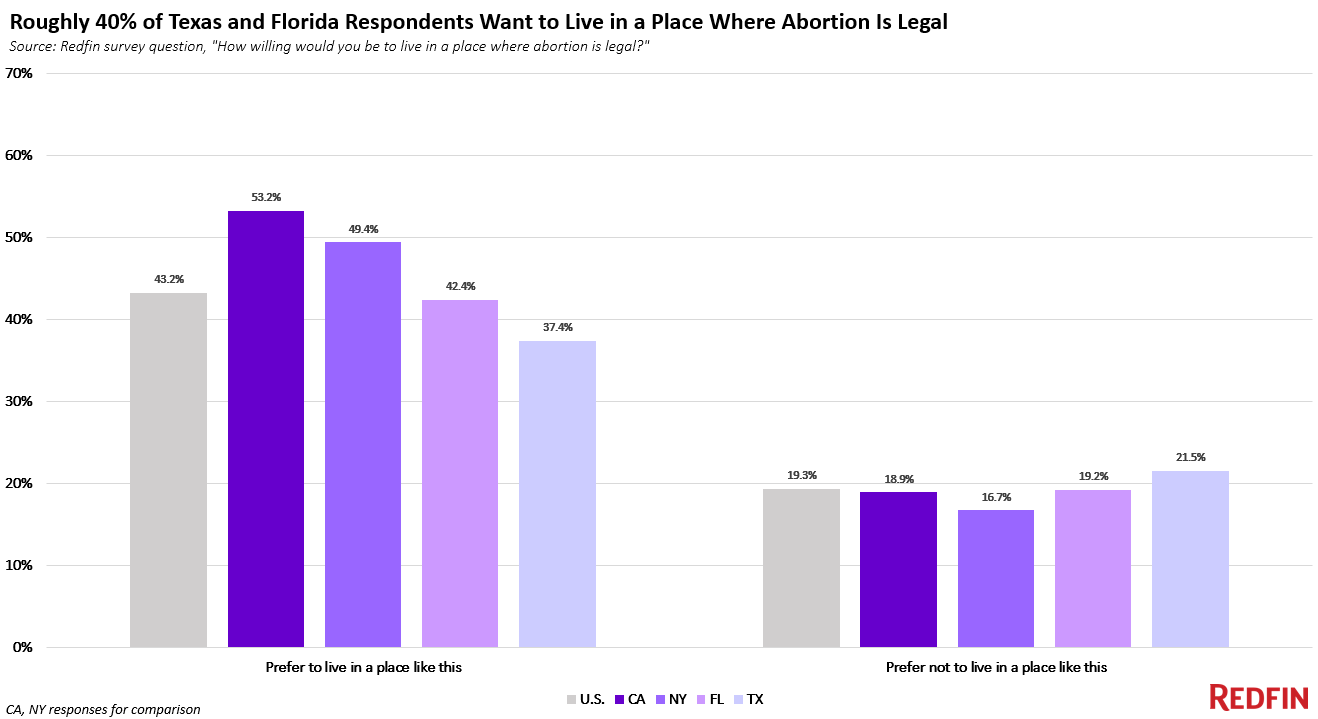
This is according to a Redfin-commissioned survey conducted by Qualtrics in May and June 2023. The survey was fielded to 5,079 U.S. residents who either moved in the last year, plan to move in the next year, or rent their home. This report focuses on the 396 respondents who indicated they live in Florida and the 414 in Texas, plus the 419 in California and 336 in New York for comparison. See the bottom of this report for more details on the survey, including each answer choice.
In Texas, abortions beyond six weeks of pregnancy have been banned since 2021. All abortions in Texas other than those to protect the mother’s life have been banned since the Supreme Court overturned Roe v. Wade, doing away with the federal right to abortion, in June 2022. In Florida, Gov. Ron DeSantis approved a bill that would prevent abortions after six weeks of pregnancy, but it’s in legal limbo until the conservative-leaning Florida Supreme Court hears a case on it.
Florida and Texas respondents are more likely to cite affordability than social views as a factor in choosing where to live
The contradiction between the type of place Florida and Texas respondents say they would prefer to live and where they actually live suggests that for many people, other factors outweigh social preferences in choosing where to reside.
Just over 1 in 10 Florida (13%) and Texas (12%) respondents who recently relocated said living in an area better aligned with their views on social issues factored into their move. Affordability was a more common reason, with more than 20% of Florida and Texas respondents citing a lower cost of living. Other reasons more commonly cited than alignment on social issues include a desire for more space and being closer to family. The results are similar for the U.S. as a whole.
“Deciding where to live is a compromise, and the housing affordability crisis in many parts of the country means many homebuyers must compromise certain preferences for affordability,” said Redfin Chief Economist Daryl Fairweather. “Even though many parts of Florida and Texas have attracted an influx of migrants who have pushed up prices over the last few years, homes there are far less expensive than a coastal city. A person who identifies with the local policies of a place like Seattle or San Francisco may live in a place like Dallas simply because it’s what they can afford.”
“Still, people often self-sort into areas where their neighbors have similar social and political views,” Fairweather continued. “Liberal people who live in Texas or Florida may choose a home in a neighborhood where they see flags that speak to their beliefs, for example.”
Homebuyers who are moving from one part of the country to another tend to flock from expensive coastal cities to relatively affordable metro areas, a trend that has been going strong for years but intensified during the pandemic because of record-low mortgage rates and remote work. Five of the 10 most popular destinations for Redfin.com users who are moving from one metro to another are in Florida, and two are in Texas. Overall, Florida and Texas gained more new residents than any other states in 2022.
Homes in Florida and Texas tend to be much less expensive than the common origins of people moving in. The typical home in Miami, for instance, sells for $515,000, compared with $705,000 in New York, the most common origin of movers to Miami. In Dallas, the typical home sells for $443,000, roughly half the price of Los Angeles, the most common origin for homebuyers moving to Dallas.
Even before the pandemic, Florida and Texas were popular destinations; they gained more new residents than any other state in both 2018 and 2019. For the many Americans who moved to those states before the Supreme Court overturned Roe v. Wade in mid-2022, abortion policies have since changed.
“For some people who moved to a place like Tampa or Dallas in 2019 or 2020 to get a more affordable home, a part of them may now wish they lived somewhere that aligns better with their views on abortion, since its legality is now in the hands of each individual state,” Fairweather said. “But it’s not that simple. They probably still appreciate the relatively low cost of living, and may not be able to afford to move to a different state. Beyond finances, many are entrenched in their jobs, their kids’ school and their communities, and those things make it hard to leave.
Florida and Texas respondents more likely to prefer living somewhere with protections for LGBTQ children than without them
Roughly one-third of Florida (37%) and Texas (33%) respondents would prefer to live in a place where gender-affirming care for children is legal, according to the same Redfin survey. That’s significantly higher than the 21% of Florida respondents and 25% of Texas respondents who would prefer not to live in such a place. Gender-affirming care includes transition surgeries and hormone therapies, among other treatments.
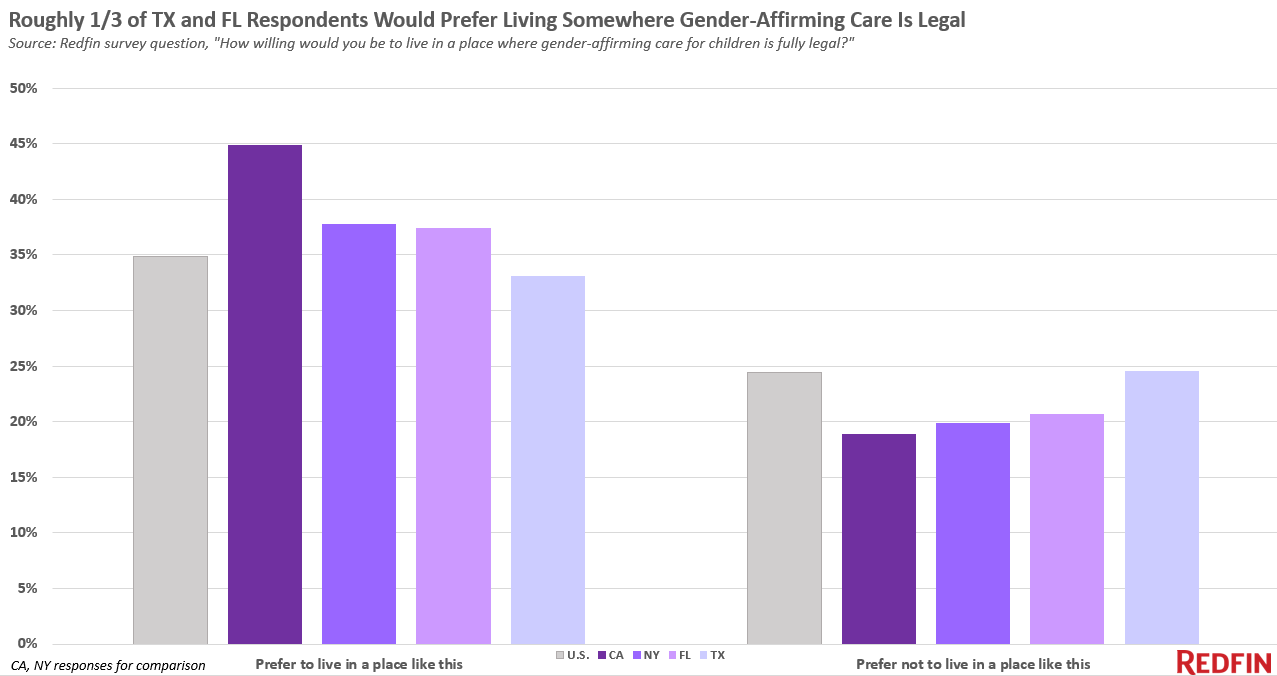
The reality of the legal landscape differs from the preference of many Florida and Texas respondents. Gender-affirming care for transgender youth is illegal in Texas and Florida as of this year, though the latter’s rule is in limbo as it experiences legal challenges to its enforcement.
A similar share of Florida (36%) and Texas (35%) respondents would prefer to live in a place that has laws allowing discussion of LGBTQ topics in schools. That’s higher than the 25% and 28%, respectively, who would prefer not to live in such a place.

Discussion of sexual orientation and gender identity in school is banned via a so-called “Don’t Say Gay” bill in Florida, and a similar bill is making its way through Texas’ state government.
The results from Florida and Texas are comparable to the nation overall.
Methodology
This report is based on results from a Redfin-commissioned survey conducted by Qualtrics in May and June 2023. The survey was fielded to 5,079 U.S. residents who either moved in the last year or plan to move in the next year, or who rent their home. This report focuses on the 396 respondents who indicated they live in Florida, the 414 in Texas, the 419 in California and the 336 in New York.
The following question was posed to respondents: “Please indicate how willing you would be to live in a place where abortion is legal” and asked them to select either “I would only live in a place like this,” “I prefer to live in a place like this,” “Has no impact on where I would live,” “I prefer not to live in a place like this,” and “I would not live in a place like this.” In this report, we combined the “only live” and “prefer to live” responses, and combined the “would not” and “prefer not” responses.
We also asked respondents to indicate their willingness to live in a place where gender-affirming care for children is fully legal, and their willingness to live in a place that has laws allowing discussion of LGBTQ topics in school, on the same scale.
Idaho's murky abortion law is driving doctors out of the state | CNN
The state of Idaho is in the beginning stages of a grand exodus. Doctors – specifically, those who care for pregnant women and perform abortions – are fleeing the state due to new abortion restrictions.
Doctors like Lauren Miller, who has been treating women and performing abortions in Boise for the last five years. Her greatest fear? “Being tried as a felon simply for saving someone’s life,” she told CNN.
Miller specializes in maternal-fetal medicine at the hospital where she works and handles high-risk pregnancies. She treats complications such as ectopic pregnancies, where a fertilized egg is outside the uterus, pre-eclampsia and other dangerous conditions.
After Idaho passed a near-total abortion ban, Miller and other doctors like her say they are unsure about how to continue to do their job.
Last August, Idaho made abortion illegal, with two exceptions.

An abortion can still be performed if the mother’s life is in danger, and in the case of rape or incest, but only after a police report has been filed and provided to the doctor. Even then, it’s restricted to the first trimester. But Miller says the law is still somewhat murky.
“We have a death exception and that is it without any other guidelines,” she said. “If I don’t act fast enough to save your life, prevent you from getting septic, I could be liable for civil cases … malpractice. But if I act too quickly and I’m not 100% certain that the patient is going to die from the complication she’s sustaining, then I could be guilty of a felony.”
“We don’t know what that bar is and no one wants to be the guinea pig first test case of that,” Miller told CNN.
State Representative Brent J. Crane, the lead negotiator on the bill, characterized the law as “a work in progress,” acknowledging to CNN that lawmakers are going to have to “come back and do more work to define what constitutes a risk to a mother’s life in those highly nuanced situations.”
Unable to help
Complicating matters more, the new law, which went into effect in August 2022, allows certain family members of a patient to sue providers who perform an abortion for at least $20,000 if the procedure breaks the abortion law.
Doctors in those cases also face suspension of their medical license, felony charges and even prison time.
Beyond that, Idaho’s governor also signed a law that says anyone helping a minor travel out of state to terminate a pregnancy – without parental consent – is guilty of a crime.
Miller, who is also head of the Idaho Coalition for Safe Reproductive Health, calls it “moral injury.” It saddens her that she cannot provide the care she’s been trained to offer.
“It goes against what we’re taught as physicians to protect the health of our patients,” she said.
So, she decided to move her practice to Colorado, where abortion is still legal. And she’s not the only one leaving.

Of the 117 doctors she informally surveyed in Idaho, 75 answered “yes” or “maybe” when asked if they were considering leaving the state at least in part because of the abortion laws.
Dr. Kylie Cooper, who worked alongside Miller, has already moved with her family out of Idaho and is now practicing in Minnesota, where abortion is legal.
“It was a really difficult decision to make … there was a wave of emotions, lots of fear and anxiety for my patients and also for myself…my husband and I had many conversations about what would it actually look like if I was charged with a felony and then went to prison,” she told CNN.
Cooper says she feels much safer after leaving Idaho.
“To watch somebody get sicker in front of your eyes and not be able to help them is hard to comprehend,” she said. “That is not the way I was trained to practice medicine. We don’t let people get so sick when we have all the tools to help them.”
‘The beginning of the collapse of an entire system’
Back in Idaho, Miller says five of the nine remaining full-time maternal-fetal medicine physicians in the state will have left by the end of this year.
These are the doctors who deal with the most significant pregnancy complications, an essential service to their patients.
Jim Souza, the chief physician executive at St. Luke’s Medical Center in Boise, told CNN: “We’re at the beginning of the collapse of an entire system of care.”
He likened it to a Jenga tower: “You can pull out certain planks and the tower still stands,” he said. “But pull out too many planks or certain planks and the whole thing falls … unfortunately that’s the position we’re in right now.”

Souza says that Idaho has already lost many of its maternal-fetal medicine physicians.
“If the momentum doesn’t shift, and we continue to pull planks out of the Jenga tower of this system of care,” he said, “there’s no question that that there will be bad perinatal outcomes for moms and babies. You need these providers in order to provide the safety net.”
And because there are no ob-gyn residencies in Idaho, finding doctors willing to relocate given the abortion laws on the books is a real challenge.
Still, Souza told CNN, “I’m an optimist at heart.”
While doctors in Idaho are already warning the public about the risks these abortion restrictions pose to the health of expectant mothers, there won’t be any data to show the real impact these laws have on the maternal mortality rate in Idaho.

That’s because this July, Idaho’s state legislature is due to sunset the Maternal Mortality Review Committee, which tracks pregnancy deaths.
In light of that, Miller warned, “We won’t see the bad outcomes that occur secondary to these laws being in place. It’s like we’re trying to hide that information from the public so we can’t see the repercussions of not having access to safe abortion care. I have no doubt that the mortality rate will rise.”
No comments:
Post a Comment